Can Dogs Eat Peas? — Safe Snack or Hidden Danger?
Yes, dogs can eat peas in moderation—but only if they’re plain, fresh, and properly prepared.
Can Dogs Eat Peas? Many owners worry about stomach upset, hidden risks, and safe portions. In this quick guide, you’ll learn what’s safe, what to avoid, and the surprising pea-related mistakes that can matter most. Yes, dogs can safely eat Peas in moderation as a healthy treat. Peas are not toxic to dogs, and they can offer fiber, vitamins, and plant-based nutrients, but they should only be an occasional addition to a complete and balanced dog diet. In Europe, that “complete and balanced” standard is aligned with FEDIAF guidance for pet foods.
Are Peas Safe for Dogs or Risky?
If you have ever cooked peas at home and noticed your dog staring at your plate with intense interest, you are definitely not alone. Pet owners across Europe ask this question every day: Can dogs eat peas safely, or should peas be avoided altogether? The good news is that plain peas are generally safe for dogs when served properly and in sensible amounts.
That said, “safe” does not mean “unlimited.” Peas are best treated as a snack, topper, or occasional reward rather than a replacement for nutritionally complete dog food. Veterinary nutrition guidance in Europe emphasizes balanced feeding, and FEDIAF’s 2025 Nutritional Guidelines remain the reference point for complete and complementary pet food across Europe.
In this complete guide, you will learn whether peas are safe or risky, what benefits they may offer, what the common mistakes are, how much to feed, which types are best, which forms are less suitable, and how to use peas wisely in a modern European dog-feeding routine.
Are Peas Safe for Dogs?
Yes, peas are generally non-toxic and safe for dogs when they are plain and fed in moderation. AKC and PetMD both state that peas are safe for dogs, and AKC specifically notes that green peas, snow peas, sugar snap peas, and garden or English peas are okay as occasional additions.
The important part is preparation. Dogs should not be offered peas that are cooked with butter, salt, seasoning, sauces, or other human ingredients that can upset digestion or add unnecessary sodium. PetMD also warns that canned peas are not recommended because of their sodium content.
If you want the simplest answer possible: plain peas are fine for most healthy dogs, but peas should not become the centerpiece of the diet. A dog’s nutritional needs are met by a complete and balanced food, not by a vegetable alone. VCA notes that treats and snack foods should remain a small part of daily calories, not the majority of intake.
Nutritional Value of Peas for Dogs
Peas are a compact source of several useful nutrients. PetMD identifies peas as a source of vitamins A, C, and K, along with iron and potassium, and also notes their fiber and antioxidant content. That is why many dog owners view peas as a wholesome extra rather than an empty-calorie treat.
From a practical nutrition standpoint, peas can add variety without a lot of fuss. They may contribute small amounts of plant-based protein and fiber, which can help make a meal feel more satisfying. Still, they are not a substitute for the protein, fat, amino acids, minerals, and calories a dog needs from a properly formulated diet. VCA emphasizes that pets need balanced nutrition, and treats should not displace the main food that supplies those essentials.
For European dog owners, that distinction matters because many premium foods use peas as one ingredient in a broader formula. The ingredient itself is not the whole story; the final diet must still meet nutritional standards and be appropriate for the dog’s life stage. FEDIAF’s guidelines exist precisely to help manufacturers formulate complete foods for healthy dogs.
Health Benefits of Peas for Dogs
1. Supports Digestion
Peas contain fiber, and fiber can support normal digestive function when used in sensible amounts. VCA explains that carbohydrates and certain fibers are fermented in the colon, which is one reason some dogs may experience more gas when pea content is high. At the same time, moderate fiber intake can be helpful as part of an overall balanced diet.
For dogs that need a little extra bulk in their snack routine, peas can be a useful add-on. They are not a cure for digestive issues, but they can fit into a healthy feeding plan when the dog tolerates them well.
2. Helps With Weight Control
Peas can be useful for weight-conscious dogs because they are a simple food with a decent amount of volume and relatively modest energy compared with many commercial treats. That makes them appealing when owners are trying to reduce table scraps or replace richer snacks with something lighter. Veterinary sources consistently recommend keeping treats to no more than 10% of daily calories, which makes low-calorie snack choices easier to manage.
This is especially relevant for less active apartment dogs in cities such as London, Paris, Berlin, Milan, or Warsaw, where daily movement may be lower than it should be. In those situations, a small portion of plain peas can be a smarter choice than many processed treats.
3. A Simple Energy Source
Peas contain carbohydrates that can provide an easily used source of energy, and that is one reason they appear in dog food formulations. The key is that the energy should come within a balanced formula rather than being stacked on top of an already calorie-rich meal. AKC notes that peas are often used in commercial dog food, while also reminding readers that they should be only an occasional treat.
4. Immune and Cellular Support
The vitamin and antioxidant content of peas may support general wellness. PetMD specifically highlights vitamins A, C, and K and notes antioxidant benefits, which is why peas are often grouped with other dog-friendly vegetables. These nutrients do not make peas magical, but they do make them a respectable snack in moderation.
5. Affordable and Easy to Use
Peas are widely available, easy to store, and inexpensive in much of Europe. That makes them a practical snack option for owners who want a simple home-food treat without buying specialty products every week. Just remember that affordable does not automatically mean “free-feeding friendly”; even simple treats still count toward the dog’s daily calorie total.
Risks of Feeding Peas to Dogs
1. Gas and Bloating
The most common downside of peas is digestive discomfort, especially when a dog eats too many at once. VCA notes that peas may contribute to flatulence depending on how much is eaten, because fiber and carbohydrates can be fermented in the gut. If your dog already has a sensitive stomach, a sudden pea-heavy snack can lead to noisy digestion and discomfort.
2. Diarrhea or Soft Stool
Too much fiber too quickly can loosen stool in some dogs. PetMD advises owners to avoid feeding too many peas, especially if the dog has never eaten them before. The safest approach is to introduce peas slowly and watch for digestive changes.
3. Canned Peas Are a Poor Choice
Canned peas are generally not the best option for dogs because they often contain extra sodium. PetMD explicitly says canned peas are not recommended for dogs, and AKC also advises avoiding canned peas with added sodium. In short, the can is the problem, not the pea itself.
4. The Grain-Free and DCM Conversation
This is the topic that deserves careful wording. Peas do not automatically cause heart disease, but the FDA has investigated a possible association between canine dilated cardiomyopathy (DCM) and certain diets, many of which were labeled grain-free and contained a high proportion of peas, lentils, other pulses, and/or potatoes as main ingredients. The FDA has also said the issue appears complex and may involve multiple factors, and the association has not been presented as a simple one-ingredient cause-and-effect story.
For that reason, the smartest position is balanced and measured: peas are fine as an occasional treat, but diets that rely heavily on legumes as primary ingredients deserve more scrutiny. In Europe, that means checking whether the food is formulated to FEDIAF standards and whether your dog’s diet is appropriate for its age, size, and health status.
Types of Peas for Dogs: Safe vs. Unsafe
Green peas, snow peas, sugar snap peas, and garden or English peas are generally acceptable for dogs when they are plain and given in moderation. AKC explicitly lists these types as okay on occasion. Frozen peas can also be fine, and PetMD says frozen peas are acceptable as long as they are not seasoned.
Canned peas are the least desirable option because of sodium and possible additives. Peas prepared with butter, salt, oil, cheese, gravy, garlic, onion, or spices are also poor choices. PetMD specifically warns against added ingredients such as butter, salt, and spices.
If you want a simple mental rule, use this: plain and minimally processed peas are the best choice; flavored or heavily processed peas are the wrong choice. That rule keeps the snack aligned with the way veterinary nutritionists think about treat feeding.
Can Dogs Eat Different Types of Peas?
Green Peas
Yes. Green peas are the most straightforward and commonly recommended form. They are plain, easy to portion, and commonly used in home feeding and commercial dog food. AKC and PetMD both support their use as an occasional treat.
Frozen Peas
Yes, frozen peas are generally safe if they are plain and unseasoned. PetMD says they can even be served straight from the freezer as a treat, though cooked peas may be easier for some dogs to chew. Frozen peas are also popular in warmer months because they are convenient and refreshing.
Pea Pods
Yes, pea pods such as snow peas and sugar snap peas are included by AKC among the pea types that are okay on occasion. The practical rule is to keep them plain and avoid anything that has been cooked or coated with extras. Introduce them slowly and in small amounts.
Split Peas
Split peas are best viewed as a cooked ingredient, not a raw snack. When plain and cooked through, they can be part of a dog-friendly meal or topper. Since the key issue with peas is usually seasoning, sodium, and excess quantity, cooked split peas can fit into a sensible feeding plan if they are served simply.
How Many Peas Can Dogs Eat?
A good rule of thumb is to keep peas inside the 10% treat rule. Veterinary sources from AKC and VCA both say that treats should not exceed 10% of a dog’s daily calories. That means peas should stay small enough that they do not crowd out the dog’s regular, complete, and balanced food.
Here is a practical starting point for plain peas as a treat, not a meal replacement:
Small dogs: about 1 teaspoon
Medium dogs: about 2 to 3 teaspoons
Large dogs: about 1 to 2 tablespoons
These are general portions, not medical prescriptions. The real limit depends on your dog’s body size, daily calorie needs, activity level, and whether the dog is already eating other treats that day. VCA notes that treats add up quickly, especially for dogs with low calorie requirements.
A simple habit helps: count peas as part of the treat budget, not as “free” extras. That approach keeps the overall diet balanced and prevents the common mistake of adding snacks on top of a full food ration.
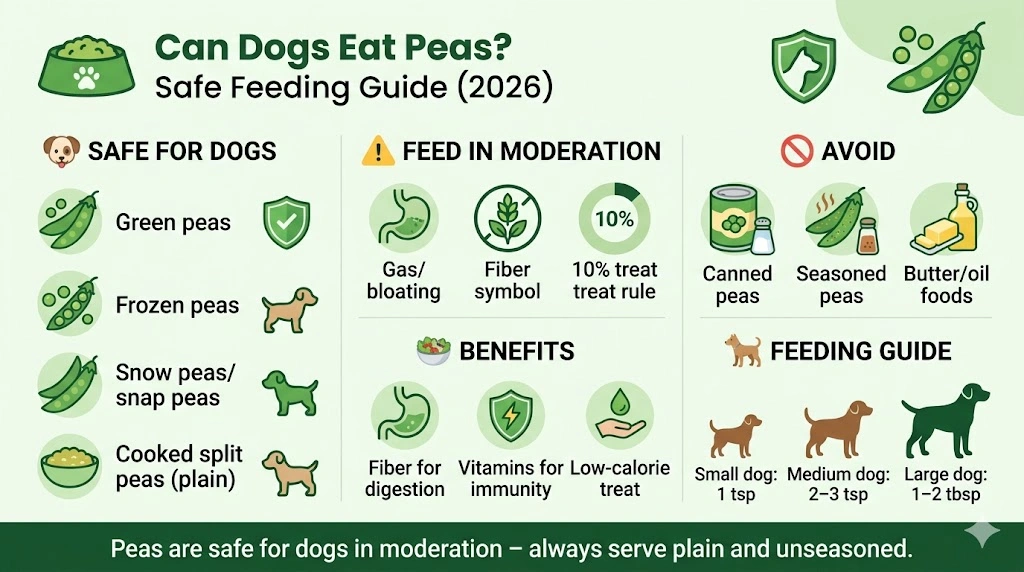
Yes — but only in moderation!
Discover which peas are safe, how much to feed, and what to avoid in this quick vet-approved 2026 feeding guide. Perfect for dog owners looking for healthy, low-calorie treat options. 🥗🐾
Can Puppies Eat Peas?
Yes, Puppies can eat peas in small amounts if the peas are plain, soft, and introduced gradually. Puppies, however, are more sensitive than adult dogs because their digestive systems are still developing and their diets need to stay tightly balanced for growth. VCA’s treat guidance is especially important here because young dogs should not have snack foods taking over their nutritional intake.
For puppies, the safest approach is to use peas as a tiny training reward or a small topper, not as a regular snack bowl. If a puppy has loose stool, seems bloated, or shows signs of food sensitivity after eating peas, stop the treat and ask your vet before trying it again. PetMD’s advice to avoid overfeeding peas applies here as well.
When NOT to Feed Peas
Peas should be limited or avoided when a dog has a medical reason to follow a specific diet, because even a healthy treat can interfere with a therapeutic feeding plan. VCA notes that dogs with medical conditions or special diets should have treat choices cleared with the veterinary care team. That is especially important for dogs on low-fat, hypoallergenic, gastrointestinal, or other prescription diets.
Peas should also be avoided when they are prepared with unsafe ingredients. That includes salt, butter, creamy sauces, onions, garlic, cheese-heavy toppings, and heavily seasoned leftovers. PetMD is clear that extra ingredients can turn a harmless vegetable into a problem.
If your dog already has chronic gas, frequent soft stool, or a history of eating problems, introduce peas only with caution or skip them entirely. VCA specifically notes that peas can contribute to flatulence depending on the amount eaten.
Best Ways to Serve Peas to Dogs
The best serving style is simple: plain, unseasoned, and given in a small quantity. Boiled peas, steamed peas, thawed frozen peas, or peas mixed into a measured portion of kibble are all reasonable ways to offer them. PetMD and AKC both support plain fresh or frozen peas and warn against extra ingredients.
A light pea topper can be useful for a picky dog, but even then, the key is moderation. If peas are mixed with the meal, they should remain just a small part of the total bowl, because complete dog food is designed to provide the full nutrient profile the dog needs. FEDIAF’s framework for complete and complementary pet food reinforces that point in Europe.
Peas vs Other Vegetables for Dogs
Peas are a decent option, but they are not always the top choice. PetMD and AKC both present peas as safe and useful in moderation, yet many other vegetables are equally or more popular as dog treats because they are easy to portion and widely accepted by dogs. Common examples include carrots, green beans, cucumber, and pumpkin-style toppers used in moderation.
The smartest comparison is not “best vegetable ever,” but “best vegetable for this dog.” For a dog that needs variety, peas are fine. A dog that gets gassy easily, another vegetable may be better. For a dog that is losing weight, the most important factor is still the total calorie budget, not the specific vegetable chosen.
Common Mistakes Dog Owners Make
One common mistake is treating peas like an unlimited health food. Even good foods can create problems when they are fed in large amounts, and that includes gas, softer stool, and calorie creep. The 10% treat rule exists for a reason, and both AKC and VCA emphasize it repeatedly.
A second mistake is using canned or heavily seasoned peas. That turns a simple vegetable into a sodium-heavy snack with unnecessary additives. PetMD and AKC both warn against canned peas with added salt and against extra ingredients such as butter and spices.
A third mistake is assuming that “natural” automatically means “ideal.” In dog nutrition, balance matters more than buzzwords. VCA’s guidance is clear: treats are fine, but they should not push the diet out of balance or replace the complete and balanced food that should remain the foundation.
Expert Vet Advice
In Europe, the safest evidence-based approach is to treat peas as a small snack, not a nutritional strategy. FEDIAF’s 2025 Nutritional Guidelines are designed to support complete and complementary pet foods for healthy dogs, and that is the right reference point when deciding what belongs in the bowl every day.
For owners who want to be extra careful, the best practical advice is simple. Introduce peas slowly, keep the portion small, avoid seasoning, watch your dog’s stool and comfort level, and consult a vet if your dog has a medical diet or persistent digestive issues. Those habits line up with the cautious feeding guidance provided by AKC, PetMD, and VCA.
Real-Life Scenarios for European Dog Owners
For apartment dogs in busy cities, peas can work well as a training reward because they are simple and easy to portion. The trick is to count them as part of the day’s treat allowance rather than handing them out freely throughout the afternoon. AKC and VCA both emphasize that treats must fit inside the overall daily calorie plan.
For dogs in cooler climates, frozen peas can be an easy seasonal option because they are convenient and refreshing. PetMD says frozen peas are fine in small quantities if they are plain, which makes them a useful low-effort snack for many owners.
For older dogs or less active dogs, portion control matters even more. Small treats can become a calorie problem surprisingly fast, and VCA warns that treats can add up quickly, particularly for dogs with low calorie requirements.
Pros and Cons of Peas for Dogs
Peas have real advantages when they are used correctly: they are simple, plain, easy to store, and can fit into a healthy snack plan. They also offer fiber and several useful nutrients, which is why they often appear in both home feeding and commercial pet food formulations.
The downsides are just as real: too many peas can cause gas or softer stool, canned peas are less suitable because of sodium, and pea-heavy diets deserve a thoughtful look because of the ongoing DCM discussion around some diets high in legumes or pulses. That does not make peas forbidden; it makes portioning and diet balance important.
FAQs
Dogs can eat peas every day, only in very small amounts, and even then, they should still stay inside the 10% treat rule. Peas should never replace a complete and balanced diet.
Peas can be a useful treat for weight-conscious dogs because they are simple and easy to portion, but they still contain calories. They help most when they replace higher-calorie snacks rather than adding on top of them.
Fresh peas are generally fine, and AKC says fresh or frozen peas are acceptable on occasion. The bigger issue is not “raw versus cooked” as much as “plain versus seasoned” and “small portion versus too much.”
Yes, peas can be safe in dog food when the complete formula is nutritionally balanced and appropriate for the dog’s life stage. In Europe, FEDIAF guidelines are the reference for balanced pet-food formulation.
Yes, AKC lists snow peas and sugar snap peas as okay on occasion. They should still be plain and fed in moderation, just like other pea forms.
Yes, frozen peas are generally safe when they are plain and unseasoned. PetMD specifically says frozen peas are fine in small quantities and can even be served straight from the freezer.
Conclusion
So, can dogs eat Peas? Yes, they usually can, and plain peas can be a healthy, convenient treat when used correctly. The strongest evidence-based message from veterinary and nutrition sources is consistent: peas are not toxic, they can provide useful nutrients, and they belong in the “occasional treat” category rather than the “daily main food” category.
For European dog owners, the best practice is simple. Choose plain peas, serve a small amount, avoid canned or seasoned versions, respect the 10% treat rule, and make sure the dog’s main food is complete and balanced according to FEDIAF-aligned standards. That is the cleanest, safest, and most practical way to feed peas responsibly.