Can Dogs Eat Tuna?
Tuna is one of the most familiar fish in European kitchens. It appears in sandwiches, pasta salads, rice bowls, and canned meals, and many dogs notice that powerful fishy aroma the moment it hits the counter. That is exactly why so many owners ask the same question: Can dogs eat tuna safely?
The most accurate answer is simple: Can Dogs Eat Tuna? Can dogs eat tuna only in very small amounts, and only occasionally? Tuna is not inherently toxic to dogs, but it is a higher-Mercury Fish, and repeated exposure can create a slow, quiet buildup of risk over time. Mercury is especially concerning because it can affect the nervous system, kidneys, and developing animals, and larger, longer-lived fish such as tuna tend to accumulate more of it than shorter-lived fish such as salmon, whitefish, sardines, and herring.
This guide is written for Can Dogs Eat Tuna owners in Europe who want a clear, practical answer without the confusion. You will learn when tuna is harmless enough to share, when it becomes a bad idea, how much is too much, why puppies should be treated more cautiously, which fish are better choices, and how to feed fish in a way that supports a balanced diet rather than disrupting it. FEDIAF’s 2025 nutritional guidelines are the Europe-wide reference point for complete and complementary pet food, and they are intended to support scientifically sound, nutritionally balanced feeding practices for Can Dogs Eat Tuna and cats.
Quick Answer
Yes, dogs can eat tuna only in very small amounts and only sometimes.
No, tuna should not be a regular part of a dog’s diet.
The reason is not that tuna is a dramatic poison in the way chocolate or onions are for Can Dogs Eat Tuna . The issue is more subtle and more dangerous in the long run: tuna tends to sit higher on the food chain, so it can carry more mercury than many other fish. Mercury bioaccumulates, meaning it can build up in fish tissue and then in the body of any animal that eats it repeatedly. EFSA notes that methylmercury is the main mercury form found in fish and that it is particularly toxic to the developing nervous system, while Merck Veterinary Manual describes chronic exposure in fish-associated food chains as a continuing concern.
So the most practical rule is this: treat tuna as an occasional novelty, not a dietary strategy. If you are looking for fish to use more regularly, salmon and sardines are much better everyday-style options for dogs. FDA human fish guidance also places canned light tuna lower than albacore, and recommends lower-mercury fish such as canned salmon and sardines as alternatives.
Why Dog Owners Ask About Tuna
Tuna shows up everywhere. It is affordable, easy to store, easy to serve, and common in European households. It also has a strong aroma, which makes it irresistible to many dogs. Owners often assume that if fish is healthy for people, it must be equally healthy for dogs.
That assumption is only partly true. Fish can certainly be useful in aCan Dogs Eat Tuna diet, but not all fish are equal. AKC notes that fish can provide good fats and amino acids, but also warns that longer-lived fish species like tuna and swordfish can contain heavy metals such as mercury, while shorter-lived fish are preferable. FEDIAF’s nutritional guidelines reinforce the broader principle that dogs need complete and balanced nutrition, not random human foods or unstructured add-ons.
Tuna also has a “healthy food” reputation because it contains protein and omega-3 fatty acids. Those nutrients are real, but they do not cancel out the mercury issue. A food can be nutritious and still be a poor choice as a frequent treat. That is the exact category tuna falls into for dogs: useful in tiny, rare servings, but not suitable as a routine habit.
What Tuna Is and Why Dogs Like It
Tuna is a large saltwater fish that lives long enough to accumulate substantial environmental contaminants over time. That matters because the longer a fish lives, the more opportunity it has to absorb mercury from its environment and from the smaller fish it eats. AKC specifically points out that tuna is a longer-lived species and that this contributes to higher mercury levels. FDA similarly distinguishes tuna species by mercury content, with albacore/white tuna typically carrying more mercury than canned light tuna.
Dogs are usually drawn to tuna because it is intensely aromatic, highly palatable, and protein-rich. From a dog’s perspective, tuna can seem like a jackpot snack. From a nutrition perspective, though, the smell and taste are not the deciding factor. The deciding factor is whether the food fits safely into a dog’s long-term dietary pattern. Merck Veterinary Manual emphasizes that balanced feeding matters and that home-prepared feeding is difficult to do correctly without professional formulation.
In other words, dogs may adore tuna, but affection is not the same thing as suitability. Many foods dogs beg for are not ideal for frequent use. Tuna is one of the clearest examples of that gap.
Is Tuna Safe for Dogs?
Tuna is not innately toxic to dogs, but it is not a low-risk everyday food either. AKC explicitly states that tuna is not inherently toxic like onions or chocolate, yet it still poses risks because of mercury. AKC also notes that dogs are smaller than humans and metabolize substances differently, which makes them more sensitive to mercury exposure.
That is why the safest framing is not “yes” or “no” in a vacuum, but rather: tuna can be tolerated in tiny, occasional portions by some Dogs, but it is not an appropriate regular feeding choice. This is especially true if the tuna is canned, salted, flavored, oil-packed, or served raw. AKC says canned tuna often contains added salt or preservatives, and raw tuna carries parasite and bacteria concerns. Another AKC article says tuna can be given only in small amounts, and that canned tuna should be in water rather than oil and without spices.
The most important concept here is bioaccumulation. Mercury does not usually cause instant drama after one tiny bite. The concern is repeated exposure. Over time, the body can retain enough mercury to create neurological or renal problems. Merck Veterinary Manual explains that methylmercury is well absorbed orally and bioaccumulates in tissues such as the brain, kidney, and fetus, and that chronic exposure remains a major food safety concern worldwide.
Tuna Risk Scale for Dogs
This is a practical, conservative guide rather than a formal veterinary dosage chart. There is no universal “official tuna dose” for dogs, so the safest approach is to keep tuna rare and minimal. The scale below is designed to show how risk rises as frequency increases, especially because mercury exposure is cumulative.
| Risk Level | Meaning | Practical Safety View |
| 0 | No tuna | Safest |
| 1 | Tiny bite once in a while | Very low risk |
| 2 | Rare treat in a small portion | Low risk |
| 3 | Weekly feeding | Moderate risk |
| 4 | Frequent feeding | High risk |
| 5 | Daily tuna diet | Dangerous |
Recommended target: stay at Level 1 or Level 2 only.
That means tuna should be treated like an occasional treat, not a dependable food source.
Nutritional Benefits of Tuna for Dogs
Tuna does contain useful nutrients. It provides high-quality protein, and fish oils can contribute omega-3 fatty acids. FDA and AKC both recognize fish as a nutritious food category, and AKC notes that fish can provide good fats and amino acids. In human fish guidance, tuna appears in the broader “good” or “best” choice framework, depending on the species and preparation, which shows that tuna itself is not nutritionally empty.
For dogs, the nutrients in tuna may support:
skin and coat quality
muscle maintenance
Overall protein intake
general palatability for picky eaters
But the important nuance is this: nutrients alone do not make tuna the best fish for dogs. Salmon, sardines, and whitefish offer many of the same benefits with a more favorable safety profile. FDA recommends lower-mercury options such as canned salmon and sardines, and AKC points out that shorter-lived fish species are preferable.
So, yes, tuna has nutritional value. The problem is that its benefit-to-risk ratio is weaker than the ratio offered by safer fish alternatives.
Why Tuna Can Be Dangerous for Dogs
1) Mercury exposure is the main concern
The biggest issue with tuna is not dramatic, immediate toxicity in small amounts. It is the repeated accumulation of mercury. EFSA explains that methylmercury is the predominant mercury form in fish and other seafood and is particularly toxic to the developing nervous system, including the brain. Merck Veterinary Manual adds that methylmercury is well absorbed orally and bioaccumulates in the brain, kidney, and fetus.
In dogs, chronic mercury exposure can contribute to signs such as:
tremors
incoordination
ataxia
abnormal behavior
blindness in severe cases
kidney injury
loss of appetite
advanced neurologic decline
Merck’s veterinary toxicosis reference describes neurological signs, including ataxia, tremors, abnormal behavior, blindness, paralysis, and high mortality in advanced cases. It also notes that the nervous system of young, developing animals is particularly susceptible to organic mercury exposure.
2) Canned tuna often brings extra sodium
Canned tuna is the version most people have on hand, but it is not automatically the safest version for dogs. AKC states that canned tuna often contains added salt or preservatives, and its human-food guidance says that tuna should be prepared only in water, not oil, and without spices. Excess salt is unnecessary and can make a small treat less suitable for dogs.
3) Raw tuna is not a good idea
Raw fish has a different set of problems. AKC notes that raw tuna carries parasite and bacteria risks, while Merck Veterinary Manual warns that raw meat-based diets can expose pets and households to pathogens, including Salmonella, Listeria, and other zoonotic hazards. Freezing does not reliably eliminate all pathogens, and even commercial raw diets can carry contamination risk.
That matters because some owners confuse “fresh” with “safe.” Fresh does not automatically mean hygienic enough for a dog. For tuna, cooking is the safer route if it is going to be offered at all. AKC’s human-food guidance says dogs should never be fed uncooked or undercooked fish.
Can Puppies Eat Tuna?
Puppies should avoid tuna regularly, and in many cases, it is better to skip it entirely. Puppies are in a rapid growth phase, and their nervous systems, kidneys, and overall metabolism are more delicate than those of healthy adult dogs. EFSA specifically notes that methylmercury is particularly toxic to the developing nervous system, and Merck Veterinary Manual says the nervous system of young, developing animals is especially susceptible to organic mercury exposure.
That is the key reason to be stricter with puppies than with adult dogs. A small adult dog can still be affected by repeated exposure, but a puppy has less room for error. There is also the practical issue that puppies are still learning what food patterns become normal. Once they get used to rich human foods, they often become pickier about their actual balanced puppy diet. FEDIAF’s guidelines stress the importance of complete and balanced pet food, which is especially relevant during growth.
So the sensible rule is straightforward: do not make tuna a puppy food habit. If a puppy accidentally licks a tiny bit of plain, cooked tuna, that is not the same as regular feeding. But as a routine treat, tuna is a poor choice for young dogs.
How Much Tuna Can Dogs Eat?
There is no official veterinary “tuna dosage” for dogs, so any serving chart should be treated as a conservative treat guide rather than a medical prescription. The safest logic is to keep the amount tiny, keep the frequency low, and stop if any digestive or neurologic reaction appears. This approach follows the broader safety principles in AKC and Merck guidance, as well as the Europe-wide emphasis on complete and balanced pet nutrition.
Conservative treatment guide
| Dog size | Practical maximum | Frequency |
| Small dogs up to 10 kg | 1 teaspoon | Rarely |
| Medium dogs 10–25 kg | 1 tablespoon | Rarely |
| Large dogs 25+ kg | 1–2 tablespoons | Rarely |
A useful working rule is once every 2–3 weeks at most, and only if the tuna is plain, cooked, unseasoned, and served in a tiny portion. That timing is intentionally cautious because mercury exposure is cumulative rather than immediate. AKC advises that fish should be introduced in small quantities and that dog owners should avoid seasonings, salt, sugar, oil, and butter.
If your dog has a medical condition, especially a chronic health issue, a food sensitivity, or a special diet plan, tuna should be discussed with a veterinarian before it is added at all. That is especially important because dogs vary in size, tolerance, and nutritional needs.
Tuna vs Salmon vs Sardines vs Whitefish
When people ask whether tuna is “good” for dogs, the better question is usually: good compared with what? As a treat fish, tuna is acceptable only with restraint, but there are better options if you want fish more often. FDA, AKC, and Merck all support the idea that shorter-lived fish are preferable because they generally carry less mercury than larger, longer-lived fish like tuna. The FDA also recommends lower-mercury fish such as canned salmon and sardines as alternatives.
| Fish type | Safety for dogs | Mercury profile | Best use |
| Tuna | Moderate risk | Higher | Rare treat only |
| Salmon | Safer | Lower | Better regular option |
| Sardines | Very safe | Very low | Excellent choice |
| Whitefish | Safe | Low | Good everyday alternative |
Bottom line: if you want to add fish to your dog’s routine, sardines and salmon are much better choices than tuna. That is true both from a mercury perspective and from a practical feeding perspective. AKC specifically says shorter-lived fish species are preferable to tuna, and FDA points to salmon and sardines as affordable, lower-mercury choices.
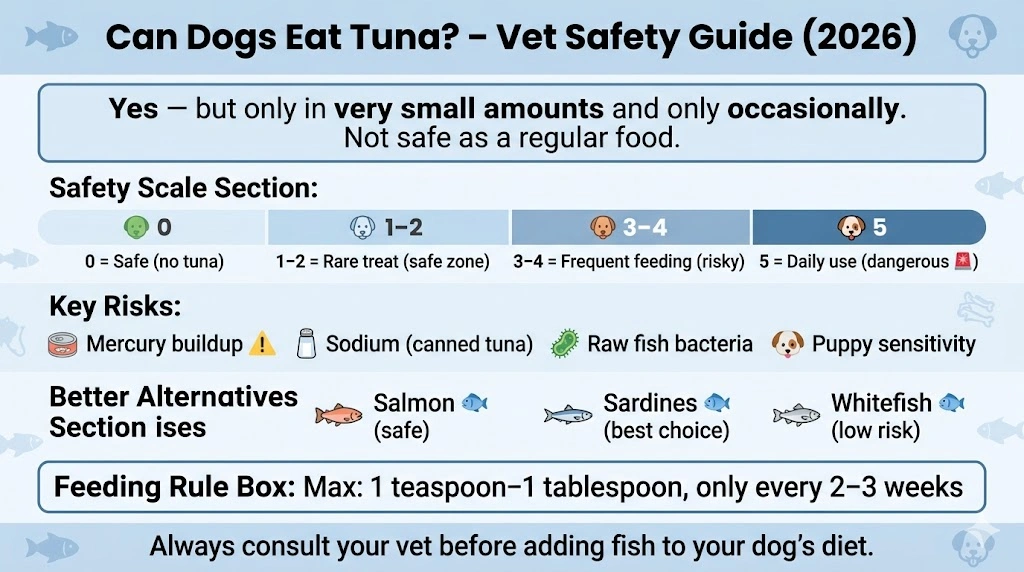
The answer is yes—but only occasionally and in very small amounts.
This infographic breaks down tuna safety, mercury risks, feeding limits, and the best fish alternatives like salmon and sardines.
Signs of Tuna Overconsumption in Dogs
Most dogs will not show dramatic symptoms from a tiny accidental taste. The concern is repeated feeding or a large serving. If a dog consumes too much tuna over time, watch for signs that could reflect gastrointestinal irritation, neurological strain, or mercury-related illness. Merck Veterinary Manual’s mercury toxicosis reference lists tremors, ataxia, incoordination, abnormal behavior, blindness, and paralysis among neurologic manifestations, and also notes vomiting, diarrhea, anorexia, and kidney involvement depending on the form of mercury exposure.
Watch for:
vomiting
diarrhea
weakness
shaking or tremors
loss of appetite
wobbliness
balance problems
abnormal behavior
unusual lethargy
If any of these signs appear after tuna exposure, contact a veterinarian promptly. The reason is not that one bite proves mercury poisoning. The reason is that these signs can point to many problems, some of which need quick treatment.
European Dog Feeding Context
Europe has a strong framework for pet nutrition. FEDIAF’s 2025 Nutritional Guidelines are intended as a practical reference for complete and complementary pet foods, and they are reviewed by independent veterinary nutritionists across Europe. That is important because it reinforces the core principle behind safe canine feeding: a dog’s main diet should be nutritionally complete and balanced, not built around random human foods.
EFSA’s mercury guidance adds another layer. EFSA explains that methylmercury is the predominant mercury form in fish and seafood and that it is particularly toxic to the developing nervous system. EFSA also notes that exposure risk rises with high and frequent fish consumption. While that guidance is written for humans, it strongly supports a conservative approach when dogs are being given tuna as an extra food.
That is why tuna should not be treated as a main protein source for dogs in Europe or anywhere else. A proper dog diet should come from complete food or a professionally designed plan, not from occasional human leftovers. Merck Veterinary Manual emphasizes that home-cooked diets require careful formulation and that raw diets carry pathogen risks.
Common Mistakes Dog Owners Make
One of the most common mistakes is assuming that “fish is fish.” It is not. Tuna is very different from sardines or salmon in mercury profile and long-term feeding suitability. AKC and FDA both highlight tuna’s higher mercury concerns relative to other fish, especially when compared with shorter-lived species.
Other common mistakes include:
feeding tuna every day
using oil-packed tuna because it seems tastier
serving seasoned tuna from human meals
Giving raw tuna without understanding parasite risk,
forgetting that even small repeated servings can add up over time
AKC’s human-food guidance says tuna should be plain, in water rather than oil, and free of spices if it is given at all. It also says dogs should be introduced to new foods in small quantities and that a quality dog food should remain the main diet.
A final mistake is treating a dog’s excitement as proof of safety. Dogs will gladly eat many things that are not ideal. Enthusiasm is not a nutrition plan.
Expert Veterinary Tips
A cautious, veterinarian-friendly approach looks like this:
Keep tuna as an occasional treat, not a staple.
Choose plain, cooked tuna only.
Use water-packed tuna, not oil-packed tuna.
Avoid salt, seasoning, and sauces.
Offer fish no more than a rare add-on, not as a weekly habit.
Prefer salmon, sardines, or whitefish when fish is part of the plan.
It is also wise to think about the bigger feeding picture. Merck Veterinary Manual emphasizes that properly formulated home-cooked diets can work, but they are difficult to balance correctly, and professional formulation is important. That same logic applies to pet snacking: a single human food might not be disastrous, but the whole pattern matters.
If your dog has a history of digestive sensitivity, kidney concerns, a restricted diet, or a tendency to grab human food and beg for more, tuna is even less attractive as a regular treat. A small portion once in a while may be fine for some healthy adult dogs, but a stable, balanced feeding routine will always be the safer win.
Pros and Cons of Tuna for Dogs
Pros
Tuna offers quality protein.
It contains omega-3 fatty acids.
This is very palatable.
It can be convenient in tiny amounts.
Cons
Tuna has a higher mercury burden than many other fish.
Canned Versions may bring added sodium.
Raw versions carry bacterial and parasite risks.
It is not appropriate as a daily or weekly core food.
It is a poor choice for puppies and for dogs that need extra caution.
When you compare both sides honestly, tuna looks less like a “healthy treat” and more like a “use sparingly, if at all” food. That does not mean it is banned. It means the margin for error is small.
Step-by-Step Safe Feeding Guide
Step 1: Choose the right tuna
Use plain tuna only. If possible, choose water-packed tuna with no added seasoning, no oil, and no sauces. AKC specifically advises avoiding spices and oil.
Step 2: Keep the portion tiny
Start with a very small amount. A teaspoon is enough for many dogs as a taste test. There is no official canine tuna dose, so conservative portions are the safest way to reduce risk.
Step 3: Observe for 24 hours
Watch for vomiting, diarrhea, shaking, wobbling, lethargy, or appetite changes. A dog that reacts badly to tuna should not be given it again. Mercury effects are usually tied to repeated exposure, but digestive upset can happen sooner with rich or salted food.
Step 4: Keep it rare
Do not turn tuna into a recurring snack. A rare treat schedule is safer than a weekly habit, and the more frequent the exposure, the less comfortable the risk profile becomes. EFSA and Merck both support the broader principle that repeated fish exposure is where mercury concerns rise.
Step 5: Stop immediately if symptoms appear
If your dog shows vomiting, shaking, coordination problems, or unusual weakness after tuna, stop feeding it and contact a veterinarian. Symptoms are not proof of mercury poisoning, but they are enough reason to seek guidance.
FAQs
Yes, but only in small amounts and only occasionally. Even then, it should be plain and unseasoned. AKC says canned tuna may contain salt or preservatives, and that tuna given to dogs should be prepared only in water, not oil, and without spices.
Yes. Daily tuna feeding is a bad idea because the main risk is cumulative mercury exposure. EFSA explains that methylmercury is the main mercury form in fish and is especially concerning for the developing nervous system, while Merck notes that bioaccumulation remains a worldwide food safety issue.
Too much tuna can lead to digestive upset, and repeated overconsumption may contribute to mercury-related neurological or kidney problems. Merck Veterinary Manual describes neurologic signs such as ataxia, tremors, blindness, and paralysis in mercury poisoning, along with gastrointestinal and renal involvement depending on exposure type.
Puppies should avoid tuna as a regular food. Their developing nervous systems are more vulnerable, and EFSA specifically notes that methylmercury is particularly toxic to the developing nervous system. Merck also states that young, developing animals are especially susceptible to organic mercury exposure.
Salmon is the better choice. AKC says shorter-lived fish species are preferable to tuna, and the FDA recommends lower-mercury alternatives such as canned salmon and sardines. Pet owners who want fish as a more regular treat are better off using salmon or sardines instead of tuna.
Conclusion
So, can dogs eat tuna?
Yes, but only in very small amounts and only occasionally.
No, Tuna should never become a regular food.
That is the most honest, practical answer. Tuna has real nutritional value, but it also carries a mercury Burden that makes frequent feeding a poor trade-off. EFSA and Merck both make clear that mercury bioaccumulation is a serious food-safety issue, especially for developing animals and repeated exposure. AKC and FDA likewise position tuna as a food that requires restraint, with lower-mercury fish such as salmon and sardines offering better long-term options.