Best Breed of Dog for Guard: Expert Security & Family Protection Breakdown
Best Breed of Dog for Guard: German Shepherd, Rottweiler, and Belgian Malinois are the top protective choices. Many people struggle to choose the right guard dog and risk safety mistakes. This guide shows which breeds truly protect, family suitability, training needs, and real security effectiveness—some results may surprise you. Choosing the best Breed of dog for guard is not about selecting the largest animal in the room, and it is certainly not about choosing a dog that simply looks intimidating. Real protection starts with behavioral stability, environmental fit, training potential, and the ability to remain composed when life becomes unpredictable.
Across Europe, especially in countries such as Germany, the UK, France, and the Netherlands, many families are now paying closer attention to home security dog breeds because property risks are evolving. Urban apartments, suburban homes, countryside estates, and rural farms all present different challenges. A dog that works beautifully in one environment may be a poor match in another.
That is why this guide is designed as a complete decision system rather than a shallow list of “big dogs that guard.” You will learn how guard dog behavior works, which breeds are strongest for families, which breeds are better for farms, how experience level affects breed choice, and how to avoid the most common mistakes people make when selecting a protection dog.
The goal is simple: help you identify the right dog for your lifestyle, your home, and your level of handling experience.
What Makes a Good Guard Dog?
A real guard dog is not a constantly aggressive animal. In fact, the most effective protection dogs are often the ones with the calmest minds. Stability matters more than chaos. Control matters more than raw intensity. A good guard dog should observe, assess, and respond appropriately, not react wildly to every small stimulus.
A guard dog serves two key functions.
The first is prevention, meaning deterrence. The dog’s presence alone can discourage unwanted approaches, alert the household, and raise the perceived risk for intruders.
The second is response, meaning the dog can react if a genuine threat appears. That response must be proportionate, trainable, and under control.
This is where many people misunderstand that protection breeds. They imagine a “guard dog” as a naturally aggressive animal. In reality, the best protection dogs are often the most balanced. They do not need to be furious; they need to be aware.
Core Traits of the Best Guard Dogs
Intelligence
A strong guard dog must be able to process information quickly. Intelligent dogs understand routines, detect unusual behavior, and separate ordinary guests from suspicious activity. They are easier to train, easier to guide, and far more reliable in everyday life.
Loyalty
Loyalty is the emotional foundation of protection. A dog that forms a deep bond with its owner is more likely to stay attentive, responsive, and protective. Protection behavior is usually strongest when trust is strong.
Trainability
A protection dog must respond well to commands. Intelligence without trainability is not enough. The dog should be able to learn obedience, boundary rules, recall, and calm behavior in social settings.
Territorial Instinct
A natural awareness of home boundaries is valuable. Some breeds are especially alert to changes around doors, gates, driveways, and property edges. This can make them excellent early-warning companions.
Controlled Temperament
The ideal guard dog does not panic, freeze, or overreact. It stays emotionally stable. A controlled temperament is essential because the dog must distinguish between normal life and actual threat.
Controlled Aggression
Guarding should be situational, not constant. The best dogs are not hostile by default. They are composed, confident, and capable of escalation only when needed.
A useful truth often overlooked is this: a medium-sized, well-trained dog can outperform a large, untrained dog in real security situations. Training and temperament often matter more than size alone.
The 3 Types of Guard Dogs
Understanding guard dog types makes the selection process much easier. Not every protection dog serves the same purpose, and not every home needs the same level of guarding behavior.
1. Alarm Guard Dogs
Alarm guard dogs act like a natural security alarm. Their greatest strength is alertness. They notice unfamiliar movement, unusual sounds, and strange activity near the property.
These dogs are typically quick to bark, fast to alert the household, and highly responsive to environmental changes. They may not be the largest or most physically imposing dogs, but they are excellent at notifying owners before problems escalate.
Common examples include the German Shepherd and the Schnauzer.
These dogs are often a strong fit for apartments, urban homes, and small families because they provide awareness without needing a highly intense protection role. They do not usually attack first. They warn first.
2. Deterrent Guard Dogs
Deterrent guard dogs protect primarily through presence. Their size, deep bark, confident stance, and calm but alert energy can discourage unwanted attention before anything happens.
These dogs are often large, powerful, and naturally imposing. Their value lies in how they influence behavior from a distance. Many intruders will choose an easier target when faced with a property protected by a serious-looking deterrent breed.
Common examples include the Rottweiler and the Bullmastiff.
These breeds are often a strong choice for houses, farms, and suburban properties where presence matters as much as reaction. They make excellent visual security dogs.
3. Active Protection Dogs
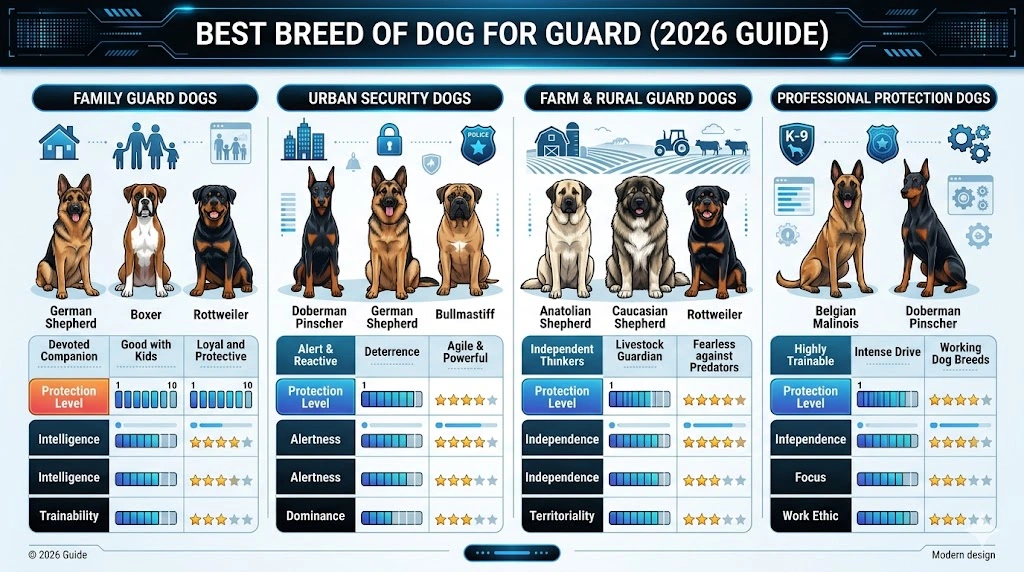
Active protection dogs are working animals with a high drive and advanced response capabilities. These are often the kinds of dogs used by police, military, and specialized security professionals.
They require serious leadership, advanced obedience, and a handler who understands structured behavior. These dogs are not casual pets with guard instincts. They are high-performance dogs that must be managed carefully.
Common examples include the Belgian Malinois and the Doberman Pinscher.
These breeds are best suited for experienced handlers, security-conscious owners, and higher-risk environments. Their potential is impressive, but their energy and intelligence demand discipline.
Best Breed of Dog for Guarding by Purpose
Different households need different types of protection. A family living in a city apartment does not need the same dog as a farmer managing a large rural property. Matching the breed to the purpose is one of the smartest steps you can take.
Best Guard Dogs for Families
Family protection dogs must offer safety without becoming unpredictable. The right breed should be steady, affectionate, obedient, and comfortable around children when raised and socialized properly.
Top choices include the German Shepherd, Boxer, and Rottweiler.
These breeds are popular because they often form strong family bonds, can be trained well, and tend to balance protection instincts with companionship. A good family guard dog should not be a source of tension in the home. It should be a trusted partner in everyday life.
The main benefit of these Best Breeds of Dogs for Guard is balance. They can be loving with their family and alert around strangers. That combination is ideal for a home environment.
Best Guard Dogs for Home Security
Urban homes in places like London, Berlin, Paris, and Amsterdam often require a different type of security mindset. In cities, a guard dog should be able to live indoors, remain manageable in shared spaces, and provide reliable alerting without becoming excessively noisy or difficult to handle.
Top choices include the Doberman Pinscher, Bullmastiff, and German Shepherd.
These dogs are valuable because they can adapt to structured household routines. They tend to be alert, intelligent, and aware of boundaries. In the right home, they can serve as excellent home security dog breeds while still functioning as affectionate companions.
Their strengths include rapid alert behavior, controlled barking when properly trained, and strong territorial awareness. For urban households, that combination is often more useful than sheer size alone.
Best Guard Dogs for Farms and Rural Properties
Rural properties present a different kind of security challenge. A farm or country estate usually has more open land, more boundary space, and more exposure to wandering animals, strangers, and property access points.
Top choices include the Anatolian Shepherd Dog, Caucasian Shepherd Dog, and Rottweiler.
These breeds are valued for endurance, independence, and strong territorial instinct. In some cases, they are used for livestock protection, perimeter awareness, and long-range monitoring of large spaces. They do not always require constant human direction to remain attentive.
A farm guard dog should be able to think independently while still respecting its owner’s leadership. That is why these breeds are often preferred in wide-open environments.
Best Guard Dogs by Owner Experience Level
Breed selection should always match the handler, not just the property.
First-Time Owners
For first-time owners, calmer and more manageable breeds are often the best starting point. Boxers and Bullmastiffs are frequently better choices because they are generally more stable and easier to guide compared with high-drive working breeds.
These dogs still require training, socialization, and consistency, but they are often easier for new handlers to live with.
Experienced Handlers
Experienced owners may be ready for higher-drive breeds such as the Belgian Malinois, Doberman Pinscher, and German Shepherd.
These dogs are intelligent, capable, and deeply responsive, but they need structure. An experienced handler is more likely to provide the leadership, routine, and discipline these breeds require.
Guard Dog Comparison Table
To simplify the selection process, it helps to compare breeds through a practical framework.
| Breed | Protection Level | Training Difficulty | Best Use | Family Friendly |
| German Shepherd | High | Medium | Family + Security | Yes |
| Rottweiler | Very High | Medium | Home Protection | Yes, with training |
| Doberman Pinscher | High | High | Urban Security | Yes |
| Bullmastiff | Medium-High | Low-Medium | Home Deterrent | Yes |
| Belgian Malinois | Very High | Very High | Professional Use | Limited |
| Anatolian Shepherd | Extreme | High | Farm Protection | Moderate |
This kind of comparison is useful because it shifts the focus away from appearance and toward function. A breed that looks impressive may not suit your life. A breed that fits your rhythm, space, and handling experience is far more valuable.
Why Most People Choose the Wrong Guard Dog
Many people make the wrong choice because they think in emotional terms instead of practical terms. They chose a dog. After all, it looks powerful, because someone online called it “the best,” or because it is famous for protection. That approach often leads to disappointment.
Common Mistakes
Choosing based on looks only.
Expecting instant protection without training.
Ignoring early socialization.
Underestimating exercise needs.
Using harsh or inconsistent training methods.
These mistakes can create anxiety, confusion, and unpredictable behavior. A poorly guided protection breed can become reactive, nervous, or hard to manage. A dog with natural guarding instincts still needs structure to become safe and reliable.
The result of bad selection is rarely better security. More often, it becomes more stress, more frustration, and less trust in the dog.
Expert Insight
From a behavioral and training perspective, dog protection is shaped by three major forces: genetics, training, and environment.
Genetics influences instinct. Some breeds naturally show more alertness, courage, territorial awareness, or working drive. This gives them the potential for guard behavior.
Training shapes behavior. The dog learns when to bark, when to settle, when to follow commands, and when to ignore ordinary distractions.
The environment builds stability. A dog raised in a calm, structured, socialized home is far more likely to behave predictably than one raised with inconsistency and chaos.
This is why early obedience training matters so much. The dog must learn basic commands, routines, and boundaries. It should also be socialized with people, sounds, traffic, animals, and daily household activities.
Mental stimulation is just as important as physical exercise. Guard breeds are often intelligent and energetic. When that energy is not guided, it can turn into frustration or behavioral problems.
The central truth is simple: a calm, trained dog is safer than an aggressive, untrained dog.
Real-Life European Scenarios
A good article should help readers picture real life, not just read theory. Different European environments create different needs.
Urban Apartment Life in the UK, Germany, and the Netherlands
For apartment living, the dog must be able to function in close quarters, hear a busy environment, and remain manageable around neighbors and visitors.
The best breeds for this setting are often the Doberman Pinscher and German Shepherd.
These breeds are valuable because they can be alert without being chaotic. They can learn indoor routines, respond well to structured training, and provide dependable warning behavior.
Cold Climate Regions in Nordic Countries
In colder regions, coat type, endurance, and environmental resilience matter more. Dogs in these climates may need a stronger build and better tolerance for harsh weather.
The Caucasian Shepherd Dog and German Shepherd are common considerations here.
Their strengths include thick coats, physical resilience, and the ability to remain functional in demanding conditions. Still, even cold-weather breeds need proper care, shelter, and attention.
Rural Farms in France, Italy, and Spain
For rural farms, territory size and independence are major factors.
The Anatolian Shepherd Dog and Rottweiler are often strong choices.
These dogs can support livestock protection, boundary awareness, and broader territory control. In a rural setting, a guard dog often needs to be comfortable making independent decisions while still obeying the owner’s authority.
Health and Safety Considerations
A protection dog is a long-term responsibility, not just a security tool. Before choosing a guard breed, it is essential to consider health, development, and safety.
Check for hip dysplasia risk, particularly in larger breeds.
Keep vaccination schedules current according to regional veterinary guidance.
Maintain regular veterinary checkups.
Provide balanced nutrition suitable for the dog’s size and activity level.
Avoid excessive exercise in puppies, whose bones and joints are still developing.
Large protection breeds can be wonderful companions, but they need structured care. Their size, energy, and working temperament mean that they should be raised carefully and responsibly.
Training System for Guard Dogs
A dog becomes a Dependable guard only when training turns instinct into reliable behavior.
Step 1: Basic Obedience
Teach the foundational commands first: sit, stay, come, heel, leave it, and quiet. These are the building blocks of control.
Step 2: Socialization
Expose the dog to people, vehicles, sounds, children, strangers, traffic, and routine public experiences. A socially experienced dog is much less likely to become fearful or reactive.
Step 3: Controlled Protection Training
Once the dog has stable obedience, begin structured boundary awareness and alert behavior training. The goal is not chaos. The goal is controlled response.
The dog should learn when to bark, when to stand watch, and when to settle down based on the owner’s cue.
Step 4: Advanced Discipline
Optional advanced training may include security drills, advanced alert conditioning, and professional-level discipline. This level is most appropriate for experienced handlers or specialized security contexts.
The more capable the dog, the more important leadership becomes.
Psychological Understanding of Guard Dogs
Many people make the mistake of thinking a good protection dog “hates strangers.” That is not the correct way to understand the behavior.
A healthy guard dog evaluates the situation. So watch body language. It recognizes unfamiliar movement. It responds to signals from the owner. This behaves according to learned patterns, not blind hostility.
That is why intelligence and training matter so much more than aggression. Aggression without Judgment is a liability. Intelligent caution is useful. Controlled awareness is valuable. A strong protection dog should be able to differentiate between a visitor, a delivery person, and a genuine threat.
This psychological balance is one reason the best guard dogs are often the calmest ones in the room.
Best Guard Dog Selection System
The easiest way to choose the right breed is to use a simple formula:
Lifestyle + Experience Level + Environment = Best Guard Dog
Here is how that works in practice.
An apartment owner who is new to dogs may do better with a Boxer or Bullmastiff.
A farm owner with experience may be better matched with an Anatolian Shepherd.
A city security-focused owner with advanced handling skills may prefer a Doberman or Belgian Malinois.
When the breed matches the lifestyle, training becomes easier, the household feels calmer, and the dog has a much better chance of succeeding.
Final Recommendation Summary
The best breed of dog for guard depends on your situation, your skills, and your living environment. There is no universal winner, because security needs vary from one home to another.
That said, the strongest all-around choices often include:
German Shepherd for balanced protection and reliability.
Rottweiler for powerful deterrence and family guarding.
Doberman Pinscher for urban security and alertness.
Belgian Malinois for professional-level protection roles.
The key lesson is simple: there is no perfect dog for every person. There is only the right match for your life.
FAQs
Boxer and Bullmastiff are great Beginner-friendly options.
Yes, if properly trained and socialized from the puppy stage.
Doberman Pinscher and German Shepherd are top choices.
Highly recommended, especially for powerful breeds.
German Shepherd and Belgian Malinois.
Yes, they act as excellent alarm systems.
Anatolian Shepherd Dog and Caucasian Shepherd Dog.
Conclusion
The best Breed of dog for guard depends entirely on your lifestyle, experience level, and living environment, rather than size or appearance alone. Some dogs are better suited for families, some for urban home security, and others for rural or farm protection. Breeds like the German Shepherd, Rottweiler, Doberman Pinscher, and Belgian Malinois stand out because of their balance of intelligence, loyalty, and trainability.
Ultimately, there is no single “perfect” guard dog. The right choice is the one that matches your needs and is supported with proper training, socialization, and responsible ownership. A well-trained dog will always provide better protection and companionship than an untrained one.