The Egg Shell Secret Most Dog Owners Discover Too Late
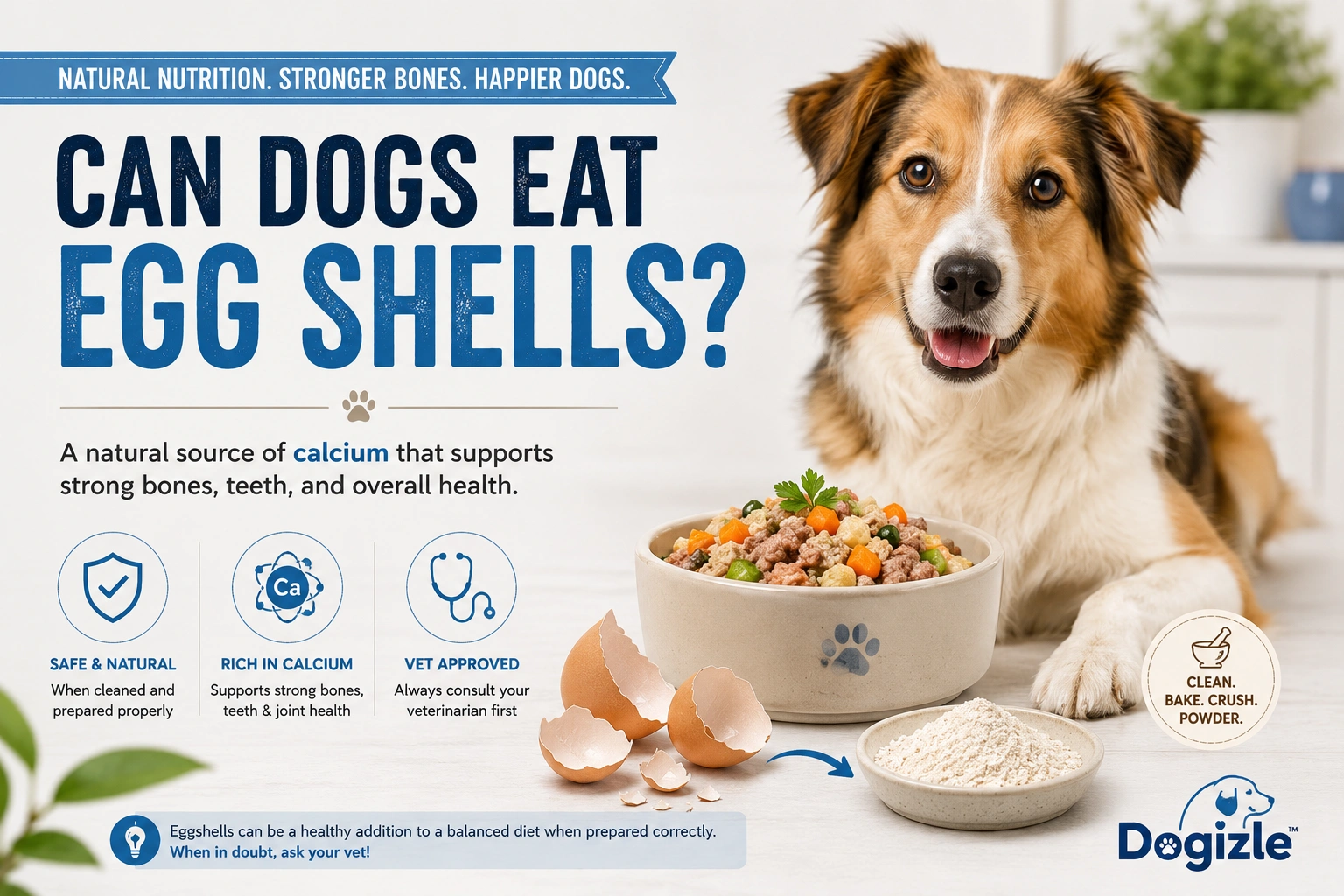
Can Dogs Eat Eggshells? The short answer is that they can, but that does not mean they should be used casually. Eggshells may provide calcium, which is useful in some homemade diets, yet the wrong amount can throw off mineral balance, and raw egg contact still raises food-safety concerns because shell eggs can carry Salmonella. In other words, this is not a “throw it in the bowl” ingredient. It is a diet tool that only makes sense when the overall recipe actually needs it.
That is exactly why this topic deserves a deeper, veterinarian-aware guide. Most dog owners are not trying to experiment with nutrition; they are trying to do the right thing, avoid waste, and support their dog’s health without creating a new problem. This article gives you the practical answer, the safety rules, the prep method, the biggest mistakes, and the situations where eggshells should be skipped entirely.
Quick Answer: Are Eggshells Safe for Dogs?
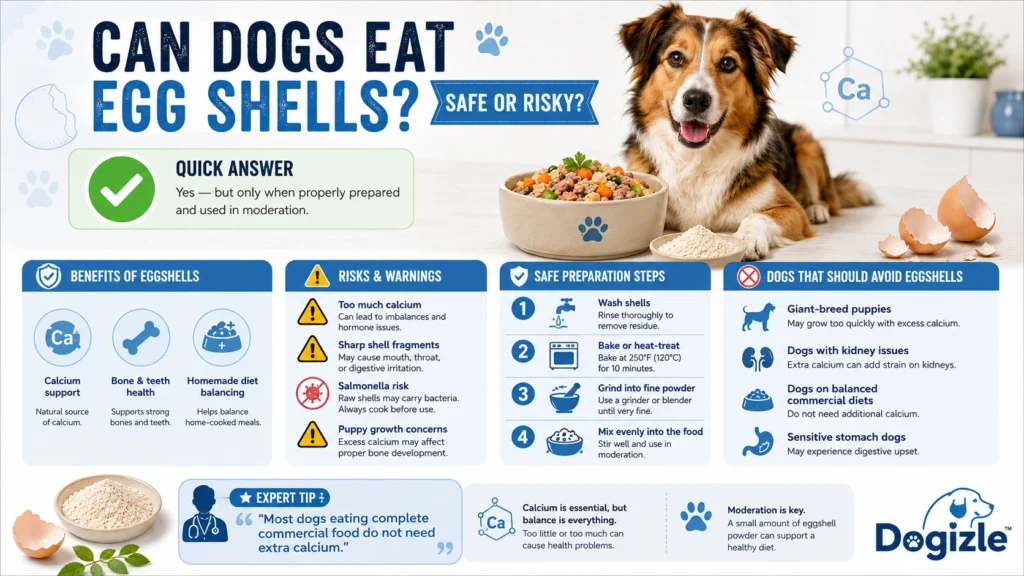
Eggshells are not toxic, but they are only worth using when they are cleaned, heat-treated, and ground extremely fine. Whole pieces can be a choking or irritation risk, and raw shells can carry bacteria. If your dog already eats a complete and balanced commercial diet, extra calcium is usually unnecessary.
What Eggshells Do for Dogs
Eggshells are mostly calcium carbonate, which means their main value is as a calcium source. Calcium matters for bones, teeth, muscle function, and nerve activity. That is why eggshells sometimes show up in homemade food plans, especially when meat-heavy recipes need help meeting calcium needs.
The key point is balance, not “more minerals.” Veterinary nutrition guidance emphasizes that homemade diets should be evaluated for the full recipe, including protein, fats, vitamins, minerals, digestibility, and bioavailability. Calcium does not exist in isolation; it needs to fit the dog’s overall calcium-to-phosphorus balance and life stage.
Mini summary
Eggshells can be useful, but only as part of a properly designed diet. They are not a default healthy topping for every dog.
The Real Risks of Feeding Eggshells
The first risk is food contamination. FDA guidance says shell eggs that have not been treated to destroy Salmonella require safe handling, including refrigeration and thorough cooking. That matters because a shell may look clean and still carry bacteria.
The second risk is shape and texture. Large or poorly crushed pieces can be hard to chew and may create a choking or irritation problem. Veterinary clinic guidance commonly recommends grinding the shell into a very fine powder before use.
The third risk is too much calcium. Merck Veterinary Manual notes that supplementing with too much calcium can increase susceptibility to some diseases, and giant-breed dogs are especially vulnerable to excess calcium during growth. It also notes that young animals from weaning to about 6 months may not regulate calcium absorption well when excess is present.
Safety & health warning
If your dog is a growing puppy, a giant-breed Puppy, or on a homemade diet, do not guess on calcium. Those are exactly the cases where a small nutritional mistake can have long-term consequences.
How to Prepare Eggshells Safely
Here is the safest practical process.
- Wash the shells well to remove leftover egg white or yolk.
- Heat-treat them by baking them or otherwise applying a safe heat step.
- Dry them fully.
- Grind them to a very fine powder so no sharp fragments remain.
- Mix them evenly into food rather than sprinkling large flakes on top.
The reason this matters is simple: the goal is not just calcium, it is calcium in a form that is less likely to create a contamination or texture problem. A very fine powder is the form that most veterinary-style guidance favors because it reduces the chance of sharp edges and makes dosing more consistent.
Step-by-step prep table
| Step | What to do | Why it matters |
| 1 | Wash the shell thoroughly | Removes residue and reduces contamination risk |
| 2 | Heat-treat the shell | Lowers bacterial risk |
| 3 | Dry completely | Makes grinding easier and more even |
| 4 | Grind to a very fine powder | Helps prevent sharp pieces and choking risk |
| 5 | Mix into the full meal | Supports even distribution and better use |
This prep flow is the practical sweet spot for safety and usability. The shell should disappear into the meal, not sit in visible fragments on top of it.
How Much Eggshell Powder Can Dogs Have?
There is no universal teaspoon dose that fits every dog. The right amount depends on the recipe, the dog’s size, the rest of the diet, and whether the dog is eating a complete commercial food or a homemade meal. WSAVA guidance says homemade foods should be evaluated recipe-by-recipe, with attention to sources and amounts of protein, carbohydrates, fats, vitamins, minerals, digestibility, and bioavailability. That is the real dosing framework.
The safest rule is this: do not add eggshell powder just because it sounds healthy. Add calcium only when the diet actually needs it. For dogs on complete commercial food, extra calcium is usually unnecessary. For homemade diets, the calcium requirement should be built into the recipe design, not guessed after the food is already in the bowl. This is an inference based on veterinary nutrition guidance and is the most responsible way to use eggshells.
Practical dosage table
| Situation | Best approach | Why |
| Complete commercial dog food | Usually no eggshells | The food is intended to be complete and balanced |
| Homemade adult diet | Only with recipe-level calcium planning | Homemade diets are commonly imbalanced without careful formulation |
| Puppy diet | Use only with veterinary guidance | Growth needs an exact mineral balance |
| Giant-breed puppy | Avoid guessing entirely | Excess calcium is especially risky during rapid growth |
| A dog with a medical diet needs | Ask the vet first | Nutrition may need to be individualized |
This table is the safest decision tool for most dog owners. The big message is not “how many teaspoons,” but “does this dog actually need it at all?”
Which Dogs Should Avoid Eggshells?
Be extra cautious, or skip eggshells unless your vet says otherwise, if your dog is a growing puppy, a giant-breed puppy, or a dog whose current diet is already complete and balanced. Merck notes that excess calcium is particularly problematic in growing large- and giant-breed dogs, and that young animals may not regulate excess calcium well during early growth.
You should also avoid using eggshells as a casual fix for a diet that is otherwise poorly planned. Veterinary guidance on home-prepared diets repeatedly warns that calcium, phosphorus, zinc, magnesium, and iron imbalances are common, and that recipe design matters more than one “healthy” ingredient.
If your dog has a sensitive stomach or you are introducing any new ingredient, start slowly and watch for vomiting, diarrhea, or discomfort. That is a general feeding precaution, and it is especially sensible when the ingredient is being used as a supplement rather than a treat.
Eggshells vs. Other Calcium Sources
Eggshells are only one possible calcium source. For many dogs, the best calcium source is simply a complete and balanced commercial food. In Europe, FEDIAF guidelines are the main reference point for complete and complementary pet foods, and they are peer-reviewed by veterinary nutritionists. That is a strong reason not to improvise calcium unless the dog is on a homemade recipe that truly requires it.
Comparison table
| Calcium option | Best for | Main advantage | Main caution |
| Complete commercial food | Most dogs | Already balanced for everyday feeding | Usually, no extra calcium is needed |
| Vet-formulated homemade recipe | Homemade feeders | Can be tailored to the dog | Must be formulated carefully |
| Eggshell powder | Some homemade recipes | Budget-friendly calcium source | Easy to overdo if guessed |
| Other calcium supplements | Recipe-specific needs | More controlled dosing | Must match the whole diet |
The important distinction is this: eggshells are not “better” than other calcium sources just because they are natural. In nutrition, “natural” is not the same thing as “correct.” The correct choice is the one that keeps the whole diet balanced.
Eggshells for Homemade Dog Food in Europe and Western Markets
This topic matters a lot more for homemade feeders than for people using standard kibble or wet food. WSAVA says homemade foods should be asked about in detail, including the exact recipe, preparation, storage, recipe rotation, and substitutions. FEDIAF’s guidelines exist as a European reference point for complete and complementary pet food, which reinforces the idea that mineral balance is not something to eyeball.
For dog owners in the UK, Germany, France, Italy, Spain, the Netherlands, Sweden, Switzerland, Australia, Canada, and the US, the same practical rule applies: if the diet is complete, leave calcium alone; if the diet is homemade, get the formula checked. Apartment owners and urban dog parents often prefer simple add-ins, but convenience should never override nutritional accuracy. That last point is a practical inference from the guideline sources, not a separate regulatory claim.
Mini summary
In Europe, especially, the safest mindset is “complete food needs no improvisation; homemade food needs a plan.” That is the right way to think about eggshells, too.
Common Mistakes Dog Owners Make
A very common mistake is feeding whole shells because the dog “seems to handle it fine.” That is not the same as safe, especially if the shell is still in pieces. Another mistake is assuming eggshells should be used every day simply because calcium sounds beneficial.
Another error is adding eggshell powder to a diet that already includes a complete mineral profile. Merck warns against indiscriminate mineral supplementation because excess can cause imbalance, and VCA notes that home-prepared diets commonly go wrong on calcium, phosphorus, zinc, magnesium, and iron.
A third mistake is treating eggshells as a cure for digestive issues, reflux, or vague “weak bones” without a proper diagnosis. One clinic page mentions acid-reflux claims, but the evidence is limited, and that is exactly why a responsible pillar article should avoid overpromising.
Expert Tips
Use eggshells only when there is a clear nutritional reason to do so. If the dog is on homemade food, ask for the full recipe to be reviewed rather than adding supplements one by one. WSAVA specifically recommends evaluating homemade foods by recipe, preparation, storage, and substitution pattern, which is a much stronger approach than guessing.
Keep the shell powder fine enough that it blends into food easily. This is cleaner for apartment living, easier to portion, and less likely to leave sharp fragments behind. It also makes the ingredient feel more like a controlled supplement and less like leftover kitchen waste. That is a practical inference from veterinary prep guidance.
When in doubt, default to the most boring answer: a complete, balanced diet. That is often the healthiest answer, too. FEDIAF and Merck both emphasize balance and proper formulation over “natural” add-ons.
Pros and Cons of Eggshells for Dogs
| Pros | Cons |
| Can provide calcium for some homemade diets | Can upset mineral balance if overused |
| Low-cost and easy to prepare | Raw shells may carry Salmonella |
| Can be ground into a fine powder | Whole pieces can pose a choking or irritation risk |
| May help correct a calcium gap in a recipe | Usually unnecessary for dogs on complete commercial food |
This is the core tradeoff. Eggshells are not inherently bad, but they are easy to misuse. That is why this ingredient belongs in a “nutrition planning” conversation, not a casual treat conversation.
People Also Ask
Yes, but only if they are cleaned, heat-treated, and ground extremely fine. Crushed is not enough if the Pieces are still sharp. The safer form is a fine powder mixed evenly into food.
Only with veterinary guidance. Puppies, especially large and giant breeds, are more sensitive to calcium imbalance during growth, and excess calcium can be harmful.
They can be useful as a calcium source in some homemade diets, but they are not necessary for every dog. If the dog already eats a complete and balanced diet, extra calcium usually adds risk without much benefit.
A heat step is the safer choice because shell eggs can carry Salmonella, and FDA guidance stresses refrigeration and thorough Cooking when working with shell eggs. Heat-treating the shells before grinding is the more cautious approach.
Too much calcium can create a mineral imbalance, and in growing dogs, it can contribute to skeletal problems. The risk is highest when owners add calcium without calculating the full diet.
Not automatically. The better choice is the one that fits the dog’s complete diet and life stage. Balance matters more than the ingredient label.
Sometimes they can be used as a calcium source in homemade recipes, but that decision should be made inside the recipe, not as a standalone swap. If the diet is already complete, replacement is usually not needed.
Final Verdict
Can dogs eat eggshells? Yes, but only with caution, proper preparation, and the right reason. Eggshells are best thought of as a Recipe tool for certain homemade diets, not a routine add-on for every dog. The safest version is clean, heat-treated, finely ground, and used only when the overall diet actually needs calcium.
For most dogs, eating a complete commercial food, the best choice is to skip the eggshells and keep the diet balanced. For homemade feeders, the smartest move is to get the full recipe checked by a veterinarian or veterinary nutritionist. That is the real long-term win for bone health, growth, and overall safety.