Introduction
Brussels sprouts are a classic human side dish, especially around winter holidays, but many dog owners pause before sharing them. That hesitation is smart. The real question is not just “can dogs eat Brussels sprouts,” but how much is safe, how should they be Prepared, and when do they become a problem?
The safe, practical answer is yes: most dogs can eat Brussels sprouts in moderation if they are plain, cooked, and served in small pieces. They are not considered toxic in the usual dog-feeding guides, and they can offer vitamins, fiber, and antioxidants. The downside is that Brussels sprouts are famous for causing gas, bloating, and digestive upset, especially if a dog eats too many or if the sprouts are prepared with butter, garlic, onions, salt, bacon, or gravy.
If you want the short version for everyday use: give Brussels sprouts occasionally, in very small amounts, and always plain. For most dogs, steamed or boiled sprouts are the safest choice, while raw sprouts are harder to digest, and whole sprouts can be a choking risk.
Quick Answer: Can Dogs Eat Brussels Sprouts?
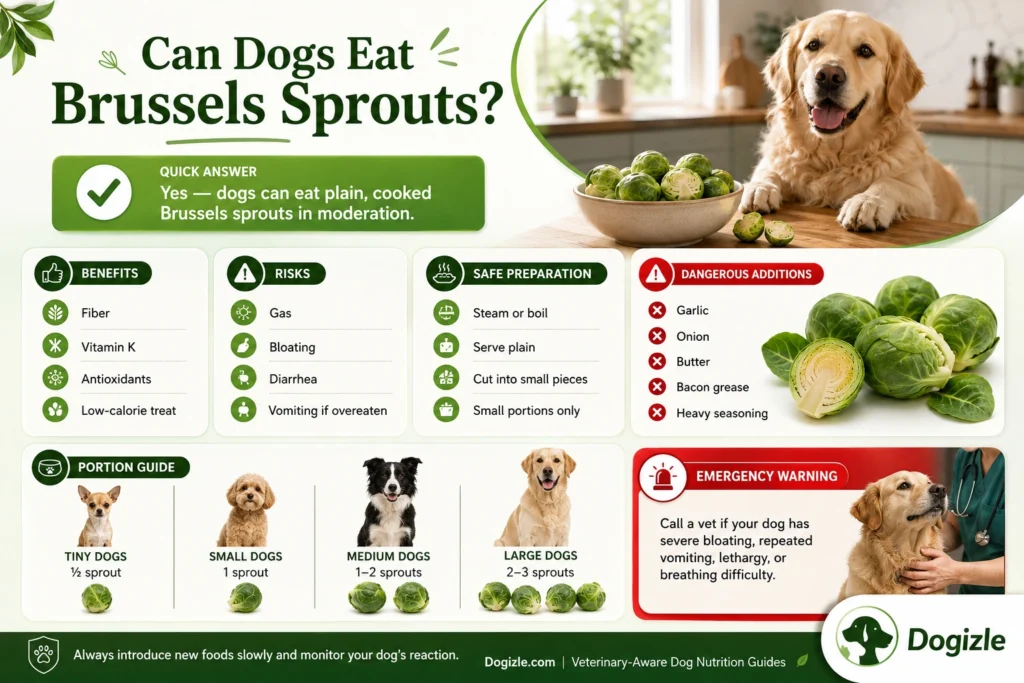
Yes, dogs can eat Brussels sprouts in moderation. They should be plain, cooked, and cut into small pieces. Avoid seasoning, sauces, butter, oil-heavy recipes, and allium ingredients such as garlic, onion, chives, and leeks.
Are Brussels Sprouts Safe for Dogs?
For most healthy dogs, Brussels sprouts are a safe occasional vegetable treat, not a daily food. The main issue is not poison; it is digestion. Brussels sprouts are cruciferous vegetables, and their fiber plus hard-to-digest compounds can create a lot of gas. PetMD specifically notes that raffinose can contribute to gas and bloating, while AKC explains that the gas effect is the best-known downside.
That is why a dog may tolerate a tiny portion perfectly well but react badly to a larger serving. A small dog, a puppy, or a dog with a sensitive stomach should start with less than you think they need.
Mini takeaway
Brussels sprouts are generally safe, but safe does not mean unlimited. The serving size matters more than the vegetable itself.
Health Benefits of Brussels Sprouts for Dogs
Brussels sprouts can be a useful treat because they contain nutrients that support general health. AKC and Rover both highlight fiber, antioxidants, and vitamins, especially vitamins K and C, plus other nutrients such as A, B1, B6, manganese, potassium, and folate. PetMD also notes that plain Brussels sprouts are rich in vitamins and fiber when served correctly.
1) Vitamin K
Vitamin K supports normal blood clotting and is also linked with bone and heart support in AKC’s overview.
2) Vitamin C and antioxidants
Antioxidants help reduce oxidative stress, and vitamin C is one of the nutrients that make Brussels sprouts attractive as an occasional treat. Rover and AKC both mention antioxidant value.
3) Fiber
Fiber can support bowel regularity in small amounts. That said, too much fiber is exactly what can create the opposite effect: loose stool, gas, or discomfort.
4) Low-calorie treat potential
Plain Brussels sprouts can be a lower-calorie alternative to many processed snacks, which is useful for owners who want variety without loading extra calories into the diet. This is a practical inference from the nutrient-and-moderation guidance in the veterinary-aware sources.
Mini takeaway
Brussels sprouts are best thought of as a nutrient-rich garnish, not a meal replacement. Their value is in moderation.
Risks of Feeding Brussels Sprouts to Dogs
The biggest risk is digestive upset. AKC says Brussels sprouts are notorious for gas. PetMD explains they can cause gas and bloating, especially if eaten in large quantities or prepared the wrong way. Hepper also warns that fat-heavy versions can trigger vomiting and diarrhea, particularly in dogs with pancreatitis or other health issues.
The most common risks are:
- Gas
- Bloating
- Loose stool or diarrhea
- Vomiting in sensitive dogs
- Choking risk if fed whole
- Intestinal blockage risk if swallowed whole and not chewed properly
A small amount of gas is usually an inconvenience, not an emergency. But repeated vomiting, serious bloating, pain, lethargy, or difficulty breathing needs veterinary attention.
Mini takeaway
The main danger is not toxicity; it is overfeeding, bad preparation, and poor tolerance.
Why Brussels Sprouts Make Dogs Gassy
Brussels sprouts contain compounds that many dogs do not digest well. PetMD points to raffinose, and AKC explains that sprouts can increase gas because of the way they affect the digestive tract and gut bacteria. In practical terms, the sprouts reach the colon, and fermentation creates gas.
That is why even a “healthy” veggie can create a very unglamorous result in real life. In a small flat or apartment, that odor can be especially noticeable, so owners often underestimate the practical side of gas before they try the first serving. That is an inference, but it follows directly from the gas risk described by AKC and PetMD.
Can Dogs Eat Raw Brussels Sprouts?
Technically, some dogs may chew raw Brussels sprouts, but raw is not the best choice. AKC says not to serve them raw because they are too hard to digest, and PetMD/Hepper both recommend cooking them first. Raw sprouts are also more likely to be tough, bulky, and awkward for smaller dogs.
If you are deciding between raw and cooked, cooked wins almost every time.
Can Dogs Eat Cooked Brussels Sprouts?
Yes. Cooked Brussels sprouts are the best option for dogs. The safest methods are steaming, boiling, or microwaving without seasoning. AKC and Hepper both recommend plain cooking, and PDSA specifically says Brussels sprouts should be steamed or boiled in very small quantities.
Best cooking rule
Cook them until they are soft enough to mash lightly with a fork, then cut them into small pieces before serving. That is the simplest way to reduce chewing difficulty and choking risk.
Best Ways to Prepare Brussels Sprouts for Dogs
Here is the safest routine for most households:
- Wash the sprouts thoroughly to remove dirt and residue.
- Trim off the hard stem.
- Cook them plain by steaming, boiling, or microwaving.
- Let them cool completely before serving.
- Cut them into bite-sized pieces, especially for small dogs.
- Serve only a tiny portion at first and watch your dog’s stool and comfort over the next 24 hours.
Safe vs unsafe preparation table
| Preparation | Safe for dogs? | Why |
| Steamed, plain | Yes | Best balance of digestibility and nutrient retention |
| Boiled, plain | Yes | Soft and easy to chew |
| Microwaved, plain | Yes | Quick and safe if unseasoned |
| Raw | Not recommended | Harder to digest and more likely to cause trouble |
| Roasted with oil | Only cautiously | Added fat can upset the stomach |
| Buttered or cheesy | No | Fat and dairy can cause GI issues |
| With garlic/onion/chives | No | Alliums are toxic to dogs |
| With bacon grease/gravy | No | High fat and hidden seasonings are risky |
| Holiday casserole | No | Often contains multiple dangerous ingredients |
Mini takeaway
For dogs, the safest Brussels sprout is plain, soft, and boring. That is exactly what you want.
Foods and Seasonings to Avoid
This section matters more than many owners expect. The vegetable itself may be okay, but the recipe can make it unsafe. PetMD warns against garlic, onions, and salt. Hepper adds butter and bacon as risk factors, and ASPCA and Blue Cross both stress that onions, garlic, leeks, shallots, and chives are poisonous to dogs, whether cooked or uncooked. Blue Cross also warns that leftovers can hide toxic ingredients and mold.
Avoid these especially:
- Garlic
- Onion
- Chives
- Leeks
- Shallots
- Salt-heavy seasoning
- Butter
- Bacon grease
- Cream sauces
- Gravy
- Cheese sauces
- Holiday leftovers with hidden ingredients
Why this matters in Europe and the UK
Brussels sprouts often appear in festive meals across the UK and Europe, where they are commonly served with roasts, gravies, and leftovers. That is exactly the danger zone. A plain sprout is one thing; a holiday plate is another. Blue Cross specifically warns against leftovers because they can contain hidden toxic ingredients.
Mini takeaway
The sprout itself is not the enemy. The seasoning and side dishes usually are.
How Many Brussels Sprouts Can Dogs Eat?
There is no single official dose, but the best current guidance is to keep portions small. AKC suggests a starting point of 1/2 to 1 sprout, depending on the dog’s size, then says no more than three per serving from time to time. Rover says one to three sprouts,s depending on size. PDSA says Brussels sprouts should only be given in very small quantities. Based on those sources, a conservative size-based chart is the safest practical approach.
Practical serving chart
| Dog size | Conservative starting amount | Upper end for an occasional treat |
| Under 10 lbs / 4.5 kg | 1/2 small sprout | 1 small sprout |
| 10–25 lbs / 4.5–11 kg | 1 small sprout | 1 sprout |
| 25–50 lbs / 11–23 kg | 1 sprout | 1–2 sprouts |
| 50–90 lbs / 23–41 kg | 1–2 sprouts | 2–3 sprouts |
| 90+ lbs / 41+ kg | 2 sprouts | 3 sprouts maximum |
This is a conservative starter chart, not a medical dose. It is based on the small-quantity guidance from AKC, Rover, and PDSA, and it should be reduced further for puppies, seniors, or dogs with sensitive stomachs.
Smart frequency rule
Brussels sprouts should be an occasional treat, not a daily vegetable in your dog’s bowl. The top veterinary-aware pages repeatedly frame them as a moderate food rather than a staple.
Can Puppies Eat Brussels Sprouts?
Yes, puppies can usually have tiny amounts of plain, cooked Brussels sprouts, but they are more likely than adult dogs to react with gas or loose stool. The safest approach is to start with a very small piece and see how the puppy handles it before offering any more. That follows the same moderation logic used by AKC, PetMD, and PDSA.
For puppies, the real question is not “can they?” but “should they?” In most homes, a puppy does not need Brussels sprouts at all. A tiny taste is fine if you want to test tolerance, but puppies do not benefit from extra fiber the way an adult dog on a stable diet might. That is a practical inference from the sources’ moderation-first advice.
What Happens if a Dog Eats Too Many Brussels Sprouts?
Most dogs do not need emergency treatment after overeating Brussels sprouts, but they may get uncomfortable. The most common signs are gas, bloating, soft stool, diarrhea, stomach discomfort, vomiting, and reduced appetite for a short time. AKC and PetMD both note that excess sprouts can cause digestive upset, while Hepper warns about vomiting and diarrhea from fattier preparations.
Symptoms to watch for
| Symptom | What it may mean | What to do |
| Mild gas | Common after sprouts | Monitor at home |
| Soft stool | Digestive overload | Skip treats for a day |
| Diarrhea | Too much fiber or bad prep | Offer water and monitor |
| Vomiting | The food did not agree with the dog | Stop treats and watch closely |
| Abdominal swelling | Possible bloating | Contact a vet promptly |
| Pain, weakness, repeated vomiting | More serious issue | Seek veterinary help immediately |
| Trouble breathing | Emergency sign | Go to an emergency vet now |
Severe swelling, repeated vomiting, lethargy, pain, or breathing trouble should not be treated as “just gas.” Those signs need prompt veterinary advice. If the sprouts were seasoned with garlic, onion, chives, butter, or other risky ingredients, the concern is greater. ASPCA and Blue Cross both emphasize the danger of alliums and toxic hidden ingredients.
Mini takeaway
A little smell is normal; ongoing sickness is not. When symptoms escalate, do not wait it out.
When to Call a Vet
Call your vet if your dog has:
- Repeated vomiting
- Persistent diarrhea
- Marked lethargy
- Painful or swollen belly
- Refusal to eat
- Trouble breathing
- Any sign of an allergic or toxic reaction
- Sprouts cooked with onion, garlic, chives, leeks, or a heavy amount of butter or grease
If you suspect toxic ingredients, contact your local vet or poison service as soon as possible. ASPCA states that its poison control line is available 24/7 in the U.S. for pet poison emergencies.
Brussels Sprouts for Dogs in Europe and Western Homes
Brussels sprouts are a familiar food in the UK and across Europe, especially in winter menus and holiday meals. That makes them one of the most common “table scrap” foods dogs are likely to steal. Blue Cross specifically warns that leftovers can hide toxic ingredients, and ASPCA highlights the danger of allium ingredients such as onion and garlic.
Practical Europe-specific advice
If you live in an apartment, gas can be more noticeable and less pleasant to manage. If you travel with your dog during the holidays, the risk increases because restaurant food and family leftovers are harder to control. In colder months, people also tend to serve richer dishes with butter, gravy, and seasoning, which makes Brussels sprouts much less dog-friendly. That is a practical inference from the holiday-leftover warnings in Blue Cross and ASPCA, plus the gas warnings in AKC and PetMD.
Apartment living tip
In a small apartment, feed only a tiny first portion and do it earlier in the day so you are not trapped overnight with digestive drama. That is common-sense prevention based on the known gas risk.
Cold weather tip
Winter meals often look harmless but hide butter, gravy, and onion-based seasoning. Keep your dog’s share plain and separate before the human meal is dressed up.
Dog-Safe Vegetables Similar to Brussels Sprouts
If your dog enjoys vegetables but Brussels sprouts are too gassy, there are easier options. PDSA lists carrots, celery, green beans, and peas among dog-friendly vegetables, and its feeding advice emphasizes plain, bite-sized pieces. PetMD and other vet-aware guides also routinely include simple vegetables as occasional treats.
Better-tolerated alternatives
- Green beans
- Carrots
- Cucumber
- Zucchini
- Peas
- Small amounts of broccoli, if your dog tolerates it
Common Mistakes Dog Owners Make
- Serving too many Sprouts at once
Even safe vegetables can overwhelm a dog’s digestion. - Using holiday leftovers
Hidden onion, garlic, gravy, butter, and grease are the real problems. - Feeding raw sprouts because they seem “healthier.er”
Raw is harder to digest and more likely to create gas and discomfort. - Not cutting them small enough.
Whole sprouts can be a choking hazard for smaller dogs. - Assuming gas is harmless, no matter what
Mild gas is common; persistent vomiting, pain, or swelling is not.
Expert Tips for Feeding Brussels Sprouts Safely
- Start with one tiny piece, not a full serving.
- Choose steamed or boiled over raw.
- Keep them plain and unseasoned.
- Watch your dog’s stool after the first serving.
- Reduce the portion further if your dog has a sensitive stomach.
People Also Ask
It is better not to feed them every day. The major dog-feeding guides frame Brussels sprouts as an occasional treat because excessive use can cause gas and digestive upset.
Yes, if they are cooked, plain, and served in small pieces. Freezing does not remove the need to keep them unseasoned and portion-controlled. This is a practical extension of the cooked-plain guidance from AKC, PetMD, and PDSA.
Only if they are roasted plain and without heavy oil, butter, garlic, onion, or seasoning. Plain cooking is the key, not the cooking style itself.
No, Brussels sprouts are generally treated as a safe vegetable for dogs in moderation. The danger comes from preparation problems, overfeeding, or toxic add-ins such as onion and garlic.
Brussels sprouts are known to cause gas and bloating. The digestive system ferments some of the compounds in the vegetable, which creates flatulence.
No, butter is not a good idea. Fatty add-ons can trigger digestive upset and may be especially risky for dogs prone to pancreatitis or stomach sensitivity.
Watch for gas, diarrhea, vomiting, or belly discomfort. If symptoms become severe or the sprouts were cooked with onion, garlic, chives, or heavy butter, call your vet.
Conclusion
Brussels sprouts can be a healthy occasional treat for dogs, but the safest version is the simplest one: plain, cooked, cooled, and served in tiny portions. The biggest mistakes are overfeeding and seasoning the sprouts like a human holiday side dish. If you keep the vegetable plain and watch your dog’s tolerance, Brussels sprouts can fit into a responsible, dog-friendly diet.
For Dogizle.com, this topic has strong potential for topical authority because it supports broader content on dog-safe vegetables, holiday food safety, digestive issues, and practical feeding guidance. Bookmark this guide, share it with another dog owner, and keep exploring Dogizle for more expert-backed dog care advice.
This content is for educational and informational purposes only and does not replace professional veterinary advice. Always consult a licensed veterinarian for medical concerns regarding your dog.