Best Large Breed Dog Food 2026 — Avoid Growth Mistakes That Hurt Big Dogs
Choosing the best Large Breed dog food is not a casual purchase. It is a long-term health decision that can shape your dog’s growth, joint comfort, digestion, body condition, and overall quality of life.
Large dogs are not simply “bigger versions” of small dogs. Their bodies place different demands on nutrition, especially during growth. They develop differently, carry more mass, and often need tighter control over calories, minerals, and feeding habits. The wrong food may not show problems immediately, but over time, it can contribute to excess weight, poor stool quality, joint strain, and uneven development.
That is why this guide goes beyond a simple product roundup. Instead of just naming brands, it gives you a practical decision system you can use for puppies, adults, and seniors. It also helps you think clearly about feeding in a European context, where labels, regulations, and product availability can vary from country to country.
If you have ever stood in front of a pet-food shelf wondering which large breed formula is actually right, this article is designed to remove that uncertainty.
How to Choose the Right Large Breed Dog Food for Every Life Stage?
Most ranking pages do one thing well: they list products.
What they often do not do is answer the real question behind the search.
The real question is not, “What is the most popular dog food?”
The real question is, “What is the right food for my dog’s size, age, digestion, and activity level?”
This article is built to solve exactly that.
It helps you decide based on the factors that matter most:
Age and life stage
Current weight and body condition
Activity level
Digestive tolerance
Budget
European labeling and feeding standards
The result is a more practical, less confusing way to choose food. Instead of feeling overwhelmed by marketing claims, you get a clear structure that helps you compare options with confidence.
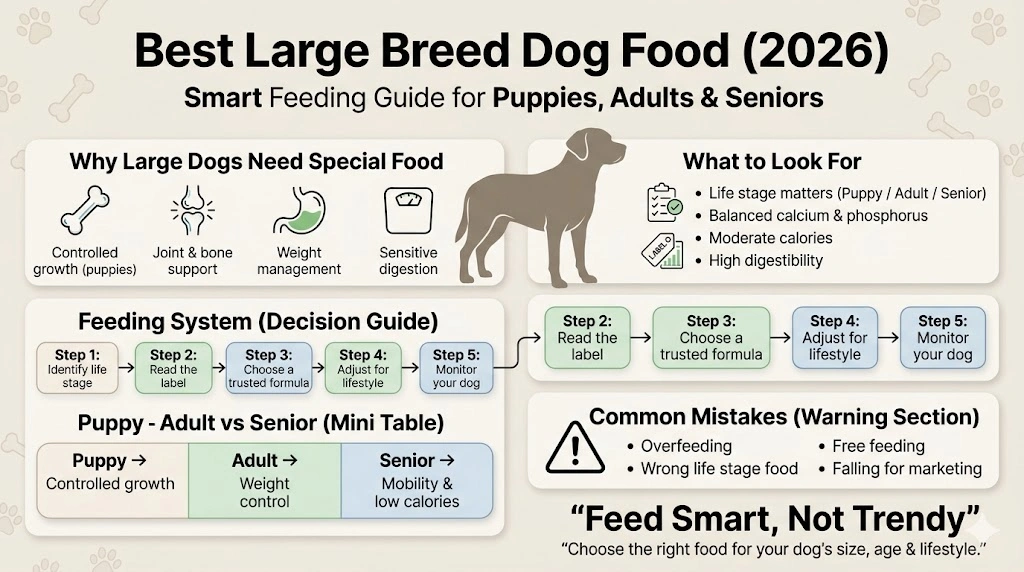
Why Large Breed Dogs Need Special Food
Large breed dogs have different nutritional pressures from smaller dogs. Their growth pattern, skeletal load, and metabolic needs all make them more vulnerable to mistakes in feeding.
1. Large Dogs Are Not Just Bigger Eaters
A common misconception is that larger dogs simply need larger portions of regular food. In reality, bigger dogs often need more careful portion control, not just more food.
They do not always need a high-calorie formula. In many cases, they need a diet that offers:
Controlled energy density
Balanced protein
Appropriate fat levels
Good digestibility
Feeding too much food, or food that is too calorie-dense, can push a large dog toward excess weight. And extra weight creates more stress on the hips, elbows, knees, and spine.
2. Growth is the Most Important Risk in large-breed puppies
Large breed puppies grow quickly, and that fast growth must be managed carefully. The challenge is not just to “feed enough,” but to feed in a way that supports steady development.
When growth is too rapid, the skeleton may develop under uneven stress. This can increase the risk of orthopedic issues later in life. For this reason, feeding a large breed puppy is not the same as feeding a standard puppy.
A proper large breed puppy food is designed to support controlled development, not maximum size at maximum speed.
3. Mineral Balance Matters More Than Most Owners Realize
Calcium and phosphorus are especially important during puppyhood. These minerals influence bone development, but more is not better.
Too much calcium can be just as problematic as too little. Large breed puppies need a formula with the right balance, not a random “strong bones” claim on the front of the bag.
This is one of the biggest reasons why large-breed puppy formulas exist separately from regular puppy foods.
4. Large Dogs Often Have Sensitive Digestion
Many large dogs are prone to digestive discomfort. Loose stools, excess gas, irregular bowel movements, and sensitive stomach responses are not unusual.
That makes digestibility a major part of food selection. A food can look impressive on paper and still be the wrong fit if it leads to recurring stomach trouble.
A good, large-breed diet should support:
Stable stools
Comfortable digestion
Consistent feeding tolerance
Steady energy
What to Look for in the Best Large Breed Dog Food
The best large breed dog food gets the fundamentals right. Fancy packaging is not the point. Clear nutritional fit is the point.
1. Life Stage Comes First
This is the most important rule of all.
A puppy is not an adult.
An adult is not a senior.
A senior is not a puppy.
Each stage requires a different nutritional strategy.
| Dog Type | Main Priority | Best Match | What to Avoid |
| Puppy | Controlled growth | Large breed puppy formula | Free-feeding and generic puppy food |
| Adult | Weight management and stability | Balanced large breed adult formula | Excessively rich diets |
| Senior | Mobility, digestibility, and lower calories | Senior large breed formula | Heavy, calorie-dense food |
The wrong stage can create the wrong result, even if the brand is famous or expensive.
2. Controlled Calories Help Prevent Weight Gain
Large breed dogs can gain weight quietly. Sometimes the change is gradual enough that owners do not notice until joints or stamina begin to suffer.
A good food should provide moderate calorie density, not overstuffed energy. That makes it easier to maintain a healthy body condition without constant food restriction.
This is especially useful for dogs that are:
Indoor pets
Less active
Spayed or neutered
Naturally food-motivated
The right formula should help your dog feel satisfied without creating long-term weight creep.
3. Calcium and Phosphorus Must Be in the Right Range
For growing large breed dogs, mineral balance is not a minor detail. It is foundational.
Look for a formula that is built specifically for large breed growth. Avoid assuming that any puppy food will do. Even when ingredients look healthy, the mineral profile may not be appropriate for a large puppy.
This is one of the clearest reasons to choose a food designed for large breed puppies instead of a standard puppy formula.
4. High Digestibility Is a Major Plus
Digestibility influences stool quality, nutrient absorption, and how comfortably your dog feels after eating.
A highly digestible food often leads to:
Cleaner, firmer stools
Less gas
Better nutrient use
More predictable appetite
That does not mean every dog must eat the same protein source or texture. It means the food should be easy on the digestive system and consistent in performance.
Large Breed Puppy vs Adult vs Senior Food
A large breed dog changes dramatically across life. The nutrition plan should change, too.
Large Breed Puppy Food
This stage is all about controlled development. The goal is not rapid growth. The goal is proper growth.
A good large breed puppy formula should include:
Balanced minerals
Measured calories
Appropriate protein
Growth support without overfeeding
Puppies do best when meals are carefully portioned rather than offered continuously.
Large Breed Adult Food
Adult dogs need stability. They are no longer building their skeleton at the same pace, but they still need support for muscle maintenance, body-weight control, and energy balance.
Adult formulas should help your dog stay:
Lean
Active
Comfortable
Consistent in digestion
Large Breed Senior Food
Older dogs often become less active, and their calorie needs usually drop. At the same time, joint comfort and easy digestion become more important.
A senior formula should typically support:
Lower calorie intake
Joint and mobility comfort
Digestive ease
Healthy body condition
The goal is not to keep an older dog eating like a young athlete. The goal is to keep the body comfortable and the weight controlled.
How to Choose the Best Large Breed Dog Food: Step-by-Step System
Rather than guessing, use a simple selection process.
Step 1: Identify the Life Stage
Ask one basic question first:
Is your dog a puppy, an adult, or a senior?
That single decision narrows Everything else. A growing dog has different needs from a fully grown dog. A senior dog has different needs from both.
Once the life stage is clear, the rest of the label becomes easier to interpret.
Step 2: Read the Label Carefully
In Europe, dog food labels usually include important information such as:
Whether it is a complete feed
Feeding instructions
Ingredient list
Nutritional information
Ignore the loud marketing phrases first. Words like “premium,” “natural,” and “holistic” may sound appealing, but they do not tell you whether the formula suits your dog.
What matters is the actual nutrient design.
Step 3: Choose Brands Known for Nutritional Consistency
Science-based brands tend to focus on formulation rather than hype. That is useful when you want dependable nutrition rather than trend-driven packaging.
Well-known veterinary and science-led options often include brands such as:
Hill’s Science Diet
Royal Canin
Purina Pro Plan
This does not mean every product from these brands is automatically perfect. It means they are generally built with nutritional structure in mind, which is especially valuable for large-breed feeding.
Step 4: Match Food to Lifestyle, Not Just Breed
Two dogs of the same breed may need different food. Why? Because their lifestyles may be different.
A dog living in an apartment may be less active than a dog with regular outdoor exercise. A cold-weather dog may burn energy differently from a dog in a warm climate. A highly active working dog needs a different calorie structure than a relaxed family companion.
Think about:
Daily movement
Climate
Indoors vs outdoors
Exercise frequency
Typical treat intake
Food should fit the life the dog actually lives.
Step 5: Watch the Dog, Not Only the Bag
The food label matters, but your dog’s response matters even more.
Healthy signs include:
Stable body weight
Good energy
Firm stools
Regular appetite
Smooth coat condition
Warning signs include:
Weight gain
Low stamina
Loose stools
Excess gas
Poor enthusiasm for meals
Visible discomfort after eating
If the dog is not thriving on a food, the label is not enough. Real-world results are the final test.
Best Large Breed Dog Food by Category
Sometimes it helps to think in categories rather than only brand names.
Best Overall Large Breed Dog Food
The best overall choice is usually a complete and balanced large breed adult formula.
Why this works well:
It suits many healthy adult dogs
It usually supports weight control
It is easier to manage long-term
It offers nutritional balance without overcomplication
This is the safest general-purpose option for many households.
Best Large Breed Puppy Food
This is the most important category for preventing future problems.
Choose a formula that is made specifically for large breed puppies and supports:
Controlled growth
Balanced calcium and phosphorus
Measured feeding
Do not substitute a regular puppy food just because it is available or familiar. Large breed puppies deserve a formula built for their growth pattern.
Best Food for Sensitive Stomachs
A good sensitive-stomach formula should be straightforward, digestible, and consistent.
Useful traits include:
Simple recipe structure
Easy-to-digest ingredients
Predictable feeding response
Steady stool quality
Avoid constant switching between Foods. Sensitive dogs often do best with routine and simplicity.
Best Food for Weight Control
Large dogs can become overweight faster than many owners expect. Because of that, weight management should be part of food selection, not an afterthought.
Look for a formula with:
Moderate calorie density
Balanced fat content
Good satiety
The best approach is usually not a harsh restriction. It is steady control with the right formula and portion sizes.
Dry Food vs Wet Food vs Fresh Food
There is no universal winner for every dog. The best option is the one that your dog tolerates well and that fits your feeding routine.
Dry Food
Dry food remains the most common choice for many households.
It is often preferred because it is:
Convenient
Affordable
Easy to store
Simple for daily feeding
For many large dogs, dry food is the most practical foundation.
Wet Food
Wet food can be a helpful option when taste and hydration matter.
It may be useful for dogs that:
Need more palatability
Prefer softer textures
Benefit from additional moisture in the diet
Fresh Food
Fresh food can feel appealing because of its ingredient image and texture. However, quality alone is not enough. The formula still needs to be nutritionally complete and balanced.
Fresh diets may be:
Highly palatable
More expensive
Less convenient for some owners
The best strategy is not choosing by trend. It is chosen based on balance, practicality, and your dog’s actual response.
Large Breed Dog Feeding Chart
A feeding chart is a starting point, not a permanent verdict.
| Dog Type | Feeding Style |
| Puppy | Measured meals, not free feeding |
| Adult | Follow the guide, then adjust as needed |
| Active dog | Higher-energy feeding approach |
| Senior | Lower calories, careful monitoring |
The amount on the package is only a reference. The dog’s body condition should guide the final decision.
Real-Life Feeding Scenarios in Europe
Europe is diverse, and feeding needs can vary with region and lifestyle.
1. City Dogs in London, Berlin, or Paris
Urban dogs often get less spontaneous movement than people assume. Apartment life, elevator living, and shorter walks can all reduce calorie burn.
For these dogs, it often makes sense to use:
Moderate-calorie food
Controlled portions
Consistent feeding times
2. Cold Regions Such as Scandinavia or Switzerland
Dogs in colder climates may need more energy depending on outdoor exposure, body type, and activity level.
The key is not to overfeed automatically. Instead, monitor weight and adjust according to movement and weather.
3. Warm Regions Such as Spain, Italy, or Greece
Hot weather often lowers activity. Dogs may move less during peak heat, and owners may naturally reduce exercise time.
In these regions, overfeeding becomes a common risk. A moderate formula with controlled portions is usually more sensible than rich, heavy feeding.
4. Multi-Dog Homes
Different dogs do not necessarily need the same food, even if they live under the same roof.
A puppy, an adult, and a senior dog may all need different formulas. A high-energy dog and a couch companion may also need different calorie levels.
Separate feeding plans usually work better than one universal bowl.
Pros and Cons of Large Breed Dog Food
Pros
Supports healthy growth
Helps manage body weight
Improves portion control
Can reduce the risk of nutritional mistakes
Often easier to match to life stage
Cons
Some products are too calorie-heavy
Not every brand lives up to its claims
Marketing language can be misleading
The wrong formula can cause more harm than good
Large breed food is helpful, but only when chosen thoughtfully.
Common Mistakes Dog Owners Make
1. Choosing Based on Brand Recognition Alone
A famous name is not a guarantee of suitability. The best food is the one that fits your dog, not the one with the biggest advertisement.
2. Feeding a Puppy Like an Adult
This is one of the most serious mistakes. Large Breed puppies need growth support, not adult maintenance nutrition.
3. Free Feeding
Leaving food out all day can make it difficult to regulate intake. For many large dogs, this increases the risk of excess weight.
4. Ignoring Body Condition
The scale is useful, but body condition is even more informative. A dog can be “normal weight” on paper and still carry excess fat.
5. Switching Food Too Quickly
Abrupt food changes often upset digestion. If you move to a new formula, transition gradually.
6. Believing Every Marketing Claim
Words are not the same as formulation. Read the nutrition details, not just the front of the bag.
Expert Tips for Feeding Large Dogs
A few steady habits can make a major difference.
Keep your dog lean.
Weigh puppies regularly.
Use a slow-feeder bowl if your dog eats too fast.
Feed at consistent times.
Focus on total nutrition, not just protein percentage.
Adjust portions based on body condition, not only the package chart.
Small adjustments made consistently are often more powerful than dramatic changes made occasionally.
Safety and Health Considerations
Watch for changes in:
Vomiting
Loose stools
Gas
Weight fluctuations
Low energy
Disinterest in food
When these signs recur, the food may not be a proper fit, or there may be a health issue that requires professional attention.
If symptoms continue, consult a veterinarian promptly.
FAQs
A complete and Balanced formula from a vet-backed brand that matches your dog’s age and needs.
They should eat large-breed puppy food with controlled calcium and growth support.
No. It depends on the overall nutrition, not just grains.
Start with the feeding chart, then adjust based on weight and activity.
No. They have completely different needs.
A simple, digestible formula with consistent feeding.
Conclusion:
The best large Breed dog food is not the most expensive product, the most famous label, or the one with the flashiest marketing.
It is the food that fits your dog.
That means:
Puppies need controlled growth
Adults need a stable weight and balanced nutrition
Seniors need fewer calories and easier digestion
The smartest approach is simple: Read the label carefully
Choose the formula for the right life stage
Monitor your dog’s body condition
Adjust feeding when needed