Introduction
Choosing the best multivitamin for dogs has become more important in 2026 because the way dogs live today is very different from the way they lived in the past. Modern dogs spend more time indoors, exercise less than working dogs of earlier generations, and often depend on processed commercial diets instead of freshly prepared meals. Their daily routines are also shaped by Apartment Living, limited outdoor exposure, inconsistent sunlight, and, in many cases, a lifestyle that is convenient for humans but not always ideal for canine wellness.
Even when a dog food package proudly says “complete and balanced,” that phrase does not automatically mean the food is perfect for every individual dog every single day. It means the formula is designed to meet established minimum nutritional requirements, not necessarily to deliver optimal support for every breed, life stage, or health condition. That distinction matters. Minimum nutrition may prevent obvious deficiency, but it does not always provide the extra margin of support that some dogs need for skin health, immune function, mobility, digestion, coat condition, energy production, or healthy aging.
Best Multivitamins for Dogs Vets Secretly Recommend
In many cities, especially across Europe and the UK, dogs are increasingly living a lifestyle that places unique nutritional demands on their bodies. Urban dogs often get less direct sunlight, which can matter for overall wellness. Some are less physically active. Some eat diets that have been heat-processed, stored for long periods, or chosen primarily for convenience rather than variety. Senior dogs may also digest and absorb nutrients less efficiently than they did when they were younger. Picky eaters, rescue dogs recovering from previous nutritional gaps, and dogs on home-prepared diets can all have slightly different nutritional needs as well.
This is where dog multivitamin supplements can become useful as a supportive tool rather than a universal requirement. A good supplement can serve as a nutritional safety net, helping fill small gaps that may exist despite a decent diet. It may support overall vitality, make coat care easier, assist with age-related changes, or help provide targeted support for dogs with special needs. But the most important truth is this: multivitamins are not automatically necessary for every dog. They are most helpful when used thoughtfully, for the right dog, at the right time, and in the right amount.
This guide explains the best multivitamin for dogs in practical terms. It covers what multivitamins do, when they matter, which ingredients are worth noticing, which ingredients are risky, how to choose a safe formula, how dosage should be approached, and how to compare options with a smart, vet-aware mindset. It is written for dog owners who want clear, usable information rather than hype, confusion, or vague marketing promises.
Do Dogs Really Need a Multivitamin?
The answer is not the same for every dog. Some dogs do perfectly well on a well-formulated diet and do not require additional vitamin support. Others may benefit from a carefully chosen supplement because their daily food intake, age, metabolism, lifestyle, or health status makes them more likely to experience subtle nutrient shortfalls.
The Truth Behind “Complete & Balanced” Dog Food
Many dog foods are labeled complete and balanced, but those words are often misunderstood. They indicate that the food is formulated to meet recognized nutritional standards, not that it is tailored to every dog’s exact needs or designed to optimize every aspect of health. A complete diet is meant to prevent deficiency, support normal growth or maintenance, and provide the nutrients a dog needs for everyday life. That is valuable, but it is not the same as personalized nutritional optimization.
A dog can eat a complete diet and still have room for improvement in areas such as skin hydration, joint comfort, digestive regularity, coat quality, or energy levels. In some cases, the issue is not that the diet is “bad.” It may simply be that the dog has higher demands than average, lower absorption efficiency, or a lifestyle that increases nutritional strain. The more active, older, more selective, or more vulnerable the dog, the more likely it is that targeted supplementation may be useful.
Why Nutritional Gaps Can Happen
Nutrient gaps can appear for several reasons, even when a dog eats decent food consistently.
Heat processing can reduce the natural strength of some vitamins and sensitive compounds. Long storage times can slowly diminish potency. Some dogs absorb nutrients less efficiently as they age. Other dogs may not finish their meals, may pick at food, or may be fed home-prepared meals that are not fully balanced. Stress, illness, recovery from surgery, and chronic inflammation can also change nutrient needs.
There is also a big difference between surviving and thriving. A dog may be healthy enough to avoid obvious deficiency disease, yet still not receive enough support for an ideal skin condition, muscle maintenance, immune resilience, or mobility. That is why many owners think of multivitamins as an “insurance policy.” Not because they replace food, but because they can help cushion the nutritional weak spots that sometimes appear in real-world feeding routines.
Dog Food Keeps a Dog Alive. Multivitamins Help Some Dogs Thrive.
That is the simplest way to understand the role of supplements. Food should always be the foundation. A supplement should never be a shortcut around good nutrition. Instead, it should be used as an added layer of support when the dog’s circumstances justify it.
When Multivitamins Are Actually Useful
The best multivitamin for dogs is often most helpful in specific situations rather than in every situation.
Senior Dogs
Older dogs often benefit from extra support because aging can affect metabolism, joint comfort, appetite, digestion, and nutrient absorption. Senior dogs may need more targeted help for mobility, cognitive function, immune balance, and healthy aging. A thoughtfully designed multivitamin can complement their diet and help cover small nutritional deficits that become more common over time.
Dogs on Homemade or Raw Diets
Dogs eating home-prepared or raw diets may be receiving excellent food, but those diets must be carefully balanced. Even well-intentioned homemade feeding plans can become incomplete if they are not designed with precision. A multivitamin can be one piece of a broader nutritional strategy, though it should never be a substitute for proper diet formulation. In these cases, a vet or veterinary nutrition professional is especially valuable.
High-Energy Working Dogs
Active dogs that perform demanding physical tasks, train frequently, or burn a lot of energy may have elevated needs. Their bodies are under more stress, and nutritional support can matter more. Depending on the dog, a supplement that includes joint support, antioxidant support, and recovery-oriented nutrients may be especially helpful.
Dogs With Skin or Coat Concerns
Dry skin, flaky fur, excessive shedding, dull coat appearance, or seasonal skin stress can sometimes respond well to formulas that include fatty acids, vitamins that support skin health, and minerals like zinc. While skin problems often have multiple causes, nutrition can be an important part of the solution.
Recovery After Illness or Surgery
Dogs recovering from medical events may not eat normally, may absorb nutrients differently, or may need extra support while their bodies heal. In these periods, a multivitamin may be useful, but only when it aligns with veterinary advice and the dog’s broader treatment plan.
When You Do Not Need a Multivitamin
Not every dog needs one. In fact, unnecessary supplementation can create confusion, extra cost, and in some cases risk.
A healthy dog eating a high-quality, balanced diet and showing no signs of deficiency may not need any added vitamins at all. If a veterinarian has already reviewed the diet and bloodwork does not suggest a nutritional concern, it may be better to keep things simple. More supplements are not automatically better. The goal is precision, not excess.
What Should the Best Multivitamin for Dogs Contain?
The best multivitamin for dogs is not defined by how many ingredients it has. It is defined by balance, clarity, quality, and suitability for the dog’s age and condition. The formula should provide useful nutrients in sensible amounts, not crowd the label with dozens of flashy additions that do little or create unnecessary risk.
Essential Vitamins
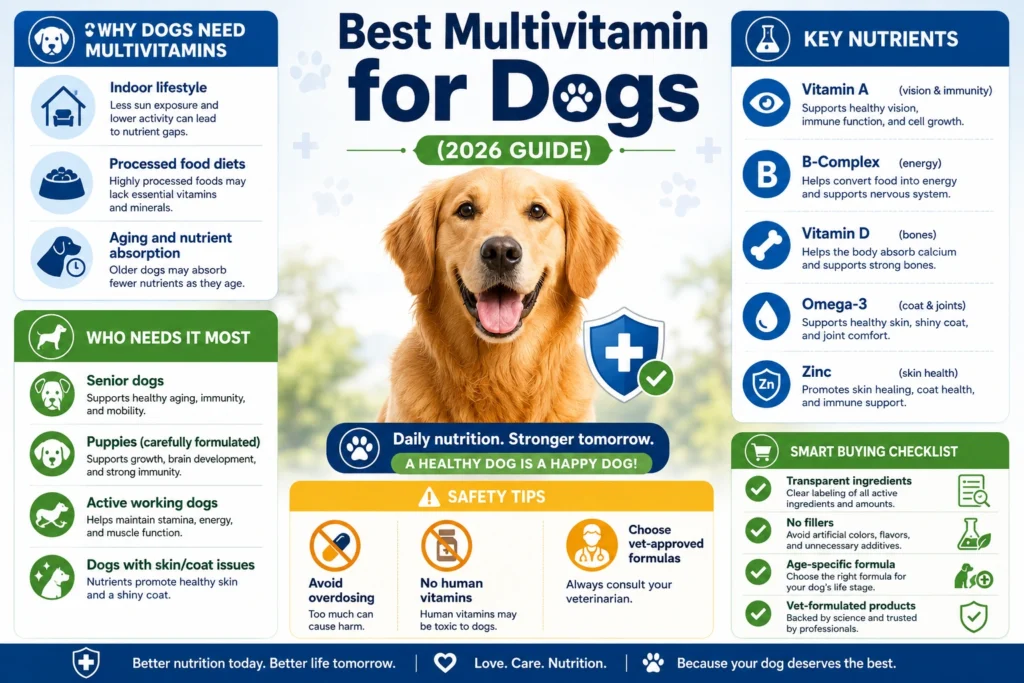
Vitamin A supports vision, skin condition, and immune function. It is important, but too much can be harmful.
B-complex vitamins support energy production, nervous system function, metabolism, and general cellular activity. These vitamins are especially useful in formulas that aim to support vitality and everyday resilience.
Vitamin D plays an important role in calcium regulation and bone health. It must be used carefully because both too little and too much can be problematic.
Vitamin E functions as an antioxidant and helps support skin, coat, and cellular protection.
Key Minerals
Zinc contributes to skin repair, coat quality, wound healing, and immune support.
Iron supports oxygen transport through the bloodstream and overall vitality. It should only be included at appropriate levels because excess iron is not harmless.
Magnesium supports muscle and nerve activity, along with multiple basic metabolic processes.
Supportive Nutrients
Omega-3 fatty acids are often valued for skin, coat, joint comfort, and inflammatory balance.
Glucosamine is commonly included in supplements for joint support, especially for older or larger dogs.
Probiotics may support digestive comfort and help promote healthy gut balance in some dogs.
A strong formula may include a few carefully selected supportive ingredients, but it should not overload the dog with everything at once. Better supplements tend to be focused and purposeful rather than crowded and trendy.
Dog Vitamin Function Breakdown
| Nutrient | Main Benefit | Possible Deficiency Signs |
| Vitamin A | Supports vision and immunity | Poor night vision, weakened defenses |
| B-Complex | Supports energy and metabolism | Fatigue, low appetite, weakness |
| Vitamin D | Supports bone strength | Bone weakness, poor mineral balance |
| Vitamin E | Supports skin and antioxidant protection | Dry skin, poor coat condition |
| Omega-3 | Supports joints and coat quality | Shedding, stiffness, dull coat |
| Zinc | Supports skin repair and healing | Hair loss, slow skin recovery |
This table is useful because it helps owners understand the purpose of each nutrient without assuming that more is always better. A supplement is only helpful if its ingredients are relevant to the dog’s actual needs.
Best Multivitamin for Dogs by Category
Different dogs need different forms of support. A puppy is not the same as a senior. A couch companion is not the same as a working breed. A dog with a sensitive stomach is not the same as a highly active sporting dog. When choosing a product, the life stage and lifestyle matter just as much as the ingredient list.
Puppies
Puppies are growing rapidly, so their nutrition must be handled carefully. They need balanced support for development, but they do not need strong adult formulas that could throw off the delicate relationship between nutrients like calcium and phosphorus. Puppy formulas should be gentle, clearly labeled, and designed specifically for growth.
Owners sometimes make the mistake of assuming that a puppy needs “extra” nutrition simply because it is growing. In reality, puppies need balance more than intensity. Over-supplementation can be risky during development, so only puppy-specific products should be used when supplements are needed.
Adult Dogs
Adult dogs typically benefit from general wellness support, maintenance of coat and skin quality, immune balance, and steady metabolic function. For this group, the best multivitamin for dogs usually focuses on maintaining health rather than aggressively correcting major issues.
These formulas are often appropriate for family dogs, city dogs, moderate-energy breeds, and dogs that need a little extra nutritional support without specialized heavy-duty ingredients.
Senior Dogs
Senior dogs are one of the most obvious groups that may benefit from a well-chosen supplement. As dogs age, they may experience slower recovery, reduced absorption, more visible joint stiffness, lower activity, and changes in skin or coat quality. A senior-focused formula may include joint support, antioxidants, and nutrients that help support overall mobility and resilience.
Skin and Coat Problem Dogs
Some dogs struggle with dry skin, seasonal shedding, irritation, or coat dullness. These dogs may benefit from support that includes omega fatty acids, Vitamin E, and zinc. While supplements are not magic, they can be part of a broader plan that also includes grooming, diet review, hydration, and environmental management.
Working and Performance Dogs
Dogs that run, train, hunt, herd, pull, or otherwise work hard often need more recovery support than average. Their joints, muscles, and metabolic systems are under greater strain. A high-quality multivitamin for these dogs may emphasize recovery support, endurance assistance, and ingredients that help maintain healthy tissue function over time.
Dangerous Ingredients to Avoid
Not all supplements are created with the same level of care. A dog owner should read labels carefully and avoid formulas that rely on unnecessary additives or unclear ingredient structures.
Artificial Colors
Artificial coloring agents may make the product look more appealing to humans, but they do not improve the supplement’s value for a dog. Products that rely on bright, unnecessary colors may be prioritizing marketing over quality.
BHA and BHT
Some preservatives can raise concerns for owners who want cleaner, more transparent formulas. It is usually smarter to choose supplements with simpler, more recognizable preservation systems.
Excess Fillers
A supplement should not be built around corn, soy, wheat, or low-value filler ingredients that take up space without adding meaningful nutrition. Filler-heavy formulas can make it harder to see what the product is really delivering.
Proprietary Blends Without Transparency
One of the biggest red flags is a product that hides its dosing behind vague blend language. If a company will not clearly tell you how much of each ingredient is included, that makes it harder to judge whether the supplement is actually useful or safe.
The ideal product is transparent. It should clearly identify ingredients, amounts, intended use, and age suitability. Simplicity and honesty are usually better than flashy packaging.
Can You Overdose a Dog on Vitamins?
Yes, and this is one of the most important reasons to avoid casual supplementation. Vitamins are not harmless just because they are “natural.” Some nutrients accumulate in the body. Others can become dangerous when given in excessive amounts.
Why Overdosing Happens
Overdose can occur when a dog receives too many supplements at once, eats a product designed for a much larger animal, consumes human vitamins, or is given a formula without proper weight-based adjustment. Sometimes owners assume that if a little is good, more must be better. With vitamins, that logic can be dangerous.
Possible Toxic Effects
Too much vitamin A can lead to bone problems and other complications.
Too much vitamin D can affect calcium balance and may become especially dangerous for the kidneys.
So too much iron can damage organs.
Excess calcium can create growth and skeletal problems in puppies.
This is why weight, age, life stage, and diet all matter. A good supplement should be used with thought, not guesswork.
Safe Dosage Guidelines
Dosage should always be based on the product label and, when possible, veterinarian guidance. A broad rule of thumb is that smaller dogs usually need lower-dose products, while larger dogs may require formulas made for bigger breeds or higher body weights.
| Dog Weight | General Dosage Approach |
| 1–10 kg | Low-dose chew or small-breed formula |
| 10–25 kg | Standard formula |
| 25–40 kg | Medium-strength support |
| 40+ kg | Larger-breed or breed-appropriate formula |
This table is not a substitute for label instructions. It is simply a practical way to think about sizing. The best supplement for one dog can be too weak for another and too strong for a third.
Natural Alternatives to Dog Multivitamins
Sometimes the best approach is not a supplement-first strategy. Real food can provide valuable nutrients when it is used appropriately and safely.
Eggs
Eggs are a good source of protein and several useful nutrients. They can contribute to overall dietary variety when prepared safely and fed in moderation.
Salmon Oil
Salmon oil is often used to support coat quality, skin comfort, and omega-3 intake. It can be a useful addition for dogs with dryness or dull fur.
Liver
Liver is nutrient-dense and provides several vitamins and minerals. However, it must be fed carefully because organ meats can be too rich in excess amounts.
Pumpkin
Pumpkin is often used to support digestive regularity and can be useful for some dogs with mild stool issues.
Vegetables
Certain dog-safe vegetables can contribute antioxidants, fiber, and overall dietary diversity. They are not a replacement for proper nutrition, but they can complement a balanced plan.
The point of food-based support is not to eliminate supplements entirely. It is to remember that good nutrition begins with the bowl, not the bottle.
How to Choose the Best Multivitamin for Dogs
A smart buyer evaluates a supplement like a careful clinician, not like a shopper chasing the loudest advertisement.
Look for Vet-Formulated Products
A formula created with veterinary input is often more trustworthy than a supplement made purely for marketing appeal. Veterinary formulation does not guarantee perfection, but it does suggest the product was designed with canine health principles in mind.
Prefer Transparent Ingredients
The label should be clear, readable, and specific. You should be able to see what is inside, how much is included, and why it is there.
Choose Age and Breed Suitability
A supplement for a senior Labrador is not the same as a formula for a growing Chihuahua puppy. Products should match the dog’s size, age, and physiological needs.
Check for Safe Manufacturing Standards
Look for products that are made under credible quality controls and that follow recognized nutrition standards. Safety matters as much as content.
Choose Easy-to-Give Formats
Chews, tablets, powders, and liquids all have different advantages. Some dogs accept chews easily. Others prefer liquids mixed into food. The best format is the one your dog will reliably take without stress.
Avoid Unnecessary Additives
The cleaner the formula, the easier it is to understand what the product is doing. Supplements that rely on excessive coloring, flavoring, or filler material are often less appealing from a quality perspective.
Expert Tip: Why Location and Lifestyle Matter
A dog’s environment affects its nutritional context. In colder climates, dogs may experience more dry skin and coat issues. So, in urban environments, many dogs spend a great deal of time indoors, which can influence activity patterns, sunlight exposure, and overall wellness. In regions with long indoor seasons or limited outdoor daylight, owners often become more attentive to vitamins and coat-supporting nutrients.
That does not mean every dog in every city needs a supplement. It means lifestyle should be part of the decision. The best multivitamin for dogs is the one that responds to real-world conditions rather than abstract theory.
Pros and Cons of Dog Multivitamins
Pros
A well-chosen multivitamin can support overall health, help maintain coat quality, assist older dogs with mobility-related needs, fill small nutritional gaps, and support immune resilience. For some dogs, the benefits can be meaningful and visible.
Cons
The same supplement can also create risk if used carelessly. Overuse, poor-quality formulas, misleading labels, and unnecessary supplementation can all cause problems. Supplements also vary widely in quality, which means the brand matters a lot. Some formulas are genuinely useful. Others are little more than expensive treats.
Common Dog Owner Mistakes
Many problems happen not because multivitamins are bad, but because they are used in the wrong way.
One common mistake is giving human vitamins to dogs. Human products may contain ingredients, doses, or sweeteners that are not safe for canine use.
Another mistake is supplementing “just in case” without identifying a real need. That often leads to cluttered routines and unnecessary expense.
A third mistake is ignoring veterinary advice. Supplements should not replace professional judgment when a dog has medical issues.
Some owners also choose the cheapest product available, assuming all multivitamins are basically the same. They are not. Cheap formulas may cut corners on ingredient quality, transparency, or manufacturing standards.
Finally, many people forget to adjust dosing according to the dog’s weight, age, and existing diet. That oversight can reduce the product’s usefulness or create avoidable risk.
Expert Veterinary Tips for Safe Supplement Use
A cautious, practical approach usually works best.
Begin by reviewing the dog’s current diet rather than immediately adding a supplement. If the food already does a good job and the dog appears healthy, a multivitamin may not be necessary.
Start with the recommended amount only, and never exceed the label unless a veterinarian specifically instructs otherwise. In some cases, a gradual introduction can make it easier to monitor tolerance.
Watch for changes in stool quality, skin condition, coat appearance, appetite, and energy. These signs can help you understand whether the product is helpful or not.
Reassess the supplement every few months. A dog’s needs can change over time, especially with aging, seasonal changes, or diet updates.
The most effective supplementation strategy is simple: use it only when it makes sense, choose quality over hype, and always keep the dog’s main diet at the center of the plan.
Real-Life European Scenarios
Urban Apartment Dogs
Dogs living in apartments often have lower daily activity and spend more time indoors. They may benefit from mild nutritional support if their diet is not ideal or if they show coat, energy, or mobility concerns.
Cold Climate Dogs
Dogs in colder regions may experience dry skin or coat stress more often. Omega-3 support and skin-friendly nutrients can be useful in such conditions, especially during harsher seasons.
Working Dogs
Working dogs tend to have higher physical demands, faster nutrient turnover, and a greater need for recovery support. They may do better with a supplement that supports joints, muscles, and general resilience.
These are examples, not universal rules. The right supplement always depends on the individual dog, not just the region.
People Also Ask
No, only dogs with specific dietary, age-related, or health-related needs are likely to benefit from them.
No, human vitamins can be unsafe or toxic for dogs and should not be used without veterinary instruction.
In many cases, owners may notice changes in about 3–6 weeks, though the timeline depends on the dog and the reason for supplementation.
Yes, but only when they are puppy-specific and used with careful attention to growth needs and dosing.
Usually, with meals, because food can help improve tolerance and absorption for many supplements.
Yes, especially formulas that include omega-3 fatty acids and zinc, though shedding can also have many other causes.
Yes, that is always the safest and most responsible approach, especially if your dog has any health conditions or is already taking other supplements.
Conclusion
The best Multivitamin for dogs is never a one-size-fits-all product. It should match the dog’s age, breed, body size, diet, activity level, and health status. A well-designed supplement can be a helpful nutritional support tool, but it should not be treated as a cure-all or a substitute for balanced feeding.
Healthy dogs eating a high-quality diet may not need multivitamins at all. Senior dogs, working dogs, dogs on homemade diets, and dogs with specific skin, coat, joint, or recovery concerns may benefit much more. In every case, the smartest approach is to focus on quality, safety, and necessity rather than on marketing claims or oversized ingredient lists.
The best dog owners look for real nutritional gaps before adding anything extra. They choose transparent formulas, avoid overuse, respect dosage guidance, and use supplementation only when it has a clear purpose. That kind of careful decision-making often leads to better energy, improved coat condition, stronger resilience, and a more confident long-term wellness routine for the dog.
A supplement should support good nutrition, not complicate it. When chosen wisely, the right multivitamin can become a useful part of a broader health plan that helps dogs stay active, comfortable, and well cared for throughout life.