
Can Dogs Eat Cucumbers? — Vet-Approved Safety Guide & Surprising Truths
Can Dogs Eat Cucumbers? Many dog owners worry if this crunchy snack is safe or secretly harmful. This guide clears confusion with vet-approved facts, safe feeding tips, and hidden risks. You’ll learn how much is safe, the benefits for dogs, and surprising truths that most pet owners don’t know today. You are in the kitchen, cutting a fresh Cucumber for a salad, and your dog is already there before the first slice even hits the board.
No barking. No jumping. Just that quiet, intense stare.
It is the kind of stare that says, very clearly, “That belongs to me too, right?”
And right then, the question lands in your mind:
Can dogs eat cucumbers safely, or is this another human snack that should stay off the dog menu?
For many dog owners across Europe, this is no longer a random curiosity. It is part of a bigger shift in how people feed their pets. Owners in the UK, Germany, the Netherlands, Sweden, France, Spain, Italy, and beyond are paying more attention to low-calorie treats, cleaner ingredients, and everyday foods that fit into a healthier lifestyle.
Are Cucumbers Safe for Dogs or Risky Treats?
That makes sense. Pet obesity is a growing concern, and many dog parents now look for light, refreshing snacks that feel better than processed treats full of salt, sugar, or artificial extras. Cucumbers often enter the conversation because they are cheap, easy to find, and naturally hydrating.
But the real answer is not simply “yes” or “no.”
The truth is more useful than that:
Yes, cucumbers are generally safe for dogs.
But safe feeding depends on preparation, portion size, dog size, and your dog’s individual digestion.
That matters.
A cucumber itself is not the problem. The problem is usually how it is served, how much is offered, and whether it is mixed with seasoning, pickling brine, or overly large pieces that create a choking risk.
This guide breaks the topic down in plain English, with practical advice you can actually use. You will learn what cucumbers do and do not offer, how to feed them safely, how much is enough, which dogs need extra caution, and when cucumbers should stay out of the bowl entirely.
If you want a simple answer first, here it is:
Cucumbers can be a safe, low-calorie treat for dogs when served fresh, plain, and in sensible portions.
Now let’s go deeper.
Can Dogs Eat Cucumbers?
Short Answer: Yes, Dogs Can Eat Cucumbers
Dogs can eat cucumbers safely in most cases, provided the cucumber is:
Fresh
Raw
Thoroughly washed
Cut into small pieces
Free from salt, vinegar, oil, spices, garlic, onion, or other seasoning
This matters because the cucumber itself is mild and non-toxic, while the unsafe parts usually come from human preparation habits. A plain cucumber slice is very different from a pickle, a marinated cucumber salad, or a seasoned dish from the dinner table.
Cucumbers are made up of roughly 95% water, which makes them one of the most refreshing snack options you can offer a dog, especially in warmer weather or after exercise. They are also naturally low in calories, which is one of the biggest reasons they are popular with owners of overweight dogs or dogs on weight-management plans.
But there is an important nuance here.
A food can be safe and still not be ideal in every situation. That is true for cucumbers, too. They are not toxic. They are not dangerous by nature. Yet they still need moderation, because too much of even a harmless food can create digestive upset.
So the best way to think about cucumbers is this:
Cucumbers are safe as a treat, not a meal replacement.
Why Cucumbers Appeal to Dog Owners
There is a reason cucumbers keep showing up in conversations about pet nutrition. They fit many of the things dog owners are trying to do right now.
They are:
Light
Crunchy
Hydrating
Affordable
Easy to prepare
Available almost everywhere
Low in fat
Low in calories
That combination is attractive, especially for owners who want to reward their dog without adding unnecessary calories.
A lot of dog snacks are either too rich, too processed, or too dense. Cucumbers feel different. They are simple. They do not look like “treat food” in the traditional sense, but they still feel special to dogs because of the texture, the freshness, and the crunch.
That crunch also matters psychologically for owners. When people hear “healthy snack,” they often want something that feels clean and natural. Cucumbers match that image. They look like wellness food, and in many cases, they behave like it, too.
But “healthy-looking” is not the same thing as “healthy in every way.”
That is why proper portioning is the key.
Nutritional Value of Cucumbers for Dogs
Cucumbers are not a superfood in the dramatic sense people sometimes imagine, but they do offer a few useful nutritional properties. They are best understood as a light supplemental snack rather than a major nutrient source.
Key Nutrients in Cucumbers
| Nutrient | What It May Support in Dogs |
| Water | Hydration support |
| Vitamin K | Normal blood clotting and bone health |
| Vitamin C | Antioxidant support and immune function |
| Potassium | Muscle and nerve function |
| Magnesium | Muscle and nerve activity |
| Fiber | Gentle digestive support in small amounts |
What makes cucumbers stand out is not one dramatic nutrient, but their overall profile. They are light, fresh, and easy on calories. That is especially useful for dogs that need to reduce weight or maintain a slimmer body condition.
They can also be a more thoughtful treat option when compared with biscuits, fatty leftovers, cheese, or heavily processed snacks.
Why Vets Often Approve Cucumbers as a Snack
Veterinary professionals often support cucumbers as an occasional treat because they are:
Low in fat
Low in sugar
Low in calories
Hydrating
Easy to portion
Generally well-tolerated by many dogs
That does not mean every vet will recommend cucumbers for every dog in every situation. It simply means the food itself is broadly compatible with dog-safe feeding habits when used correctly.
If your dog is on a special diet, has a sensitive stomach, or has a medical issue such as recurrent digestive upset, then the safest approach is still to treat cucumbers as an optional extra, not a routine dietary feature.
Are Cucumbers Safe for All Dogs?
The Short Truth: Usually Yes, But Not Always in the Same Way
Most dogs can eat cucumbers safely, but not every Dog should be given them in the same amount, shape, or frequency.
Some dogs need more caution because of age, size, dental health, chewing style, or stomach sensitivity.
1. Small Dogs
Breeds such as Chihuahuas, Yorkshire Terriers, Pomeranians, Miniature Dachshunds, and similar small dogs are more vulnerable to choking hazards because their throats are narrower and their mouths are smaller.
For them, a cucumber slice that looks harmless to a larger dog may actually be a problem.
Best approach:
Cut the cucumber into tiny cubes or thin slivers. Keep pieces soft and manageable. Avoid large rounds or thick chunks.
2. Puppies
Puppies have developing digestive systems. Their stomachs are still learning how to handle different foods, and they can react more quickly to new ingredients.
That does not mean puppies cannot eat a cucumber. It means the introduction should be slow and controlled.
Best approach:
Offer only a tiny amount the first time. Watch for loose stool, stomach gurgling, gas, or refusal to eat later. Keep the first servings small enough to test tolerance.
3. Senior Dogs
Older dogs may have slower digestion, weaker teeth, missing teeth, or more sensitive gastrointestinal systems.
Even a simple snack can feel heavier to them than it does to a younger dog.
Best approach:
Use smaller portions and softer pieces. If your senior dog has trouble chewing, try lightly mashing the cucumber or cutting it into very fine pieces.
4. Dogs With Sensitive Stomachs
Some dogs are naturally more reactive to new foods. They may develop gas, loose stool, or mild digestive discomfort from even a modest serving.
Best approach:
Introduce cucumber slowly and only by itself, not alongside several new foods at once. That makes it easier to identify what caused any reaction.
5. Dogs With Diabetes or Weight Issues
Cucumbers can be useful for dogs that need lower-calorie treats, especially when owners are trying to reduce snack calories. Still, every dog with a medical condition should have its diet reviewed by a vet.
Best approach:
Use cucumber sparingly and treat it as part of the dog’s overall calorie plan.
Can Puppies Eat Cucumbers?
Yes, But Careful Introduction Matters
Puppies can eat cucumbers if they are introduced properly and in very small amounts.
Puppy feeding is always about gentleness and observation. Their digestive systems are still adapting, and even foods that are perfectly safe for adult dogs can be too much for a puppy if the quantity is large.
Safe Feeding Rules for Puppies
Start with one or two tiny pieces
Offer plain cucumber only
Use bite-sized portions, never large chunks
Watch the stool for the next 24 hours
Keep the first serving small enough to test tolerance
What to Avoid for Puppies
Frozen large pieces
Seasoned cucumber
Pickles
Thick slices
Feeding too much too soon
Giving a cucumber as a replacement for proper puppy food
Why Puppies Need Extra Care
Puppies are not mini adult Dogs. Their growth stage makes them more sensitive to abrupt dietary changes. A new snack should never overwhelm their developing system.
A tiny sample is enough for the first introduction. If the puppy tolerates it well, the cucumber can remain a small occasional treat later on.
Cucumber Skin and Seeds: Safe or Not?
This is one of the most practical questions dog owners ask, because many people do not want to peel or deseed a cucumber unless it is necessary.
Cucumber Skin
Cucumber skin is generally safe for dogs.
It can also provide a bit of extra fiber. However, the skin is slightly tougher than the flesh, which means it may be harder for some dogs to digest, especially small dogs or dogs with delicate stomachs.
Good rule of thumb:
For tiny dogs, older dogs, or dogs with digestive sensitivity, peeling the cucumber is often the wiser choice.
Cucumber Seeds
Cucumber seeds are not toxic. In small quantities, they are usually fine.
However, some dogs may experience mild gas or stomach discomfort if they eat a lot of seeds, especially if the cucumber is very large or the dog has a sensitive digestive tract.
Practical advice:
Seeds are usually not a problem in moderate amounts, but if your dog tends to be gassy or easily upset, removing them can help make the snack gentler.
Best Practice
Wash cucumbers well
Peel if your dog is small or sensitive
Remove excess seeds if needed
Cut into manageable pieces
This is a simple preparation routine that reduces risk without making the snack complicated.
Frozen Cucumber for Dogs: Helpful Summer Snack or Hidden Problem?
Frozen cucumber can be a clever summer idea, especially in hotter European climates, where dogs may need extra hydration support. A cold cucumber piece can feel refreshing and soothing on warm days.
That said, frozen food is not automatically ideal for every dog.
Benefits of Frozen Cucumber
Can feel cooling in warm weather
May help with hydration
Can be a low-calorie enrichment snack
May soothe teething puppies in small amounts
Important Warning
Do not give large frozen cucumber chunks. Hard frozen pieces can be uncomfortable for teeth and may increase choking risk if your dog tries to swallow them too quickly.
Best Way to Serve Frozen Cucumber
Freeze very small slices
Offer only a small number at a time
Let the piece soften a little if your dog bites aggressively
Supervise while eating
Frozen cucumber is best treated as a summer treat, not a daily habit. It should be safe, simple, and small enough to chew comfortably.
How Much Cucumber Can Dogs Eat?
The main rule to remember is the 10% treat rule.
That means treats of any kind should make up no more than about 10% of a dog’s daily calorie intake. Cucumbers are low in calories, so they usually fit within that limit quite easily. Still, quantity matters.
Feeding Guide by Dog Size
| Dog Size | Suggested Amount |
| Small dogs (up to 10 kg) | 1–2 small slices |
| Medium dogs (10–25 kg) | 3–5 slices |
| Large dogs (25 kg+) | 5–10 slices |
These numbers are general starting points, not fixed rules. A very active large dog may tolerate slightly more, while a small or sensitive dog may need less.
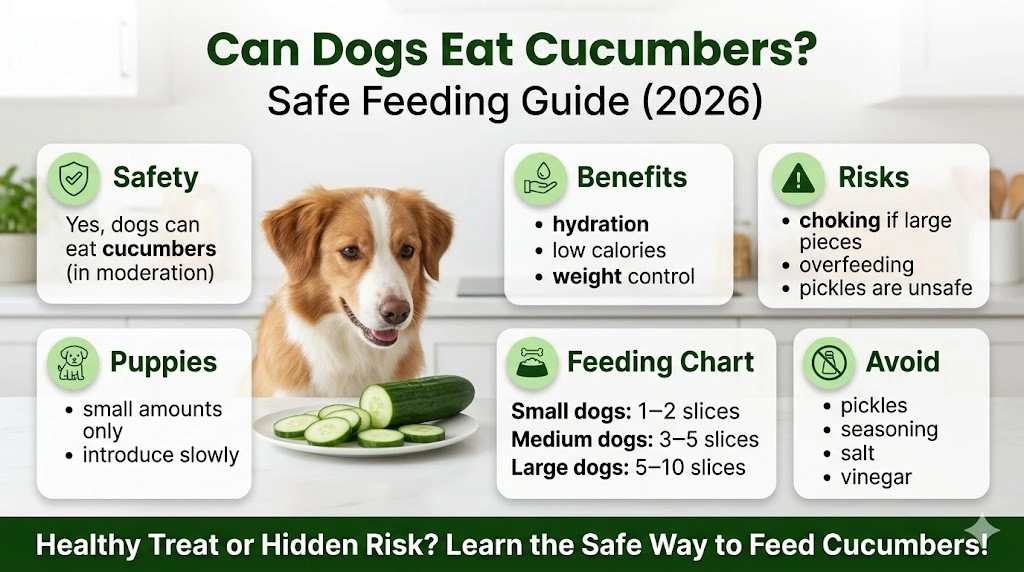
Discover vet-approved feeding tips, benefits, risks, and portion guide in this simple infographic every dog owner should know in 2026.
Why Overfeeding Happens
Many owners assume that because a cucumber is healthy, there is no real downside to adding more. But even low-calorie foods can create problems when the quantity becomes too large.
Signs You Gave Too Much
Loose stool
Gas
Mild bloating
Stomach gurgling
Reduced appetite later
General digestive discomfort
If this happens, reduce the amount next time and give the digestive system time to settle.
Can Dogs Eat Pickles?
No, Pickles Should Be Avoided
This is one of the most important distinctions in the entire topic.
A cucumber is not the same as a pickle.
Pickles are usually preserved in vinegar, salt, and spices. Some recipes also contain garlic, onion, chili, or other ingredients that are bad for dogs. Even when the ingredients look simple, the salt content alone is usually too much for canine digestion.
Why Pickles Are Unsafe
High sodium levels
Vinegar and acid
Possible garlic or onion
Seasonings and preservatives
Potential stomach irritation
What About Low-Salt Pickles?
Even “low salt” versions are not a safe replacement for plain cucumber. They still tend to contain ingredients that are not suitable for dogs.
Clear Rule
Fresh cucumber is okay. Pickles are not.
That distinction is easy to remember and very useful in everyday life.
Cucumber vs Other Dog-Safe Vegetables
Cucumber is not the only vegetable dogs can eat, but it has a few unique strengths.
| Vegetable | Calories | Hydration | Safety | Common Best Use |
| Cucumber | Very low | Very high | Excellent | Light hydration snack |
| Carrot | Low to medium | Medium | Excellent | Crunchy chewing snack |
| Celery | Low | High | Good | Fiber support and crunch |
| Zucchini | Low | High | Excellent | Gentle vegetable snack |
What Makes Cucumber Special
Cucumber stands out because it is one of the most water-rich snack options and one of the easiest to keep low in calories. That combination is attractive for overweight dogs and for owners who want a refreshing treat during warm weather.
When Another Vegetable May Be Better
Carrots are often better for chewing satisfaction.
Celery may be useful in very small amounts for some dogs.
Zucchini can be easy on the stomach for many dogs.
So, cucumber is not “the best” in every category. It is simply one of the easiest, lightest, and most hydration-friendly options.
Health Risks and Side Effects
Cucumbers are generally safe, but safe does not mean consequence-free in every case.
Possible Side Effects
Mild stomach upset
Gas
Loose stool
Choking if pieces are too large
Teeth discomfort if frozen chunks are too hard
Reduced appetite if too much is fed before a meal
Why do these problems happen
Usually, the issue is not the cucumber itself. It is the amount, the size of the pieces, or the dog’s individual sensitivity.
For example, a dog that eats half a cucumber quickly may feel fine at first, then develop gas or loose stool later. Another dog may swallow a chunk that is too large and struggle to chew it properly.
When to Be Extra Careful
If your dog has a history of digestive issues, food sensitivities, swallowing problems, or dental trouble, introduce cucumber more cautiously.
Real-Life Scenarios in Europe
One reason this topic is so practical is that dog owners often think about snacks in the context of their normal lifestyle, season, and local climate.
1. Apartment Dogs in the UK, Germany, and the Netherlands
Dogs that live in apartments or urban settings sometimes get fewer opportunities for vigorous exercise. For them, low-calorie treats matter more because daily movement may not be enough to offset frequent snacks.
Cucumber can be a smart reward for training or a small in-between treat without adding much to the calorie load.
2. Cold Regions Like Sweden and Finland
In colder months, hydration needs may look different from summer, and dogs may not crave refreshing snacks as much. In these settings, cucumber can still be useful, but usually more as an occasional treat than a frequent one.
3. Mediterranean Countries Like Spain, Italy, and Greece
In hot weather, a cucumber can become more appealing because it feels cool, light, and watery.
Frozen cucumber slices, given carefully, can be a smart seasonal snack as long as the pieces are small and safe to chew.
These practical differences matter because feeding habits are often shaped by climate and routine. A treat that makes sense in July may not make the same amount of sense in January.
Common Mistakes Dog Owners Make
Even with a simple food like a cucumber, people still make avoidable mistakes.
Mistake 1: Feeding Large Chunks
Large pieces increase choking risk, especially for small dogs.
Mistake 2: Giving Pickles Instead of a Plain Cucumber
This is the biggest mistake. Pickles are processed, salty, and often seasoned in ways that dogs should not eat.
Mistake 3: Assuming “Healthy” Means Unlimited
Healthy foods can still cause trouble if overfed.
Mistake 4: Not Washing the Cucumber
Because cucumbers may carry dirt, wax, or residues from handling and transport, washing is a sensible habit.
Mistake 5: Using Cucumber as a Meal Replacement
Cucumber is not a replacement for balanced dog food. It is a snack, not a complete diet.
Mistake 6: Feeding Too Fast
Some dogs gulp treats quickly. When that happens, even safe foods can become choking hazards if the pieces are too large.
Pros and Cons of Cucumbers for Dogs
Pros
Very low in calories
High water content
Useful for hot weather
Can support weight management
Easy to prepare
Widely available
Usually well tolerated
Cons
Not nutritionally essential
Can cause gas or loose stool if overfed
Can be a choking hazard if cut badly
Not suitable as a replacement for balanced meals
Pickled versions are unsafe
A balanced perspective helps. Cucumbers are useful, but they are not magic. They are simply a clean, light snack option when used sensibly.
Can Dogs Eat Cucumbers Every Day?
Yes, in small amounts, some dogs can eat cucumber daily as part of their treat rotation.
But daily does not mean unlimited.
If a cucumber becomes a frequent snack, keep the quantity small and consistent. The main goal is to avoid unnecessary digestive stress or calorie creep.
A Good Daily Rule
A few tiny Cucumber pieces as a treat is generally more sensible than a large bowl of cucumber. The smaller the serving, the lower the chance of problems.
When Daily Feeding Might Not Be Ideal
If your dog already gets several treats per day
If your dog has a sensitive stomach
If your dog has had gas or loose stool from a cucumber before
If your dog is on a vet-specific nutrition plan
Are Cucumbers Good for Overweight Dogs?
Yes, They Can Be a Smart Low-Calorie Treat
This is one of the most common reasons people search for cucumber safety in the first place.
For dogs that need to lose weight or maintain a healthier body condition, a cucumber can be a useful snack because it offers volume, crunch, and freshness without many calories.
That means your dog can still feel rewarded without taking in a heavy treat.
Important Note
Weight management is not just about substituting one snack for another. It is about the dog’s full intake, exercise, meal balance, and long-term routine.
Cucumber can help with the treat part of the plan, but it is only one small piece of the bigger picture.
Can Cucumber Help With Dehydration?
It Can Support Hydration, But It Cannot Replace Water
Because cucumber is mostly water, it can contribute to hydration. That is useful on warm days or after moderate activity.
However, a cucumber should never be treated as a substitute for clean drinking water.
Dogs should always have access to fresh water. Cucumber is simply a supplemental source of moisture, not the main hydration system.
Can Dogs Eat Cucumber Skin?
Yes, Usually, But Peel It for Small or Sensitive Dogs
Cucumber skin is generally safe and adds some extra fiber. But the texture can be a bit tougher for some dogs, especially small dogs and dogs with digestive sensitivity.
If your dog is tiny, elderly, or prone to stomach upset, peeling the cucumber may make it easier to digest.
Can Dogs Eat Cucumber Seeds?
Yes, In Moderation
The seeds are not toxic. In most dogs, they are harmless in normal serving sizes.
Still, dogs with sensitive digestion might react with mild gas if they eat a lot of cucumber seeds. If that happens, try removing some of the seeds and see whether the snack becomes easier on the stomach.
Best Way to Prepare Cucumbers for Dogs
A safe cucumber snack is easy to make.
Wash the cucumber well
Cut off the ends if you prefer
Peel if your dog is small or sensitive
Remove some seeds if needed
Slice into bite-sized pieces
Serve plain and fresh
That is the whole process.
No salt.
No vinegar.
No seasoning.
No butter.
No dressing.
Simple is best.
Signs Your Dog Enjoys Cucumber Safely
Some dogs take to cucumber right away. Others are indifferent. That is normal.
Signs of good tolerance include:
No vomiting
No loose stool
Normal appetite after eating
No bloating or gas
Happy chewing and interest in the snack
If your dog handles a cucumber well, it can stay in the rotation as a light treat.
When to Stop Feeding Cucumber
Stop and reduce the snack if you notice:
Loose stool
Repeated gas
Vomiting
Itchy reaction after feeding
Unusual lethargy
Choking or trouble chewing
Most dogs never have major issues with a cucumber. But any change in digestion or behavior should be taken seriously, especially if the symptoms appear after a new food introduction.
FAQs:
Yes, but only in small amounts as a treat. Daily cucumber is usually fine when portions stay modest, and the dog tolerates it well.
Yes. Cucumbers are a very low-calorie snack and can be a helpful option for dogs that need weight control.
Yes, cucumber skin is generally safe. For small dogs or sensitive dogs, peeling is often the easier option.
They can support hydration because they contain a lot of water, but they cannot replace clean drinking water.
Yes, puppies can eat cucumber in very small, soft pieces after weaning, provided it is introduced slowly.
It depends on the goal. Can Dogs Eat Cucumbers are lower in calories and better for hydration. Carrots are often better for chewing and dental-style treats.
Yes, in moderation. Seeds are not toxic, though some sensitive dogs may experience mild gas.
Too much cucumber may cause gas, loose stool, or mild stomach upset. If symptoms are severe or ongoing, contact a vet.
Conclusion:
Yes, dogs can eat Cucumbers safely in most cases, and they can be a very useful treat when served properly.
That is the key idea.
Cucumbers are light.
Cucumbers are refreshing.
Cucumbers are low in calories.
Cucumbers can fit nicely into a healthy treat routine.
But the safest rule is also the simplest one: