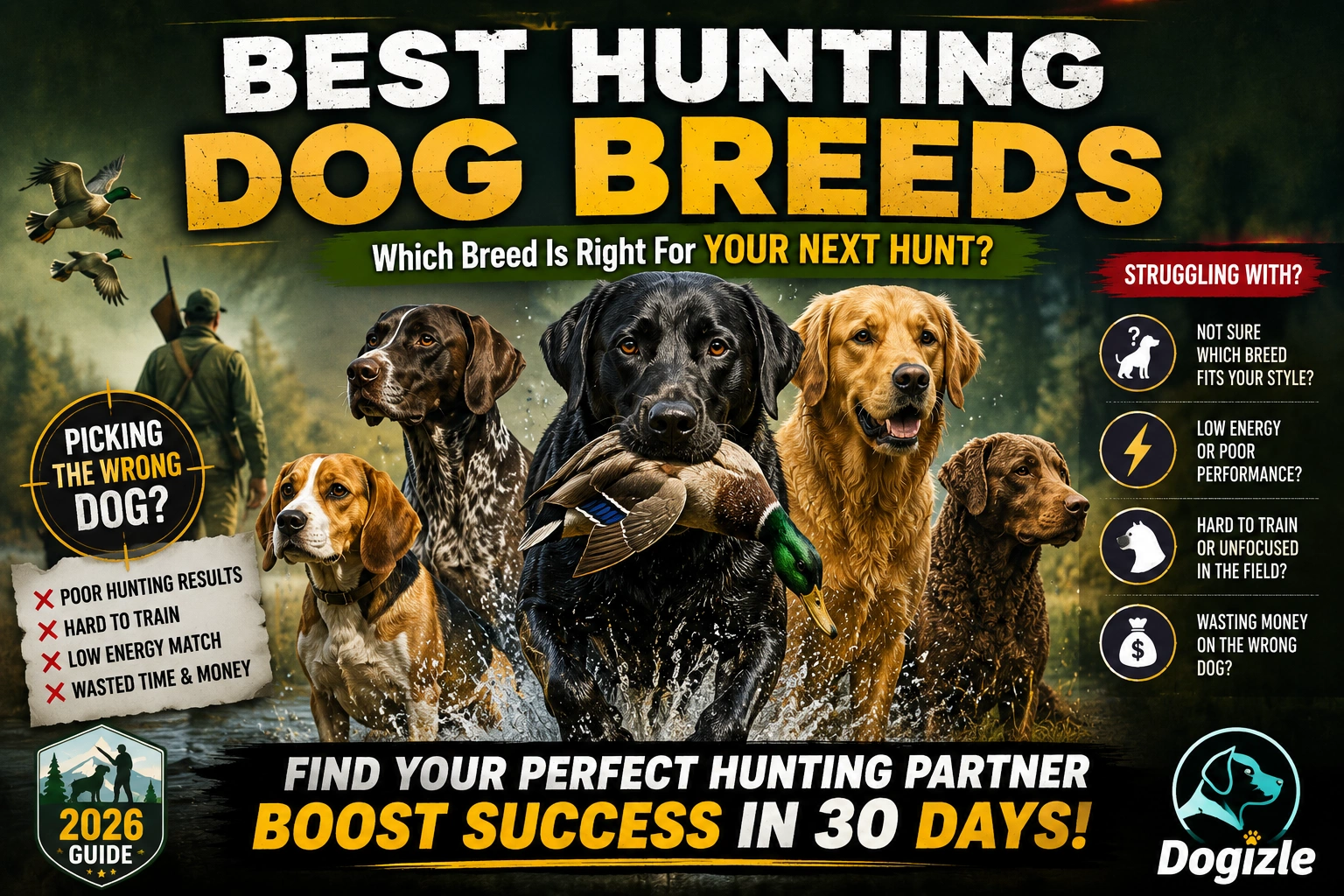
Best Hunting Dog Breeds: Top Picks & Expert Advice for Every Hunter
Choosing the best hunting dog Breeds is not about picking the most famous dog, the most attractive dog, or the breed that looks impressive in photos. It is about semantic fit: the right dog for the right purpose, in the right landscape, with the right training style, and the right level of handler experience. In practical terms, that means matching prey type, terrain, climate, and work style instead of relying on popularity alone. Official kennel organizations classify hunting breeds by function; the AKC’s Sporting Group includes retrievers, spaniels, pointers, and setters, while hounds are recognized for scenting and stamina, and The Kennel Club uses working tests to assess natural hunting, pointing, and retrieving ability.
That is the reason this guide is different. It is built like a strong content cluster: clear entity coverage, intent-based headings, practical comparisons, and decision-making guidance that helps a reader choose, not just browse. It also reflects responsible ownership, because a hunting dog is both a performance partner and a living animal with welfare needs. The British Veterinary Association emphasizes positive welfare outcomes, evidence-based decision-making, and responsible dog ownership, while FEDIAF highlights nutritious pet food and responsible pet care as central to pet wellbeing.
In this complete pillar guide, you will learn the top 15 hunting dog breeds, how to choose based on game type and terrain, which dogs tend to suit beginners versus advanced handlers, and what matters most for European hunters dealing with wet ground, dense forests, cold weather, and changing conditions. You will also get an FAQ section with the same questions preserved, so the article stays user-friendly and search-ready.
What Makes a Great Hunting Dog?
A great hunting dog is not simply energetic. It is a coordinated working animal with the instinct, nerve, structure, and trainability to perform under pressure. In semantic terms, the phrase “good hunting dog” covers several overlapping traits: prey drive, scent work, obedience, stamina, coat type, retrieval style, and task specialization. Sporting breeds are usually built around hunting, pointing, flushing, or retrieving, while hounds tend to be selected for scent tracking and persistence.
The strongest hunting dogs usually share five core traits.
First, they have a strong prey drive. That does not mean they are uncontrollable; it means they are naturally motivated to search, track, chase, and engage with game. Without that instinct, field work becomes slow, inconsistent, and frustrating.
Second, they have excellent scenting ability. Some breeds are built to follow a trail with laser-like focus. This matters in forests, fields, wetlands, and mixed terrain where scent can rise, scatter, or disappear depending on wind and moisture.
Third, they are trainable. Hunting is not a random activity. It is controlled work. A dog that ignores signals, breaks on command, or loses concentration under distraction will struggle in real hunts.
Fourth, they need endurance and stamina. Hunting can mean long walks, cold water, rough ground, and hours of waiting followed by sudden bursts of action. A dog must stay efficient, not just excited.
Fifth, specialization matters. Retrieving, pointing, flushing, and tracking are different jobs. Some breeds can do more than one, but every dog has its own natural strengths. A dog that excels in water retrieval may not be the same dog that thrives in thick brush or on a scent trail. The Kennel Club and AKC both organize and test dogs around these working functions because the job itself shapes the breed’s value.
For hunters in colder European regions, coat type matters too. Thick, insulating coats and water resistance are helpful when hunting in rain, marshes, snow, or freezing temperatures. That does not automatically make every long-coated dog a cold-weather specialist, but it does make climate matching a major part of the decision.
Types of Hunting Dogs Explained
Many articles skip this part, but this is where the real decision-making starts. If a reader understands the type of dog, the breed choice becomes much easier.
Retrievers
Retrievers are designed to bring back shot game, especially from water. They are common in duck hunting and waterfowl work because they usually combine a soft mouth, strong swimming ability, and solid cooperation with humans. The AKC Sporting Group description specifically notes that these dogs were developed to work closely with hunters in water and woods.
Pointers and Setters
Pointers and setters locate birds and indicate where the game is hiding. This is especially useful in open fields, upland areas, and bird hunting environments. They are often quick, alert, and wide-ranging, which helps them cover ground efficiently.
Hounds
Hounds are the scent specialists. They are built to follow a trail over distance, often with tremendous persistence. This is why they are often associated with deer, fox, rabbit, and raccoon hunting. Their endurance and nose work are the key advantages.
Spaniels
Spaniels are flushing dogs. They push birds or small game out of dense cover so the hunter can take the shot or continue the work. They are especially useful in forests, wetlands, thick brush, and tangled terrain where visibility is limited. The Kennel Club’s working gundog framework recognizes spaniels as a distinct working type with their own natural ability patterns.
15 Best Hunting Dog Breeds (Ranked & Reviewed)
This ranking is based on real-world Usefulness, versatility, learnability, climate fit, and how each breed tends to perform in field conditions. It is intentionally practical rather than purely show-ring driven.
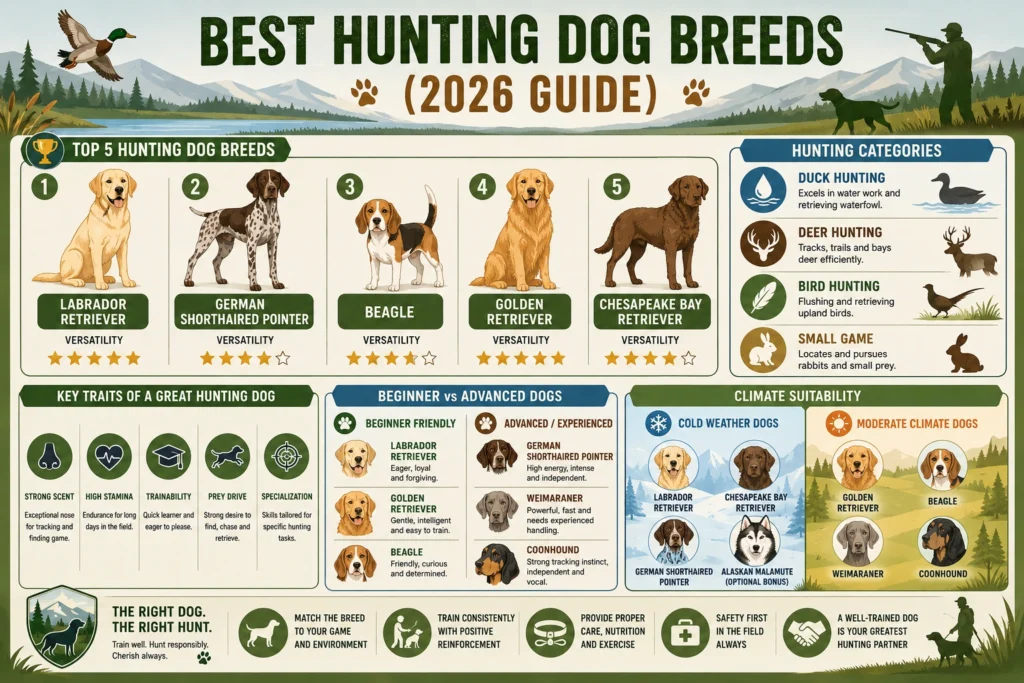
1. Labrador Retriever — Best Overall
If you want the safest all-around choice, the Labrador Retriever is the breed most people start with for a reason. It is highly trainable, steady in the field, and exceptionally strong in water retrieval. For duck hunting, this breed remains one of the most reliable options because it combines enthusiasm, intelligence, and a cooperative nature.
Labradors also fit well into family life, which matters for hunters who want one dog to do both field work and home companionship. Their balanced temperament makes them ideal for beginners, and their popularity is not an accident; it comes from years of consistent performance in hunting and retrieving roles. As a Sporting breed, the Labrador sits squarely inside the functional profile the kennel organizations associate with hunting work.
2. German Shorthaired Pointer — Most Versatile
The German Shorthaired Pointer is the “multi-tool” of hunting dogs. It can point, track, and retrieve, which makes it a strong choice for hunters who want flexibility. This breed is often recommended for experienced handlers because its energy level is high, its drive is intense, and its work style is fast.
In a field context, versatility is the main selling point. If your hunting style shifts between birds and mixed quarry, or if you want a dog that can adapt to different assignments, the GSP is one of the strongest options. It is also a breed that benefits from disciplined training and clear structure, because intelligence without direction can become restlessness.
3. Beagle — Best for Small Game
The Beagle is a classic scent hound for rabbits and hares. Its value lies in nose power, persistence, and manageable size. In forests and brushy areas, a Beagle can follow scent trails with remarkable determination. It is also a practical breed for hunters who prefer small-game work and want a dog that works well in packs.
Beagles are often chosen by beginners because they are friendly, hardy, and generally easier to live with than some high-octane field breeds. Their main strength is scent tracking, so they are not trying to be everything at once. That focus is exactly why they work so well for small game. The AKC’s Hound Group description highlights scent tracking and stamina as defining strengths across the group.
4. Golden Retriever — Best Bird Retrieval Partner
The Golden Retriever is one of the best choices for hunters who want a gentle, responsive, and highly trainable retrieving dog. It is excellent for bird retrieval and performs well in settings where calm handling matters. Like the Labrador, it is also a strong family companion, which makes it appealing for people who do not want a dog that is “all business” all the time.
Goldens are especially attractive to new hunters because they often learn quickly and respond well to positive reinforcement. Their strength is not aggression or raw force; it is consistency, intelligence, and willingness to cooperate.
5. English Springer Spaniel — Best Flushing Dog
The English Springer Spaniel is built for movement through dense terrain. This breed excels at flushing birds from cover, which makes it valuable in forests, hedgerows, marsh edges, and other tight environments. It is energetic, agile, and always ready to work.
This is a good dog for hunters who need action in thick cover rather than long-distance pursuit. The Springer is quick, compact, and highly alert. In the field, that often translates into efficient bird work with less wasted motion.
6. American Foxhound — Best for Deer Tracking
The American Foxhound is a scenting specialist with long-range stamina. It has the drive to follow a scent trail over a significant distance, which is why it is often associated with deer hunting and similar tracking work. If your priority is sustained trail work rather than close-range retrieval, this breed deserves attention.
Foxhounds are not usually the easiest dogs for beginners, because their independence and drive can be intense. But for a handler who understands scent work, this breed can be extremely effective.
7. Chesapeake Bay Retriever — Best for Cold Water
The Chesapeake Bay Retriever is built for hard conditions. It is one of the best options for cold-water work because it tends to be tough, powerful, and weather-resistant. Hunters who deal with rough water, wind, and low temperatures often appreciate the breed’s physical resilience.
This is not just a retriever for mild days. It is a working dog that thrives when the environment is demanding. That toughness makes it especially attractive in northern climates and for serious waterfowl work.
8. Pointer — Best for Upland Birds
The Pointer is fast, focused, and purpose-driven. Its job is to locate birds and hold point so the hunter can move in. It is especially useful in open fields and upland bird settings where the dog can range freely and cover ground efficiently.
Pointers are admired because they are elegant in motion and direct in purpose. They are not usually the easiest breed for a total beginner, but in the right hands, they can be outstanding field partners.
9. Irish Setter — Best for Wide Open Bird Country
The Irish Setter brings speed, endurance, and visual range to bird hunting. This breed tends to do especially well in open landscapes where it can work at a distance without obstacles getting in the way. It is known for style, energy, and stamina.
A good Irish Setter can be a joy in the field, but it usually needs structured training and regular exercise. Hunters who want a beautiful dog that also works hard will often find this breed appealing.
10. Weimaraner — Best for Strong-Driven Hunters
The Weimaraner is powerful, athletic, and serious about work. It is often chosen by experienced hunters who want a dog with a lot of drive and a willingness to stay active for long periods. This breed can handle demanding field work, but it usually needs an experienced hand.
The key phrase here is “high intensity.” Weimaraners are not low-maintenance leisure dogs. They are capable, focused workers who need direction, exercise, and a meaningful job.
11. Treeing Walker Coonhound — Best for Raccoon Work
The Treeing Walker Coonhound is a scent-driven hunting dog with a clear specialty: tracking and treeing raccoons. It is known for determination, voice, and persistence. If you want a dog that can follow scent with grit and keep pressure on game, this breed stands out.
Its loud baying is not a flaw in the hunting context; it is part of the job. In fact, it helps the hunter locate the dog and track the quarry’s movement.
12. Boykin Spaniel — Best for Wetlands and Boats
The Boykin Spaniel is compact, friendly, and especially useful in smaller spaces. It is an excellent fit for wetlands, boats, blinds, and tighter hunting setups. Hunters often appreciate the breed’s portability and cooperative attitude.
It is a dog that makes sense when the environment is cramped but still demanding. It can work hard without taking up too much room, which is a practical advantage many readers overlook.
13. Norwegian Elkhound — Best for Big Game in Cold Weather
The Norwegian Elkhound is a northern hunting breed with a thick coat, strong build, and brave temperament. It is a natural fit for colder climates and larger game pursuits. The FCI recognizes the Norwegian Elkhound in its Nordic Hunting Dogs section and notes that it is subject to a working trial in Nordic countries, which reflects its functional heritage.
For European hunters in cold regions, this breed is particularly relevant because it matches the climate as well as the quarry. It is a dog that feels at home when the weather is hard and the work is serious.
14. Brittany — Best Lightweight Bird Hunter
Brittany is fast, lightweight, and easy to train compared with many high-drive hunting dogs. It is popular with beginners who want a capable bird dog that does not feel overly intimidating. It performs well in upland bird situations and works well for hunters who value responsiveness.
This breed is often a smart compromise: energetic enough for hunting, manageable enough for everyday life, and versatile enough to stay useful in many field setups.
15. Irish Water Spaniel — Best for Water Retrieval
The Irish Water Spaniel is distinctive, clever, and highly suited to water work. Its curly coat offers protection, and its work style is well matched to retrieval in wet conditions. It is also one of the more unusual breeds on this list, which makes it memorable as well as functional.
For hunters who need a water-focused working dog with a different look and a strong job focus, this breed is a serious contender.
Best Hunting Dogs by Purpose
The easiest way to choose a hunting dog is to start with the job, not the breed.
Best Duck Hunting Dogs
For duck hunting, the strongest choices are the Labrador Retriever and Chesapeake Bay Retriever. Both are well-suited to water, cold conditions, and retrieving work. The Labrador is the easier all-around choice, while the Chesapeake is often preferred when the environment is harsher.
Best Deer Hunting Dogs
For deer tracking, scent hounds lead the list. The American Foxhound is a strong option for long-range scent work, and other hounds can also be effective depending on local conditions and traditions. Hounds are built around stamina and trail-following, which is exactly what deer hunting requires.
Best Bird Hunting Dogs
For birds, the strongest answers are German Shorthaired Pointer, English Springer Spaniel, Pointer, Golden Retriever, and Irish Setter. Pointers locate, spaniels flush, and retrievers bring game back. That division of labor is exactly why the Sporting Group is so important in kennel classification.
Best Small Game Hunting Dogs
For rabbits and hares, the Beagle is the classic answer. It has the scenting instincts, persistence, and practical size to work well in forests and brushy ground. In small-game hunting, nose and stamina often matter more than brute strength.
Best All-Around Hunting Dogs
For hunters who want broad versatility, the Labrador Retriever and German Shorthaired Pointer usually rise to the top. The Labrador is more beginner-friendly, while the GSP offers more range and multi-role flexibility.
How to Choose the Right Hunting Dog (Expert Guide)
Choosing the right hunting dog should feel like solving a search-intent question: what is the exact use case? The more specific the answer, the better the breed match.
1. Start With the Game
Birds call for pointers, setters, spaniels, and retrievers. Ducks call for retrievers with water ability. Deer work often favors scent hounds. Small game often pairs well with Beagles and similar nose-driven dogs.
2. Match the Terrain
Water, reeds, marshes, and river edges favor retrievers and water-capable breeds. Dense forest usually favors spaniels and scent hounds. Open field hunting often favors pointers and setters because they can cover more ground and locate quarry from a distance.
3. Match the Climate
Cold weather rewards thick coats, water resistance, and physical toughness. Mild climates allow broader flexibility. Warm weather can make heavy-coated breeds less comfortable, especially if work sessions are long.
4. Match the Handler’s Experience
Beginner handlers usually do better with Labradors, Golden Retrievers, and Beagles because these breeds are often easier to manage and train. Advanced handlers may prefer German Shorthaired Pointers, Weimaraners, or coonhounds because those dogs usually require stronger structure, sharper timing, and more patience.
5. Think About Daily Life Too
A hunting dog is not just a field asset. It is a home companion, a training project, and a long-term commitment. Energy level, grooming needs, space requirements, and exercise demands all matter. Welfare-based ownership is not optional; it is part of the job. The BVA’s welfare position stresses minimizing negative impacts and promoting good outcomes, which is a useful framework for anyone considering a working dog.
Beginner vs Advanced Hunting Dogs
Beginner-Friendly Dogs
Labrador Retriever, Golden Retriever, and Beagle are the most sensible starting points for many new hunters. They are widely appreciated for trainability, manageable temperament, and practical field usefulness. They give a beginner a better chance of building confidence without being overwhelmed by a dog that is too intense or too independent.
Advanced Hunting Dogs
German Shorthaired Pointer, Weimaraner, and Coonhounds are more demanding. These dogs can be exceptional workers, but they usually need stronger handling, clearer rules, and more field time. They are often best for hunters who already understand conditioning, recall, leash discipline, and task-specific training.
Hunting Dog Comparison Guide by Working Style
Instead of treating this as a static table, think of it as a decision map.
If you want a dog that is steady, adaptable, and easy to live with, the Labrador Retriever is the clearest option.
If you want a dog that can do several jobs well, the German Shorthaired Pointer is one of the most efficient choices.
So, if you want a scent-focused dog for small quarry, the Beagle is a classic specialist.
If you need hard-wearing performance in cold water, the Chesapeake Bay Retriever is built for that environment.
If you want a dog that is serious, athletic, and requires a confident handler, the Weimaraner belongs in the conversation.
Each of these breeds occupies a different niche, and that niche is what makes the breed valuable.
Safety & Health Considerations
A hunting dog’s performance depends on safety as much as talent. Good welfare is not a side note; it is the foundation of reliable work. The BVA emphasizes responsible ownership, evidence-based welfare, and minimizing harm, while modern pet-food guidance in Europe also places strong emphasis on nutritious, safe products.
Keep vaccinations current. Use proper identification. Monitor paw health, hydration, muscle fatigue, and overheating. Do not push a dog into extreme weather without adequate preparation. GPS collars and reliable tracking tools can be helpful in the field, especially when visibility is poor or terrain is difficult.
It is also wise to know local rules. Hunting regulations, animal-welfare requirements, and working-dog standards can vary by country and region. In parts of Europe, working ability and registry standards matter in kennel systems, which is one reason official organizations such as FCI and The Kennel Club place so much emphasis on function.
Common Mistakes Dog Owners Make
The first mistake is choosing by appearance. Beautiful coats, dramatic posture, or viral popularity do not replace working fit.
The second mistake is ignoring the climate. A breed that thrives in one setting may struggle in another. Cold, wet, mountainous, and brush-heavy environments all create different physical demands.
The third mistake is undertraining. Hunting dogs need repetition, structure, and consistency. Talent without training becomes noise.
The fourth mistake is underexercising. These are working animals. A dog that does not get enough physical and mental activity will usually invent its own problems.
The fifth mistake is treating a working dog like a toy or novelty breed. The better mindset is partnership. A hunting dog is a teammate that depends on you for direction, health, and care.
Expert Tips for Hunting Dog Owners
Start early. The best foundation usually begins when the dog is still young, with short, positive, low-pressure sessions.
Use positive reinforcement. Working dogs respond well when training is clear, fair, and consistent.
Build from simple to complex. Obedience first, field control second, scenario training third.
Practice in real conditions. A dog that listens in the backyard is not automatically ready for marshes, forests, or open fields.
Invest in the right gear. Good collars, tracking tools, leads, and protective equipment can make training safer and more effective.
Stay consistent. A hunting dog does not improve through occasional effort. It improves through repeated, structured work.
The Kennel Club’s field-trial and working-gundog pages make the same core point in official form: working ability should be assessed as working ability, not assumed from appearance alone.
People Also Ask
The German Shorthaired Pointer is usually the most versatile hunting dog because it can point, track, and retrieve. That multi-role profile makes it especially useful for hunters who want one dog to handle more than one task.
The Labrador Retriever is often considered the easiest hunting dog to train because it is responsive, steady, and highly cooperative. It is one of the best choices for beginners who want strong field potential without excessive difficulty.
The Labrador Retriever is usually the best duck-hunting dog for most people. The Chesapeake Bay Retriever is another strong choice, especially in colder, tougher water conditions.
The Chesapeake Bay Retriever and Norwegian Elkhound are both strong cold-weather options. The Chesapeake suits waterfowl work in harsh conditions, while the Norwegian Elkhound is especially relevant for colder European environments.
Yes, many hunting dogs are excellent family dogs, especially Labradors and Golden Retrievers. The key is matching energy level, training, and exercise needs to your household routine.
Conclusion
Choosing the best hunting dog breed is ultimately about fit, not fame. Every breed on this list has been shaped by generations of selective breeding for specific working roles—whether that is retrieving waterfowl, tracking deer through dense forest, or flushing birds in open fields.
There is no single “perfect” hunting dog for everyone. Instead, there is a perfect match for your hunting style, terrain, climate, and experience level. A Labrador Retriever may be unbeatable for a beginner focused on duck hunting, while a German Shorthaired Pointer may be ideal for experienced hunters who want a versatile all-in-one field partner. Meanwhile, scent-driven breeds like Beagles and Foxhounds excel when tracking and endurance matter most.
What truly separates a good Hunting dog from a great one is not just genetics, but also:
- Consistent training
- Proper conditioning
- Clear communication
- Responsible care and welfare
When these elements come together, a hunting dog becomes more than a tool in the field—it becomes a reliable partner built on trust, discipline, and shared purpose.