Introduction
Yes, dogs can eat plain, cooked maize kernels in moderation, but only off the cob and without butter, salt, or seasoning. Maize on the cob can cause choking or a dangerous intestinal Blockage, so it should be avoided. Maize is one of those foods that sounds simple until your dog is staring at it with serious interest. The good news is that can dogs eat maize is not a trick question: in the right form, maize can be safe for many dogs. The bad news is that the wrong form — especially Maize on the cob — can turn into a real emergency fast. Corn cobs can cause choking or a dangerous intestinal blockage, which is why veterinary sources consistently warn owners to keep corn cobs away from dogs.
This guide gives you the answer quickly, then goes deeper: what maize actually is, which forms are safe, whether maize is good in dog food, how much is reasonable, and what to do if your dog eats a cob or husk. It is written for everyday dog owners in the US, UK, and across Europe, where “maize” is the more common term, but the biology is the same crop known in North America as corn.
What Is Maize, and Is It the Same as Corn?
Yes. Maize and corn are the same crop. Britannica identifies corn as Zea mays, a cereal grain in the grass family, and describes it as one of the world’s major food crops. In North American English,h it is usually called corn; in many other regions, including Europe, maize is the more common term.
That matters for search intent because users typing maize are usually asking the same question as users typing corn. Your page should treat them as the same core topic while still using the exact keyword naturally.
Mini summary: Maizeze is corn; the important question is not the name, but the form, preparation, and portion.
Quick Answer: Can Dogs Eat Maize?
Yes — dogs can eat plain, cooked maize kernels in moderation, as long as the kernels are served off the cob and without butter, salt, seasoning, garlic, onion, or sugary sauces. Veterinary and pet nutrition sources consistently agree on that point. The biggest risk is not the kernels themselves, but the cob, husk, and heavily seasoned or processed versions.
Maize is not an essential food for dogs, but it can fit into a balanced diet when used correctly. Purina and AKC both note that corn can contribute useful nutrients in dog food, while PetMD notes that plain corn can offer protein, fiber, vitamins, antioxidants, and essential fatty acids.
Which Forms of Maize Are Safe for Dogs?
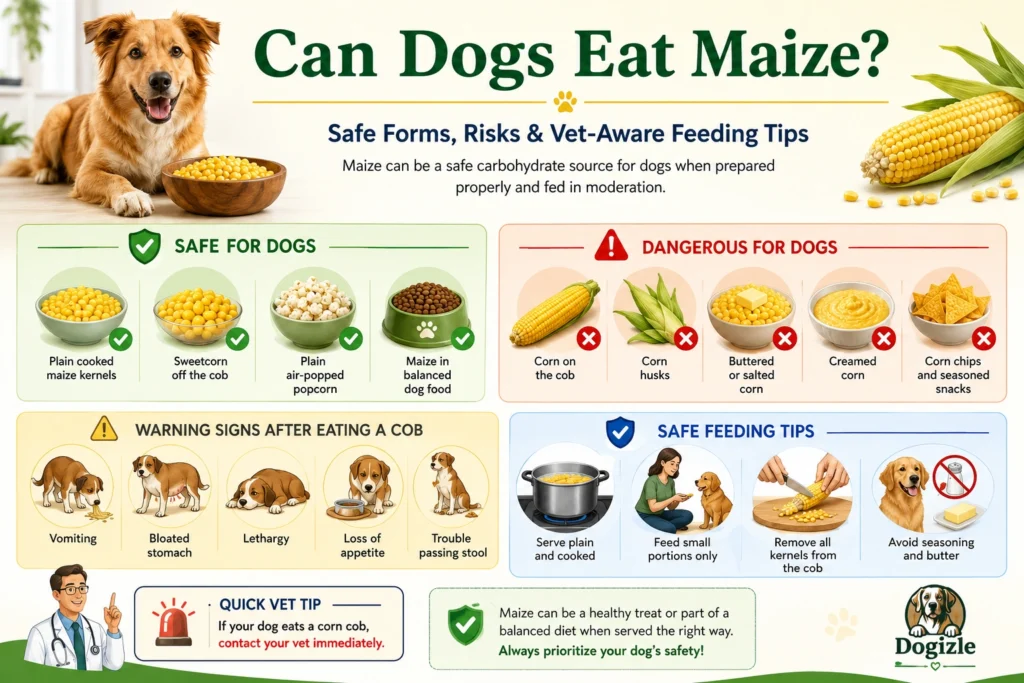
Safe forms at a glance
| Maize form | Safe? | Why |
| Plain cooked kernels | Yes | Easy to portion and serve in moderation |
| Frozen kernels | Yes | Can be a simple treat if plain |
| Air-popped popcorn | Yes, in small amounts | Only if plain and unseasoned |
| Corn in complete dog food | Yes | Can be part of a nutritionally balanced recipe |
| Raw corn kernels | Usually not ideal | Less digestible than cooked kernels |
| Maize on the cob | No | Choking hazard and obstruction risk |
| Corn husk | No | Can cause blockage or GI upset |
| Seasoned, buttered, salted maize | No | Can trigger stomach upset or toxicity from add-ons |
| Canned corn with extra salt/sugar | Usually avoid | Extra sodium and additives can be a problem |
| Creamed corn | Avoid | Often contains dairy, sugar, and extra ingredients |
This safety split is consistent across PetMD, Purina, Chewy, Rover, and Vets Now. They all support plain kernels in moderation and warn against cobs; Chewy and Rover also specifically caution against canned, creamed, and seasoned forms.
The safest way to serve maize
- Cook it plain.
- Remove every kernel from the cob.
- Serve a small amount only.
- Skip butter, salt, spice blends, garlic, onion, cheese, or oil.
- Watch for stomach upset the first time.
PetMD notes that cooked corn can be easier to digest than raw, and Chewy and Rover both stress that only plain kernels should be offered.
Mini summary: if it is plain, cooked, and off the cob, it is the version most likely to be safe.
Which Maize Products Should Dogs Avoid?
Avoid these forms completely or nearly always
1) Corn on the cob
This is the biggest danger. The cob is not digestible, and veterinary sources warn it can cause choking, intestinal blockage, and, in severe cases,s perforation or surgery.
2) Corn husks
Chewy specifically warns that husks can cause digestive problems, blockage, constipation, diarrhea, or choking.
3) Buttered, salted, or seasoned maize
Butter, salt, pepper, garlic, and onion are all poor choices for dogs. PetMD warns that butter adds fat and can contribute to pancreatitis and obesity, while garlic and onion are toxic to dogs.
4) Creamed corn
Chewy notes that creamed corn often includes dairy and sugar, which are not ideal for dogs.
5) Canned corn with lots of sodium or sugar
Rover and Chewy both warn that canned corn can contain added salt and other ingredients that make it less suitable.
6) Corn-based snack foods
Corn chips, heavily processed snack foods, and barbecue leftovers usually bring salt, fat, seasoning, and extra risk with very little benefit.
Practical rule: if a human would need to “make it tasty,” it is probably not the right maize form for your dog.
Is Maize Good for Dogs in Dog Food?
Yes, maize can be a useful ingredient in a complete and balanced dog food. Purina says corn in dog food is acceptable and beneficial, while AKC notes that corn provides linoleic acid and fiber; PetMD also describes protein, fiber, vitamins, antioxidants, and essential fatty acids as part of corn’s nutritional value.
The important context is that pet food should be judged by the whole formula, not one ingredient. The FDA explains that “complete and balanced” pet foods are designed to meet nutrient profiles or pass feeding trials, and FEDIAF’s 2025 guidelines serve as the European reference framework for complete and complementary dog foods.
Why does corn/maize show up in dog food
- It can provide digestible energy.
- It can contribute fiber.
- It can support skin and coat health through linoleic acid.
- It may help stool quality when used properly in a balanced formula.
Europe-specific practical note
For European dog owners, the key question is not “does this food contain maize?” but “is this complete and balanced under recognized nutritional standards?” FEDIAF’s guidelines are the reference point used across Europe, and they are reviewed by independent veterinary nutritionists.
Mini summary: Maize in quality dog food is not automatically a problem; the full nutritional profile matters more than one ingredient.
Maize and Grain Sensitivity: Can Dogs React to It?
Yes, but it is not the first thing to assume. Corn sensitivity or allergy can happen, but it appears less common than many owners think. PetMD and Chewy both mention possible symptoms such as itching, ear problems, vomiting, diarrhea, gas, or bloating after corn exposure. Texas A&M also recommends working with a veterinarian or veterinary nutritionist if a dog seems to do better without wheat or corn.
Possible signs of a maize sensitivity
- Itchy skin
- Recurrent ear infections
- Vomiting or diarrhea
- Gas or bloating
- Skin redness or scratching after meals
Important distinction
A food allergy is different from a food intolerance, and not every stomach issue means maize is the cause. The cleanest way to investigate is with your vet, especially if symptoms continue.
How Much Maize Can a Dog Have?
A sensible rule is to keep maize as an occasional treat, not a meal. Rover says treats should make up no more than 10% of a dog’s daily calories, and PetMD also emphasizes small portions and moderation.
Practical serving guide
| Dog size | Conservative starter amount | Notes |
| Toy / very small dog | 1–2 teaspoons of plain kernels | Start tiny |
| Small dog | 1 tablespoon | Watch for loose stool |
| Medium dog | 1–2 tablespoons | Treat only |
| Large dog | 2–3 tablespoons | Still not a meal |
This is a practical, owner-friendly guide, not a veterinary prescription. Use less for puppies, seniors with sensitive stomachs, overweight dogs, or dogs with known food sensitivities.
Feeding tips
- Keep the first portion very small.
- Feed maize only after the dog has eaten its normal meal.
- Stop if you notice loose stool, gas, vomiting, or itching.
- Avoid maize entirely if your vet has recommended a special diet.
Mini summary: small, plain, occasional — that is the safest feeding pattern.
What If My Dog Ate Corn on the Cob or a Maize Husk?
Treat this seriously.
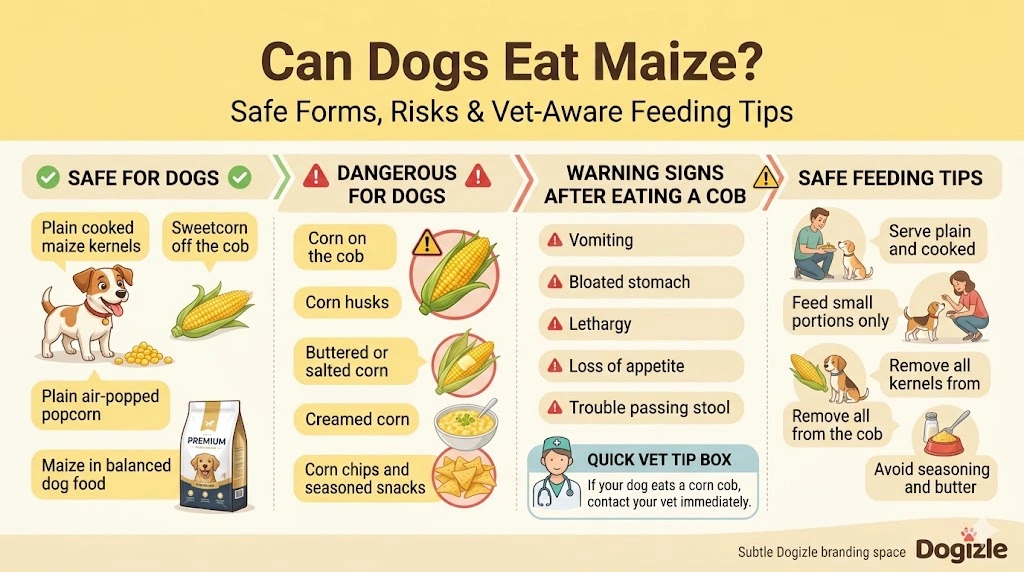
Veterinary sources agree that the cob can cause obstruction and may require imaging, endoscopy, or surgery. Symptoms to watch for include vomiting, diarrhea, lethargy, reduced appetite, abdominal pain, and difficulty passing stool. Vets Now also notes that corn cobs may lead to blockage or perforation, and Chewy warns that a blockage can become life-threatening.
What to do right away
- Remove the cob or husk if it is still accessible.
- Do not wait for symptoms if part of the cob was swallowed.
- Call your vet or an emergency clinic immediately.
- Do not give fatty foods, home remedies, or “bulky” foods unless a vet specifically instructs you to do so.
- Watch for vomiting, pain, bloating, low energy, or loss of appetite.
Emergency red flags
- Repeated vomiting
- Bloating or a hard abdomen
- Crying, pacing, or obvious pain
- Refusing food
- Straining with little or no stool
- Weakness or collapse
Important note: obstruction cases can move quickly. The safest response is to contact a vet promptly rather than “wait and see.”
Comparison Table: Maize Forms and Safety
| Form | Verdict | Owner action |
| Plain cooked kernels | Generally safe in moderation | Serve small amounts off the cob |
| Air-popped popcorn | Sometimes okay | Only plain and unsalted |
| Sweetcorn in dog food | Usually fine | Check that the food is complete and balanced |
| Maize on the cob | Dangerous | Avoid completely |
| Corn husk | Dangerous | Keep away from dogs |
| Buttered/salted/seasoned corn | Poor choice | Skip it |
| Canned corn | Mixed | Check sodium and ingredients carefully |
| Creamed corn | Poor choice | Avoid |
This table reflects the common consensus across PetMD, Purina, AKC, Chewy, Rover, and Vets Now.
Why This Matters More in Europe and Urban Homes
European owners often use the term maize, while many U.S.-based pages default to corn. That language gap matters for SEO, but it also matters for trust: users should instantly recognize that both words refer to the same crop. Britannica confirms the crop is Zea mays, and FEDIAF provides the main European nutrient-guidance framework for pet food.
Urban and apartment dogs also face a very practical issue: food scraps are easier to grab in small spaces, and barbecue leftovers are often left within reach. Rover and Vets Now both note that cobs and scraps create real seasonal risk, especially when people are eating outdoors or tossing leftovers carelessly.
Apartment living tip
Keep trash bins secured, clear plates immediately, and tell guests not to drop cobs on the floor. That one habit can prevent a surgery-level emergency.
Expert Tips for Feeding Maize Safely
- Choose plain cooked kernels only.
- Use maize as an occasional topper, not a staple.
- Keep portions smaller for small breeds and puppies.
- Avoid giving maize after a rich meal.
- Never feed cob, husk, or barbecue leftovers.
- Check packaged corn foods for salt, sugar, or onion/garlic seasoning.
- When in doubt, pick a dog treat that is designed for dogs.
Purina, PetMD, and Chewy all support the idea that the issue is not corn itself, but how it is served and what it is mixed with
Common Mistakes Dog Owners Make
1) Thinking the cob is the “healthy part.”
It is the opposite. The cob is the dangerous part.
2) Giving seasoned leftovers
Salt, butter, garlic, onion, and sauces change the risk profile fast.
3) Assuming “natural” means safe
Corn cobs are natural and still dangerous.
4) Feeding too much at once
Too much maize can trigger digestive upset or weight gain.
5) Ignoring small symptoms after cob ingestion
A dog can worsen before it looks truly ill, so early vet contact is smart.
Pros and Cons of Maize for Dogs
Pros
- Can be safe in plain, cooked form
- Can provide energy and fiber
- May support skin and coat health through linoleic acid
- Common and affordable in dog food
- Usually fine in complete and balanced recipes
Cons
- Cob can be dangerous
- Too much can upset the stomach
- Seasoned and processed forms are often poor choices
- Some dogs may be sensitive or allergic
- Not a necessary food for dogs
People Also Ask
Yes, plain cooked kernels in small amounts are generally safe if served off the cob.
No. The cob can cause choking or intestinal blockage and may require emergency treatment.
Yes. Corn or maize can be part of a complete and balanced dog food and may contribute useful nutrients.
In small amounts, plain cooked kernels may be okay, but puppies have more sensitive digestion and unique nutritional needs, so gradual introduction and vet guidance are smart.
Yes, if it is plain and off the cob. Sweetcorn is not the same as a cob and should not be served with butter, salt, or seasoning.
Not by default. The risk depends on the form, the amount, and what it is mixed with. Corn cobs and heavily seasoned foods are the real concern.
Call your vet or an emergency clinic right away, especially if vomiting, pain, bloating, or appetite loss appear.
Sometimes, but start with a very small amount or skip it entirely if your dog has a history of digestive upset. If symptoms repeat, ask your vet.
Conclusion
So, can dogs eat maize? Yes — but only the right version. Plain, cooked kernels served off the cob can be safe in moderation, while maize on the cob, husks, and heavily seasoned or Processed forms should be avoided. The cob is the real danger because it can cause choking or obstruction, and that is a vet visit you do not want to delay.
For everyday feeding, think simple: small portions, no seasoning, and no cob. For dog food, judge the full recipe, not one ingredient. And if your dog eats a cob or starts showing signs of blockage, act quickly. Responsible feeding is always the best shortcut to a healthier dog.