Best Invisible Dog Fence:
Best Invisible Dog Fence helps you choose the right system for your dog’s safety. Confused between wireless, GPS, and in-ground options? This guide clears the real differences, hidden flaws, and performance truths so you can avoid costly mistakes and pick the most reliable solution with confidence in 2026. Choosing the best invisible dog fence is not simply a shopping decision. It is a safety choice, a training choice, and in many cases, a long-term lifestyle decision. A good system can help protect your dog, reduce daily stress, and give you peace of mind. A poor choice can create confusion, frustration, wasted money, and in some cases, fear-based behaviour in your dog.
That is why the best invisible dog fence is not always the most expensive one, the most popular one, or the one with the most features. The best system is the one that fits your yard, your dog’s temperament, your training style, and your budget.
A lot of competing articles stop at product lists. They name a few brands, give a few specifications, and move on. That approach is incomplete. It does not help the reader understand how containment actually works. It does not explain how training affects success. It does not address the real-world trade-offs between wireless, GPS, and in-ground systems. And it rarely tells people what to do when their dog is stubborn, sensitive, distracted, or highly energetic.
This guide is different. It is built to help readers make a smarter decision, not just a faster one. It explains the three main types of invisible fences, the situations where each one makes sense, the training process that determines success, and the safety issues every owner should understand before buying.
What Is an Invisible Dog Fence?
An invisible dog fence is a containment system that helps keep a dog inside a set boundary without using a physical barrier such as wood, metal, or chain link. Instead of a traditional fence panel, the system uses a signal boundary, a collar worn by the dog, and training that teaches the dog where the limit is.
In practical terms, the system does not “block” the dog the way a real fence does. It teaches the dog to recognise an invisible boundary and respond before crossing it. That is why many professionals describe it as a training-based containment solution rather than a true fence.
Most systems follow the same basic pattern. First, a boundary is created using a wire, a radio signal, or GPS technology. Then the dog wears a compatible collar. When the dog approaches the boundary, the collar may give a warning tone, a vibration, or another alert. In some systems, a mild correction can follow if the dog continues moving forward.
The most important thing to understand is this: the equipment alone does not keep the dog safe. Training does. A dog that understands the boundary is much more likely to respect it. A dog that has not been introduced properly may become confused, ignore the system, or become stressed.
Because of that, invisible fences work best when they are treated as a behaviour training tool, not as a replacement for supervision or responsible ownership.
How It Works in Simple Terms
The process is fairly straightforward.
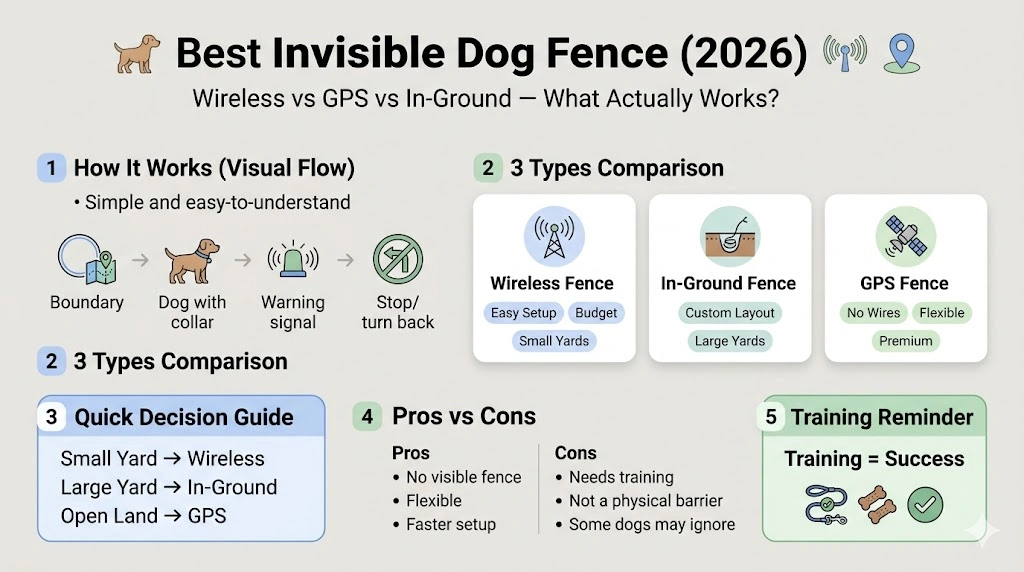
A boundary is established, either with wire, wireless transmission, or GPS coordinates. The dog wears a collar that can detect the signal. When the dog gets too close to the edge, the collar gives a warning. If the dog keeps moving forward, some systems add a stronger alert or correction. Over time, the dog learns that crossing the boundary is not a good idea.
That is the entire concept in plain language.
There is one important truth here: invisible containment systems do not physically stop a dog. They rely on conditioning. That means the success of the system depends on the dog learning the rules and respecting the boundary, even when distracted by wildlife, noise, excitement, or curiosity.
This is why the training phase matters so much. A system that looks simple on paper can fail in practice if the dog is introduced too quickly or inconsistently. On the other hand, a well-trained dog can do very well with the right setup.
The 3 Main Types of Invisible Dog Fence Systems
If you want to choose the best invisible dog fence, the first step is understanding the three main categories. Each one has strengths, weaknesses, and ideal use cases.
1. Wireless Dog Fence
A wireless dog fence uses a central transmitter that sends a signal in a circular shape around the home or chosen location. The dog wears a collar that detects when it gets near the edge of that circle.
This type is especially appealing for people who want a quick setup and minimal installation. There is usually no digging, no wire burial, and no complicated layout work. That makes wireless systems popular with renters, first-time pet owners, and people with smaller yards.
Wireless systems are often best for:
- Small to medium yards
- Simple property shapes
- Temporary containment needs
- Renters or people who move often
The biggest advantage is convenience. You can usually set one up fast and start training quickly. The biggest drawback is flexibility. Since the boundary is usually circular or limited in shape, it is not the best choice for unusual property lines, narrow side yards, sloped landscapes, or areas where you need to exclude specific zones such as gardens, pools, or driveways.
Wireless systems can be a good solution, but they are not automatically the best solution for every dog or every property.
2. In-Ground Wired Dog Fence
An in-ground wired fence uses a buried wire that defines the exact boundary you want. The wire is connected to a transmitter, and the collar responds when the dog gets close to that buried line.
This is the most customizable type of invisible dog fence. You can shape the boundary around trees, patios, gardens, driveways, or irregular lot lines. You can create custom coverage that fits your property instead of forcing your property to fit the product.
In-ground systems are often best for:
- Large yards
- Irregular property layouts
- Long-term installations
- Owners who want precise boundary control
The main strength of this option is reliability and customisation. The main weakness is the installation effort. You may need to plan the layout carefully, bury wire, and spend more time setting up and testing the system. For many owners, that is worth it because the result is more precise and often more dependable than a wireless circle.
If your yard is complex, this is often the strongest candidate.
3. GPS Dog Fence
A GPS dog fence uses satellite positioning and app-based controls to create a virtual boundary. Instead of a buried wire or central transmitter, the system typically relies on GPS data and software.
This option is attractive for people with large open properties, travel needs, or a preference for modern tech features. It is often more flexible than wireless and more portable than in-ground wire systems.
GPS systems are often best for:
- Large open land
- Travel or temporary use
- Tech-friendly owners
- Users who want flexible digital boundaries
The biggest advantage is freedom. You do not need to bury wire, and you are not limited to a fixed transmitter circle in the same way many wireless systems are. The biggest drawback is that GPS can be less precise than a physical wire in some conditions, especially when the space is too small, the environment is complicated, or the signal quality is inconsistent.
GPS systems can be powerful, but they are not the universal answer. They shine in open spaces and modern use cases, but they are not always the best fit for small residential yards with close boundaries and lots of obstacles.
Quick Comparison Table
| Type | Setup | Boundary Control | Price Range | Best For |
| Wireless dog fence | Very easy | Low | Lower | Small yards, renters |
| In-ground dog fence | Moderate | High | Mid-range | Large or custom yards |
| GPS dog fence | Easy to moderate | Medium | Higher | Open land, travel, tech users |
This table gives a simple starting point, but it should not be your only deciding factor. A fence system is only successful when it matches the dog as well as the property.
How to Choose the Best Invisible Dog Fence
This is where many competitor pages fail. They talk about products, but they do not teach decision-making. That is a missed opportunity because the real choice is not “Which brand is best?” The real choice is “Which type of system fits my actual situation?”
1. Match the Fence to Your Property
Start with the land itself.
Ask a few practical questions:
- Is the yard small or large?
- Is the shape simple or irregular?
- Are there areas you want to include or exclude?
- Are there obstacles such as trees, slopes, gardens, or pools?
If the yard is small and simple, a wireless fence may be enough. If the property is large or has an unusual layout, an in-ground fence is often more suitable. If you have open acreage and want flexibility, GPS may be the better fit.
A simple rule helps here:
Small yard = wireless
Large or custom yard = in-ground
Open land = GPS
That rule is not perfect, but it is a very useful starting point.
2. Match the Fence to Your Dog
A fence is not just about the space. It is also about the dog.
Some dogs are naturally calm and responsive. Others are impulsive, stubborn, intense, or highly prey-driven. Those differences matter.
An easier dog may be comfortable with almost any decent system, provided training is done properly. A harder dog may need a stronger training program, more supervision, and a system with better reliability or more precise boundary control.
Consider your dog’s:
- Age
- Energy level
- Prey drive
- Sensitivity
- Trainability
- Reaction to correction or loud sounds
A dog that is confident, curious, and responsive may adapt quickly. A dog that chases squirrels, ignores cues, or bolts after distractions may need more careful management. In those cases, the fence itself is only one piece of the solution.
3. Match the Fence to Your Budget
Budget matters, but it should be viewed carefully.
Wireless systems are usually the least expensive and easiest to begin with. In-ground systems often fall in the middle because of installation and equipment costs. GPS systems are often the premium option.
But a lower upfront price is not always a true bargain. A cheap system that does not suit the yard or the dog may create more problems than it solves. Likewise, a premium system may be unnecessary if the yard is small and simple.
A better question is not, “What is the cheapest option?” It is, “What is the most cost-effective option for this dog and this property?”
4. Match the Fence to Your Lifestyle
Your routine matters too.
Do you travel often with your dog? Do you rent rather than own? Do you need something portable? Do you want a fixed boundary that stays in place for years? Do you plan to move soon?
If portability matters, wireless or GPS may be more practical. If you want a long-term boundary tailored to a specific property, in-ground is often the stronger option.
This is where long-term thinking matters. A system that is easy today may not be useful six months from now. A system that takes a little more effort at installation may save trouble later.
Best Invisible Dog Fence by Use Case
Different situations call for different systems. There is no single winner for every buyer.
Best for Most Families
For many households, the most balanced choices are in-ground or GPS systems. These usually offer more adaptability and better long-term usefulness than a basic wireless circle.
They are especially helpful when the yard is not perfectly simple, when the dog is active, or when the owner wants a setup that can grow with the household’s needs.
Best Invisible Dog Fence for Small Yards
Wireless dog fences are often the easiest answer for small spaces.
They are quick to install, easy to understand, and convenient for people who do not want to dig or design a wire layout. They also appeal to renters and people who need a fast solution.
Still, small yards do not automatically mean wireless is the best. If the property has unusual edges, narrow sections, or areas to avoid, a wired system may still be better.
Best Invisible Dog Fence for Large Dogs or Large Yards
In-ground dog fences are often the stronger choice here.
Large dogs can be more powerful, more persistent, and more likely to test boundaries. Large yards also create more layout challenges. A buried wire system lets you design a boundary that fits the environment instead of forcing a round shape onto a complicated space.
For many large-dog owners, that extra control is worth the setup effort.
Best GPS Dog Fence for Premium Use
GPS fences are usually the premium option.
They are appealing when flexibility, app control, and portability matter. They may be especially useful for open land, modern households, or owners who prefer digital management over physical installation.
They are not automatically better than other systems. They are simply better for specific scenarios.
Pros and Cons of Invisible Dog Fences
Every containment choice has trade-offs. Understanding them up front helps prevent disappointment later.
Pros
Invisible fences do not create a visible barrier, which some owners prefer for aesthetic reasons. They can be faster to set up than building a traditional fence, and they can protect sensitive areas such as gardens, pools, or driveways. They are also often more adaptable than a solid fence when the property layout is unusual.
In addition, they can be a practical alternative when local rules, land conditions, rental agreements, or cost make a physical fence difficult.
Cons
The biggest downside is that invisible fences are not physical barriers. A dog can cross them if it is not properly trained or if a strong enough distraction appears.
These systems also require time, consistency, and supervision. They are not “install and forget” products. Some dogs may become anxious, confused, or overreact to the correction if the setup is poor.
Misuse can make problems worse instead of better.
That is why it is important to think of invisible fences as training tools rather than guaranteed barriers.
How to Train a Dog for an Invisible Fence
This is the most important part of the entire guide.
A good system with bad training often fails. A modest system with great training may work surprisingly well. Training is what transforms a piece of equipment into a behaviour boundary.
Phase 1: Boundary Awareness
The first goal is simple: help your dog understand where the line is.
Use flags if the system includes them. Walk the dog on a leash near the boundary. Let the dog see, hear, and experience the edge in a controlled way. Keep sessions short, calm, and repetitive.
This stage is about building understanding, not pressure.
The Dog should begin to associate the boundary with warning signs and with the idea that moving away is the right choice.
Phase 2: Reinforcement
Once the dog starts noticing the boundary, reinforce the correct behaviour.
Praise the dog when it turns away from the line. Use treats, calm encouragement, and repetition. Keep the sessions structured and avoid pushing too quickly.
The goal here is to teach the dog that leaving the boundary is rewarding. That is much better than creating a learning process that feels scary or confusing.
Phase 3: Real-World Testing
After the dog understands the basic idea, gradually increase the challenge.
Add mild distractions. Use outdoor environments. Test the behaviour in real settings while still supervising carefully. Do not assume a dog that succeeds in one calm session is ready for full independence.
This is where patience matters most.
A rushed training process can produce false confidence. A slow, steady process is more likely to create a dependable result.
Golden Rule
Never rush the training process.
If there is one line worth remembering, this is it. The fence itself may be simple, but the behaviour change takes time.
Common Problems and How to Fix Them
Even good systems can run into trouble. These are some of the most common issues owners face.
Problem 1: The Dog Runs Through the Fence
This can happen when a Dog is highly motivated, distracted by prey, or not fully trained. It can also happen when the system is introduced too quickly.
A stronger response is not always the answer. Often, the real fix is a slower training plan, better supervision, and more repetition in low-distraction settings.
Problem 2: The Dog Becomes Scared
Fear is a sign that the introduction may have been too intense, too abrupt, or too correction-heavy.
In that case, lower the intensity if the system allows it and shift the focus toward positive reinforcement. The dog should learn the boundary without feeling panicked or trapped.
Problem 3: GPS Drift
GPS drift can happen when the signal is not ideal, the area is too small, or the environment creates inconsistency. This can reduce precision and make the system less reliable.
If drift becomes a real issue, a larger boundary or a different type of containment system may be a better choice.
Problem 4: The System Feels Unsafe
Sometimes the issue is not the product itself, but the way it was used.
Poor setup, rushed training, overcorrection, and lack of supervision can all create safety concerns. The answer is to return to the basics, use the least forceful effective approach, and follow a more careful introduction process.
Safety and Welfare Considerations
This topic matters for both trust and search performance, but more importantly, it matters for the dog.
Invisible fences are not just technical devices. They affect behaviour, emotion, and daily safety. That means owners should think about welfare, not only convenience.
Key Safety Points
Invisible fences are training tools, not magical solutions. They do not protect every dog equally. Some dogs are highly responsive, while others are impulsive or highly motivated by movement, wildlife, or excitement.
Misuse can create fear, stress, or confusion. A dog that is startled too often may become hesitant or uneasy outdoors. That is why correct setup and gradual training are essential.
The safest approach is always the one that uses the lightest effective method and the clearest possible training.
What Experts Commonly Emphasise
Veterinary and behaviour-focused organisations often stress reward-based learning, gradual introduction, and careful monitoring of the dog’s reactions. That does not mean every invisible fence is inherently wrong. It does mean owners should avoid assuming that stronger correction equals better training.
The better question is: does the dog understand the boundary, and does the system support calm, reliable behaviour?
If the answer is no, the setup needs more work.
Legal Considerations:
If you are reading from Europe or shipping to Europe, legal and welfare rules matter. Regulations differ from country to country, and in some places, certain collar types or correction-based devices are restricted or closely regulated.
That means the law in one country may not match the law in another. The same product might be acceptable in one region and limited in another.
Before buying, always check the current local rules. A responsible purchase is not only about performance. It is also about compliance.
Invisible Fence vs Physical Fence
This comparison is worth making clearly.
Invisible Fence
An invisible fence is often cheaper, faster to install, and more flexible in some layouts. It can be a useful solution when a physical fence is impossible, impractical, or too expensive.
Physical Fence
A physical fence gives a real barrier. It does not depend as heavily on collar response or boundary learning. In many situations, it is safer, more intuitive, and more dependable.
Best Overall
If it is possible to install a physical fence, that is often the safest option overall. Invisible systems can work well, but they should not be treated as the strongest choice in every situation.
That difference matters.
A physical fence prevents many problems before they begin. An invisible fence requires more behaviour management. Both can have a place, but they are not the same.
Special Use Cases
Some situations deserve extra attention.
Apartment Living
Invisible fences are usually not ideal for apartments. The outdoor space is often too limited, too shared, or too inconsistent for the system to make sense. In many apartment settings, a leash, supervised outings, and structured training are more appropriate.
Cold Weather Areas
In colder regions, durability matters. Look for waterproof or weather-resistant systems and consider how the ground conditions affect installation. In-ground systems may be more durable over time in these environments, especially if the area is exposed to seasonal changes.
High-Prey-Drive Dogs
Dogs that chase squirrels, birds, rabbits, or other moving targets can be the hardest to contain. These dogs may ignore warnings if excitement takes over.
For them, training must be especially careful. Supervision should be stronger, and the containment system should not be your only layer of protection.
Quick Decision Guide
Use this simple guide to narrow your choice.
Want an easy setup? Choose a wireless dog fence.
Want a long-term solution? Choose an in-ground dog fence.
Want flexibility and portability? Choose a GPS dog fence.
That is the simplest version. The better version is to combine that with your dog’s temperament and your property’s shape.
FAQs
Yes, they can work, but only when training is done properly. A fence system on its own does not teach behaviour. The Dog must learn the boundary through consistent practice.
They can be safe when used correctly and introduced carefully. The safest approach is usually one that focuses on gentle training, clear communication, and close observation of the dog’s reactions.
In-ground fences are usually the strongest option for large yards because they offer better boundary control and more layout flexibility. GPS systems can also work well in some large open spaces.
Stubborn dogs often do better with systems that are reliable, consistent, and paired with strong training. In many cases, that means an in-ground system or a premium GPS option, depending on the property.
Yes. Some dogs will ignore the boundary, especially if they are highly excited or strongly motivated by prey or play. That is one reason training and supervision are so important.
It depends on the country. Rules vary, and some places have restrictions on certain correction-based devices. Always check local laws before buying or using any system.
A physical fence is often the safest containment option because it creates a real barrier. In some cases, supervised leash training and long-line work are also safer than relying on invisible containment alone.
Conclusion
Choosing the best invisible dog fence (2026) is not about finding a single “perfect” product—it is about matching the system to your dog’s behaviour, your yard layout, and your long-term lifestyle needs.
If you want the simplest setup, a wireless dog fence offers quick installation and works well for small, open yards. If you need precise control and long-term reliability, an in-ground wired fence is usually the strongest option. And if flexibility, portability, or open-land coverage matters most, a GPS dog fence can be the right premium solution.
However, the most important takeaway is this: no invisible fence works without proper training. The system only supports the boundary—the dog’s understanding and consistency are what actually keep them safe.
In short:
- Choose the system that fits your property
- Match it to your dog’s temperament
- Invest time in training and supervision
When these three factors align, an invisible dog fence becomes not just a tool—but a reliable part of your dog’s safety and freedom.