Introduction
The best animal clippers for dogs are quiet, sharp, low-vibration models that cut thick coats fast without stressing your pet. Struggling with mats, noise, or bad trims? This guide reveals top picks, grooming secrets, and mistakes that ruin coats. Some budget clippers outperform expensive brands in surprising ways today.
Choosing the Best Animal Clippers for dogs is not simply a matter of buying a grooming device. It is a decision that directly affects your dog’s comfort, skin protection, coat integrity, emotional calm, and long-term grooming experience. A well-matched clipper can make home grooming smoother, safer, and far less stressful. A poor match can lead to pulling, snagging, overheating, anxiety, and, in some cases, skin injury.
Most pet owners still choose clippers based on price, brand popularity, or what appears in an ad. That approach may work for many consumer products, but grooming tools are different. Dogs are living, sensitive beings with coat structures, skin thicknesses, and behavioral responses that must be respected. The right clipper is not the most expensive one. It is the one that aligns with the animal’s coat type, grooming frequency, noise sensitivity, and the owner’s skill level.
This 2026 guide is built for dog owners who want more than a basic product list. It is designed to help you understand the grooming system behind professional results. You will learn how dog clippers function, why certain features matter more than others, how to choose according to coat type, and how to reduce the risks associated with at-home grooming. The goal is not only to help you select a tool, but to help you make a smarter grooming decision from the start.
Why Most Dog Owners Choose the Wrong Clippers
Many articles about grooming clippers stop at a surface-level recommendation. They tell you which brand is “best,” or they rank products without explaining the mechanics behind the choice. That is useful only in the narrowest sense. Real grooming is not about choosing a random product from a list. It is about matching a tool to the biological and behavioral needs of the dog.
The most common mistake is assuming that a clipper designed for human hair will work just as well on a dog. It often does not. Human clippers are generally built for finer, straighter hair and may not have the cutting strength, blade geometry, or heat handling needed for dense coats or double coats. Another mistake is selecting a weak motor for thick or matted fur. That often causes tugging, inefficient cutting, and unnecessary stress for the dog.
Noise is another underestimated factor. Many dogs are highly sensitive to sound and vibration. A clipper that feels manageable to a person may sound harsh or intimidating to a nervous animal. If the grooming experience becomes unpleasant, the dog may resist future sessions, making the problem worse over time. Heat is equally important. A blade that grows too hot can irritate the skin and create a painful grooming session, even if the cut itself looks clean.
The result of these errors is more than a bad haircut. It can include skin irritation, accidental nicks, coat damage, fear responses, and a dog that begins to associate grooming with discomfort. That is why choosing dog clippers should be treated as a practical grooming system, not a casual shopping decision.
Understanding Dog Clippers:
To choose the best animal clippers for dogs, it helps to understand what actually happens when the blades move through the coat. A good clipper is a combination of motor performance, blade design, thermal control, and ergonomic handling. When these elements work together, the grooming process becomes smoother and safer. When one of them is weak, the whole experience can suffer.
Motor Power: RPM Versus Torque
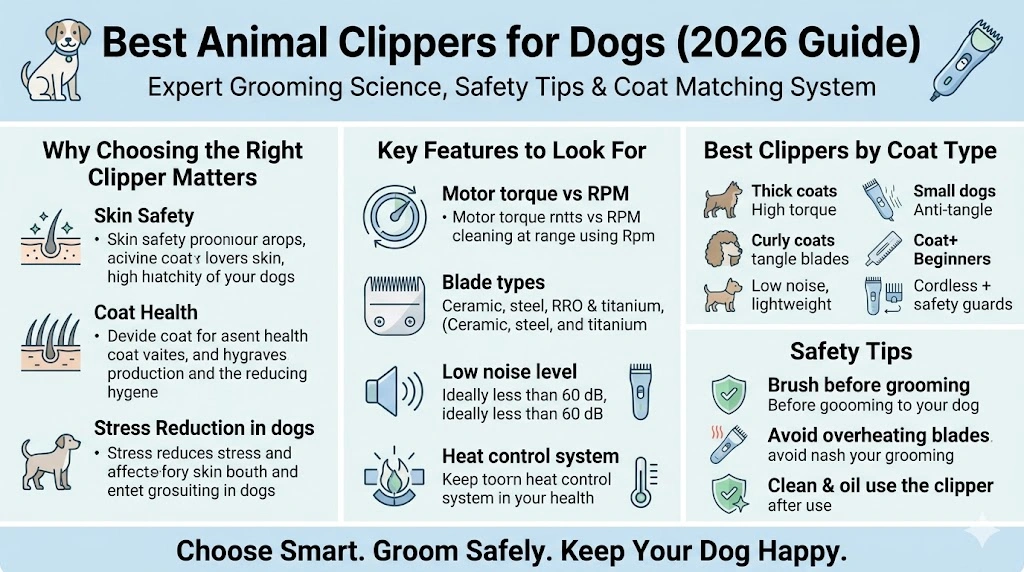
Many buyers focus on RPM, or revolutions per minute, because it sounds technical and impressive. RPM tells you how quickly the blade moves. That matters, but speed alone does not guarantee a better clipper. Professionals pay close attention to torque, which is the cutting force behind the motion. Torque determines how well the clipper can maintain performance when it meets thick, dense, or tangled fur.
A motor with high RPM but weak torque can move fast without actually cutting efficiently. In that situation, the clipper may catch the hair rather than slicing through it cleanly. That creates pulling, uneven results, and discomfort. By contrast, a clipper with strong torque delivers more stable cutting power, especially on heavy coats, double coats, or fur with mats.
For thick-coated breeds, torque matters more than speed. A fast but weak clipper may look impressive on paper, but in practical grooming, it can underperform. A powerful motor with balanced speed is usually the safer and more effective choice.
Blade Technology: Safety and Comfort
The blade is where the actual cutting happens, so blade material and blade behavior are central to the grooming outcome. Different blade types offer different strengths.
Ceramic blades are valued for staying cooler during long grooming sessions. They can be a strong option for sensitive dogs because lower heat helps reduce irritation. Ceramic also tends to provide a smoother feel during extended use.
Steel blades are durable and common, but they can warm up more quickly. That means they may require more frequent cooling breaks, especially during longer sessions or when working on dense coats.
Titanium-coated blades often offer a useful middle ground. They are designed to be durable, efficient, and smoother in cutting performance. For many owners, titanium-coated or hybrid blade systems provide a practical balance of comfort and durability.
Professional groomers often prefer systems that combine low heat, good cutting efficiency, and reliable edge retention. That is why ceramic and titanium combinations are frequently seen in higher-quality grooming setups.
Noise Level: A Major Behavioral Factor
Dogs experience sound differently from humans. A clipper that seems only slightly loud to a person may feel overwhelming to a dog, especially one that is anxious, young, elderly, or noise-sensitive. Sound and vibration are part of the grooming experience, and their effect should never be dismissed.
Lower-noise clippers are often easier for nervous dogs to tolerate. Less vibration can also improve handling control, because the device feels calmer in the hand and is less startling near the animal’s body. In practical terms, quieter clippers can reduce resistance, shorten grooming sessions, and make the dog more willing to cooperate next time.
Noise is not only a comfort issue. It affects behavior. A stressed dog may pull away, try to escape, flinch, or react defensively. That is why quiet dog clippers for nervous pets are not a luxury. They are a meaningful safety feature.
Heat Control System: The Hidden Safety Risk
Heat is one of the most overlooked problems in grooming. A blade that becomes too warm can cause discomfort or even minor burns, particularly on sensitive skin or in delicate areas. Heat also makes the session more unpleasant, which can teach the dog to fear the clipper.
A good clipper should support better thermal control through airflow, blade material, friction reduction, and maintenance-friendly design. Some systems include ventilation structures that help disperse heat more efficiently. Others use blades that are engineered to remain cooler for longer periods. Regular lubrication also plays a role because reduced friction means less heat buildup.
For home groomers, heat control should be considered essential. A clipper that works well for the first few minutes but gets too hot shortly after is not an ideal tool for consistent grooming.
Best Animal Clippers for Dogs by Coat Type
Professionals rarely use the same clipper for every dog. Coat type is one of the most important variables in grooming. A tool that is excellent for a Yorkie may be completely wrong for a Husky. Matching the clipper to the coat is one of the clearest ways to improve grooming results.
Thick and Double Coats: Huskies, Shepherds, Similar Breeds
Dogs with thick or double coats need a clipper that can handle density without slowing down or overheating. Breeds such as German Shepherds and Siberian Huskies have coats that can trap dirt, shed heavily, and resist weak cutting systems.
For these coats, the best features include a high-torque motor, strong cooling support, and blade systems that can tolerate sustained use. Detachable blade systems, especially A5-style blades, are often favored because they allow more control and easier maintenance. Multi-speed settings can also help, since the groomer may need more power in dense areas and more control in sensitive areas.
The reason this matters is simple: dense coats place more resistance on the blade. Weak clippers can tug, stall, or force the owner to make repeated passes over the same area. That increases stress for the dog and raises the risk of skin irritation.
Curly and Doodle Coats: Poodles, Labradoodles, and Similar Breeds
Curly coats are beautiful, but they are also prone to tangling and matting. These coats can trap loose hair close to the skin, creating compact areas that are difficult to clip cleanly. A standard low-power clipper may struggle in these conditions.
A better choice for curly coats usually includes anti-tangle cutting support, ceramic or titanium blade combinations, and a motor strong enough to maintain smooth motion through dense curls. Mid-to-high torque is especially helpful because it reduces the chances of snagging.
The main challenge with curly coats is mat formation. Mats are not just cosmetic; they can pull on the skin and create discomfort. A clipper that is too weak can make the process slower and rougher. Best Animal Clippers for Dogs with steady performance helps the groomer work more cleanly and with less repeated contact.
Small and Sensitive Dogs: Chihuahua, Yorkshire Terrier, and Similar Breeds
Small dogs often have a different grooming profile. They may not need the heavy-duty force required for a Husky, but they may be more reactive to vibration, sound, and handling pressure. Their skin can also be delicate, making gentle performance more important than raw power.
For these dogs, quiet operation, low vibration, and a lightweight design are valuable. A clipper that feels bulky or loud may increase stress. A more compact, well-balanced tool helps the owner move carefully and stay in control.
The grooming goal for sensitive small breeds is not maximum force. It is precision, calm handling, and comfort.
Beginner Home Grooming Users
First-time groomers should think less about advanced performance and more about safety and usability. A beginner-friendly clipper should be easy to hold, easy to clean, and hard to misuse. Cordless models often appeal to beginners because they reduce cable management and allow freer movement around the dog.
Guard combs, blade covers, and simple maintenance steps also make a difference. The idea is to reduce the learning curve while keeping the dog safe. Beginners should prioritize control over power. A moderate, manageable clipper is usually better than a highly aggressive professional unit.
Comparison Table:
| Category | Best For | Motor Type | Blade Type | Skill Level |
| Heavy Duty | Thick coats and double coats | High-torque corded | Steel or titanium | Advanced |
| Curly Coats | Doodles and similar breeds | Mid-to-high cordless | Ceramic or hybrid | Intermediate |
| Small Dogs | Sensitive pets | Low vibration | Ceramic | Beginner |
| Home Use | General grooming | Cordless | Basic steel or hybrid | Beginner |
This table gives a simple overview, but the most important point is that no single clipper is ideal for every dog. The right match depends on coat behavior, grooming frequency, and the owner’s comfort with the tool.
Corded Versus Cordless Clippers:
Both corded and cordless clippers have genuine advantages. The best option depends on how and where the grooming happens.
Corded Clippers
Corded clippers are often preferred for demanding grooming tasks because they provide continuous power. There is no battery to lose charge halfway through the session, which makes them reliable for thick coats, longer grooms, and more intensive work. Many professional groomers appreciate the consistency of a corded tool.
The limitation is mobility. The cord can restrict movement, especially in small spaces. Beginners may also find cords awkward at first, particularly if the dog moves frequently. Still, for heavy-duty work, corded clippers remain an excellent choice.
Cordless Clippers
Cordless clippers offer flexibility and easier handling. Many owners find them less stressful because there is no cable to manage, and that can be especially useful when grooming nervous dogs. They also tend to feel more modern and convenient for quick or routine trims.
The trade-off is battery life. A cordless clipper may lose power during long grooming sessions, and some models can feel weaker as the battery drains. For that reason, cordless clippers are often best for light to medium use, touch-ups, and home grooming in comfortable sessions.
Many professionals combine both types: corded for the heavy work, cordless for detail and finishing.
Grooming Safety and Health: Essential Best Practices
Animal welfare should remain at the center of every grooming choice. A clipper is only valuable if it helps maintain hygiene and coat care without causing pain or harm.
Before grooming, brushing is important because it removes loose hair and helps identify tangles or mats. Cutting through mats without preparation can increase pulling and discomfort. The coat should be clean enough to groom safely, and the blades should be maintained properly throughout the process.
After each use, blades should be cleaned and oiled according to the manufacturer’s guidance. This helps preserve cutting efficiency and reduces friction. Heat management is also important during the session. If blades begin to feel warm, the groomer should pause, cool them, and resume only when safe.
Dry mat shaving should be avoided whenever possible because mats can tighten against the skin and make the clipping process more painful. In some cases, severe matting may require professional assistance.
The main health risks from poor grooming include cuts, burns, skin irritation, coat damage, and fear responses. Grooming should support wellbeing, not create a negative association with care.
Common Mistakes Dog Owners Make
One of the largest errors is choosing clippers based on price alone. A cheap tool may look appealing, but if the motor is too weak or the blades overheat quickly, the apparent savings disappear fast.
Another common mistake is ignoring coat type. A clipper that works well for a short-coated dog may fail on a dense, curly, or double coat. Coat biology should guide the purchase.
Using human clippers is another problem. Human clippers are not built with canine comfort or coat structure in mind. They may cut unevenly, snag more easily, or create overheating issues.
Skipping maintenance is also risky. Even a high-quality clipper will perform poorly if the blades are dirty, dry, or dull. Grooming too quickly can compound these problems. Fast, rushed grooming is more likely to produce uneven results and stress the dog.
The better approach is slow, informed, and consistent. A calm grooming routine usually creates a better outcome than a rushed one with a powerful tool.
Expert Grooming Tips:
Before clipping, brush the coat thoroughly. This makes the cutting path easier and helps reveal any knots that may need extra attention. Start with a longer guard length whenever possible. It is safer to remove less hair first and adjust gradually than to cut too short immediately.
Work in small sections. This helps maintain control and prevents the dog from becoming overwhelmed. Keep sessions short, especially for young or anxious dogs, and pause when needed. Shorter sessions often produce better behavior and better outcomes than long, exhausting grooming blocks.
For longer or denser coats, a cooling spray can help manage heat buildup, though it should be used according to the product instructions and with attention to skin sensitivity. Regular blade cleaning during the session can also improve cutting quality and comfort.
Professional grooming is often less about speed and more about rhythm, control, and awareness.
Real-Life Grooming Scenarios
Apartment Dogs in Cities Like Paris, Berlin, or London
Dogs living in apartments often benefit from quiet cordless clippers. In smaller spaces, the sound can feel more intense, and the dog may already be sensitive to close handling. A low-noise, lightweight clipper supports shorter, calmer grooming sessions. This is especially useful when the owner has limited space and needs an efficient routine.
Cold Regions and Alpine Climates
In colder climates, double coats play a critical insulation role. Over-trimming can remove too much of the protective layer. Grooming should maintain coat health without stripping away the structure that helps regulate temperature. In these settings, the goal is controlled maintenance, not aggressive shortening.
Humid Regions
In humid climates, coats may mat faster and retain moisture more easily. More frequent grooming can help prevent tangles and buildup. Owners in humid areas may benefit from tools that handle regular maintenance well and can keep the coat tidy without requiring long or difficult sessions.
These scenarios show why grooming advice cannot be one-size-fits-all. Climate, living environment, and coat behavior all influence the right tool choice.
A Practical Buying Framework
When choosing the best animal clippers for dogs, use a decision framework instead of relying on ads. Ask these questions:
What type of coat does the dog have?
How sensitive is the dog to noise and vibration?
Will the clipper be used occasionally or regularly?
Does the owner need corded power or cordless flexibility?
Is the priority safety, speed, precision, or convenience?
Once these are answered, the right choice becomes much clearer. For thick coats, prioritize torque and cooling. For sensitive dogs, prioritize quiet performance and low vibration. For beginners, prioritize light handling and safety accessories. For professional-level use, prioritize durability and consistent blade performance.
A smart purchase works well not only on the first day, but over months of grooming without causing stress or maintenance problems.
Pros and Cons Summary
Pros
Animal clippers can improve hygiene, reduce shedding, support at-home grooming, and save money over time. They also help owners maintain regular coat care between professional appointments.
Cons
Grooming tools require maintenance, learning, and patience. A poor-quality clipper can harm the grooming experience, and even a strong tool can cause problems if used incorrectly.
The key is not to avoid clippers. It is about choosing the right one and using it responsibly.
FAQs
Cordless, low-noise clippers with ceramic blades are best for beginners.
No, they can damage skin and cause uneven cutting.
Every 4–8 weeks, depending on coat type.
Yes, modern high-torque models are very strong.
Ceramic blades are safest because they conduct heat poorly.
Yes, but frequency depends on breed.
No—motor torque matters more than price
Conclusion:
Choosing the best animal clippers for dogs is not about chasing brand hype or picking the most expensive model. It is about understanding the dog in front of you and matching the grooming tool to that dog’s coat, sensitivity, and care needs.
The smartest buyers focus on five essentials: coat type, motor torque, blade safety, noise level, and heat control. When those factors are balanced correctly, grooming becomes safer, calmer, and more efficient. The result is not just a neat coat. It is a healthier grooming routine, a more comfortable dog, and a more confident owner.