
Best Hypoallergenic Dog Breeds — The Truth About “No-Shed” DogsDog Breeds
Best Hypoallergenic Dog Breeds can help allergy-sensitive owners find lower-shedding companions without the constant sneezing and cleanup. In this guide, you will learn which breeds fit apartments, families, and active homes best, plus what makes some dogs easier on allergies than others. The surprising part: no breed is fully allergy-free. Choosing the best Hypoallergenic dog breeds is not simply a matter of picking a cute face, a trendy breed, or a coat that looks low-maintenance.
For allergy sufferers, the real goal is day-to-day comfort: fewer sneezing fits, less eye irritation, better indoor air quality, and a Best Hypoallergenic Dog Breeds that fits your routine without turning your home into an allergen hotspot. The important truth is that dogs are not “allergy-free.” Dog allergies are driven mainly by proteins in dander, saliva, urine, and sebum, not by fur alone. The most widely recognized dog allergens include Can f 1, Can f 2, Can f 3, Can f 4, Can f 5, and Can f 6.
Why Do Some Dogs Trigger Allergies More Than Others?
That is why this guide goes beyond a simple breed list. Instead of repeating the same old “best dogs for allergies” roundup, it gives you a practical decision system based on allergy severity, grooming commitment, living space, family size, and lifestyle fit. It also explains why the word “hypoallergenic” is useful as a shorthand but weak as a guarantee, because scientific studies have found that so-called hypoallergenic dogs do not always produce fewer allergens than other dogs.
Why This Guide Is Different
Most articles on this topic stop at a generic list of breeds. They may mention that some dogs shed less, that some people react less strongly to certain breeds, or that grooming matters. But they often fail to answer the questions that actually matter in real life: Which dog is best for apartment living? Which dog is easier to manage for a family with children? Which breed may be easier for someone with mild allergies versus severe asthma? And which home habits matter just as much as breed choice? AAAAI and ACAAI both emphasize that pet allergies are caused by proteins in dander, saliva, and urine, and that management strategies like limiting exposure, using air filtration, and keeping pets out of the bedroom can make a meaningful difference.
This article fixes that gap with a more complete framework. Instead of treating the dog as the only variable, it treats the whole environment as the decision. That means breed, grooming, vacuuming, bedding, air filters, and daily habits all matter. In other words, the right dog is not just the one that sheds the least; it is the one that fits your immune system, your home, and your lifestyle.
The Science Behind Dog Allergies
To understand hypoallergenic dog breeds properly, you need to understand what actually triggers a reaction. Dog allergy symptoms are usually caused by specific proteins found in saliva, skin flakes, urine, and oil from the skin. When a dog licks its coat, sheds skin flakes, or moves through the house, those proteins can spread onto furniture, bedding, carpets, and clothing. AAAAI explains that the best-known dog allergens include Can f 1 through Can f 6, with Can f 1 among the most important and widely discussed.
The phrase “low Shedding” is often misunderstood. Less shedding can sometimes reduce the spread of allergens, but it does not eliminate allergens themselves. Hair is not the root cause; it is mostly a carrier. A dog can shed very little and still produce enough allergenic proteins to trigger symptoms in a sensitive person. That is why a dog with a curly coat or a soft, continuously growing coat may be easier for some families to manage, but still not safe for every allergy sufferer.
One of the most important studies on this topic found that dogs marketed as hypoallergenic did not necessarily have lower allergen levels in hair, coat, or homes. In fact, the 2012 study by Vredegoor and colleagues found higher Can f 1 levels in hair and coat samples from so-called hypoallergenic dogs compared with control breeds. Another study looked at allergen levels in homes and found no clear proof that “hypoallergenic” breeds always meant lower allergen exposure. The practical takeaway is simple: the label is not a medical promise.
How To Choose the Right Hypoallergenic Dog
The smartest way to choose a dog is to start with your allergy severity. Mild allergies, moderate allergies, and severe allergies require very different strategies. As someone with mild symptoms, a low-shedding breed plus a good cleaning routine may be enough. For someone with moderate sensitivity, grooming, air filtration, and strict bedroom boundaries become more important. For someone with severe allergies or asthma, breed choice alone is not enough; real-life exposure testing and medical guidance matter much more than online breed claims. ACAAI recommends limiting exposure and considering treatment options such as allergy medications or immunotherapy when needed.
A practical decision process looks like this: mild allergy sufferers usually do best with low-shedding dogs and a manageable cleaning routine; moderate allergy sufferers usually need a curly or hair–like coat, consistent grooming, and a controlled home environment; severe allergy sufferers should test the exact dog before adoption and speak with an allergist. The same breed can be tolerable for one person and miserable for another, because sensitivities vary from person to person and even from dog to dog.
Best Hypoallergenic Dog Breeds (2026 List)
The breeds below are not “perfectly allergen-free” because no dog is. Instead, they are commonly chosen by allergy-conscious households because they tend to shed less, are often easier to groom in a controlled way, or may fit apartment and family life more comfortably than heavier-shedding breeds. Think of this section as a lifestyle match guide, not a promise that any breed will work for everyone.
1. Poodle – Best Overall Hypoallergenic Dog
If you want a single Breed that is frequently recommended for allergy-sensitive households, the Poodle is often the first place to start. The reason is not magic; it is practicality. Poodles usually have a dense, curly coat that does not release hair as aggressively as many other breeds, and they come in Toy, Miniature, and Standard sizes, which makes them flexible for different homes and lifestyles. That flexibility matters because the best “allergy-friendly” dog is often the one you can realistically live with for years, not just the one that sounds impressive on paper. Poodles are also widely valued for intelligence and trainability, which helps when you want a grooming and cleaning routine to actually stick. This is an editorial recommendation, but it aligns well with the broader science that dog allergies are managed through exposure control rather than by breed label alone.
For families, the Poodle can be an excellent all-rounder. As apartments, the smaller sizes are especially appealing. For active owners, the Standard Poodle can match a more energetic lifestyle. The trade-off is grooming. A Poodle may be better for allergies, but it is not low-maintenance. If you want a dog that stays looking tidy without regular brushing and professional coat care, this breed may not be the easiest match.
2. Bichon Frise – Best Small Family Dog
The Bichon Frise is a strong choice for people who want a cheerful, social, family-friendly companion in a small package. It is often chosen by allergy-conscious owners because its coat is generally considered lower shedding than many popular companion breeds, and its size makes it especially practical in smaller homes. As with every breed here, the real benefit is not “zero allergens”; it is a coat and lifestyle profile that may be easier to manage with consistent grooming.
Bichons are especially appealing for families who want a playful Best Hypoallergenic Dog Breeds that fits into daily life without dominating the space. The main trade-off is upkeep. A Bichon’s coat needs routine grooming to stay comfortable and clean, and that grooming commitment is part of what keeps the breed appealing in allergy-sensitive homes. In plain terms, the breed can work beautifully, but only when the owner is ready to maintain it properly.
3. Maltese – Best Apartment Dog
The Maltese is one of the most natural picks for apartment life because of its small size, companionable personality, and coat type that many allergy-sensitive owners find easier to live with than heavy-shedding breeds. In a compact home, size matters. A smaller dog usually means less physical clutter, easier movement around furniture, and a simpler grooming footprint. That makes the Maltese attractive for singles, couples, and city dwellers who want a devoted lap companion.
The downside is not subtle: the coat can tangle, and that means brushing becomes part of the relationship. If grooming is ignored, the dog becomes less comfortable, the coat becomes harder to manage, and allergen control becomes less effective. The Maltese is a great example of why “low shedding” does not equal “no effort.” It is an elegant option, but it rewards consistency.
4. Schnauzer – Best Smart Watchdog-Style Dog
Schnauzers are often a smart pick for allergy-conscious households that want more alertness and watchdog energy than a very soft companion breed. Their wiry coat is often perceived as easier to manage than high-shedding coats, and their temperament tends to appeal to people who want a dog that is observant, loyal, and somewhat protective without being massive or overwhelming. This makes the Schnauzer a strong middle-ground choice for homes that want personality and practicality together.
The trade-off is coat care. Depending on the type of Schnauzer, grooming may involve clipping or a more specialized maintenance routine. That means the breed is suitable for owners who are willing to invest in upkeep, not for people who want a “wash-and-forget” pet. Still, for many households, the combination of manageable coat, strong presence, and compact-to-medium size is exactly what they want.
5. Portuguese Water Dog – Best Active Lifestyle Dog
The Portuguese Water Dog fits active households that want a low-shedding companion with lots of energy and a strong willingness to work. It is an appealing breed for people who like outdoor time, long walks, runs, hiking, or structured play. In allergy terms, its curly coat and grooming demands can make it a better fit than many more heavily shedding breeds, especially when the owner can keep up with maintenance.
This breed is not for people who want a quiet, low-activity home with minimal effort. It needs exercise, engagement, and regular grooming. But if your lifestyle is already active and you are looking for a dog whose coat and temperament can keep pace with that rhythm, the Portuguese Water Dog Breeds is one of the strongest candidates. It is a good example of how the “best hypoallergenic dog” is often the dog that matches your daily energy level as much as your allergy profile.
6. Yorkshire Terrier – Best Tiny Allergy-Friendly Dog
The Yorkshire Terrier is a Popular option for people who want a very small dog with a hair-like coat rather than a classic heavy-shedding fur coat. For allergy-sensitive owners, the tiny size can be a real advantage because it usually means less overall mess and easier management in a compact home. Yorkies are especially attractive for apartment dwellers who want a lively companion without a lot of bulk.
The trade-off is maintenance. Yorkies need brushing, and their coat can become difficult to manage if it is neglected. That said, many owners are willing to accept the grooming commitment because the breed is portable, compact, and suitable for smaller spaces. If your goal is a tiny dog with strong companion value and a coat that is generally easier to control than a shedding breed, the Yorkie remains a classic choice.
7. Shih Tzu – Best Calm Indoor Companion
The Shih Tzu is often a strong fit for households that want a calm, indoor-oriented companion rather than a highly athletic dog. For allergy-conscious owners, the appeal comes from the breed’s hair-like coat and its generally manageable size. In practical terms, a Shih Tzu can suit people who spend a lot of time at home and want a steady lap companion that feels emotionally present without needing an extreme exercise schedule.
The main caution is grooming. A Shih Tzu can require a lot of coat care, especially if the coat is kept longer. That makes it better for people who are comfortable with brushing, bathing, and professional grooming. If you want a dog that feels calm, affectionate, and home-centered, the Shih Tzu can be a lovely fit. If you want a very low-maintenance dog, it is less ideal.
8. Bolognese – Hidden European Gem
The Bolognese is a lesser-known breed that deserves more attention in allergy-friendly dog discussions, especially among European households. It is a small companion breed with a soft, fluffy appearance and a temperament that many people find appealing for quieter homes. Because it is less mainstream than the Poodle or Bichon, it is sometimes overlooked, even though it may be a very practical fit for the right owner. That makes it a genuine “hidden gem” in this niche.
Like the other dogs in this category, the Bolognese still requires grooming and owner commitment. It is not the right choice for someone who is frequently away from home or who wants a dog that can simply be brushed once in a while and forgotten. But for calm homes that want a small companion with low-shedding appeal and a softer daily footprint, it is worth serious consideration.
Best Hypoallergenic Dogs by Lifestyle
Best for apartments
For apartment life, the best matches are usually the Maltese, Yorkshire Terrier, and Toy Poodle. These dogs are small enough to fit comfortably into compact spaces, and their size makes daily management easier. In a small home, a smaller dog often means less hair spread, simpler cleaning, and less environmental clutter. The goal is not perfection; it is convenience and consistency.
Best for families
For family households, the Poodle, Bichon Frise, and Portuguese Water Dog are strong options because they combine social temperament with enough trainability and structure to fit an active home. Families usually benefit from dogs that are adaptable, predictable, and easy to integrate into routines. That matters even more when allergies are part of the equation, because a chaotic home makes allergen control harder.
Best for active owners
If your life already includes long walks, hiking, outdoor recreation, or a generally high-energy schedule, the Portuguese Water Dog and Standard Poodle are especially compelling. A dog that needs more movement can be a problem for a sedentary owner, but a blessing for someone who already enjoys an active routine. In this category, match the dog to your real habits, not your idealized ones.
Best for beginners
For first-time owners who also have allergy concerns, the Maltese and Bichon Frise are often appealing because their size keeps things manageable, and their companion nature is easy to understand. That said, beginner-friendly does not mean effortless. Grooming, cleaning, and exposure control still matter. The most successful first-time owner is usually the one who can follow a system consistently.
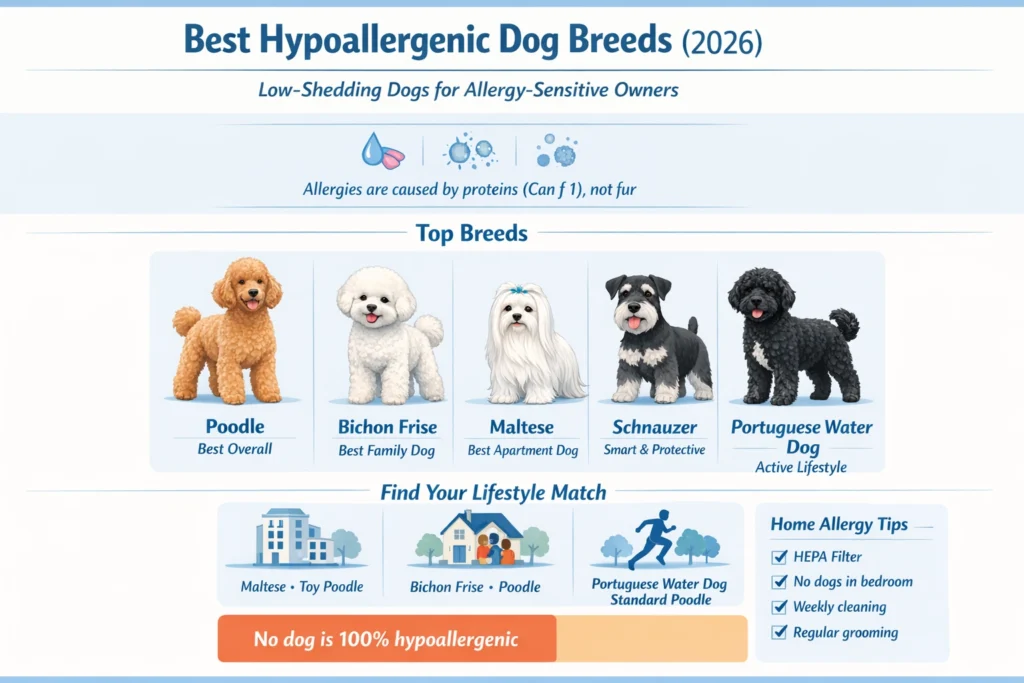
Home Allergy Management Matters More Than Breed Alone
This is the part that many articles underplay. A good breed choice helps, but it does not replace home control. AAAAI and ACAAI both emphasize exposure reduction strategies such as keeping pets out of the bedroom, using HEPA air filters, washing bedding regularly, and managing the indoor environment carefully. Those habits are not optional extras; they are central to symptom management.
A practical home routine can make a visible difference. Vacuuming several times a week, reducing fabric buildup where dander can accumulate, cleaning dog bedding, and brushing the dog outdoors are all common-sense steps that help reduce allergen spread. Air filtration can reduce airborne allergens and may provide relief, especially when paired with other avoidance strategies. In some cases, washing the dog can also reduce allergen levels temporarily, although the effect may not last on its own.
For people with persistent symptoms, medical support matters too. ACAAI notes that medications can help, and allergen immunotherapy is another option in selected cases. So the full strategy is not “choose one dog and hope for the best.” The real strategy is breed selection plus environmental management plus medical guidance when needed.
Common Mistakes People Make
One of the most common mistakes is buying a dog based only on the label “hypoallergenic.” That label can be useful in everyday conversation, but it does not mean the dog produces no allergens. Another mistake is assuming that short hair automatically means fewer allergy symptoms. Short hair can still carry dander and saliva proteins, and those proteins are the true trigger.
People also make the mistake of choosing a breed without testing real-life exposure first. A few minutes in a breeder’s house is not the same as living with a dog for months. Another common problem is underestimating grooming commitment. Many low-shedding or curly-coated breeds depend on regular maintenance, and skipping that maintenance can make the home messier rather than cleaner. Finally, people often forget that cleaning systems, air filters, and bedroom rules can matter as much as the breed itself.
Europe-Specific Ownership Tips
If you live in Europe, there are extra practical details to think about before adopting. Apartment sizes can vary, building rules may limit noise or pet behavior, and grooming availability can differ from city to city. A dog that is easy to maintain in one region may be harder to manage in another if access to grooming or veterinary support is limited. So part of choosing the right dog in Europe is matching the breed not only to your body, but also to your local infrastructure.
Travel rules also matter. The European Union states that pets such as dogs, cats, and ferrets need the appropriate identification and vaccination status for travel, and EU pet passports are issued by authorized veterinarians. The current EU guidance explains that the passport contains details including the pet’s microchip or tattoo code and rabies vaccination record, and that rabies vaccination must be up to date. If you expect to move across borders or travel frequently, this is not a small detail; it is part of responsible ownership.
Pros and Cons of Hypoallergenic Dogs
The biggest advantage of low-shedding or allergy-conscious breeds is obvious: they may be easier to live with for people who react strongly to pet allergens. They can also be easier to keep looking cleaner, especially when paired with a strong grooming routine and a good vacuuming system. For many households, that combination creates a more comfortable and more controlled indoor environment.
The main downside is equally important: no Best Hypoallergenic Dog Breeds is truly allergen-free. Even the most promising breed can trigger symptoms in the wrong person. On top of that, many of the breeds that appeal to allergy sufferers need regular grooming, and grooming is time, cost, and effort. The final drawback is variability. What works beautifully for one owner may still be a bad match for another owner with the same diagnosis.
FAQs About Hypoallergenic Dogs
No. All dogs produce Allergens such as proteins found in dander, saliva, urine, and skin oils. AAAAI specifically notes that dog allergens include Can f 1, Can f 2, Can f 3, Can f 4, Can f 5, and Can f 6, and that the “hypoallergenic” label should not be treated as a guarantee.
The Poodle is widely considered one of the most reliable choices overall because it combines a lower-shedding coat profile with size options and strong trainability. That said, “best” still depends on your allergy level, your grooming habits, and your living space.
Maltese, Yorkshire Terrier, and Toy Poodles are among the strongest apartment-friendly choices because of their small size and manageable indoor footprint. In smaller homes, compact dogs are often easier to maintain and easier to integrate into daily routines.
Yes. Bichon Frises are often a great family choice because they are affectionate, social, and generally easy to include in everyday life. They still need grooming, but for many households, the temperament and size make that effort worthwhile.
Yes, grooming can help reduce allergen spread, especially when paired with bathing, brushing outdoors, and washing bedding regularly. Washing the Best Hypoallergenic Dog Breeds may reduce allergen levels, while air filtration can reduce airborne allergens and may provide additional relief.
No. Shedding helps spread allergens, but the actual triggers are proteins in saliva, skin flakes, urine, and sebum. That is why a dog that sheds less is not automatically safe for an allergy sufferer.
Final Verdict — Should You Get a Hypoallergenic Dog?
Before adoption, spend real time with the Dog, not just a polished online listing. Visit more than once if possible, and notice whether symptoms appear after longer exposure. Ask about coat type, grooming history, and the best hypoallergenic dog breeds’ living environment. If you have a strong allergy history, speak to an allergist before making the final decision. That approach may feel slower, but it is much safer than adopting first and reacting later. ACAAI and AAAAI both frame pet-allergy management as a mix of exposure reduction and medical support, which makes testing and preparation especially important.
A good adoption process is practical, not emotional. The goal is not to find the cutest puppy in the room; it is to find the best hypoallergenic dog breeds you can live with comfortably for years. Allergies, grooming effort, energy level, and home setup all need to be part of the decision. The healthiest adoption choice is the one you can sustain.