Best Salmon Oil for Dogs — Stop Itch & Boost Shine Fast (2026 Guide)
Best Salmon Oil for Dogs helps reduce itching, supports a shinier coat, and boosts overall skin health. In this guide, you will learn how to choose the safest, most effective option for your dog—without wasting money on weak formulas that promise results but disappoint fast in real-world testing today, 2026.
If your dog is constantly scratching, shedding more than usual, or looking a little lackluster in the coat department, you are not imagining it. Skin dryness, seasonal irritation, brittle fur, and inflammation-related discomfort are among the most common reasons dog owners start looking for a nutritional supplement that actually makes sense.
Why Your Dog Needs Salmon Oil (And What Most Owners Miss)
One of the most widely used options is salmon oil for dogs.
This guide goes far beyond a simple product roundup. Instead of just throwing a list of “best brands” at you, it gives you a practical, decision-based framework so you can choose the right salmon oil for your specific dog, based on health goals, age, sensitivity, and quality signals.
You will learn:
- What salmon oil for dogs actually is
- How it works in the body
- Why is it different from other oils
- How to choose a good formula safely
- How to understand dosage basics without guesswork
- What side effects to watch for
- How to store it correctly
- How to buy based on your dog’s real needs rather than marketing hype
That matters because not every salmon oil is equal. Two bottles may both say “salmon oil,” but one may be rich in EPA and DHA with strong freshness controls, while the other may be vague, poorly tested, or already oxidized. The label can look similar, but the result in your dog can be completely different.
So let’s break it down in clear, practical language.
What is Salmon Oil for Dogs? Salmon oil for dogs is a liquid omega-3 supplement made from salmon. It is typically used as a dietary topper or daily nutritional add-on to support skin, coat, joints, and overall wellness.
Its most important nutrients are:
- EPA (eicosapentaenoic acid)
- DHA (docosahexaenoic acid)
These are the two major active omega-3 fatty acids that make fish oil valuable in canine nutrition.
Dogs do not naturally manufacture enough omega-3s on their own to meet all needs, which means they must get them from food or supplementation. That is why salmon oil has become so popular among owners who want support for:
- itchy or dry skin
- dull coat
- flaking
- excess shedding
- joint stiffness
- healthy development in puppies
- general inflammation balance
Think of salmon oil as a concentrated source of useful fats that the body can absorb and use for structural and functional support. It is not a medicine, and it does not “cure” disease, but it can be a strong nutritional tool when used correctly.
Why Salmon Oil is Special
There are many oils on the market, but salmon oil stands out because it is naturally rich in pre-formed marine omega-3s. That matters because dogs use EPA and DHA more directly than plant-based omega-3 precursors.
In simple terms, salmon oil is often preferred because it provides the body with omega-3 forms that are already biologically useful. By contrast, plant oils such as flaxseed contain different fatty acids that dogs convert inefficiently.
That is one reason salmon oil is so commonly recommended in discussions about:
- skin barrier support
- coat conditioning
- inflammatory balance
- cognitive development
- mobility support
Salmon oil is also attractive because many dogs tolerate it well, it is easy to mix into food, and it can be adjusted more flexibly than some capsule-based supplements.
How Salmon Oil Works Inside a Dog’s Body
To understand why salmon oil is used, it helps to understand the path it follows inside the dog.
Step 1: Digestion
After the dog eats the oil, the digestive system breaks it down in the stomach and small intestine. Because it is a fat-based nutrient, it is processed differently from carbohydrates or proteins.
Step 2: Absorption
The fatty acids are absorbed through the intestinal lining and move into circulation.
Step 3: Cell Integration
Once in the body, EPA and DHA become part of cell membranes. That means they are not just “floating around” doing nothing; they are incorporated into tissues that include:
- skin cells
- immune cells
- brain tissue
- joint structures
- Organ systems involved in inflammation response
Step 4: Functional Support Over Time
As the body continues to use these fatty acids, they may help support a healthier inflammatory response, better moisture retention in the skin, and more resilient tissues overall.
This is why salmon oil is usually not described as an instant fix. It works gradually, not dramatically. Most dogs need consistent use over several weeks before visible changes become obvious.
Important Fact: This is one of the biggest mistakes dog owners make. They buy a quality oil, use it for three days, and decide it is “not working.”
That is usually too soon.
For many dogs, salmon oil needs 3–6 weeks before the early signs of improvement begin to show. In some cases, it may take longer depending on the dog’s age, underlying condition, diet, and how severe the issue is.
If a dog’s coat problem is tied to allergies, fleas, hormonal imbalance, infections, or another medical issue, salmon oil may support the body, but it will not solve the root cause by itself.
Key Benefits of Salmon Oil for Dogs
Let us look at the major reasons people use this supplement.
1. Skin Health and Itch Relief
One of the most common reasons to use salmon oil is to support the skin barrier. When the skin is dry, irritated, or inflamed, dogs may scratch, lick, chew, or rub themselves more often than usual.
Omega-3 fatty acids are often discussed for their role in helping maintain healthier skin function and reducing the impact of dryness and irritation.
Potential skin-related benefits may include:
- less flakiness
- improved moisture retention
- Reduced scratching caused by dryness
- better skin comfort
- support during seasonal changes
That said, salmon oil is not a substitute for diagnosis. If the itch is severe, persistent, or worsening, underlying causes like parasites, allergies, infection, or endocrine issues should be checked by a veterinarian.
2. Shinier Coat and Reduced Shedding
Many owners first notice salmon oil because the coat starts to look more polished and feels softer to the touch.
Healthy fats can improve the quality of the outer coat by supporting skin condition from the inside. That can translate into:
- smoother texture
- better shine
- less brittle fur
- more manageable grooming
- reduced dullness
Shedding will never stop completely. Dogs naturally shed based on breed, season, temperature, hormones, and health. But if a dog is shedding heavily because the coat is dry or undernourished, salmon oil may help improve that overall condition.
3. Joint and Mobility Support
EPA and DHA are also valuable in discussions about stiffness, mobility, and inflammatory comfort. Older dogs, active dogs, and breeds prone to joint strain may benefit from omega-3 support as part of a broader wellness plan.
This does not mean salmon oil is a replacement for joint medication or medical care. It means it can serve as a nutritional layer that supports long-term comfort and movement.
Many owners use salmon oil for dogs who:
- move more slowly in the morning
- struggle with stiffness after rest
- show reduced flexibility
- need extra support as they age
4. Brain and Puppy Development
DHA is especially important in early life. It supports brain and eye development and is often included in puppy nutrition for that reason.
That is why salmon oil can be useful for growing dogs when it is used in the right amount and with veterinary guidance. A puppy does not need the same supplement strategy as an adult or senior dog. Their needs are different, and the dosing approach should reflect that.
5. Heart and Long-Term Wellness Support
Omega-3s are also associated with broader wellness support, including cardiovascular balance and healthy inflammatory function.
While salmon oil is not a cure or a direct medical therapy, it can be part of a long-term nutritional approach that supports the body across multiple systems.
Salmon Oil vs Fish Oil vs Flaxseed Oil
A lot of people use these terms as though they mean the same thing, but there are important differences.
| Type | Best For | Strength | Weakness |
| Salmon Oil | Skin and coat support | High EPA + DHA | Quality varies widely |
| Fish Oil | General omega-3 supplementation | Broad source of marine omega-3s | Purity depends on the brand |
| Flaxseed Oil | Plant-based preference | Easy to find | Poor conversion in dogs |
Salmon Oil
Usually preferred when the goal is skin, coat, and general omega-3 support with a familiar fish-based source.
Fish Oil
A broader category that may include salmon oil or other fish sources. The key is not the name on the front; it is the actual EPA and DHA content and the quality controls behind it.
Flaxseed Oil
Plant-based oils can be useful in some situations, but dogs do not convert plant omega-3s into usable forms efficiently. That is why fish-based options often make more sense when the goal is direct omega-3 support.
The practical takeaway is simple: do not choose an oil based only on the name. Choose it based on the actual active fatty acids, freshness, sourcing, and suitability for your dog.
How to Choose the Best Salmon Oil for Dogs
This is where many buyers go wrong. They focus on price, brand popularity, or packaging design instead of the real decision variables.
Use this buying framework instead.
Step 1: Check EPA and DHA on the Label
A quality formula should clearly list:
- EPA amount
- DHA amount
- serving size
- total omega-3 content
If a product only says “salmon oil” and avoids specifics, that is a warning sign. You need the numbers because the numbers tell you how much active benefit the product can actually provide.
Step 2: Evaluate the Source
Look for clear sourcing details such as:
- wild-caught salmon
- cold-water origin
- traceable fish source
- clean, reputable production standards
The source matters because fish oil quality is linked to purity, environmental controls, and freshness.
Step 3: Look for Purity and Testing
Good brands often mention:
- third-party testing
- heavy metal screening
- contaminant testing
- oxidation control
- quality certification
This is especially important because oils can degrade over time, and low-quality fish oils may contain unwanted residues or become rancid.
Step 4: Check the Packaging
Oil can spoil if exposed to heat, oxygen, or light.
Better packaging usually includes:
- dark bottle
- tight seal
- easy-to-close cap
- clear storage guidance
- protection from excessive heat
If a bottle looks cheap, transparent, or poorly sealed, freshness may be an issue.
Step 5: Match the Product to Your Dog’s Goal
Not all dogs need the same ratio or style of formula. A dog with itchy skin may need a different emphasis than a puppy or a senior dog.
Dog Profile Decision System
Use the goal-first approach below.
| Dog Type | Best Focus | What to Look For |
| Itchy or allergic dog | Higher EPA emphasis | Anti-inflammatory omega-3 profile |
| Puppy | Higher DHA emphasis | Brain and eye support |
| Senior dog | Balanced EPA + DHA | Mobility and comfort support |
| Dry coat the dog | Skin and coat support | Freshness and purity |
| Sensitive stomach dog | Gentle introduction | Slow starting dose |
This is one of the most important sections in the entire guide.
The right salmon oil for dogs is not the same for every dog. A formula that works beautifully for a senior Labrador with stiffness might not be ideal for a puppy or a sensitive terrier.
The best mindset is not “Which oil is best overall?” but “Which oil is best for this dog’s current need?”
That decision shift alone can save money, reduce mistakes, and improve results.
Salmon Oil Dosage for Dogs
There is no universal perfect dose for every product because supplements differ in concentration.
One bottle may have a strong dose in just one teaspoon. Another may be much weaker and require more liquid to deliver the same amount of EPA and DHA.
So the smarter way to think about dosage is this:
Safe Dosing Method
Step 1: Check the EPA and DHA amounts per serving
Step 2: Start with the lowest recommended amount
Step 3: Give it with food
Step 4: Increase gradually after several days if needed
Step 5: Monitor stool, appetite, smell, and overall tolerance
This “start low, go slow” method is especially useful for dogs with sensitive digestion.
Why food matters
Giving salmon oil with a meal often improves tolerance and can reduce stomach upset.
Why gradual adjustment matters
If you jump too quickly to a high amount, your dog may develop soft stool, greasy coat residue, or general digestive discomfort. A slower introduction gives the body time to adapt.
Why label reading matters
Because strength varies, the amount of liquid is less important than the amount of active omega-3s. That is the real metric you want to pay attention to.
How Long Does It Take to Work
Patience is important here.
A typical timeline may look like this:
- Week 1–2: Adjustment stage
- Week 3–6: Early visible improvement in skin comfort or coat quality
- Week 6–12: More noticeable changes in coat texture, sheen, or mobility support
Not every dog follows the same pattern. A Dog with a minor dryness issue may improve sooner, while a dog with deeper inflammatory or nutritional imbalance may take longer.
The best results usually come from consistency, not sporadic use.
Side Effects of Salmon Oil for Dogs
Most dogs tolerate salmon oil well, especially when it is introduced carefully and given in appropriate amounts.
Still, side effects can happen.
Possible side effects include:
- soft stool
- mild diarrhea
- fishy breath
- oily coat or residue
- stomach upset
- Reduced enthusiasm for food if the oil is unpalatable
These effects are often dose-related. Too much too soon is a common reason dogs react badly.
Higher-risk situations
Use extra caution if your dog has:
- a history of pancreatitis
- a bleeding disorder
- diabetes
- confirmed fish allergy
- a sensitive digestive system
- medications that may affect clotting
In those cases, it is wise to ask a veterinarian before beginning a supplement routine
Storage Tips:
Salmon oil can degrade. That is not a minor issue. Rancid oil is not just less useful; it may be unpleasant and potentially counterproductive.
Follow these storage rules:
- keep it cool
- keep it out of direct light
- Close it tightly after each use
- Follow the bottle’s storage instructions
- refrigerate if recommended
- Buy sizes that you can finish before they degrade
A small bottle used regularly is often better than a huge bottle that sits open for too long.
Freshness matters because fatty acids are sensitive to oxidation. Once the oil goes off, the smell usually becomes harsher, and the quality drops.
Best Salmon Oil Strategy
Instead of chasing a “best brand” title, use this strategy.
Step 1: Identify the Health Goal
Ask: What is my dog really needing right now?
- skin support?
- less itching?
- Better coat texture?
- puppy development?
- joint support?
- general omega-3 balance?
Step 2: Match EPA and DHA to the Goal
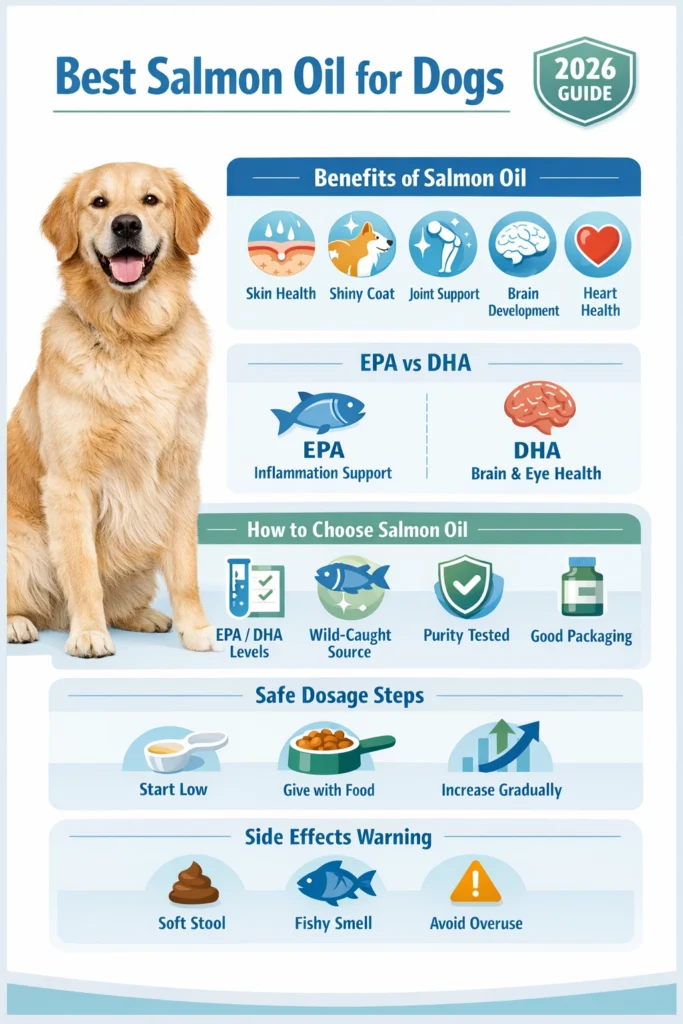
- EPA is often discussed for inflammation support
- DHA is often linked to brain and eye development
A good formula for one goal may not be ideal for another.
Step 3: Verify Quality Signals
Check for:
- source transparency
- test results or third-party testing, freshness controls, storage guidance, clear labeling
Step 4: Start Conservatively
Do not overdose at the beginning. Introduce the oil gradually so the digestive system can adjust.
This method is more reliable than guessing and more sustainable than randomly switching products.
Common Mistakes Dog Owners Make
A lot of frustration comes from avoidable errors.
1. Buying the cheapest bottle
Low price can sometimes mean low concentration, poor sourcing, weak testing, or worse freshness.
2. Ignoring EPA and DHA
If the label does not tell you the active omega-3 levels, you are buying blind.
3. Expecting instant results
Fatty acid support is gradual. A few days are rarely enough.
4. Starting too high
A heavy starting dose can upset the stomach and make the dog reject the oil.
5. Using oil as a substitute for diagnosis
If a dog has persistent itching, hair loss, hot spots, infection, or severe discomfort, a supplement alone is not the answer.
Expert Tips for Better Results
Here are the practical habits that improve the chance of success:
- Give salmon oil with food
- begin with a smaller amount
- increase gradually only if needed
- Use it consistently for several weeks
- monitor coat, stool, appetite, and scratching patterns
- Combine it with a balanced diet
- Seek veterinary advice for chronic skin or joint problems
Consistency beats intensity.
In other words, a moderate, reliable routine is usually better than a large, irregular dose.
Europe-Focused Buying Notes
If you are shopping in Europe, there are additional quality and compliance considerations worth keeping in mind.
Pet supplements in Europe are generally subject to feed and labeling rules, so transparency is important. Look for brands that are clear about:
- ingredient origin
- EPA and DHA content
- manufacturing standards
- compliance with relevant feed regulations
- responsible sourcing
For European buyers, reputable labeling and traceability are especially valuable. That means the packaging should not leave you guessing about where the oil came from, what it contains, or how it should be stored.
The smartest approach is to choose products with clear composition, dependable sourcing, and straightforward instructions.
Buying Checklist for Dog Owners
Before you buy, ask these simple questions:
- Does the label list EPA and DHA?
- Is the source clear?
- Is the oil third-party tested?
- Is the bottle protected from light?
- Does it include storage instructions?
- Does the dose fit my dog’s needs?
- Is the product fresh enough to use fully before expiration?
If the answer to several of these is “no,” keep looking.
This checklist helps you avoid marketing-driven purchases and focus on practical quality.
Which Dog Benefits Most from Salmon Oil?
Salmon oil can be useful for many Dogs, but it is especially appealing for:
- dogs with dry skin
- dogs that shed heavily due to coat dryness
- dogs with dull or brittle fur
- senior dogs needing joint support
- puppies needing DHA support
- dogs on dry food diets
- dogs that need an easy daily supplement
That said, not every dog needs it. A healthy dog already receiving a balanced diet may not need a supplement at all.
The right question is not “Can I use salmon oil?” but “Does my dog actually need this specific nutritional support?”
Pros and Cons Summary
Pros
- supports skin and coat health
- may help with inflammatory balance
- easy to mix into meals
- useful for puppies, adults, and seniors
- can support long-term wellness routines
Cons
- quality varies a lot
- Poor storage can ruin the oil
- can cause stomach upset in some dogs
- not a cure for disease
- Incorrect dosing can create problems
No supplement is perfect. Salmon oil is useful because it is practical, but it still needs thoughtful use.
A Smart Buying Framework in One Minute
If you only remember one thing from this guide, remember this:
- Identify your dog’s real goal
- Check the EPA and DHA values
- Verify freshness and testing
- Start with a small dose
- Monitor your dog for 3–6 weeks
That is the whole strategy.
The best salmon oil for dogs is not the fanciest bottle or the loudest marketing claim. It is the formula that matches your dog’s needs, contains clearly labeled omega-3s, and stays fresh long enough to be useful.
FAQs
Both can work, but the best choice is the one that clearly shows EPA and DHA levels.
Yes, daily use is common if the dosage is correct.
Usually 3–6 weeks, sometimes longer.
Yes, but only low-dose DHA-focused formulas.
Yes, if shedding is linked to dry skin or poor coat health.
Mild stomach upset, oily coat, or fishy smell in some dogs
Conclusion
In conclusion, salmon oil for Dogs is a simple but powerful nutritional supplement that can support skin health, coat shine, joint comfort, and overall wellness when used correctly. However, the real results depend less on branding and more on quality, EPA/DHA content, proper dosing, and consistency over time. It is not a quick fix, but a long-term support tool that works best when matched to your dog’s specific needs and introduced gradually. Choosing a well-tested, properly stored, and clearly labeled product—and using it with patience—is the key to seeing safe and meaningful improvements in your dog’s health.