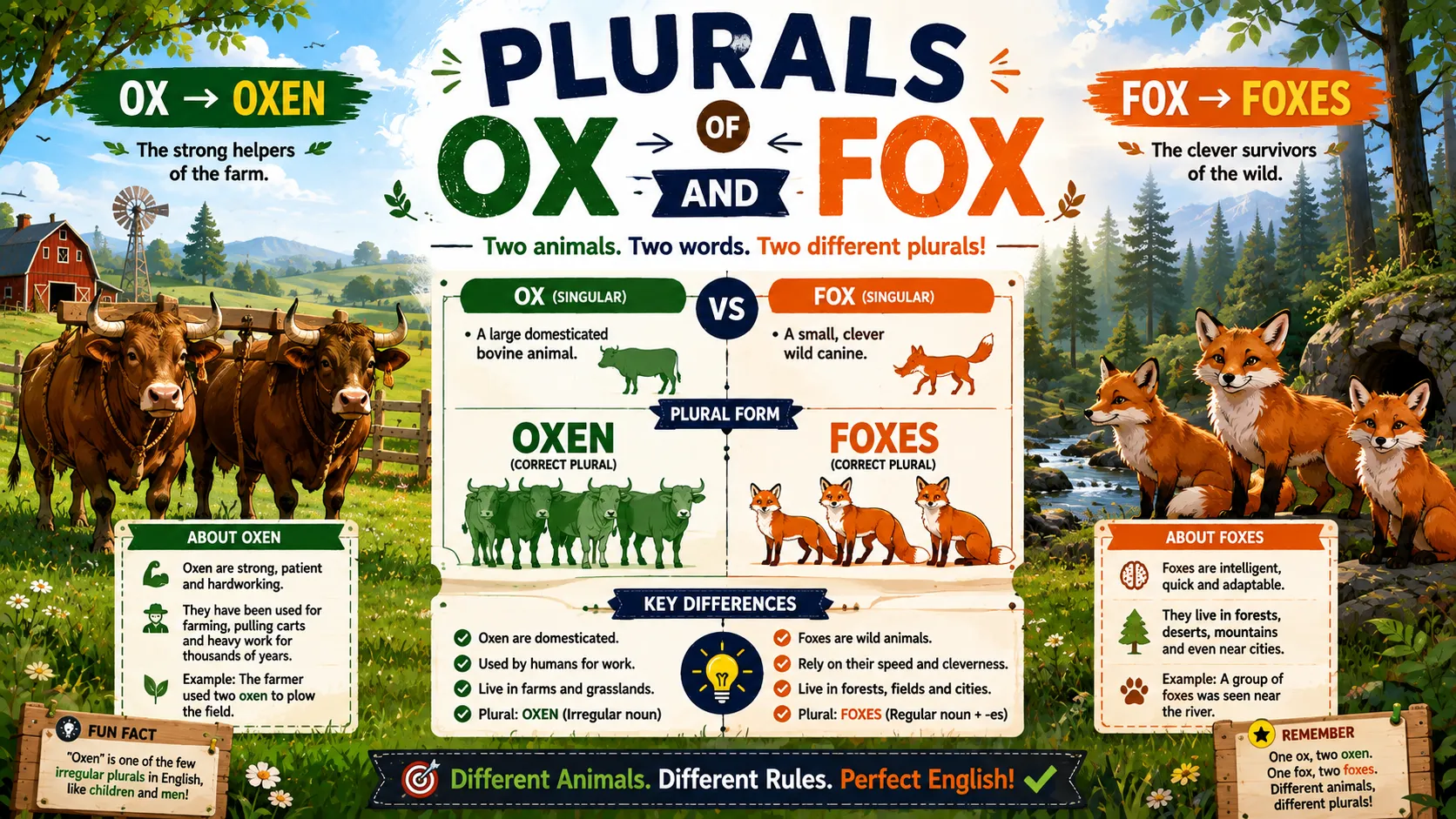
Plurals of Ox and Fox: Why It’s Oxen, Not Oxes (And Foxes, Not Foxen)
They look like they Should Rhyme Grammatically — both ox and fox are short, both end in -x — but their plurals come from two completely different systems in the history of English, and only one of those systems is still “alive” today. That’s the part most competing articles skip past.
1. Quick Answer: Plural of Ox and Fox
The plural of ox is oxen. The plural of fox is foxes.
| Word | Plural | Type | Formed by |
| Ox | Oxen | Weak (-en) plural | Adding the old Germanic suffix -en |
| Fox | Foxes | Regular plural | Adding -es after a sibilant sound |
- ❌ Oxes is never correct.
- ❌ Foxen is never correct — it’s a joke, not a word.
- ✅ Oxen and foxes are the only standard forms in modern English, confirmed by Merriam-Webster, Cambridge, and the Oxford English Dictionary.
2. Singular Forms of Ox and Fox
Ox (plural: oxen) refers to a castrated adult bull, typically of domestic cattle, raised and trained specifically as a draft animal for plowing, hauling, and other heavy farm labor. It comes from Old English oxa.
Fox (plural: foxes) refers to a small-to-medium canine mammal in the genus Vulpes (most commonly the red fox), known for its bushy tail, pointed muzzle, and reputation for cunning in folklore across dozens of cultures. It comes from Old English fox.
Both words are over a thousand years old. Both end in the letter “x.” That’s basically where the similarity ends.
3. Regular vs. Irregular Plural Nouns in English
Modern English mostly makes plurals one way: add -s, or -es if the word ends in a hissing/buzzing sound (s, x, z, ch, sh). Cat → cats. Box → boxes. Simple.
But English wasn’t always this tidy. Old English (spoken roughly 450–1150 CE) had several competing plural systems, inherited from Proto-Germanic, and modern “regular” -s/-es plurals only won out gradually over the following few centuries. A handful of words got left behind, still using older rules. Ox is one of the purest surviving examples.
Most articles on this topic lump every leftover “irregular” word into one bucket. That’s inaccurate. There are actually two distinct kinds of irregular plural hiding in that list, and separating them is the key to understanding this topic instead of just memorizing it — covered in the next two sections.
4. Why Ox Becomes Oxen
Ox comes from Old English oxa. In Old English, this noun belonged to a class that formed its plural with the suffix -an, giving the plural oxan. Over the centuries, as English spelling and pronunciation shifted, -an smoothed into the modern -en — leaving us with oxen.
Almost every other noun that once followed this same pattern eventually switched over to the regular -s plural. Ox is one of only a couple of words that never made that switch, which is exactly why it still looks “wrong” to modern instincts.
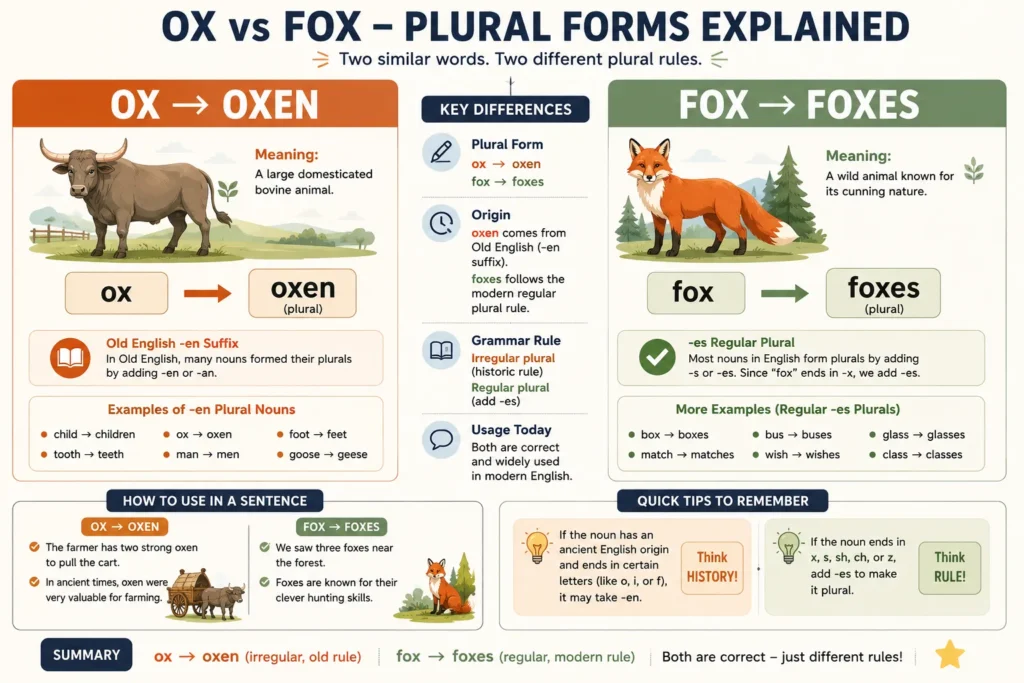
5. Weak (-en) Plurals: The Oxen Family
This group is called the Old English weak noun declension. It’s a suffix pattern — you’re adding something onto the end of the word, not changing the word itself. Today only a tiny handful of true -en plurals survive in ordinary use:
- ox → oxen
- child → children (technically a double plural: the Old English plural was already cildru*, and speakers later added* -en on top of it — the only English noun with two plural markers stacked together)
- brother → brethren (archaic/religious usage only; “brothers” is the everyday plural)
This is the group ox belongs to.
6. Mutation Plurals: The Geese/Men Family (Not the Same as Oxen)
This is the group almost every competing article incorrectly merges with oxen. These plurals come from a totally different historical process called i-mutation (or umlaut): in prehistoric Old English, a plural-marking sound that used to follow the vowel caused the vowel itself to shift, and then that original ending sound dropped off entirely — leaving only the changed vowel to signal “plural.”
- man → men
- woman → Women
- foot → feet
- tooth → teeth
- goose → geese
- mouse → mice
- louse → lice
None of these add -en, -s, or any suffix at all — the entire plural is carried by the vowel change. That makes them fundamentally different from oxen, not cousins of it.
Why this matters: if a grammar page tells you “oxen, children, geese, and men are all -en plurals,” it has the mechanism wrong for half its examples — geese and men never had an -en ending at any point in their recorded history.
7. Why Fox Becomes Foxes
Fox never belonged to the weak declension in the first place — Old English fox already pluralized with the ancestor of the modern -as/-es ending, so it was on the “regular” track from the start. It simply rides the same rule that governs any modern noun ending in a sibilant sound (s, x, z, ch, sh): add -es, both to keep the word pronounceable and to mark the extra syllable clearly in speech.
- box → boxes
- fax → faxes
- buzz → buzzes
- match → matches
- dish → dishes
- fox → foxes
There has never been a stage of English where “foxen” was a standard form. It shows up occasionally as a deliberate joke (by analogy with oxen) or in fantasy writing for stylistic flavor — but it has no historical grammatical basis, unlike kine or eyen, which really were once real plurals that later fell out of use.
8. Pronunciation of Oxen and Foxes
- Oxen is pronounced /ˈɒksən/ (OK-sən) — two syllables, stress on the first.
- Foxes is pronounced /ˈfɒksɪz/ (FOK-siz) in British English or /ˈfɑːksɪz/ in American English — also two syllables, with that telltale “-iz” ending.
Say “foxs” out loud — it’s nearly impossible to pronounce cleanly, which is exactly why English inserts that extra vowel sound before the final -s. That “-iz” sound is the giveaway you’re dealing with a regular sibilant plural, not an irregular one.
9. Oxen vs. Foxes: Side-by-Side Comparison
| Feature | Ox | Fox |
| Plural | Oxen | Foxes |
| Plural type | Weak (-en) plural | Regular (-es) plural |
| Mechanism | Suffix added | Suffix added |
| Old English root | oxa → oxan | fox → foxas |
| Still productive today? | No — closed class of ~2 words | Yes — applies to any new noun ending in a sibilant |
| Common mistake | “Oxes” | “Foxen” |
| Pronunciation | /ˈɒksən/ | /ˈfɒksɪz/ |
10. Vixen, Kits, and Skulks: Related Fox Terms
- A female fox is a vixen.
- A baby fox is a kit or, less commonly, a cub or pup.
- A group of foxes is most often called a skulk of foxes, though leash and earth also appear in older hunting terminology.
None of these terms show up on competing “plural of ox and fox” pages, despite being some of the most-searched adjacent queries for this exact topic.
11. Cow, Calf, and Yoke: Related Ox Terms
- A female ox (technically, the intact female of domestic cattle used for the same work) is simply a cow; a young one is a calf.
- A group of oxen is a yoke, team, drove, or span of oxen, depending on region and era — “yoke” specifically referred to a pair harnessed together.
- An ox that hasn’t been castrated and trained for labor is technically a bull; a castrated young male raised for beef rather than labor is a steer or bullock.
12. Other Words Ending in -X and Their Plurals
English has a few exceptions worth knowing if you’re going down this rabbit hole:
| Singular | Plural | Notes |
| Box | Boxes | Standard -es rule |
| Fox | Foxes | Standard -es rule |
| Lynx | Lynxes | Standard -es rule (occasionally “lynx” is left unchanged as a collective, like “deer”) |
| Fax | Faxes | Standard -es rule |
| Index | Indexes or Indices | Two acceptable plurals — “indices” in math/science, “indexes” in general/publishing use |
| Ox | Oxen | The one true exception on this list |
13. Common Mistakes: Oxes and Foxen
- Writing “oxes.” This is the single most common error with this word, and it’s understandable — every instinct from regular English grammar tells you to add -es to a word ending in x. Ox is simply the exception that instinct doesn’t cover.
- Writing or saying “foxen” as if it were correct. It’s a pun, not a plural. Use it only if you’re intentionally being playful.
- Assuming “oxen” and “children” work by the same rule as “geese” and “men.” They don’t — oxen/children are suffix plurals, geese/men are vowel-mutation plurals.
- Using “ox” as a plural itself. Unlike some collective animal terms (deer, sheep, fish), ox does change form in the plural — you always need “oxen” for more than one.
14. Quick Practice Exercise
Try filling in the blanks before checking the answers below.
- The farmer hitched two ______ (ox) to the plow.
- A ______ (fox) den was spotted near the old barn.
- It’s ______ (fox), never foxen — no matter how tempting that sounds.
- The word ______ (ox) is one of the last surviving -en plurals in English, alongside children.
- A group of foxes is called a ______ of foxes.
Answers: 1. oxen 2. fox’s 3. foxes 4. oxen 5. skulk
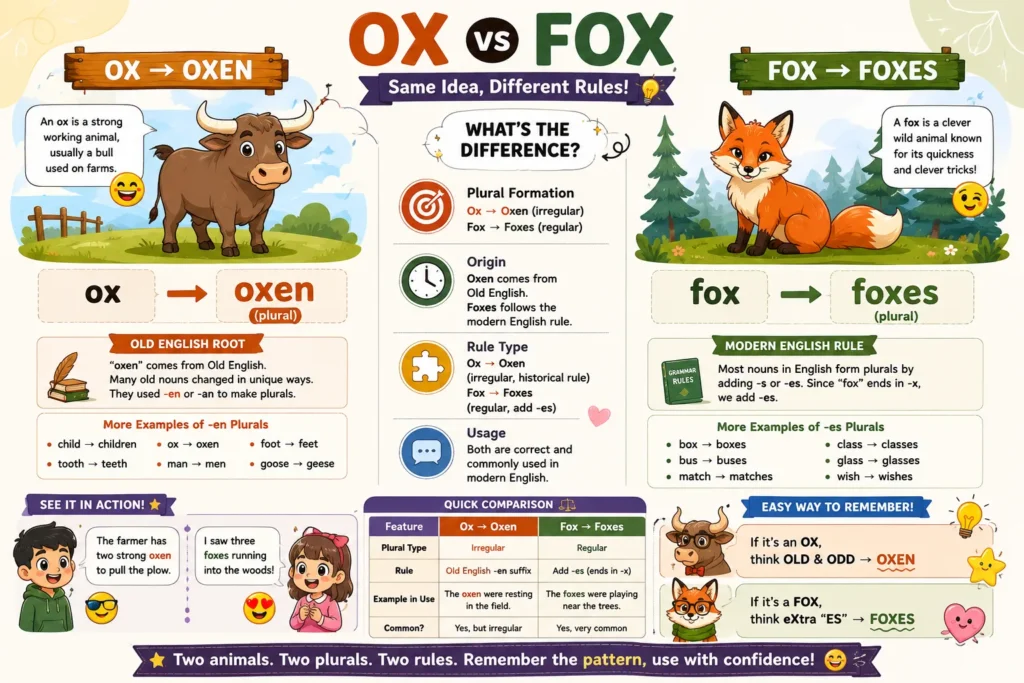
15. Other Surviving Irregular Plurals in English
Beyond the weak (-en) and mutation families already covered, English keeps a few more irregular patterns alive:
- Zero plurals (same form singular and plural): sheep, deer, fish, moose, aircraft
- Foreign/borrowed plurals: criterion → criteria, cactus → cacti, phenomenon → phenomena
- Archaic weak plurals that didn’t survive: eyen → eyes, shoon → shoes, kine → cows (kine still appears occasionally in poetic or dialectal use)
Explore Nore: https://dogizle.com/goomar-meaning/
People Also Ask
The plural of ox is oxen. The plural of fox is foxes. Ox uses an old Germanic -en suffix; fox uses the regular modern -es rule for words ending in a sibilant sound.
No. “Oxes” is a common but incorrect form. The only standard modern English plural of ox is oxen, in every major dictionary and style guide.
Because ox descends from a small, closed group of Old English nouns that formed plurals with the suffix -an (later -en) rather than the -s/-es ending that eventually became the default for almost every other English noun. Ox simply never switched over.
Because fox was never part of that -en plural group historically — its Old English plural already used the ancestor of the modern -es ending. “Foxen” only sounds plausible because oxen exists; it has no basis in the actual history of the word.
No, and this is the most commonly repeated error on this topic. Oxen (like children) is a weak, suffix-based plural — you add -en. Geese, men, feet, teeth, and mice are mutation plurals — the vowel itself changes, with no suffix added at all.
Conclusion
Ox and fox look like Grammatical Twins — same length, same final letter, same animal-noun category — but they represent two different chapters of English history colliding in the present tense. Oxen is a fossil of the Old English weak declension, one of only two or three words still carrying it. Foxes is just the regular rule doing what it always does. Neither is an accident, and neither is really “wrong” or “weird” once you see the system behind it — English just kept a couple of its oldest habits around for these particular animals.