Grand Rising Meaning: What It Really Means, Where It Comes From, and How to Respond
Quick answer: “Grand rising” is a warm, intentional way of saying “good morning.” It comes from African American Vernacular English (AAVE) and Black spiritual/conscious-living culture, and it swaps “morning” for “rising” so the greeting doesn’t sound like “mourning.” People use it to express gratitude for waking up and to set a positive tone for the day.
If you’ve seen “Grand Rising” replacing “Good Morning” in a caption, a text, or a comment section, you’ve probably wondered what it actually means, where it came from, and whether it’s something you should be saying too. This guide answers all of that clearly, in one place.
1. What Does “Grand Rising” Mean?
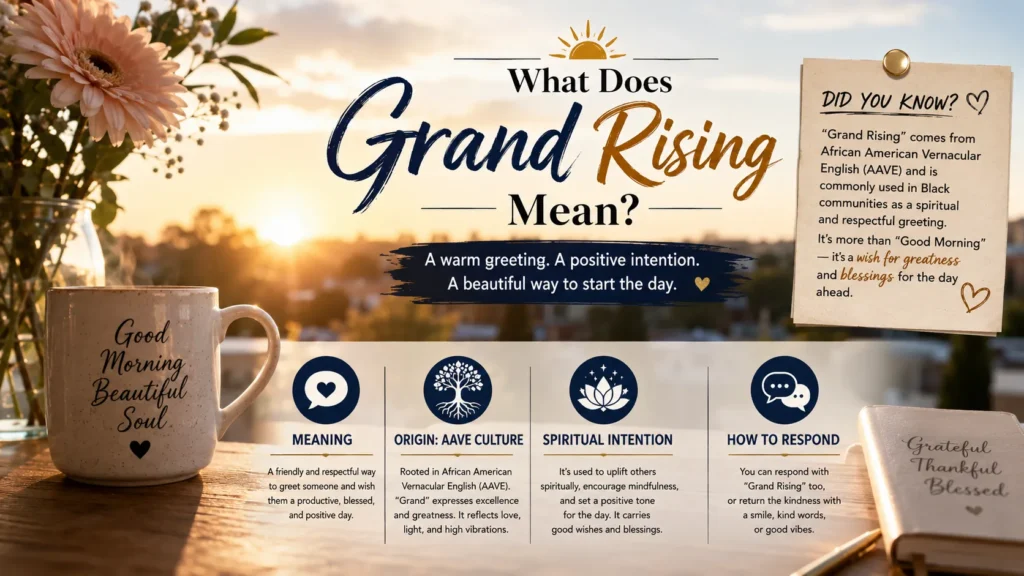
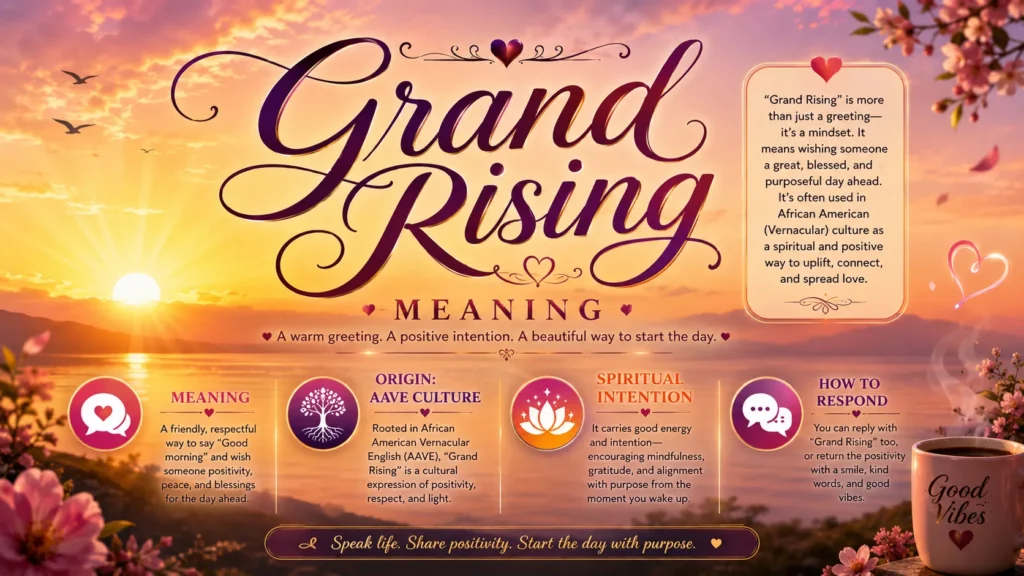
“Grand rising” is a greeting used in place of “good morning.” It means essentially the same thing — hello, I hope your day is good — but it’s a deliberate word choice rather than a default one.
- Grand = magnificent, worth celebrating, significant
- Rising = waking up, the sun rising, rising above yesterday’s struggles
Together, “grand rising” isn’t just a hello — it’s a small daily affirmation that you made it to a new day, and that the day has potential.
2. Quick Meaning Summary
| Aspect | Detail |
| Meaning | An intentional, affirmation-based way of saying “good morning” |
| Origin | African American Vernacular English (AAVE), Black spiritual/conscious-living culture |
| First mainstream visibility | Social media (Instagram, then TikTok), early-to-mid 2020s |
| Core reasoning | Avoids the “morning/mourning” homophone; adds gratitude and intention |
| Typical users | Black spiritual and wellness communities, conscious-living/manifestation communities, now broader social media users |
| Formality | Casual to spiritual/personal — not typically used in formal business contexts |
3. Where Does “Grand Rising” Come From?
Well-supported: “Grand rising” comes out of AAVE and Black spiritual/conscious-living communities, where intentional, affirmation-based language has long been part of everyday speech. It gained wider visibility through Black social media creators and spiritual wellness spaces, then crossed into mainstream slang via Instagram captions and later TikTok.
Contested or unverified:
- Rastafarian tradition and reverence for the rising sun — thematically plausible, not conclusively documented.
- Caribbean origins specifically — may reflect the broader Black diaspora’s shared linguistic patterns rather than one point of origin.
- Ancient Egyptian deities — a recent TikTok claim with no credible historical or linguistic support. This looks like social media retroactively assigning ancient significance to a modern phrase.
Bottom line: “Grand rising” is a modern AAVE-rooted phrase from Black spiritual and conscious-living culture — not an ancient or foreign import. Its exact first use isn’t publicly documented, which is normal for organically grown slang.
4. Why “Rising” Instead of “Morning”?
The most consistent explanation is a play on sound: “morning” and “mourning” are homophones. In communities that pay attention to the vibrational or energetic quality of words, saying “morning” every day is, linguistically, saying something that sounds like grief on repeat. “Rising” replaces that with a word about upward motion — getting up, the sun climbing, rising above Circumstance.
This instinct also shows up in phrases like “blessed morning” or “great rising,” where speakers deliberately choose words that match the energy they want to carry into the day.
5. Grand Rising on Social Media
- TikTok: Widely used in spiritual, mindfulness, and “conscious living” caption culture. Also the source of the unfounded Egyptian-origin claim and various parody/meme versions.
- Instagram: One of the earliest mainstream homes for the phrase — often paired with sunrise photos, gratitude posts, or morning affirmation content.
- X (Twitter) and Facebook: Used more casually as a greeting or reply to morning posts, often without the deeper spiritual framing.
- Reddit and Quora: Mostly host debate around the phrase’s meaning and appropriateness rather than organic use of it.
6. The Spiritual Meaning Behind Grand Rising
For people who use the phrase with intention, “grand rising” functions like a micro-ritual. It can represent:
- Gratitude — acknowledging that waking up at all isn’t guaranteed
- Intention-setting — a verbal cue to start the day with purpose instead of autopilot
- Reclamation — choosing language that feels self-authored rather than inherited by default
- Community connection — a shared greeting that signals belonging within Black spiritual and conscious-living spaces
This spiritual framing is a practice, not a fixed doctrine — some tie it to prayer or faith, others to secular mindfulness, and plenty just like the sentiment.
7. Grand Rising in the Bible
“Grand rising” itself does not appear in Scripture — it’s a modern phrase, not a biblical one. However, the broader concept of “rising” carries real weight in the Bible:
- Resurrection imagery — Jesus Christ’s rising is the Bible’s central “rising” narrative.
- Renewal and mercy — passages describing God’s mercy as “new every morning” echo the same spirit of daily gratitude that “grand rising” expresses.
- Rising above hardship — Scripture frequently frames faith as strength to rise above struggle, doubt, or fear.
Some Christians use “grand rising” comfortably as a personal expression of gratitude for a new day. Others prefer to keep it separate from worship language since it isn’t a biblical term. Neither position makes the phrase itself “unbiblical” — it’s simply not sourced from Scripture.
8. Grand Rising vs. Good Morning
| Good Morning | Grand Rising | |
| Origin | Old English, universal | AAVE, Black spiritual/conscious-living culture |
| Tone | Neutral, formal-friendly | Warm, intentional, energetic |
| Common context | Any setting, including professional | Social media, casual, spiritual/wellness spaces |
| Underlying idea | Acknowledges the time of day | Celebrates waking up and starting fresh |
| Workplace appropriateness | Always safe | Better suited to personal relationships |
Functionally, the two are interchangeable greetings. The difference lives in tone and intent.
9. Is “Grand Rising” Cultural Appropriation?
The case for caution: The phrase originates in Black spiritual and linguistic tradition. Stripping it of context and using it purely as an aesthetic or trend — especially for profit, without acknowledgment — mirrors a pattern seen with other AAVE terms that went mainstream.
The case for more nuance: Language spreads and evolves constantly. Many people who use “grand rising” do so out of genuine appreciation, not extraction. Intent, context, and awareness all matter.
- Understand where the phrase comes from
- Don’t present it as your Own invention or repeat false origin claims
- Don’t mock it or use it ironically while ignoring its cultural roots
Used with genuine sentiment and basic awareness, most communities describe this as respectful use, not appropriation.
10. The Andrew Tate Controversy, Explained
“Grand rising” spiked in mainstream search volume partly because Andrew Tate began using the phrase publicly as part of his personal branding around discipline and masculinity. Black social media users quickly pushed back, correctly noting he didn’t originate the phrase — it predates his usage by years within Black spiritual and AAVE culture.
It’s a useful example of how slang migrates: a phrase with deep cultural roots gets picked up by a high-visibility figure, presented as novel, and the resulting friction becomes its own cultural moment.
11. How to Respond to “Grand Rising”
- Mirror it back: “Grand Rising!” — simplest, most natural response.
- Add warmth: “Grand Rising to you too, hope you have a beautiful day.”
- Keep it casual: A plain “Good morning!” or “Morning!” is completely fine.
- Just say thanks: “Thank you, you too!”
- Non-verbal: A smile, wave, or emoji (👍/☀️) works in casual texting.
Avoid responding sarcastically or dismissively if the person clearly means it sincerely.
12. When (and When Not) to Use Grand Rising
Good contexts:
- Texting friends or family
- Social media captions and comments
- Spiritual, wellness, or conscious-living communities
- Personal journaling or affirmation practices
Think twice:
- Formal workplace emails or client communication
- Using it performatively with zero understanding of its background
- Using it to mock or parody Black culture or AAVE
13. Common Misunderstandings
- “It’s an ancient Egyptian phrase.” Not supported by any credible source.
- “Andrew Tate invented it.” No — he popularized it, but it predates him.
- “It can be used any time of day.” Traditionally, it’s morning-specific.
- “It’s tied to one specific religion.” It isn’t — its spiritual framing varies person to person.
14. Grand Rising Synonyms and Related Terms
- Blessed Morning
- Great Rising
- Rise and Shine (used with intention)
- Joyful Morning
- Peaceful Morning
- Wishing You a Grand Day
15. Examples of Grand Rising in a Sentence
- “Grand Rising, everyone! Let’s make today count.”
- “Woke up grateful today — Grand Rising to my whole timeline.”
- She texted back, “Grand Rising! Hope your morning is just as bright.”
- “Grand Rising, fam. New day, new mercies.”
- He starts every journal entry with “Grand Rising” before writing his goals for the day.
People Also Ask
It’s an informal, energetic way of saying “Good Morning,” used especially within Black spiritual and conscious-living communities, that emphasizes gratitude and intention for the new day.
Traditionally, yes — it’s a morning-specific greeting rather than a general hello for any time of day.
No. The phrase predates his usage and comes from AAVE and Black spiritual culture; his use of it simply brought it to a wider, more mainstream audience.
Not inherently. Using it with awareness of its origins and genuine sentiment is generally seen as appreciation rather than appropriation. Mocking it or spreading false origin claims is where it becomes disrespectful.
It can, depending on who’s using it — some tie it to prayer or spiritual gratitude, others use it in a secular, mindfulness-oriented way. There’s no single official doctrine attached to it.
No, the exact phrase isn’t biblical, though the Bible’s themes of resurrection and daily renewal echo a similar spirit.
Conclusion
“Grand Rising” is more than a trendy swap for “good morning” — it’s an intentional greeting rooted in African American Vernacular English and Black spiritual/conscious-living culture, built around gratitude, positive intention, and avoiding the accidental echo of “mourning.” Viral claims about ancient Egyptian origins don’t hold up, and while public figures like Andrew Tate brought it to new audiences, they didn’t create it.
Used with a basic understanding of where it comes from, “grand rising” is a warm, low-stakes way to start a conversation — and now you have the full, accurate picture behind i.t
Here are both prompts, ready to drop into any AI image generator (Midjourney, DALL·E, Ideogram, etc.), each specified for landscape/wide orientation.