WRD Meaning in Text: The Complete Guide to Origin, Uses, and Etiquette
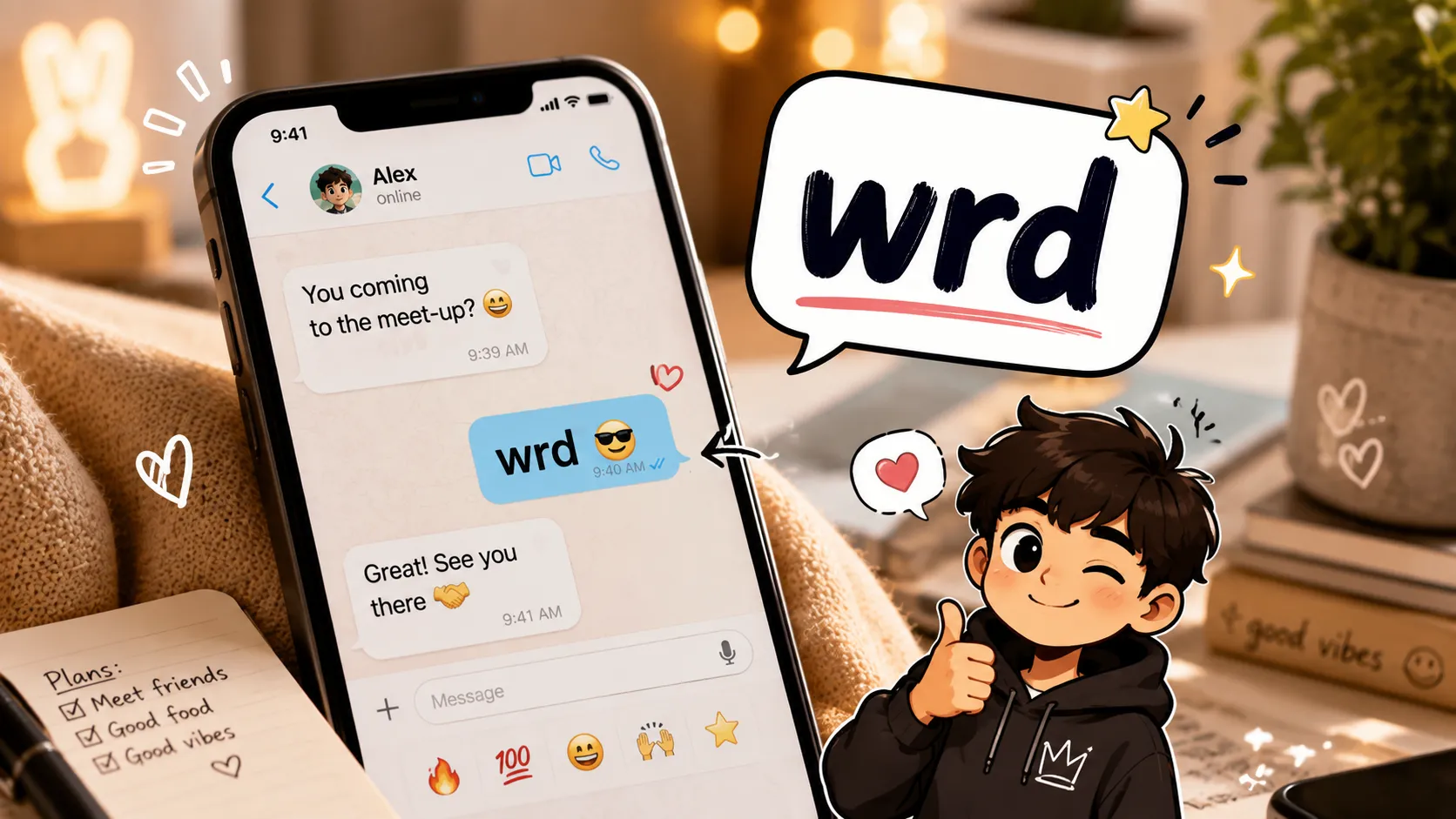
You get a text back that just says “Wrd.” No punctuation, no context clue, nothing.
Is it a typo? A new abbreviation you missed? Something you’re supposed to already know?
Here’s the short version, then the full picture — because “wrd” actually carries more nuance than the one-line answers you’ll find elsewhere.
Quick Answer
“WRD” is texting shorthand for “word.” It’s used to show agreement, acknowledgment, or (less often) surprise — similar to saying “I hear you,” “for real,” or “okay, got it.” A separate, smaller usage shortens “weird” to “wrd” instead, so context always decides which one you’re looking at.
Quick Meaning Summary
| Full form | “Word” (vowel-dropped) |
| Category | Texting / internet slang |
| Primary meaning | Agreement, acknowledgment (“I hear you,” “understood”) |
| Secondary meaning | Surprise/disbelief when written “wrd?” |
| Minor alternate meaning | “Weird” (mostly Snapchat) |
| Tone | Casual, informal |
| Best used in | Texts, DMs, group chats, comment sections |
| Avoid in | Professional messages, formal writing |
| Origin | AAVE, popularized via hip-hop culture (late 1980s–90s) |
What Does WRD Mean in Text?
At its core, WRD is a vowel-dropped spelling of “word.” Texting culture routinely strips vowels from common responses to save keystrokes — “gd” for “good,” “srsly” for “seriously,” and “wrd” for “word” all follow the same pattern.
But the meaning doesn’t come from the spelling shortcut alone — it comes from a decades-old spoken expression. When someone says “word” out loud in response to a statement, they’re not talking about vocabulary. They’re saying:
- “I hear you.”
- “That’s true.”
- “I agree.”
- “Understood.”
“WRD” is simply that spoken habit, typed. It’s less a new slang term and more a texting-era transcription of something people have been saying out loud since long before smartphones existed.
Where WRD Actually Comes From {#where-wrd-actually-comes-from}
Most articles on this topic mention “hip-hop” in one vague sentence and move on. Here’s the fuller picture:
The expression “word” as a stand-alone affirmation traces back to African American Vernacular English (AAVE), where it was used to affirm truth or agreement — close in spirit to “that’s right” or “you’re speaking facts.” It gained wide cultural visibility through hip-hop and street culture in the late 1980s and early 1990s, often shortened further to “word up” or “word is bond” (meaning your word is your promise — a phrase popularized in that era’s music).
From there, the timeline into texting looks roughly like this:
- 1980s–1990s: “Word” spreads as a spoken affirmation through hip-hop culture.
- Early 2000s: As SMS and early chatrooms (IRC, AIM) popularize vowel-dropped shorthand, “word” becomes “wrd” in typed conversation.
- 2010s: Snapchat, Instagram, and group texting normalize “wrd” as a default one-word reply among younger users.
- 2020s–today: TikTok comment sections and Discord chats keep “wrd” in constant circulation, now often paired with reaction emoji or GIFs instead of a written reply.
Because the term’s roots are specific to AAVE, it’s worth using with a bit of awareness — the phrase carries cultural history, not just texting convenience. More on that in the respect and appropriateness section below.
The 4 Real Meanings of WRD (and How Punctuation Changes Them) {#the-4-real-meanings-of-wrd}
This is the part most guides flatten into one bullet point. In practice, punctuation and tone completely change what “wrd” is doing in a conversation.
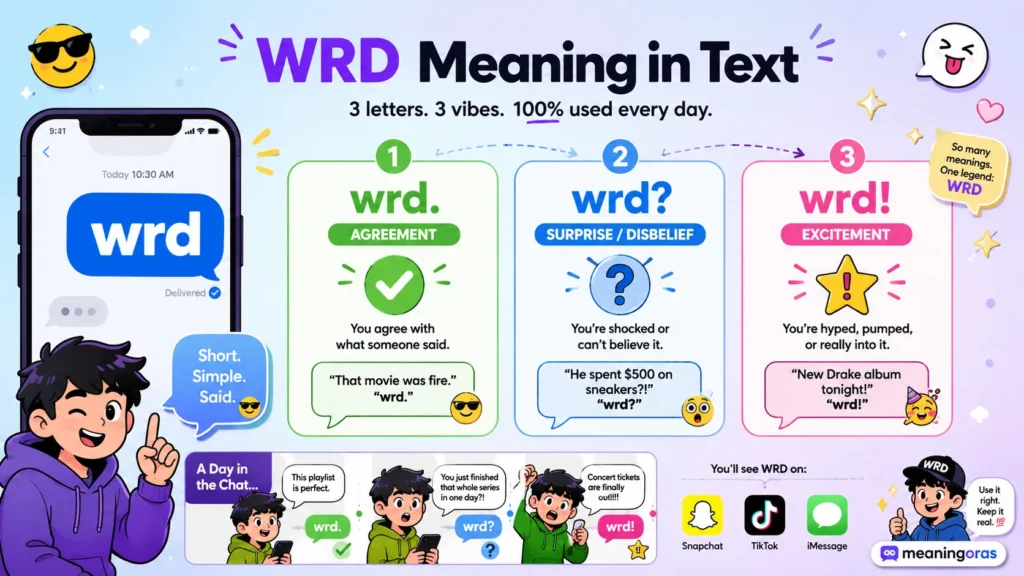
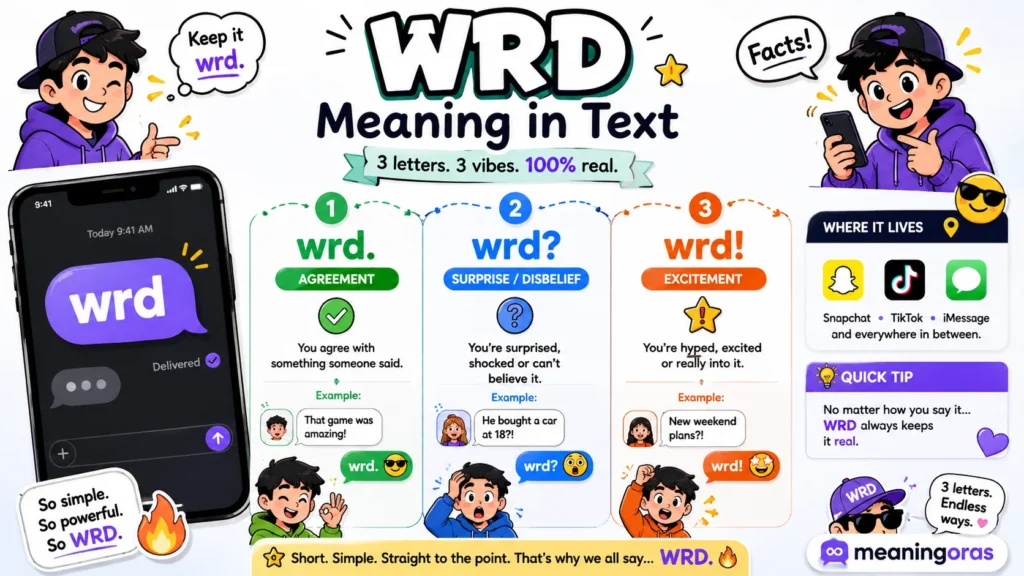
1. Agreement or Acknowledgment — “wrd.”
The default, most common use. A calm, neutral confirmation that you heard and agree.
“I’ll be there around 8.” → “wrd.”
2. Surprise or Disbelief — “wrd?”
Add a question mark, and it flips into “really?” or “are you serious?” — a request for confirmation, not agreement.
“I got the job.” → “wrd?? no way”
3. Excitement or Emphasis — “wrd!”
An exclamation point turns a flat acknowledgment into genuine enthusiasm — closer to “hell yeah” or “let’s go.”
“We’re going to the concert this weekend!” → “wrd!! finally”
4. “Weird” (a separate, minority usage) — “wrd” or “so wrd”
On some platforms, mostly Snapchat, a smaller group of users shorten “weird” the same way, dropping the “ei” instead of the “o.” This version usually shows up describing a person, situation, or behavior rather than replying to a statement.
“He texted me at 3 a.m. asking for advice on his ex.” → “that’s so wrd”
How to tell them apart in practice: the “word” meaning almost always follows a statement someone just made (it’s a response). The “weird” meaning almost always describes a noun — a person, thing, or event (it’s a description). If “wrd” is sitting alone as a reply, it’s “word” more than 90% of the time.
WRD on Snapchat, TikTok, Discord, and iMessage {#wrd-by-platform}
The “word” meaning is consistent everywhere, but usage habits shift slightly by platform:
| Platform | How WRD typically shows up |
| Snapchat | Most common spot for the “weird” alternate meaning; often paired with reaction stickers or a 😏/😳 emoji to signal tone |
| TikTok | Almost always “word,” used in comment sections to agree with a video or another comment |
| Instagram DMs / comments | Quick agreement or acknowledgment, frequently followed by a follow-up question |
| Discord / gaming chats | Fast acknowledgment mid-match (“gg” energy) — confirms you saw a message without breaking focus |
| iMessage / SMS | The most neutral use — plain agreement, similar to “ok” or “got it” |
The meaning barely changes across apps. What changes is how often the “weird” alternate reading shows up — it’s essentially a Snapchat-specific quirk rather than a cross-platform standard.
WRD in a Sentence: Real Examples {#wrd-in-a-sentence}
Showing agreement:
- “That movie was actually incredible.” → “wrd, best one this year”
Confirming plans:
- “Meeting’s moved to 7.” → “wrd, I’ll be there”
Reacting to news:
- “I finally passed my driving test!” → “WRD!! Let’s celebrate”
Expressing disbelief:
- “She said she’s moving to another country next month.” → “wrd? since when”
Casual check-in response:
- “Just got back from the gym, feeling good.” → “wrd, keep it up”
Using the “weird” meaning:
- “This app keeps logging me out for no reason.” → “Yeah, that’s been wrd all week”
How to Respond to WRD {#how-to-respond-to-wrd}
This is a genuinely common follow-up question that competing guides skip entirely: what do you say back when someone sends you “wrd”?
There’s no fixed reply — “wrd” doesn’t demand a response the way a question does — but a few natural options:
- Mirror it back: “wrd” → “fr” or “wrd” (keeps the same casual energy)
- Move the conversation forward: treat it as an acknowledgment and just continue the topic — no reply is technically “required”
- Add detail if they seemed surprised: if they sent “wrd?” you’re expected to confirm or explain further, since that version is really a question in disguise
- Match the emotional tone: if they sent “WRD!!” back with enthusiasm, a flat “ok” can read as dismissive — a fitting reply keeps similar energy
WRD vs. Word vs. Bet vs. FR: How They Actually Differ {#wrd-vs-similar-slang}
These terms overlap, but they aren’t interchangeable — each carries a slightly different implication:
| Term | Best used for | Implied tone |
| WRD | General agreement or acknowledgment | Neutral, casual |
| Word (spoken/full spelling) | Same as WRD, more old-school or spoken | Neutral |
| Bet | Agreeing to a plan or confirming you’ll follow through | Confident, action-oriented |
| FR (for real) | Emphasizing that something is genuinely true | Sincere, emphatic |
| Say less | Signaling you understand and no further explanation is needed | Confident, decisive |
| Aight | Casual acceptance, often slightly more indifferent | Relaxed, neutral-to-mild |
| Facts | Strongly agreeing with an opinion or statement | Emphatic agreement |
If you only remember one distinction: “wrd” acknowledges, “bet” commits, “fr” emphasizes truth, and “facts” validates an opinion. They get used interchangeably in casual speech, but a careful writer or curious reader can hear the difference.
When to Avoid Using WRD {#when-to-avoid-wrd}
WRD is built for low-stakes, casual exchanges. Skip it in:
- Professional emails or work Slack/Teams messages — reads as unclear and overly casual
- Messages to someone Significantly Older or unfamiliar with texting slang — high risk of the “typo?” confusion this article opened with
- Serious or sensitive conversations — a one-word reply can feel dismissive when someone is sharing bad news or something emotional
- Formal writing of any kind — school assignments, cover letters, official documents
In those settings, a plain “understood,” “got it,” or “I agree” communicates the same thing without the ambiguity.
Is WRD Rude or Disrespectful?
No — WRD itself isn’t rude. It’s informal, not hostile. The risk isn’t offense; it’s mismatched tone. A one-word reply can feel curt in a serious conversation, even though that’s rarely the sender’s intent.
Worth noting separately: because the phrase’s roots trace to AAVE and hip-hop culture, it’s reasonable (and increasingly common advice) to use it the way you would any borrowed cultural slang — casually, without mocking or exaggerating it for effect. Used normally in conversation, it’s not considered disrespectful; used as a caricature or stereotype, it can read that way. That distinction matters more than most guides let on.
Other Meanings of WRD (Outside Texting) {#other-meanings-of-wrd}
Texting slang isn’t the only place “WRD” shows up. A few legitimate, unrelated expansions exist:
- Water Resources Department — a common government agency name used at the state or municipal level in several countries.
- Word (computing) — in computer science, a “word” is a fixed-sized unit of data a processor handles at once (commonly 16, 32, or 64 bits), and “WRD” occasionally appears as shorthand for it in technical documentation.
- “What’s Really Good” — occasionally cited as an alternate slang expansion, functioning as a casual greeting similar to “what’s up.” This usage is far less common than the “word” meaning and mostly appears in isolated slang-dictionary entries rather than everyday conversation.
Explore More: https://dogizle.com/oop-meaning-in-text/
Common Misunderstandings
A few mix-ups come up often enough to call out directly:
- “It’s just a typo.” It isn’t — it’s a deliberate, consistent abbreviation, not a dropped letter.
- “It’s brand new Gen Z slang.” The spelling is recent; the underlying expression (“word” as agreement) predates texting by decades.
- “WRD only ever means ‘weird.'” This happens when someone sees it once in a Snapchat caption and assumes that’s the default — it’s the minority usage, not the standard one.
- “A one-word ‘wrd’ reply means someone’s uninterested or annoyed.” Usually not — it’s simply efficient, low-effort acknowledgment, not a mood signal. Tone comes from punctuation and surrounding context, not the word choice itself.
- “It’s disrespectful to use if you’re not familiar with hip-hop culture.” Used in its ordinary conversational sense, it’s broadly accepted slang; the concern is exaggeration or mockery, not casual everyday use.
People Also Ask
The same thing regardless of who sends it — Agreement or acknowledgment. There’s no gender-specific meaning; only tone and punctuation shift the nuance.
Yes. “WRD” is simply the vowel-dropped, faster-to-type version of “word,” used the same way.
No. Add a question mark (“wrd?”) and it means “really?” Add an exclamation point (“wrd,”! and it signals excitement. Used to describe something rather than reply to it, it can mean “weird” instead.
Generally no. It’s casual slang best kept to friends, DMs, and informal group chats — not client-facing or professional messaging.
Speed and style. Dropping vowels is a common texting shortcut, and using the abbreviated form also signals familiarity with current online conversational norms.
It originates from African American Vernacular English and was popularized further through hip-hop culture in the late 1980s and early 1990s, often as part of the longer phrase “word is bond.”
Conclusion
WRD comes down to one simple idea: it’s texting shorthand for “word,” used to show agreement, acknowledgment, or excitement — with a smaller, mostly Snapchat-specific meaning of “weird” showing up when it’s describing something rather than replying to it. Punctuation does the heavy lifting: a period keeps it calm, a question mark turns it into disbelief, and an exclamation point signals genuine enthusiasm.
The term isn’t new slang dressed up for texting — it’s a decades-old AAVE and hip-hop expression that simply found a shorter spelling once typing speed started to matter. Used casually among friends, it’s a fast, natural way to keep a conversation moving; used in professional or formal settings, it’s worth swapping for plainer language.
Once you know the difference between “wrd,” “wrd?”, and “wrd!” — and can spot the rare “weird” usage from context — you’ll never have to pause over that text again.