
Goomar Meaning: Origin, Definition, and How It’s Really Used
You heard it in The Sopranos. Maybe a coworker dropped it as a joke. Maybe someone texted it and you had to Google it mid-conversation. Either way, you landed here because you want a straight answer, not a rambling history lecture — so here it is: A Goomar is Italian-American slang for a mistress or “side chick,” almost always tied to a married man living a double life. Below, we break down exactly where the word comes from, how people actually use it today (in texts, on TikTok, and in real conversation), and where the line is between “harmless pop-culture reference” and “seriously loaded word.”
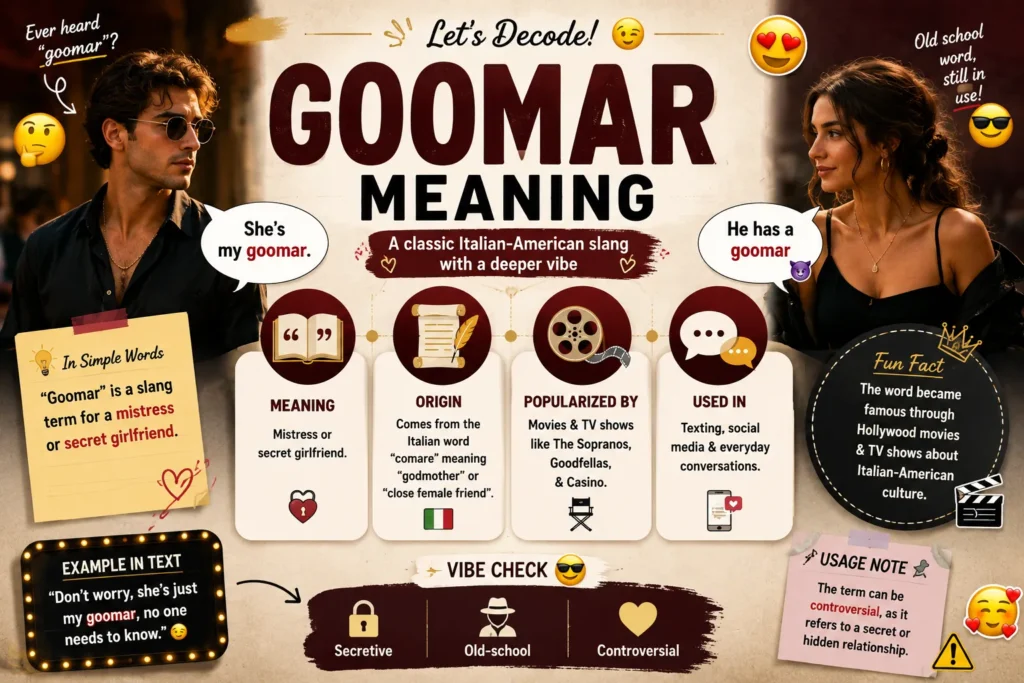
1. What Does “Goomar” Mean?
At its core, goomar means “the other woman” — a woman a man (typically married or otherwise committed) sees secretly, outside his primary relationship. It’s not casual slang for a random hookup; it usually implies something sustained: an ongoing, often long-term affair with its own routine, secrecy, and — in the classic mafia-movie version — financial support from the man involved.
Unlike neutral terms like “girlfriend” or “partner,” goomar carries built-in baggage. Say it, and you’re instantly signaling infidelity, secrecy, and a specific cultural flavor (Italian-American, often mob-adjacent) rather than just “affair partner” in the abstract.
2. Quick Meaning Summary
| Meaning | A mistress, side-piece, or secret girlfriend of a married man |
| Origin | Italian word comare (“godmother”) → Italian-American slang |
| First popularized by | Italian-American mob culture and gangster films |
| Common spellings | Goomar, goomara, goomah, gumar, gumma, goomer |
| Tone | Informal, often joking or sarcastic; can be blunt or judgmental |
| Best used | Casual conversation, pop-culture references, texting/social media |
| Avoid using | Formal writing, professional settings, directly about real people you know |
3. Origin and History of Goomar
The word’s backstory is more wholesome than its modern meaning would suggest.
Goomar traces back to the Italian word comare, which itself comes from the Latin commater — literally “with mother” (com- + mater). In traditional Italian communities, a comare was a respected role: a godmother, a close family friend, someone who helped care for children and was trusted like extended family.
When Italian immigrants brought the word to the United States, two things happened at once: the pronunciation shifted (softening into “goomar”), and the meaning drifted dramatically. Within tight-knit Italian-American communities — many touched by organized crime — the word stopped meaning “trusted family friend” and started meaning something closer to “the woman a man keeps on the side.”
By the mid-to-late 20th century, goomar had settled firmly into its modern sense: a mistress, typically belonging to a married man, often one connected to the mob.
4. Why Is Goomar So Popular?
The word owes almost all of its mainstream recognition to one source: Italian-American mob culture on screen.
- The Sopranos — mob boss Tony Soprano’s affairs made “goomar” a household term for an entire generation of TV viewers.
- Goodfellas (1990) — Martin Scorsese’s crime classic used the term as part of its authentic mafia dialect.
- Casino (1995) — another Scorsese film that reinforced the word’s association with organized crime and double lives.
Because these films and shows were so widely watched, goomar escaped its original, tightly regional Italian-American usage and became recognizable to a much broader audience — even people with zero connection to that culture now know roughly what it means.
5. Goomar Meaning in Text
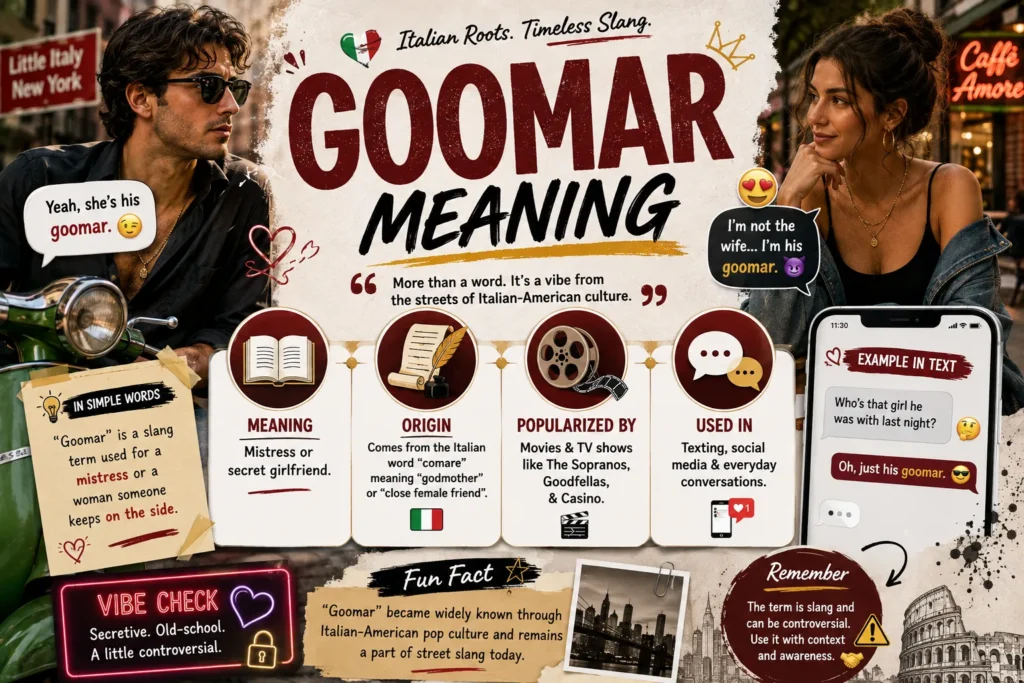
In texts and DMs, goomar almost never carries its full, literal “mob mistress” weight. It gets used more loosely — as a tease, a pop-culture nod, or shorthand for anyone’s secret romantic interest.
- “lol who’s your goomar 👀” — teasing a friend about a secretive crush or ex
- “he’s out with his ‘goomar’ again 💀” — a sarcastic jab referencing someone’s suspected side relationship
- “just watched Goodfellas, goomar is now my favorite word” — pure pop-culture commentary, no real-life meaning attached
In text form, tone carries the word. The same message can read as a lighthearted joke or a pointed accusation depending on who’s sending it and why.
6. How Goomar Is Used in Everyday Conversation
Traditionally, goomar is used matter-of-factly within Italian-American communities to refer to a specific person’s mistress — often with a knowing wink rather than outright judgment.
- “Where’s Tony tonight?” “He’s with his goomar.”
- “If he tells you he’s seeing his goomar, don’t ask questions.”
Outside that cultural context, spoken use is rarer than written/texted use — most people encounter and use the word online rather than in face-to-face conversation.
7. Goomar Meaning on Social Media
On platforms like TikTok, Instagram, and X, goomar shows up mostly as:
- Meme captions referencing The Sopranos or mob movies
- Comment-sectionJokes teasing someone about a suspected secret partner
- Audio trends built around Sopranos or Goodfellas clips where a character says the word
- Reddit threads discussing the word’s meaning or debating its correct spelling
It’s rarely used to make a serious real-world accusation on social platforms — it functions closer to slang for comedic or ironic effect than a literal label.
8. Goomar in Pop Culture (The Sopranos, Goodfellas, Casino)
Three titles are responsible for nearly all of the word’s mainstream recognition:
- The Sopranos — Tony Soprano’s affairs made the term instantly recognizable to millions of non-Italian-American viewers.
- Goodfellas (1990) — Scorsese’s film used the word as authentic mob dialect, cementing its association with organized crime.
- Casino (1995) — another Scorsese mob classic that reinforced the same meaning for a wider audience.
Because of these three, most people today learn the word from screens, not from Italian-American communities directly.
9. Alternative Spellings of Goomar
Because the word entered English through spoken slang rather than formal writing, spelling was never standardized. You’ll see all of these used interchangeably:
- Goomar
- Goomara / Goomada
- Goomah
- Gumar / Gumma
- Goomer
All refer to the same core meaning; the spelling usually just reflects how the writer has heard it pronounced.
10. Goomar vs. Mistress: What’s the Difference?
| Goomar | Mistress | |
| Cultural tone | Italian-American, often mob-associated | Neutral, formal English |
| Register | Casual/slang | Standard/formal |
| Where you’d use it | Texting, jokes, pop-culture talk | Writing, formal or serious discussion |
| Connotation | Playful, sarcastic, or blunt | Serious, literary, or clinical |
They describe the same role — a married man’s secret romantic partner — but goomar comes loaded with cultural specificity that “mistress” doesn’t carry.
11. Goomar vs. Side Piece vs. Sneaky Link
- Goomar — Italian-American, often implies a longer-term, more established affair with mob-culture undertones.
- Side piece — general modern slang, no cultural specificity, can imply anything from a fling to a long-term secret partner.
- Sneaky link — usually a casual, low-commitment secret hookup, not necessarily tied to an existing relationship on either side.
The three overlap heavily but differ in cultural flavor and implied seriousness — goomar is the most specific and the most “old-school.”
12. Common Misunderstandings About Goomar
“It just means girlfriend.” Not quite — goomar specifically implies secrecy and infidelity. Calling someone’s actual, public girlfriend a “goomar” misses the point of the word entirely.
“It’s only used by Italian-Americans.“ Historically, yes — but thanks to decades of mob movies and shows, it’s now understood (and casually used) far outside that community, especially online.
“It’s always meant as a joke.” Context matters. Among friends referencing pop culture, it’s usually lighthearted. Used to describe a real situation, it can carry real judgment — the word doesn’t soften the fact that it’s describing infidelity.
“Goomar and mistress mean exactly the same thing.” They’re close, but goomar is more specific — it carries an Italian-American, often mob-culture connotation that the generic word “mistress” doesn’t have.
13. Is Goomar Offensive?
Goomar isn’t a slur, and it isn’t targeted at a protected group — but it isn’t a “safe” neutral word either. Because it specifically describes infidelity, using it to talk about a real person can come across as judgmental, gossipy, or crude, even when the speaker means it casually. Used purely as a pop-culture reference (quoting a show or movie), it’s generally read as harmless. Used to label a real relationship, it carries the same weight as calling someone “the other woman” — worth saying deliberately, not carelessly.
Explore More:https://dogizle.com/km-meaning-in-text-2/
14. Related Terms and Similar Slang
- Side piece — general modern slang for a secret romantic partner
- Sneaky link — a secret hookup, usually less relationship-oriented than a goomar
- Comare — the original Italian word (“godmother”) that goomar evolved from
- Mistress — the closest formal English equivalent
- The other woman — a plain-English description of the same role
15. How to Respond If Someone Calls You (or Mentions) a Goomar
If it’s clearly a joke (a caption, a meme reference, friendly teasing), the easiest response is to play along or laugh it off — it’s rarely meant as a genuine accusation in that context.
If it’s said seriously — about you, or about someone you know — it’s worth pausing rather than reacting instantly. The word specifically implies a real affair, so treat it the way you would any serious claim about infidelity: ask directly, get context, and don’t assume the worst from a single word choice.
People Also Ask
Goomar is Italian-American slang for a Mistress or secret girlfriend, usually belonging to a married man.
It’s not a slur, but it does describe infidelity, so it can come across as judgmental or crude depending on context and tone.
It comes from the Italian word comare, meaning “godmother,” which shifted in meaning within Italian-American communities to describe a mistress.
Not exactly — comare is the real Italian word. Goomar is the Americanized, slang pronunciation and meaning that developed in the U.S.
“Goomar” is more casual and carries specific cultural connotations (Italian-American, often mob-related) that the generic word “mistress” doesn’t capture.
No — the term specifically refers to a woman. There isn’t a widely used male equivalent with the same cultural history.
Conclusion
At its heart, Goomar Means A Mistress — specifically one tied to Italian-American culture and, historically, the mob lifestyle popularized by films like Goodfellas and Casino and shows like The Sopranos. It evolved from comare, a warm, respected Italian term for “godmother,” into something far more loaded. Today, you’ll mostly encounter it online as a pop-culture reference or a joking bit of slang rather than a literal description — but its roots in infidelity mean it’s still a word worth using thoughtfully. If slang words with unexpected backstories are your thing, check out our other breakdowns of internet and cultural terms to keep building your vocabulary.