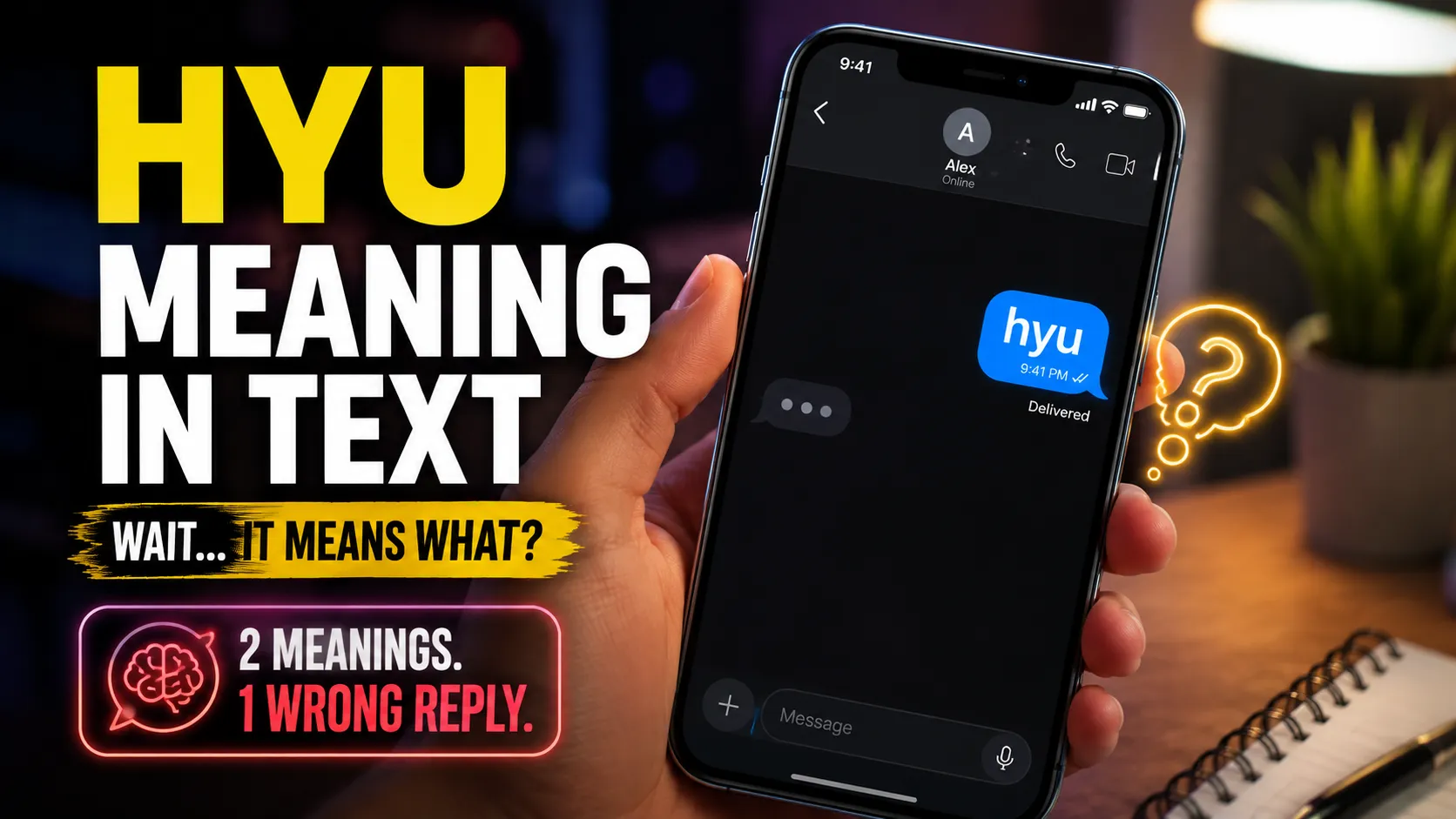
HYU Meaning in Text: Hit You Up or How You? (2026)
You’re mid-conversation, a message pops up with just three letters — “hyu” — and now you’re stuck. Reply with what, exactly?
Here’s the short version: HYU most commonly means “Hit You Up,” used to say someone will contact you later. In a smaller number of casual contexts, people also use it as shorthand for “How You?” — a lazy version of “how are you.” Below, you’ll learn exactly how to tell which one someone means, see real examples, and know how to reply on any platform.
What Does HYU Mean in Text?
HYU is a texting abbreviation with two active meanings. The dominant one is “Hit You Up” — a way of saying you’ll message, call, or reach out to someone again soon. The second, less common meaning is “How You?” — a shortened, casual version of “how are you,” used mostly as a greeting.
Which one applies depends entirely on where HYU sits in the message and what the conversation is about — a distinction covered in detail further down.
Quick Meaning Summary
| Meaning | How Common | Typical Use | Example |
| Hit You Up | Most common (~80% of uses) | Promising future contact | “Busy now, HYU tonight” |
| How You? | Less common, growing among Gen Z | Informal greeting | “hyu? ✋” |
| Airport code myth | Not applicable to texting | Aviation (incorrectly attributed) | See Common Misunderstandings |
Origin and History of HYU
The phrase “hit up” has roots in casual American English and gained wide mainstream use through hip-hop culture and early-2000s texting slang, describing the act of contacting or visiting someone directly. As SMS character limits and fast-paced messaging apps became the norm, “hit you up” naturally compressed into HYU — following the same abbreviation pattern that gave us HMU (“hit me up”), its direct counterpart.
This origin lines up with how major slang and language references trace “hit up,” reinforcing that HYU isn’t a random internet invention but a natural shorthand of an established phrase.
Why Is HYU Popular?
HYU has stuck around for two decades of digital communication because it solves a real problem: how to end a conversation without actually ending it. Saying “I’ll hit you up” (or its short form) lets someone step away from a chat while signaling the relationship or plan stays open — softer than silence, faster than typing a full sentence.
Its staying power also comes from platform habits. Texting, DMs, and comment sections all reward brevity, and HYU fits that pattern the same way HMU, WYD, and HRU do. As group chats and social platforms multiplied, so did the everyday need for a quick, low-effort way to say “we’ll talk later.”
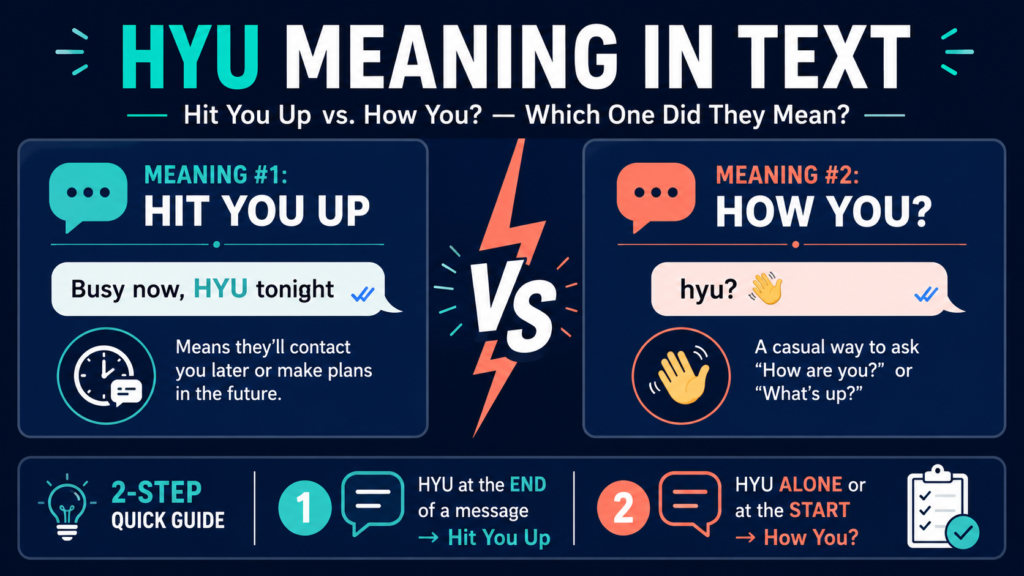
HYU Meaning: Hit You Up
In this sense, HYU signals a promise of future contact. It’s used when someone can’t talk right now but wants to keep the conversation open:
- “Can’t talk rn, HYU later.”
- “I’ll HYU with the details tomorrow.”
- “Running into a meeting, HYU after 5.”
This is the original and still-dominant use of HYU across texting, Instagram DMs, and TikTok comments.
HYU Meaning: How You?
In this sense, HYU functions as a compressed greeting — similar to HRU (“how are you”) or WYD (“what you doing”). It usually appears as a standalone message or conversation opener:
- “hyu? been a minute”
- “yo hyu 👀”
- “hyu today”
This usage skews younger and shows up more often on Snapchat and TikTok than in standard texting.
How to Tell Which Meaning Someone Means
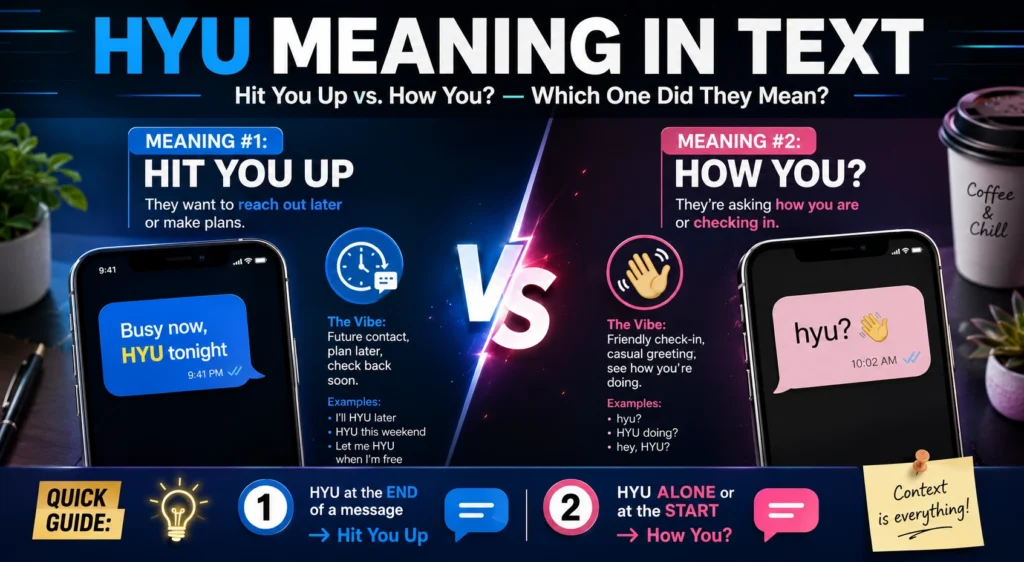
Context is what separates the two meanings — and it comes down to position in the message:
- If HYU appears at the end of a message, right before someone signs off → it means Hit You Up.
- If HYU appears as the entire message, or right at the start of a conversation → it usually means How You?
That single positional clue resolves almost every real-world case.
HYU on Texting and WhatsApp
Almost always means “Hit You Up.” Common in sign-offs when someone’s ending a chat but wants to keep the door open — “can’t talk rn, hyu later.”
HYU on Instagram
Frequently means “Hit You Up,” especially in networking or casual flirting contexts — “hyu when I land.”
HYU on Snapchat
Both meanings appear here, but “How You?” shows up more often as a quick check-in on a streak or story reply.
HYU on TikTok
Mostly “Hit You Up,” often used lightheartedly rather than literally — commenters signaling they’ll follow up in someone’s DMs.
Real Examples of HYU in Chats
- “Running into a meeting, HYU after 5.” → Hit You Up — a promise to reconnect later.
- “hyu? been a minute” → How You? — a casual greeting reopening contact.
- “I’ll HYU with the address once I confirm.” → Hit You Up — planning-related follow-up.
- “yo hyu 👀” → How You? — informal opener, often flirty in tone.
- “Can’t chat, will hyu tomorrow about the plan.” → Hit You Up — deferring a conversation.
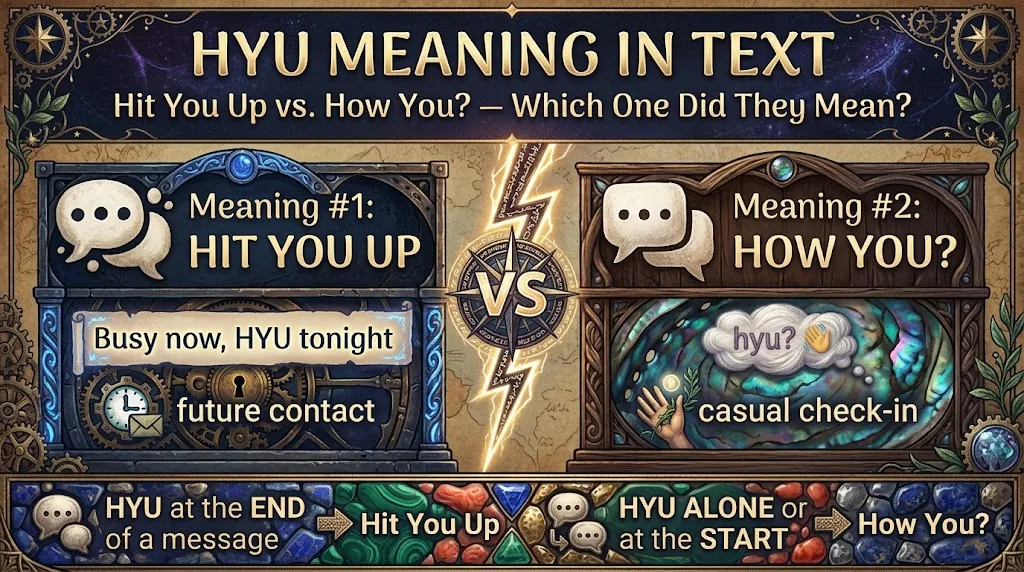
How to Reply to HYU
If it’s “Hit You Up” (a promise to follow up):
- “Sounds good, talk soon”
- “Okay, I’ll be around”
- “No rush, whenever works”
If it’s “How you?” (a greeting):
- “I’m good, you?”
- “Pretty good, just busy with work”
- “Doing alright, what’s up with you?”
Matching your reply to the correct meaning avoids the slightly awkward moment of answering “I’m good!” to what was actually a plan to text you later.
Explore More: https://dogizle.com/frl-meaning-in-text/
Common Misunderstandings About HYU
- “HYU means the same as HMU.” No — they’re inverses. HYU is them reaching out to you; HMU is you asking them to reach out.
- “HYU is always flirty.” Not necessarily. Tone depends entirely on the relationship and surrounding conversation.
- “HYU is rude or dismissive.” It isn’t inherently one or the other. “I’ll HYU later” said abruptly can feel like a brush-off, but the abbreviation itself is neutral.
- “HYU is an airport code.” A claim circulating on a few slang sites says HYU is the IATA code for Hydaburg Seaplane Base in Alaska — that’s inaccurate; its actual code is HYG, not HYU.
HYU vs Similar Texting Abbreviations (HMU, HRU, WYD)
| Abbreviation | Meaning | Direction |
| HYU | Hit You Up / How You? | They’ll contact you / greeting |
| HMU | Hit Me Up | You want them to contact you |
| HRU | How Are You | Direct greeting |
| WYD | What You Doing | Asking about current activity |
People Also Ask
It most often means “Hit You Up,” indicating the sender will message or contact you again soon. Less commonly, it’s used as a casual way of asking “how are you.”
No. They’re opposite directions of the same idea — HYU means someone will contact you, while HMU means you’re asking someone to contact you first.:
Not by default. HYU is a neutral abbreviation used across friendships, family chats, and casual messaging, though tone and relationship context can make it feel flirty.
It can feel that way, but the phrase itself is just a soft commitment to reconnect — not a guarantee, similar to saying “talk soon” in person.
HRU is a direct, unambiguous “how are you.” HYU is more ambiguous — it can mean the same thing informally, or it can mean “hit you up,” depending on where it appears in the message.:
Mostly, yes, though “How You?” appears slightly more often on Snapchat and TikTok, while “Hit You Up” dominates in standard texting and Instagram DMs.
Conclusion
HYU is a small abbreviation carrying two real meanings, and getting it wrong just means replying “I’m good!” to someone who was actually promising to text you later — a minor, harmless mix-up once you know the pattern. Use the position rule above, match your reply to the intended meaning, and you’ll never second-guess a “HYu” text again. For more texting shorthand explained just as clearly, check out our guides on HMU, HRU, and other common chat abbreviations.