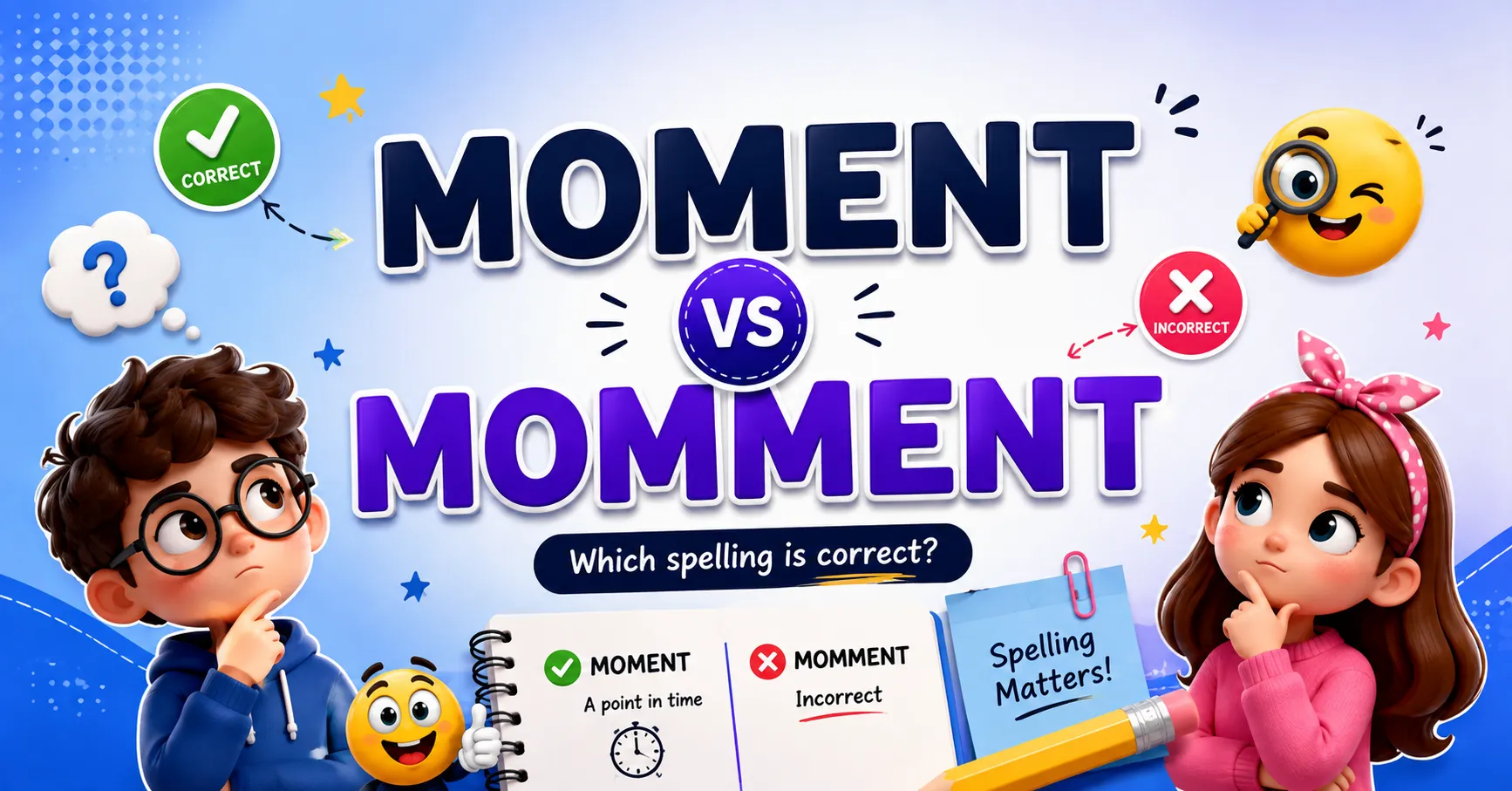
Moment vs Momment: Which Spelling Is Correct?
If you’ve ever typed “Momment” and paused, wondering if it looked wrong, you’re not alone. This guide settles it for good — with the correct spelling, the real reason the mistake happens, and simple tricks so you never second-guess it again.
1. Quick Answer
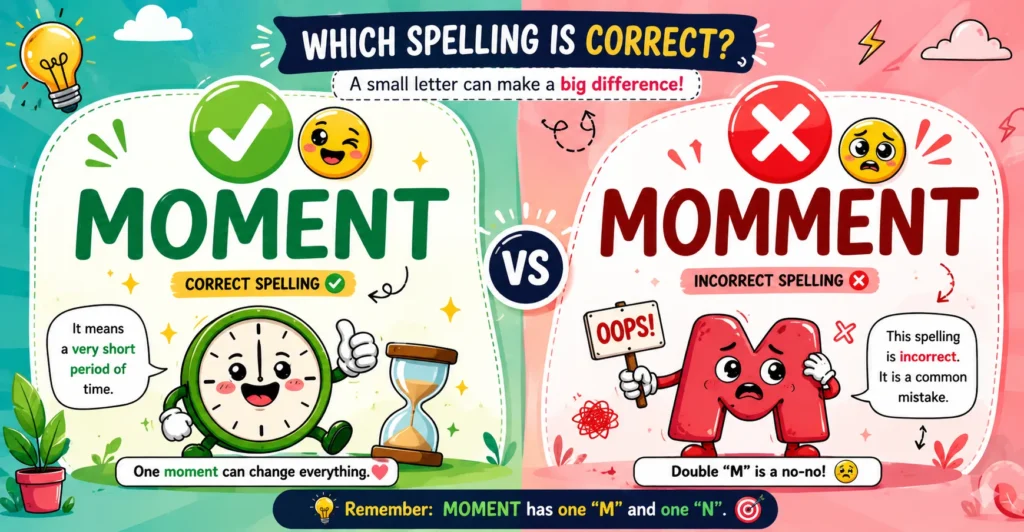
“Moment” is the only correct spelling. “Momment” is always wrong — it doesn’t exist in any English dictionary, in any dialect.
The mix-up happens because your brain pattern-matches “moment” against real double-m words like comment and commitment. There’s no rule, region, or context where the double-m version is acceptable.
2. What Does “Moment” Mean?
Moment is a noun with four core senses.
- A very brief period of time — “I’ll be with you in a moment.”
- A specific, precise point in time — “At that exact moment, the lights went out.”
- An occasion of real significance — “Winning the award was a defining moment in her career.”
- A physics/engineering measure of a force’s tendency to rotate an object around an axis — as in moment of inertia or bending moment.
Pronunciation: /ˈmoʊ.mənt/ — MOH-mənt, stressed on the first syllable.
3. Is “Momment” a Word?
No. “Momment” isn’t listed in Merriam-Webster, the Oxford English Dictionary, Cambridge Dictionary, or Dictionary.com.
It has no etymology, no accepted definition, and no grammatical function of its own. Every major spell-checker — Word, Google Docs, iOS, Android — flags it automatically.
This makes “momment” a straightforward orthographic error, not a variant spelling. Some English words genuinely do have accepted alternates, like judgment vs. judgement. “Moment” isn’t one of them.
4. Why Do People Write “Momment”? (The Real Reason)
False analogy with double-m words. English is full of correct double-m words: comment, commitment, committee, commission, common. Your brain groups “moment” with this family by habit, even though it was never part of it.
Phonetic doubling instinct. Some Speakers Unconsciously Feel the stressed syllable needs a “heavier” middle consonant, which nudges the fingers to double the letter while typing.
Autocorrect and swipe-typing. On mobile keyboards, an extra tap or swipe drag over the “m” key can insert a duplicate letter that autocorrect doesn’t always catch mid-sentence.
Typing speed, not knowledge gaps. The error shows up far more in texts and captions than in edited writing. Most people who type “momment” already know the correct spelling — they just moved faster than their fingers could keep up.
5. Where Does “Moment” Come From? (Etymology)
Moment traces back to the Latin momentum, meaning “movement” or “importance” — a contraction of movimentum, from movere (“to move”).
It entered English via Old French moment in the 14th century, keeping essentially the same spelling it has today.
English later borrowed the same Latin root a second time, giving us momentum — the physics/everyday word for driving force (“the campaign gained momentum”). Moment and momentum share an ancestor but mean different things today.
6. Moment vs Momment: Quick Comparison Table
| Moment | Momment | |
| Correct spelling? | ✅ Yes | ❌ No |
| In the dictionary? | Yes (Merriam-Webster, Oxford, Cambridge) | No |
| Part of speech | Noun | Not a word |
| Pronunciation | /ˈmoʊ.mənt/ | N/A |
| Example | “Wait a moment.” | “Wait a momment.” ❌ |
7. Related Word Confusions
- Moment vs. Momentum — Moment is a point in time (or a rotational-force measure in physics); momentum is a measure of motion or driving force. Same root, different meaning, never interchangeable.
- Moment vs. Memento — A memento is a physical object kept as a reminder of a person or event. It looks similar but is unrelated in meaning.
- Momment vs. Comment — This is the actual source of the confusion. Comment legitimately has a double m, which is why your brain wants to apply the same pattern to moment.
8. “Moment” in Real Context
- “Give me a moment, I’ll be right there.”
- “At this moment, we are unable to confirm the shipment date.”
- “The novel’s climactic moment reshapes the reader’s understanding of the protagonist.”
- “Historians consider this the pivotal moment in the negotiations.”
Every context — casual, formal, academic — uses the exact same spelling: moment.
9. Common Idioms Using “Moment”
- In a moment — very soon
- Moment of truth — a decisive point
- One moment, please — a Polite Request To Wait
- Never a dull moment — constant activity
- On a moment’s notice — with very little warning
10. Moment in Formal vs Casual Writing
Formal writing — “Please allow a moment for the system to process your request.” Precise, professional tone; no contractions, no emoji.
Casual writing — “One sec, gimme a moment 😂” Same correct spelling, just a relaxed tone and shorter phrasing.
Academic writing — “This moment marks a turning point in post-war literature.” Longer sentence structure, formal register, still the identical spelling.
Register changes the tone of a sentence. It never changes the spelling of moment.
11. Memory Tricks That Actually Work
- “One moment, one m.” A moment is brief — just like it only needs one middle letter.
- Split it visually: MO-MENT. There’s no natural spot for a second m to live.
- Anchor it against COMMENT. Once you fix “double-m belongs to comment,” the vague feeling that “moment” needs one too disappears.
- Count the letters. Moment = 6 letters. Seven means you’ve made the mistake.
12. How to Stop Making This Mistake for Good
- Turn on autocorrect on your phone and browser — most current spell-checkers catch “momment” specifically.
- Run a grammar tool like Grammarly or the built-in checker in Google Docs/Word before publishing anything.
- Read the sentence back once before sending anything formal — this single habit catches most doubling errors.
- Say it in your head as “MO-ment.” Separating the syllables mentally makes the single m obvious.
13. Quick Self-Test
- Give me a ___ to think. (moment / momment)
- It was the best ___ of my life. (moment / momment)
- At that ___, everything changed. (moment / momment)
- Every ___ counts. (moment / momment)
- Please wait a ___ while we connect you. (moment / momment)
Answer key: All five are moment.
14. Common Mistakes to Avoid
- ❌ Give me a momment. → ✅ Give me a moment.
- ❌ It was the best momment ever. → ✅ It was the best moment ever.
- ❌ Every momment matters. → ✅ Every moment matters.
- ❌ We shared a beautiful momment together. → ✅ We shared a beautiful moment together.
- ❌ Assuming “momment” is a valid alternate spelling → ✅ Only “moment” exists in any dictionary.
- ❌ Trusting autocorrect blindly on formal documents → ✅ Proofread once before sending.
15. Key Takeaways
- “Moment” is always correct. “Momment” is always wrong — in every dialect, context, and register of English.
- The mistake comes from false pattern-matching with double-m words like comment and commitment, not from any genuine spelling ambiguity.
- Moment comes from Latin momentum via Old French, and shares a root — but not a meaning — with momentum itself.
- Use the “one moment, one m” trick, and read your sentence back once before publishing, and this typo won’t happen again.
People Also Ask
No. American and British English use the identical Spelling, Moment. There’s no regional variant with a double m.
Most modern checkers do, but older or minimal browser spell-checkers sometimes miss it mid-sentence. Don’t rely on autocorrect alone for anything formal.
Your brain is pattern-matching it against real double-m words like comment and commitment. That visual similarity is what makes the error so persistent, even among fluent writers.
Noun only. There’s no verb form — you can’t “moment” something.
Moments — a regular plural, no spelling changes.
No. Momentous (meaning highly significant) is a correctly spelled word derived from moment, not from the misspelling “momment.”
Conclusion
The confusion between moment and momment comes down to one simple fact: only moment exists in the English language. The double-m version isn’t a regional variant, an accepted alternate, or a modern shorthand — it’s a typing habit borrowed from words like comment and commitment that never actually Applied Here.
Once you understand why the mistake happens, it’s easy to stop making it. Anchor “moment” against “comment,” proofread once before hitting send, and you’ll never lose that half-second of doubt again. Bookmark this page next time a tricky spelling catches you off guard, and check the related word confusions above if double letters keep tripping you up elsewhere.