Dog Named Dog: Is It a Good Idea?
Dog Named Dog can be funny, but it may confuse training, weaken recall, and create unexpected problems. In this guide, you’ll discover whether naming your dog “Dog” is smart or risky, how dogs actually respond to names, and the hidden psychology trainers use for faster obedience, stronger bonding, and safer recall that most owners never realize. Imagine standing in a busy public park surrounded by people, pets, noise, and distractions. You call out loudly:
“Dog! Come here!”
Suddenly, several heads turn. Multiple Dog Named Dog react. Some owners look confused. And your own dog? There’s a hesitation—a moment of uncertainty.
This is not just a funny scenario—it’s a real-world consequence of naming your dog “Dog.”
At first glance, the idea may seem amusing, clever, or even refreshingly minimal. Many pet owners convince themselves:
- “It’s simple and effortless.”
- “I’ll change it later.”
- “It’s unique in a funny way.”
However, naming a dog is not a trivial choice—it’s a core communication tool that shapes:
- Training effectiveness
- Emotional attachment
- Daily interaction
- Safety in critical moments
In modern living environments—especially urban settings filled with distractions—clear and distinct communication is essential.
This comprehensive guide will help you understand:
- The psychology behind naming a dog “Dog.”
- The advantages and disadvantages
- How it influences behavior and learning
- Smarter alternatives that actually work
- A proven system to choose the perfect name
By the end, you’ll have a clear, practical answer—not just opinion, but insight grounded in behavior and real-life usability.
Why Do People Name Their Dog “Dog”?
Although it sounds random, the decision often follows predictable human behavior patterns.
1. Simplicity & Minimalism
In a world full of choices, people gravitate toward simplicity.
- No need to brainstorm
- No endless name lists
- No decision fatigue
“Dog” feels direct, uncomplicated, and immediate.
But simplicity can sometimes sacrifice effectiveness.
2. Temporary Name That Becomes Permanent
This is one of the most common scenarios.
- “Let’s just call him Dog for now.”
- The dog starts responding
- Family members adopt the name
- It becomes permanent
What begins as temporary often becomes fixed through repetition.
3. Humor & Irony
Some owners choose the name purely for amusement.
- It sounds ironic
- It feels witty
- It gets laughs
But humor fades over time. Daily repetition does not.
4. Cultural & Media Influence
Generic animal naming appears frequently in:
- Movies
- TV shows
- Memes
- Online culture
This subtly normalizes the idea, making it feel acceptable—even smart.
Psychology Behind Dog Naming
Naming is not just emotional—it’s rooted in behavioral science.
How Dogs Recognize Names
Dogs do not interpret names the way humans do. Instead, they respond to:
- Sound patterns
- Vocal tone
- Repetition
- Association with outcomes
A name is essentially an auditory signal, not a label of identity.
What Makes a Good Dog Name?
Research and trainers consistently highlight these factors:
Short length (1–2 syllables)
Strong consonant sounds (K, T, D, B)
Distinct from commands
Unique sound pattern
Examples:
- Effective: Max, Luna, Rex
- Less effective: Alexander, Christopher
What Happens When You Name a Dog “Dog”?
By choosing “Dog,” you remove essential elements:
Distinctiveness
Clear identity signal
Separation from everyday language
This leads to:
- Reduced training clarity
- Slower response time
- Weaker emotional association
The word “dog” is constantly used in normal conversation, making it harder for your pet to distinguish when it is being addressed.
Pros & Cons of Naming Your Dog “Dog”
Let’s examine this objectively.
Pros
Extremely simple
Easy to remember
Amusing and ironic
No decision-making stress
Can be socially memorable
Cons
1. Training Confusion
Commands such as:
- “Good dog”
- “Bad dog.”
Become ambiguous signals rather than clear communication.
2. Weak Identity Formation
Dogs build recognition through:
- Repetition
- Sound association
- Emotional reinforcement
A generic term weakens that connection.
3. Social Awkwardness
Typical conversation:
- “What’s your dog’s name?”
- “Dog.”
This creates confusion and repetitive clarification.
4. Poor Recall Efficiency
Recall depends on:
- Unique sounds
- Sharp tones
“Dog” blends into the background language, reducing effectiveness.
Comparison: “Dog” vs Proper Names
| Feature | Name “Dog” | Proper Name |
| Training Clarity | Low | High |
| Recall Speed | Weak | Strong |
| Emotional Bond | Limited | Strong |
| Social Interaction | Confusing | Clear |
| Personalization | None | Strong |
| Memorability | Moderate | High |
Is “Dog” Actually a Good Name?
Short Answer: No (for most situations)
Why?
- Too generic
- Weak training efficiency
- Limited emotional connection
- Confusing in real-world environments
When It Might Work
There are rare exceptions:
Highly trained animals
Owners using alternative cues
Humor-focused households
Controlled environments
Even in these cases, it’s far from optimal.
Better Alternatives to “Dog”
Choosing a functional yet expressive name can dramatically improve communication.
Simple Dog Names (Best for Training)
- Max
- Leo
- Milo
- Bella
- Luna
Clear, short, and effective.
Funny Dog Names
- Sir Barksalot
- Bark Twain
- Doggo
- Woofy
Retains humor without sacrificing clarity.
Unique Names (Modern Style)
- Nova
- Zuko
- Orion
- Nala
- Freya
Distinct and memorable.
Personality-Based Names
| Personality | Name Ideas |
| Energetic | Bolt, Flash |
| Calm | Shadow, Misty |
| Playful | Coco, Bubbles |
| Strong | Titan, Rex |
Matching temperament strengthens bonding.
Smart Framework to Choose the Perfect Dog Name
Step 1: Keep It Short
- 1–2 syllables
- Easy pronunciation
- Quick recognition
Example: “Max” vs “Maximilian.”
Step 2: Use Distinct Sounds
Avoid overlap with commands like:
- Sit
- Stay
- No
Choose sharp, clear phonetics.
Step 3: Match Personality
Align name with traits:
- Active → Bolt
- Calm → Shadow
- Strong → Rex
Step 4: Test in Real Situations
Try the name:
- At home
- Outdoors
- During training
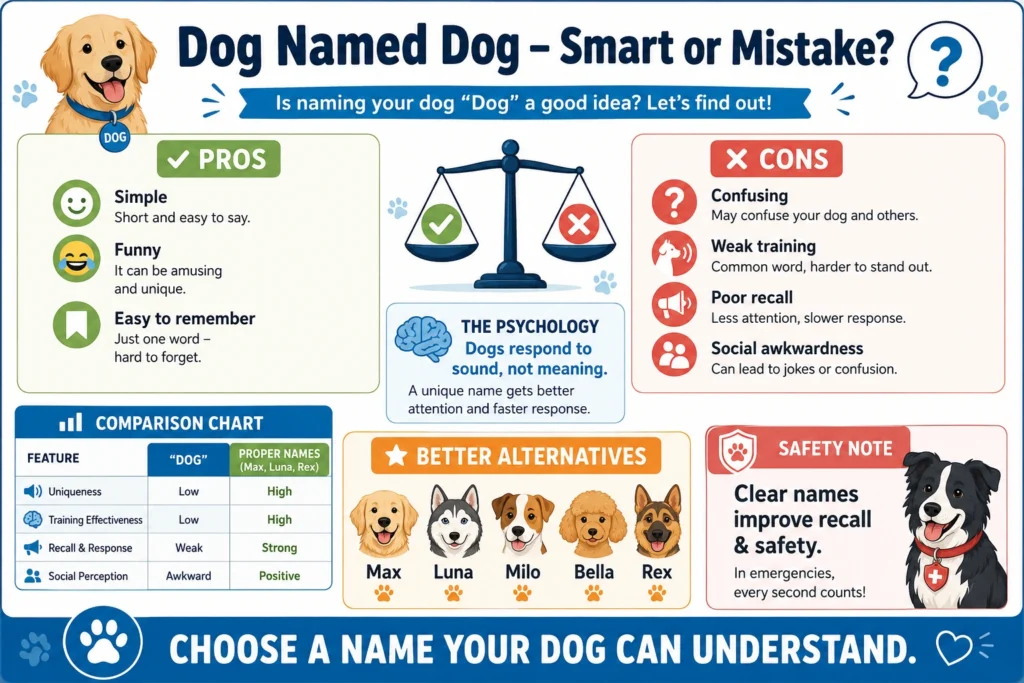
Discover the pros, cons, psychology, and better dog name alternatives in this quick visual guide.
Real-Life Scenarios
Apartment Living
Shared environments include:
- Multiple pets
- Background noise
- Proximity
Generic names create confusion quickly.
Urban Walking
Busy streets require:
- Fast commands
- Immediate response
Dog Parks
Imagine shouting:
“Dog! Come here!”
Result:
- Multiple dogs react
- Owners become confused
- Your dog hesitates
Safety & Behavioral Considerations
Behavioral Impact
Confusion can lead to:
- Anxiety
- Frustration
- Slower learning
Safety Risks
Poor response may cause:
- Delayed recall in danger
- Reduced control
- Increased accident risk
Training Efficiency
Clear names lead to:
- Faster learning
- Better obedience
- Stronger communication
Common Mistakes Dog Owners Make
Avoid these pitfalls:
Prioritizing humor over functionality
Choosing long or complex names
Ignoring phonetic clarity
Not testing the name
Frequently changing names
Real Examples of “Dog Named Dog”
This concept appears in:
- Online forums
- Casual pet ownership
- Fictional storytelling
In real-life scenarios:
- Owners often regret the choice
- Many eventually rename their pets
Pros & Cons Summary
Advantages
- Simple
- Amusing
- Easy
Disadvantages
- Confusing
- Inefficient for training
- Weak emotional connection
- Socially awkward
FAQs
Yes. It creates confusion and reduces training effectiveness.
Yes. Dogs learn names through repetition and association.
Yes. It’s easier in the early months, but possible anytime with training.
Short, clear names like:
Max
Luna
Leo
Bella
No. But proper training and care are essential.
Yes. Working breeds respond strongly to clear, sharp sounds.
Yes. It improves bonding and connection.
Conclusion
Naming your dog “Dog” may seem clever initially, but over time, it introduces real challenges:
- Ineffective communication
- Reduced training success
- Public confusion
- Weaker emotional bond