Introduction
If you have ever peeled a hard-boiled egg and watched your dog stare at it like you just invented treasure, you are not alone. Many dog owners want a simple answer: Can Dogs Eat Hard-Boiled Eggs without causing stomach upset, weight gain, or hidden health problems? The good news is that the strongest pet-health sources agree that fully cooked eggs can be a safe, nutritious occasional treat for many dogs, as long as they are plain and served in moderation.
This matters because the internet is full of mixed advice. Some pages say eggs are healthy, others warn about raw eggs, and many bury the exact hard-boiled answer inside a broader egg article. For dog owners, that is not enough. You need a clear yes/no answer, a portion guide, and a practical way to decide whether your own dog should get eggs today. That is exactly what this guide is built to do.
Snippet-Ready Answer
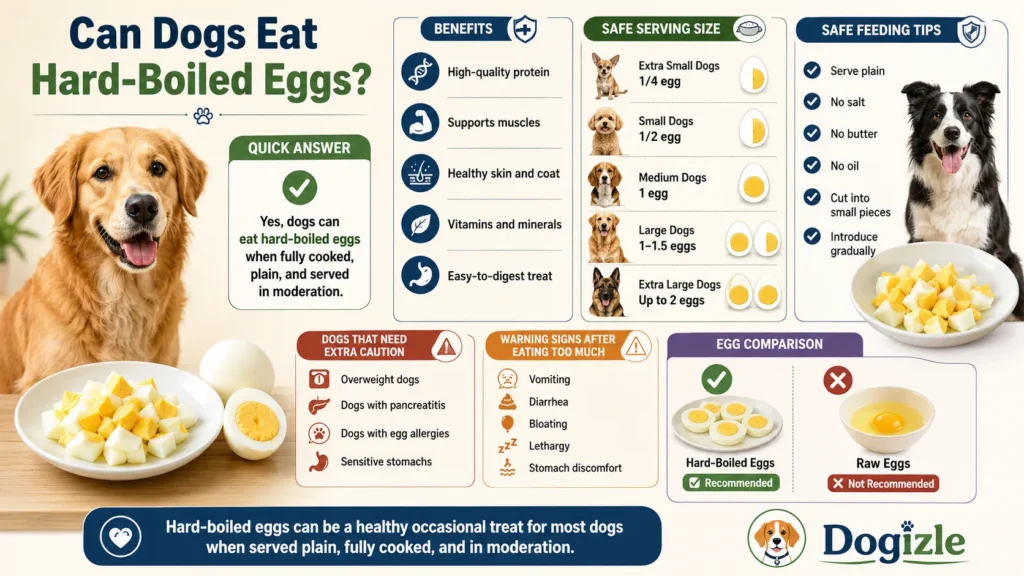
Yes, dogs can eat hard-boiled eggs if they are fully cooked, plain, cooled, and served in moderation. Hard-boiled eggs are one of the safest and simplest ways to feed eggs to dogs, while raw or undercooked eggs should be avoided because of salmonella risk and nutrient concerns.
Are Hard-Boiled Eggs Good for Dogs?
Yes, hard-boiled eggs can be a good occasional treat for many dogs. Eggs provide high-quality protein, healthy fats, vitamins, and minerals that support muscles, skin, coat, immune function, and general body maintenance. Purina describes eggs as an especially strong protein source, and PetMD notes that cooked eggs supply nutrients in a digestible form.
The keyword here is occasional. Eggs are nutritious, but they are still an extra food, not a replacement for complete and balanced dog food. The best current guidance keeps treats under the 10% rule, meaning most of your dog’s calories should still come from regular meals.
Why is his hard-boiled better than raw
Cooked eggs remove the raw-egg concerns that show up repeatedly in veterinary-aware guidance: Salmonella exposure, possible biotin interference from avidin in raw egg whites, and bacterial contamination as eggs age. This is why the safest advice across major pet sources is to cook eggs thoroughly and serve them plain.
How Many Hard-Boiled Eggs Can a Dog Eat?
The safest answer is: it depends on the dog’s size, daily calories, and health status. PetMD and Chewy both provide practical serving ranges by body size, and Purina and AKC reinforce that treats should stay within the 10% calorie rule.
Portion Guide for Healthy Dogs
| Dog size | Typical serving | Frequency |
| Extra-small dogs (2–10 lb / 1–4.5 kg) | 1/4 egg | 1–2 times per week |
| Small dogs (11–20 lb / 5–9 kg) | 1/2 egg | 1–2 times per week |
| Medium dogs (21–50 lb / 10–23 kg) | 1 egg | 1–2 times per week |
| Large dogs (51–90 lb / 23–41 kg) | 1 1/2 eggs | 1–2 times per week |
| Extra-large dogs (91+ lb / 41+ kg) | 2 eggs | 1–2 times per week |
This is the clearest current size-based guidance in the ranking set, and it fits the broader 10% treat rule used by major pet sources. Start smaller if your dog is new to eggs, then watch for digestive upset or itching before increasing the amount.
Easy rule of thumb
A better real-world method is to treat a hard-boiled egg as a small snack, topper, or training reward rather than a meal substitute. For many dogs, a few chunks of egg are enough. The goal is not to “feed eggs well,” but to use them safely without upsetting the diet.
How to Serve Hard-Boiled Eggs to Dogs Safely
The safest preparation is simple: boil the egg fully, cool it, peel it, and serve it plain. Do not add salt, pepper, butter, oil, garlic, onion, spices, or sauces. PetMD, AKC, and Chewy all make the same core point: plain and fully cooked is the safest path.
Step-by-step serving method
- Boil the egg until both the white and yolk are firm.
- Let it cool fully so it does not burn the mouth.
- Peel the shell unless your vet has told you otherwise.
- Cut the egg into small pieces, especially for small dogs.
- Offer a small amount first, then observe your dog for 24 hours.
Best uses for hard-boiled eggs
Hard-boiled eggs work well as a simple snack, a high-value training reward for some dogs, or a topper for dogs who need a little meal interest. Chewy also notes that eggs can be used in enrichment ideas, but they still need to stay within the dog’s daily calorie budget.
Hard-Boiled Eggs vs. Other Egg Options
| Egg form | Safe for dogs? | Main benefit | Main risk |
| Hard-boiled | Yes, usually the safest choice | Fully cooked, easy to portion | Too much can add calories and fat |
| Scrambled, plain | Yes | Also, fully cooked and easy to eat | Adding butter/oil ruins the benefit |
| Raw | No, not recommended | No added benefit over cooked eggs | Salmonella, digestive illness, and biotin concerns |
| Eggshells | Only with vet guidance | Calcium source in specific cases | Sharp edges, unnecessary for most dogs |
Can Puppies Eat Hard-Boiled Eggs?
Yes, puppies can eat hard-boiled eggs in small amounts, but their portions should be even more controlled than those of adult dogs. Chewy suggests about 1/4 to 1/2 an egg two to three times a week, depending on size, while PetMD says puppies can eat eggs,s but should be limited in portion size.
For puppies, the safest approach is to start tiny, keep the egg plain, and count it as a treat. Puppies have sensitive digestion, and their nutrition needs to stay balanced for growth, so eggshells should never replace a puppy-formulated diet.
Which Dogs Should Avoid Hard-Boiled Eggs, or Get Vet Advice First?
Most healthy dogs can handle small amounts of plain cooked egg, but some dogs need extra caution. Dogs that are overweight, prone to digestive upset, or sensitive to richer foods should be watched carefully because eggs add calories and fat. Chewy warns that too many eggs can trigger stomach upset and may increase pancreatitis risk, while AKC warns that too many eggs can push dogs over their calorie target.
Dogs with known egg allergies should also avoid eggs unless a veterinarian has already advised otherwise. AKC notes that egg allergies can show up as vomiting, diarrhea, itchiness, or other skin and GI signs.
Higher-caution dogs include:
- Dogs on calorie-restricted plans
- Dogs with a history of pancreatitis or fat sensitivity
- Dogs with egg allergies or suspected food reactions
- Dogs with chronic digestive issues or very sensitive stomachs
What If My Dog Ate Too Many Hard-Boiled Eggs?
Most cases of overdoing egg end with stomach upset rather than a true emergency, but the symptoms should be taken seriously. Chewy lists vomiting, diarrhea, poor appetite, abdominal discomfort, and gas as common signs after too much egg. It also notes that a high-fat intake can raise pancreatitis risk.
Watch for these warning signs.
- Repeated vomiting
- Repeated diarrhea
- Bloated or painful belly
- Refusing food
- Lethargy or unusual tiredness
- Any sign that your dog “just does not seem right.”
If the symptoms are mild, many dogs settle with observation. If the dog is young, old, medically fragile, or the symptoms are more than mild, contact your veterinarian. That advice matches the cautious approach used by major pet-health sources.
Can Dogs Eat Egg Shells?
Eggshells are not the best default choice for most dogs. PetMD says they can be used in specific cases with veterinary guidance, but AKC points out that shells can have sharp edges and may hurt the throat or internal organs.
If a vet ever recommends calcium support, there are usually easier and more precise options than tossing in eggshells. For most dog owners, the simplest safe answer is to skip the shell and serve the cooked egg only.
Practical Feeding Guide for Real-Life Dog Owners
| Situation | Best approach | Why |
| First time feeding egg | Offer a tiny piece only | Let’s test for allergy or stomach upset |
| Small dog | Use a few bite-sized pieces | Easier to portion and reduce overfeeding risk |
| Training treat | Use sparingly, not every session | Helps stay under the 10% treat rule |
| Sensitive stomach | Skip or ask your vet first | Eggs may be too rich for some dogs |
| Weight-loss plan | Usually not a routine snack | Eggs add calories quickly |
Europe-Specific Practical Advice
For European dog owners, the safest mindset is the same: hard-boiled eggs are an occasional extra, not a main feeding strategy. The European pet food sector is built around complete and complementary feed categories, and EU feed rules are structured around safe marketing and handling of pet food products. That means eggs should be treated as a human food add-on, not as a replacement for a complete pet diet.
This matters in real European homes where owners juggle apartment living, smaller storage space, colder winters, and busy urban schedules. Hard-boiled eggs are convenient, but convenience should never replace portion control. In practical terms, keep them plain, refrigerate leftovers promptly, and use very small pieces for toy breeds and apartment dogs that do not burn many calories each day.
Apartment living tip
If you live in an apartment, egg pieces should be tiny enough that the dog does not gulp them. Small dogs, indoor dogs, and less active city dogs are especially prone to excess calories, so a few pieces go a long way. The treat rule exists for a reason.
Cold-weather and winter-care tips
In colder months, many dogs get less outdoor activity, which makes treat calories matter even more. That is one reason to keep hard-boiled eggs occasionally rather than daily. A “small reward” can become a weight issue surprisingly fast if activity drops.
Common Mistakes Dog Owners Make
- Feeding eggs with butter, oil, salt, or seasoning
- Turning egg into a daily habit instead of an occasional treat
- Giving too much to a small dog because the egg looks harmless
- Offering raw egg because it seems “natural.”
- Ignoring symptoms after a new food trial
- Giving eggshells without vet guidance
Expert Tips for Feeding Hard-Boiled Eggs Safely
- Start with a tiny amount, even if the dog has eaten eggs before.
- Keep the egg plain and cool.
- Use eggs as a topper only when needed, not as a routine calorie booster.
- Cut pieces smaller for toy breeds and fast eaters.
- Remember that “healthy” does not automatically mean “unlimited.”
Pros and Cons of Hard-Boiled Eggs for Dogs
| Pros | Cons |
| High-quality protein and useful nutrients | Can add calories and fat quickly |
| Easy to prepare, plain, and safe | Too much may upset digestion |
| Good occasional treat for many dogs | Not ideal for dogs with egg allergies or sensitive stomachs |
| Simple to portion by size | Raw or undercooked eggs are not safe choices |
People Also Ask
Usually no. Eggs are best used as an occasional treat, not a daily staple. The strongest current guidance keeps treats within the 10% calorie rule and recommends watching overall calorie intake.
Both can be safe if fully cooked and plain, but hard-boiled eggs are simpler because there is no butter or oil to worry about. That makes them the easiest low-risk option for most owners.
No, raw eggs are not recommended. Major pet sources warn about salmonella, possible bacterial contamination, and biotin-related concerns from raw egg whites.
Cooked egg whites can be fine, but the simplest approach is the whole plain cooked egg in a small portion. The yolk contains useful nutrients, while the total serving still needs to stay small.
Yes, in small portions. Puppies can eat eggs, but they should get only a limited amount because their growth diet needs to stay balanced.
Use a small amount of plain, fully cooked egg, chopped into tiny pieces, and subtract it from the dog’s total treat budget for the day. That keeps the snack helpful instead of calorie-heavy.
Some can, some should not. Start tiny only if your vet is comfortable with it, and stop if you see vomiting, diarrhea, gas, or discomfort.
Final Verdict
Yes, dogs can eat hard-boiled eggs when the eggs are plain, fully cooked, cooled, and served in moderation. For many Healthy Dogs, hard-boiled eggs can be a useful occasional treat, topper, or training reward. For dogs with weight issues, egg allergies, pancreatitis concerns, or sensitive digestion, caution matters more than convenience.
The smartest approach is simple: start small, keep it plain, use the 10% treat rule, and watch your dog’s reaction. That is how you turn a breakfast snack into a safe, useful part of responsible dog care.