Introduction
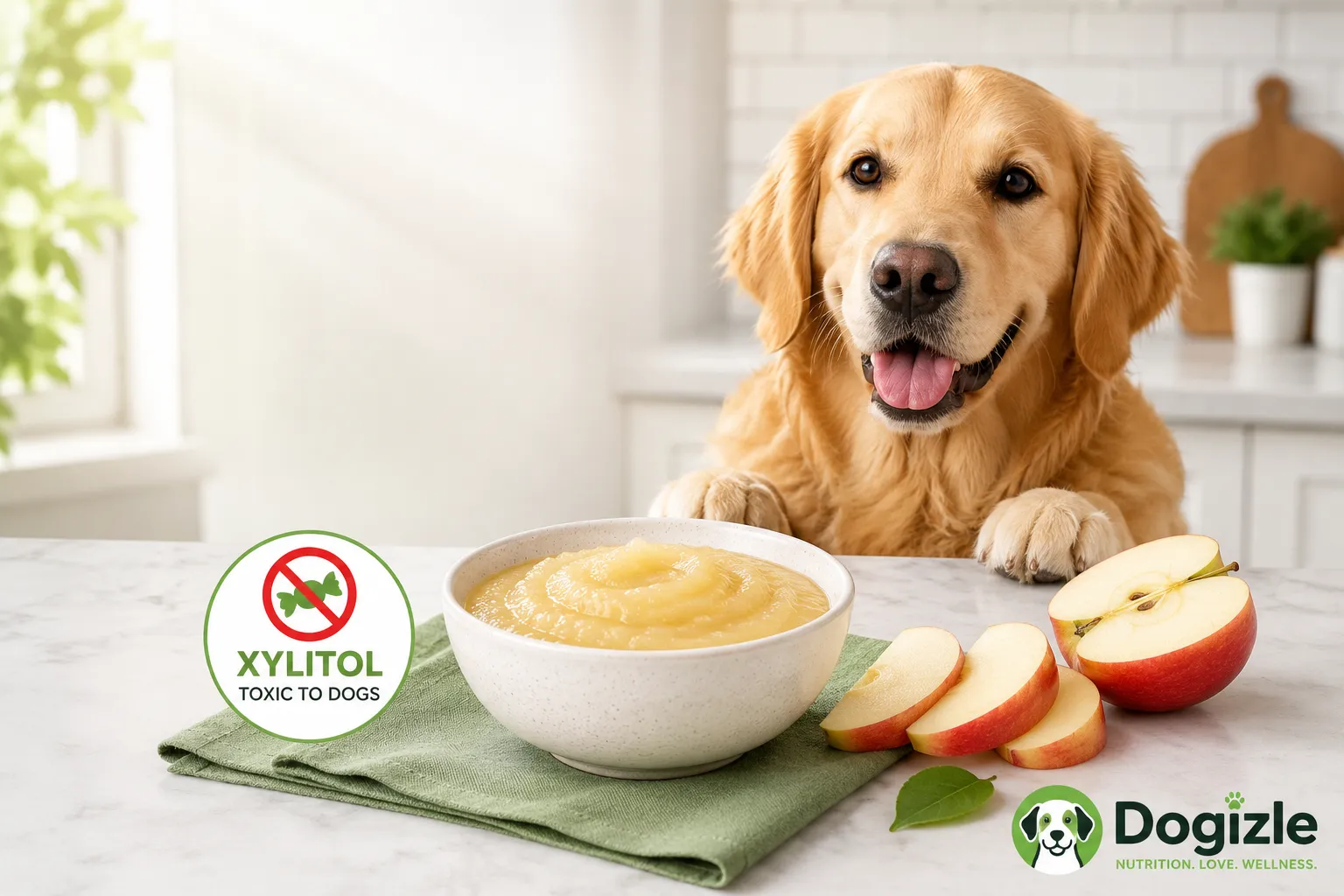
Dogs can eat Plain, Unsweetened Applesauce in small amounts, but it should stay an occasional treat, not a regular part of the diet. The safest version is simple applesauce made from apples only, with no added sugar, spices, or sweeteners. That matters because many commercial apple sauces contain ingredients that can upset a dog’s stomach, and some sugar-free products may contain xylitol, a substance that can be dangerous or even life-threatening for dogs. Apple seeds, stems, and cores are also not safe to feed.
Quick Answer
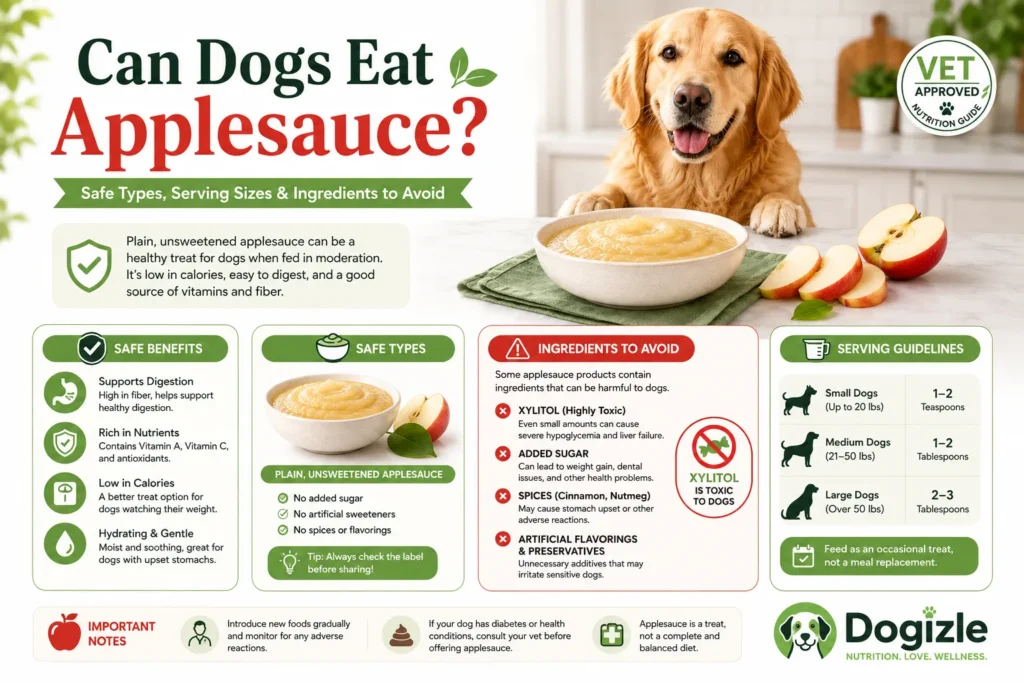
Yes — dogs can eat applesauce if it is plain, unsweetened, and served in moderation. A teaspoon is the kind of small treat Purina recommends for homemade applesauce, and treat calories should stay within the usual 10% limit for the day. If the applesauce contains xylitol, added sugar, cinnamon-heavy flavoring, preservatives, or other extras, it is no longer a smart snack choice.
Is Applesauce Safe for Dogs?
Plain applesauce is basically cooked apple, and apples themselves are generally safe for dogs when served correctly. The problem is not the fruit itself; it is what gets added to it. Commercial apple sauces often include sugar, lemon, vinegar, cinnamon, preservatives, food coloring, or sweeteners. Purina specifically warns that store-bought versions may include xylitol and other additives that can cause problems for dogs. PetMD and Petco give the same overall message: keep it plain, keep it small, and avoid the processed versions with extra ingredients.
The safest rule
If the label does not look clean enough for a child, it is probably not clean enough for a dog. Plain apple-only applesauce is the safest option, and even then, it should stay small and occasional.
Plain vs. Sweetened Applesauce
The fastest way to judge applesauce is by reading the ingredient list, not the front label. The front may say “natural,” “fruit blend,” or “no sugar added,” but the back tells the real story. Purina warns about lemon juice, cider vinegar, cinnamon, sugar, and xylitol, while Petco flags sugar, cinnamon, preservatives, and toxic sweeteners as common risks.
| Applesauce type | Safe for dogs? | Why |
| Plain, unsweetened, homemade | Yes, in small amounts | Closest to a simple cooked apple with no risky extras. |
| Plain, unsweetened store-bought | Usually, but check the label carefully | May still contain preservatives or hidden sweeteners. |
| Sweetened applesauce | Better to avoid | Added sugar gives no benefit and can upset digestion. |
| Cinnamon applesauce | Usually avoid | Often includes sugar or other risky ingredients. |
| Xylitol/birch sugar applesauce | Never feed | Xylitol is dangerous for dogs. |
| Applesauce with seeds or core pieces | Avoid | Apple seeds, stems, and cores are unsafe. |
Mini summary: The safest applesauce for dogs is plain, unsweetened, and boring. The more “flavored” it looks, the less dog-friendly it usually is.
What Ingredients Make Applesauce Unsafe?
The biggest danger is xylitol. The FDA says xylitol poisoning can start quickly and may cause vomiting, weakness, collapse, difficulty walking, seizures, coma, liver failure, and bleeding problems. The FDA also says it can be found in sugar-free products, dental products, medicines, and supplements. That makes ingredient checking essential.
The next issue is added sugar. Sugar does not help your dog nutritionally, and Purina notes that extra sugar can contribute to obesity and dental disease. Petco also warns that sugar can trigger stomach issues, including diarrhea.
Then there are the apple parts themselves. The ASPCA says apple stems, leaves, and seeds contain cyanogenic compounds and can be toxic; the ASPCA and Blue Cross both advise removing seeds and cores before feeding apples to dogs. PetMD similarly says the core and stem can be a choking hazard and that seeds contain trace amounts of cyanide.
Xylitol danger
In Europe and on imported foods, xylitol may also be listed as birch sugar or E967. A veterinary source from Colorado State University notes that birch sugar is the same substance as xylitol, so dog owners should look for those names too.
Cinnamon applesauce
Cinnamon itself is not the main issue in most applesauce products. The problem is that cinnamon applesauce often comes bundled with sugar, preservatives, nutmeg, or xylitol. PetMD specifically says to avoid cinnamon applesauce for dogs because it can contain high amounts of sugar and unsafe ingredients.
How Much Applesauce Can Dogs Have?
The safest answer is very little. Purina recommends only an occasional teaspoon, and the standard treat guideline from veterinary sources is that treats should stay at or below 10% of the dog’s daily calories. UC Davis and AKC both support that 10% rule, and Purina repeats the same principle for treats and applesauce.
| Dog size | Conservative starting amount | Notes |
| Toy / small dogs | A few licks to 1 teaspoon | Start tiny because small dogs fill up fast. |
| Medium dogs | 1 teaspoon | This matches Purina’s “occasional teaspoon” style guidance. |
| Large dogs | Up to 1 tablespoon only as an occasional treat | Still keep treats within the 10% limit. |
This is a conservative, practical guide, not a veterinary dose. The real ceiling depends on your dog’s size, calorie needs, weight, and health history. For a dog that is overweight, diabetic, or on a prescription diet, treat guidance should be more cautious still.
Mini summary: Use applesauce like a garnish, not a snack bowl. Tiny amounts are fine; frequent servings are where problems start.
Can Applesauce Help a Dog’s Stomach?
Sometimes, yes — but only in a limited, informal sense. Dogster notes that apples contain pectin, a soluble fiber that may help with mild digestive upset and diarrhea. That said, this is not a treatment plan. If a dog has ongoing diarrhea, vomiting, lethargy, blood in the stool, or a painful belly, applesauce is not the answer; a vet visit is.
There is also a practical reason to be careful here: a dog with a sensitive stomach may do better with fewer ingredients, not more. PetMD notes that too much fruit can cause digestive upset, and Blue Cross says fruit should only make up a small part of the diet.
Applesauce for diarrhea
A little plain applesauce may help some dogs, but it should not be used as a home remedy for persistent diarrhea. If the diarrhea lasts more than a day, is frequent, or comes with vomiting, weakness, or dehydration, veterinary care is the responsible next step.
Which Dogs Should Avoid Applesauce?
Some dogs should only have applesauce after a vet says it is okay. Petco warns that health conditions or sensitivities can make applesauce a bad choice, and PetMD notes that sweet fruit should be used more cautiously in dogs with obesity or diabetes. Dogs with sensitive stomachs may also react badly to even small amounts.
That includes dogs who:
- have diabetes or other sugar-management issues,
- are overweight or prone to weight gain,
- get diarrhea easily,
- are on a special veterinary diet, or
- have a history of food sensitivities.
Applesauce for puppies
Puppies can have a tiny taste of plain, unsweetened applesauce, but their digestive systems are more delicate. Keep portions extremely small, and make sure the puppy’s main nutrition still comes from complete and balanced puppy food. Veterinary nutrition guidance emphasizes that treats should be limited because the puppy’s diet needs to do the heavy lifting.
What to Do If Your Dog Ate the Wrong Kind
Act fast if the applesauce contained xylitol, birch sugar, or E967. The FDA says xylitol poisoning can begin within 20 minutes and may cause vomiting, weakness, collapse, trouble walking, seizures, coma, liver failure, and bleeding problems. The FDA says to contact your vet, emergency clinic, or poison control immediately.
If you are in Europe or buying imported products, check for the alternate names too. CSU Veterinary Health notes that xylitol may appear as birch sugar or birch sap, and the European code E967 is used for xylitol in food labeling.
| What your dog ate | Likely concern | What to do |
| Applesauce with xylitol/birch sugar / E967 | Medical emergency | Call a vet or emergency clinic immediately. |
| Applesauce with lots of sugar | Stomach upset, calorie overload | Monitor closely and call your vet if symptoms appear. |
| Cinnamon applesauce | Possible GI irritation or unsafe additives | Check the label and call your vet if you are unsure. |
| Applesauce with seeds/core pieces | Choking or toxin concern | Contact your vet if your dog ate a large amount or is acting unwell. |
| Plain applesauce, but the dog seems sick | Individual sensitivity | Stop the treat and watch for vomiting or diarrhea. |
Emergency warning signs: vomiting, weakness, wobbliness, collapse, seizures, trouble breathing, or unusual lethargy need prompt veterinary attention. That is especially true if xylitol may be involved.
Homemade Applesauce for Dogs: The Safest Version
If you really want to share applesauce, homemade is the cleanest choice because you control every ingredient. Purina recommends using apples only, with the cores and seeds removed, and avoiding sugar or any extra flavorings. That is the safest format for dog owners who want to keep the treat simple.
Simple dog-safe applesauce method
- Wash the apples well.
- Remove the core, seeds, and stem.
- Cook the apple flesh until soft.
- Mash it thoroughly.
- Serve plain, with no sugar, cinnamon, nutmeg, lemon juice, or sweeteners.
Important: Do not use a recipe that tastes like dessert. The point is not to make a human-style applesauce; the point is to keep it plain and simple for the dog.
Plain Applesauce vs Fresh Apple Slices
Fresh apple slices are often the better choice because they are simpler to portion, easier to inspect, and less likely to hide extra ingredients. PetMD, Blue Cross, and AKC all support apples as a safe treat when the core and seeds are removed. PetMD also notes that apple skin is usually fine for most dogs, though sensitive stomachs may do better with a peeled apple.
When apples are better than applesauce
- You want the simplest possible treat.
- You need better portion control.
- You want to avoid store-bought additives.
- Your dog gets loose stool from richer snacks.
Europe-Specific Practical Advice
For dog owners in the UK and across Europe, the main label risk is still the same: xylitol. But on imported products or mixed-language packaging, it may appear under different names. CSU Veterinary Health notes that xylitol can be listed as birch sugar or birch sap, and the European additive code E967 is another label to watch for.
That matters because European shelves often carry more imported “sugar-free” or “reduced sugar” products than owners expect. A clean habit is to ignore the front of the package and scan the ingredient list for the sweetener itself. If you see a sugar-free product and are unsure, leave it out of your dog’s diet. The FDA’s warning on xylitol is simple: when in doubt, keep it away from your dog.
Apartment living tip
In city homes and apartments, people often reach for shelf-stable human snacks because they are convenient. That convenience is exactly why applesauce deserves extra caution: it is easy to over-serve, easy to store on a counter, and easy to misread on a label. A few fresh apple cubes are usually easier and safer to manage than an open jar of flavored applesauce.
Pros and Cons of Applesauce for Dogs
Pros
- Easy to serve in tiny amounts.
- Some dogs enjoy the taste.
- Plain applesauce may offer a little soluble fiber.
Cons
- Easy to overfeed.
- Store-bought versions may contain sugar, spices, preservatives, or xylitol.
- It does not add much that a balanced dog diet does not already provide.
Mini summary: Applesauce is more of a “sometimes treat” than a meaningful food choice. The downside is usually not the apple; it is the packaging and additives.
Common Mistakes Dog Owners Make
- Assuming “natural” means safe.
- Buying cinnamon or “holiday” applesauce without reading the label.
- Forgetting that xylitol can be hidden in sugar-free foods.
- Giving too much because the dog seems to love it.
- Using applesauce as a daily routine instead of an occasional treat.
Expert Tips
- Keep the ingredient list short enough to count on one hand.
- Treat applesauce as a bonus, not a diet tool.
- For dogs with sensitive stomachs, test only a tiny amount first.
- If the product says sugar-free, check for xylitol first, not last.
- When in doubt, use fresh apple slices instead of applesauce.
People Also Ask
No. Applesauce should stay an occasional treat, not a daily habit. Treats should remain a small part of the diet, with the bulk of calories coming from complete and balanced dog food.
Yes, if it is plain and unsweetened, with no sugar, spices, xylitol, or other flavorings. Purina recommends keeping homemade applesauce simple and using apples only.
It is better to avoid it. PetMD says cinnamon applesauce can contain high amounts of sugar and may include unsafe ingredients such as xylitol or nutmeg.
Usually no. Fresh apple slices are simpler, easier to portion, and less likely to hide additives. Just remove the core and seeds first.
Tiny amounts only, and only plain unsweetened applesauce. Puppies are more sensitive, so treats should stay very limited and never replace balanced puppy food.
Treat it as an emergency. FDA guidance says xylitol poisoning can happen fast and requires immediate veterinary help.
Sometimes a small amount may be used for mild digestive upset because apples contain pectin, but it is not a real treatment for ongoing diarrhea. If the symptom continues, call a vet.
Yes, they should be avoided. ASPCA says apple seeds, stems, and leaves contain cyanogenic compounds, and Blue Cross and PetMD both recommend removing the core and seeds before feeding apples.
Final Verdict
Can dogs eat applesauce? Yes — but only when it is plain, unsweetened, and served in very small amounts. The safest version is homemade applesauce made from apples alone, with no sugar, cinnamon, or sweeteners. Store-bought applesauce becomes risky fast when labels get crowded with additives, and xylitol is a hard stop because it can be dangerous for dogs. When you want the simplest, cleanest option, fresh apple slices are usually better than applesauce.