Introduction
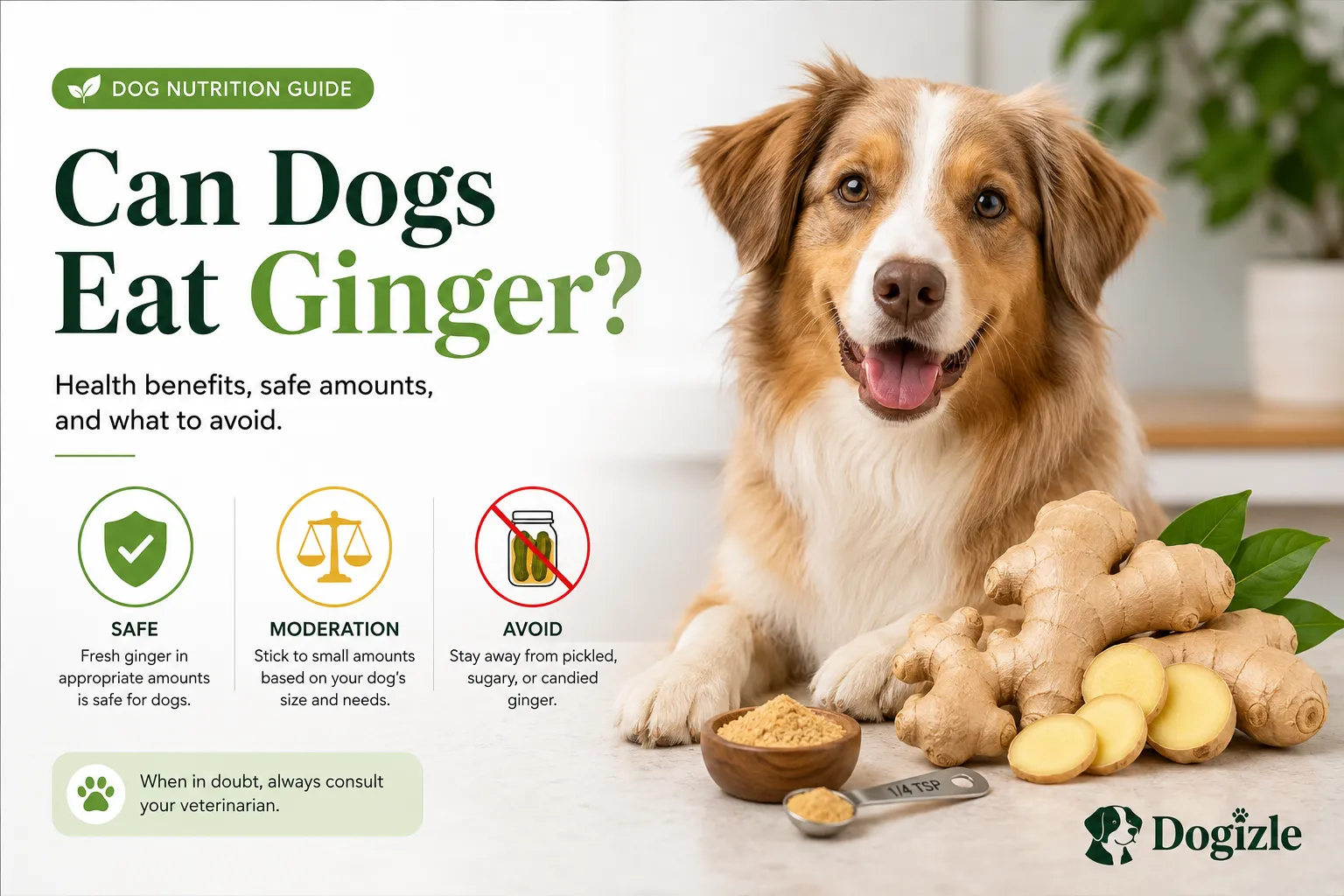
Can dogs eat ginger? Yes, but only in tiny, plain amounts, and not every ginger product is a good idea. The strongest current advice across major pet and veterinary sources agrees on the basics: fresh or powdered ginger is usually the safest route, while pickled ginger, ginger biscuits, ginger ale, and other sweetened or seasoned versions should be avoided. Ginger may also be discussed as a support ingredient for nausea, digestion, and motion sickness, but the evidence is mixed, and it should never replace proper veterinary care.
For dog owners, the real problem is not just “yes or no.” It is figuring out which form is safe, how much is too much, which dogs should avoid it, and when to call a vet. That is where most competitor pages still fall short. This guide fills that gap with a practical, easy-to-scan framework for everyday dog owners, including city households, apartment dogs, travel-prone dogs, and families who want a trustworthy answer without the fluff.
Quick Answer: Can Dogs Eat Ginger?
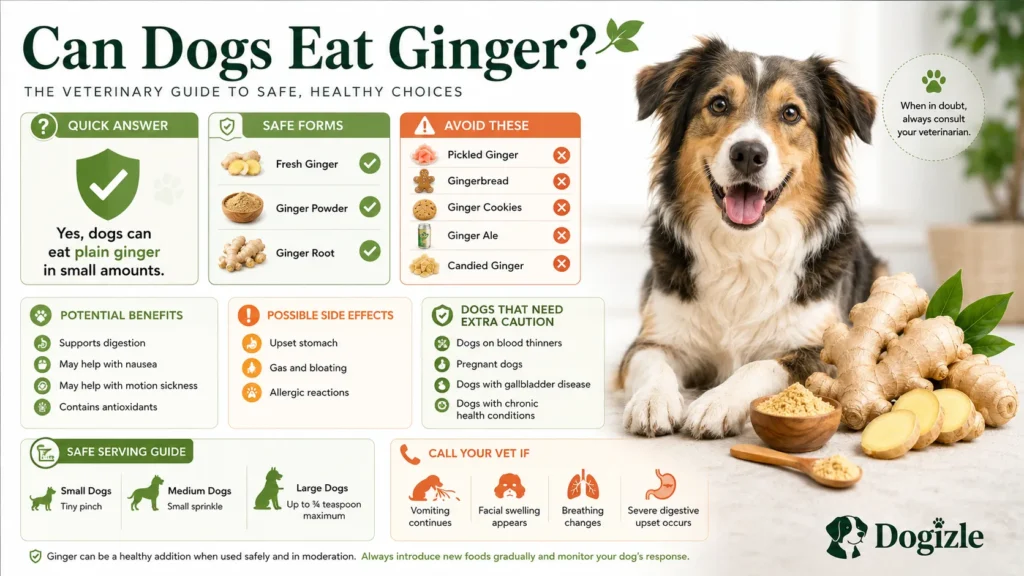
Yes, dogs can eat ginger in small amounts when it is plain and used carefully. Most trusted pet sources say the safest options are fresh ginger or powdered ginger, with some sources also allowing ginger juice in moderation. Pickled ginger, gingerbread, ginger ale, and ginger biscuits are not good choices because they often bring sugar, salt, vinegar, spices, or other harmful ingredients with them.
The safest rule for owners
Use ginger like a supplement-like ingredient, not a snack. Start tiny, watch your dog, and stop immediately if the tummy gets upset or your dog has a medical condition that makes ginger a bad fit.
Ginger Safety Decision Tree
1) Is it plain ginger?
If it is fresh or powdered ginger, it may be okay in a very small amount. AKC even includes ginger juice as a safe form, but PetMD and Purina are more conservative and focus on fresh or powdered ginger.
2) Is it a human food?
If it is pickled ginger, gingerbread, cookies, ginger ale, candied ginger, or a holiday dessert, skip it. These foods often contain sugar, salt, vinegar, nutmeg, xylitol, or other ingredients that are not appropriate for dogs.
3) Does your dog have a health issue or medication risk?
If your dog has bleeding issues, gallbladder disease, liver or kidney disease, diabetes, heart disease, or takes NSAIDs or anticoagulants, ask your vet first. Pregnant or nursing dogs also need caution.
Ginger Forms: What Is Safe and What Should Be Avoided?
| Ginger form | Generally okay? | Why | Best practice |
| Fresh ginger | Usually,y yes, in tiny amounts | Commonly recommended by AKC, PetMD, Purina, and Rover. | Peel, mince finely, and use only a small amount. |
| Powdered ginger | Usually, ly yes, in tiny amounts | Also commonly recommended by the major pet sources. | Start with a pinch, not a full sprinkle. |
| Ginger juice | Sometimes allowed | AKC includes it as a safe form, but most other sources focus on fresh or powder. | Use conservatively and only if your vet says it fits your dog. |
| Pickled ginger | Best avoided | PetMD says not to share it; Wag warns about sugar, salt, and xylitol risk. | Do not treat sushi ginger as dog food. |
| Ginger biscuits/cookies | Best avoided | Purina says to avoid ginger biscuits; Rover warns that baked goods often bring sugar and nutmeg with them. | Do not use people cookies as a dog treat. |
| Ginger ale/ginger beer | Avoid | Sugary, carbonated, and potentially risky due to additives. | Not a dog-safe ginger option. |
| Candied ginger | Avoid | Too much sugar and usually not a dog-safe snack. | Skip it completely. |
| Holiday desserts with ginger | Avoid | Often contain sugar, fat, nutmeg, chocolate, or xylitol. | Keep these away from dogs. |
Mini takeaway: plain ginger is the only form worth discussing as a possible dog-safe option. Everything else should be treated as a human food, not a pet treat.
What Ginger Can Do for Dogs
Ginger is often used because it may help with nausea, upset stomach, motion sickness, gas, and inflammation. AKC says it has been used for motion sickness, chemotherapy-related nausea, and digestive upset. PetMD also notes its anti-inflammatory and antioxidant properties, and Rover highlights possible digestive and motion-sickness support.
But this is where trust matters. Purina says there is little scientific evidence for many of the claims people make about ginger for dogs, and PDSA says there is no evidence that herbal or natural remedies, including ginger, work for travel sickness. The most honest position is that ginger may help some dogs, but it is not a guaranteed fix, and it should not replace proper veterinary care when a dog is actually sick.
Best use case
Ginger makes the most sense as a tiny, occasional support ingredient for a healthy dog that simply needs a little digestive help or a vet-approved travel strategy. It is not a daily wellness trend, and it is not a cure for chronic vomiting, chronic diarrhea, or unexplained nausea.
How Much Ginger Is Safe for Dogs?
There is no universal veterinary dose for every dog, so the safest approach is always to start low and ask your vet if your dog has any medical issues. AKC offers a common rule of thumb of no more than 1/16 teaspoon per pound of body weight, with cautious caps of 1/4 teaspoon for small dogs and 3/4 teaspoon for larger breeds. Wag gives a similar rough guide, suggesting up to 1/2 teaspoon for dogs under 35 lbs and up to 3/4 teaspoon for dogs over that weight. PetMD also advises tiny amounts and gives weight-based examples for healthy adult dogs.
| Dog size | Conservative starter amount | Rough upper guide from sources | Notes |
| Toy / very small dogs | Tiny pinch | Up to about 1/4 tsp total in AKC’s cautious framing | Go lower if your dog has a sensitive stomach. |
| Small dogs | Pinch to a small sprinkle | Around 1/4 to 1/2 tsp, depending on the guide used | Start below the guideline, not at the top of it. |
| Medium dogs | Small sprinkle | Around 1/2 tsp in PetMD/Wag-style examples | Only for a healthy dog with no contraindications. |
| Large dogs | Small sprinkle | Up to 3/4 tsp in conservative examples | Bigger does not mean unlimited. |
Important note: these are rule-of-thumb guides, not personal medical prescriptions. The right amount depends on size, health status, medication use, and whether your vet is recommending ginger for a specific reason.
Best Ways to Give Ginger to Dogs
The safest approach is simple: peel fresh ginger, mince it finely, and mix a tiny amount into food. AKC recommends peeling and mincing fresh ginger, then sprinkling it over food or serving it in a thin slice. Purina and Rover also support tiny amounts of fresh or powdered ginger, and Purina advises making sure the amount fits the dog’s size and health status.
A practical step-by-step method
- Start with the smallest possible amount.
- Mix it into a familiar meal, not a rich treat.
- Watch your dog for 24 hours.
- Stop if you see nausea, bloating, rash, or unusual behavior.
- Ask your vet before repeating it, especially if your dog is on medication.
What to avoid when serving ginger
Do not hide ginger inside fatty snacks, sugary treats, or holiday foods. Rover specifically warns against baked goods and people food containing ginger because of ingredients like sugar and nutmeg, while Purina says ginger biscuits are best avoided.
Mini takeaway: if the ginger came from a cookie, drink, sushi tray, or dessert table, it is probably the wrong form for your dog.
What Ginger Forms Should Dogs Avoid?
Pickled ginger
PetMD says pickled ginger should not be shared with dogs, and Wag warns that pickled versions may contain too much sugar, salt, or even xylitol. That is enough reason to keep sushi ginger off the menu.
Gingerbread, cookies, and holiday treats
Rover and Purina both warn against ginger biscuits and baked goods. The ginger itself is not the main issue; the other ingredients are. Nutmeg, chocolate, xylitol, excess sugar, and excess fat are the real hazards.
Ginger ale and ginger beer
These drinks are a poor choice because they are often sugary and carbonated, and they may contain other ingredients that dogs should not have.
Candied ginger
Candied ginger is basically a sugar delivery system. It should not be used as a dog treat.
When Dogs Should Not Eat Ginger
Avoid or delay ginger if your dog has any of the following issues:
- Bleeding disorders or a known clotting problem.
- NSAID use, such as carprofen, meloxicam, or robenacoxib.
- Upcoming surgery, because ginger may affect the bleeding risk.
- Gallbladder disease, pregnancy, or nursing.
- Liver or kidney disease, where Purina says extra caution is needed.
- Diabetes, heart disease, or low blood pressure, where Wag advises caution.
- Very sensitive stomachs, because even small amounts may trigger upset.
Best practice
If your dog is already on medication, on a prescription diet, or being treated for vomiting, diarrhea, pain, or chronic disease, do not guess. PetMD and VCA both recommend checking with your veterinarian first before adding ginger or any new supplement.
Side Effects and Warning Signs
VCA says ginger may cause mild skin irritation or mild gastrointestinal upset. It also warns that more serious reactions can happen, including an allergic reaction with irregular breathing, rash, fever, or swelling around the face.
| Possible sign | What it may mean | Action |
| Mild gas or mild tummy upset | The dose may be too high, or your dog may not tolerate ginger well | Stop ginger and monitor closely. |
| Itching or skin irritation | Possible sensitivity or allergy | Stop and call your vet if it continues. |
| Rash, fever, facial swelling, irregular breathing | Possible serious allergic reaction | Contact a vet immediately. |
| Repeated vomiting or significant diarrhea | Ginger may be making things worse | Stop using it and speak to your vet. |
Red flag: if your dog looks unwell for reasons beyond a mild tummy upset, do not keep “testing” ginger. That is the moment to get professional help.
Does Ginger Help Motion Sickness in Dogs?
This is one of the biggest reasons people search the topic. AKC and PetMD both note that ginger is often used for motion sickness or nausea support, and VCA says natural remedies, including ginge,r may be helpful for some dogs.
But the evidence is not strong enough to promise results. Purina says there is little scientific evidence that ginger helps with travel sickness, and PDSA says herbal or natural products containing ginger or mint have no evidence showing they work for car sickness. The smartest approach is to treat ginger as a discussion point, not a guaranteed fix.
A better travel plan for the city and family dogs
For dogs who struggle on car rides, public transport, or longer trips, the practical answer is usually a mix of vet guidance, calm conditioning, and travel preparation rather than ginger alone. PDSA advises speaking to your vet if your dog is prone to car sickness because prescription help may be more appropriate.
Ginger for Apartment Dogs, Urban Dogs, and Winter Holidays
If you live in an apartment or a busy city, ginger-related mistakes are often about human food access rather than the root itself. Holiday desserts, takeaway sushi, gingerbread, spice cookies, and sugary drinks are all more likely to appear in urban homes, and those are exactly the forms dogs should not be stealing. Keep them out of reach and treat ginger as a carefully controlled ingredient, not a table food.
For the winter and holiday season, the risk goes up again. Ginger shows up in cookies, loaves, drinks, and festive meals, and those are the exact items that can bring sugar, fat, nutmeg, or xylitol into your dog’s bowl by mistake. That is especially important for families, guests, and children who may not realize the difference between plain ginger and a ginger dessert.
Mini takeaway: the ginger root is not the main danger; the holiday wrapper around it usually is.
Pros and Cons of Ginger for Dogs
Pros
- May help with mild nausea or upset stomach in some dogs.
- Can be used in very small amounts as a plain ingredient.
- Is discussed in veterinary resources as a possible support ingredient for motion sickness and inflammation.
Cons
- Evidence for many benefits is limited.
- Can cause digestive upset or allergic reactions.
- Unsafe when hidden inside sugary or seasoned human foods.
- May not be a good fit for dogs on certain medications or with chronic disease.
Common Mistakes Dog Owners Make
- Giving ginger from a people snack instead of plain ginger. That is where sugar, salt, nutmeg, and xylitol problems begin.
- Starting with too much. The main rule across sources is moderation.
- Using ginger to self-treat a sick dog. Purina and PetMD both say to consult a vet rather than self-medicate.
- Ignoring medication conflicts. Ginger can be a problem for dogs on NSAIDs or anticoagulants.
- Assuming ginger is always safe because it is “natural.” Natural does not automatically mean harmless. VCA and PDSA both stress that supplements and home remedies still need caution.
Expert Tips for Safer Use
- Start with a pinch, not a spoonful.
- Use ginger only as an occasional add-on, not a daily habit.
- Watch your dog for 24 hours after the first try.
- Keep a note of any vomiting, itching, bloating, or unusual behavior. That helps your vet a lot.
- For repeated car sickness, ask your vet about better options instead of relying on ginger alone.
People Also Ask
Yes. Fresh ginger is one of the most commonly recommended forms, as long as it is plain and given in a tiny amount. Peel it, mince it finely, and do not treat it like a regular snack.
Usually, yes, in very small amounts. A pinch is the safest place to start, especially for small dogs or dogs with sensitive stomachs.
Best to avoid it. PetMD says not to share pickled ginger, and Wag warns about sugar, salt, and possible xylitol exposure.
It may help some dogs, but the evidence is mixed. VCA says ginger can be helpful as a natural remedy, while PDSA says there is no evidence that herbal remedies work for travel sickness.
There is no one-size-fits-all dose. AKC offers a rule of thumb of up to 1/16 teaspoon per pound of body weight, while Wag gives a rough cap of 1/2 teaspoon under 35 lbs and 3/4 teaspoon over that weight. Start far lower than the maximum.
Most likely,y you will see an upset stomach, gas, bloating, or nausea. In some cases, dogs may also show skin irritation or allergic signs.
Not without veterinary guidance. Because puppies are small, more sensitive, and easier to upset, it is safer to ask your vet before trying any supplement-like ingredient. This follows the broader caution urged by Purina, PetMD, and VCA for age, size, and health status.
Final Verdict
Can dogs eat ginger? Yes, but only in tiny, plain amounts and only when it makes sense for that dog. The safest options are fresh or powdered ginger, used sparingly and with caution. Pickled ginger, ginger cookies, gingerbread, ginger ale, and other sweetened human foods should be avoided. The biggest trust signal you can give readers is honesty: Ginger may help some dogs, but it is not a miracle fix, and dogs with bleeding risk, digestive sensitivity, chronic disease, or medication conflicts should not be treated casually.
For Dogizle, the winning angle is simple: give the reader the fast answer, then guide them through safe forms, correct amounts, warning signs, and vet-aware next steps. That is the kind of page people bookmark, trust, and share.