YHU Meaning in Text: The Complete Guide to This Gen Z Slang
Quick answer: YHU Means “you.“ It’s a stylized, phonetic respelling used in texting, DMs, and social media comments — not an acronym, and it doesn’t stand for a hidden phrase.
If someone just texted you “yhu” and you’re trying to figure out whether it means something deeper, you’re in the right place. Below is everything the other guides on this topic either got wrong, skipped, or explained badly — the real origin, the pronunciation, how tone shifts by platform and by who’s sending it, how to reply, and how YHU compares to similar Gen Z spelling trends.
What Does YHU Mean in Text?
YHU is a stylized spelling of “you,” used almost exclusively in informal digital communication — texts, Snapchat, Instagram comments, TikTok, and group chats.
- YHU = you (sometimes “you’re,” depending on the sentence)
- It carries the same meaning as “you,” just a softer, more casual feel
Example:
“yhu always kno what to say 🥹” Translation: “You always know what to say.”
The spelling changes. The meaning doesn’t.
Quick Meaning Summary
| Aspect | Detail |
| Meaning | “You” |
| Word type | Stylized/phonetic spelling (not an acronym) |
| Pronunciation | Same as “you” |
| Tone | Casual, soft, sometimes flirty |
| Common on | Snapchat, Instagram, TikTok, texting |
| Formal use | Avoid |
How Do You Pronounce YHU?
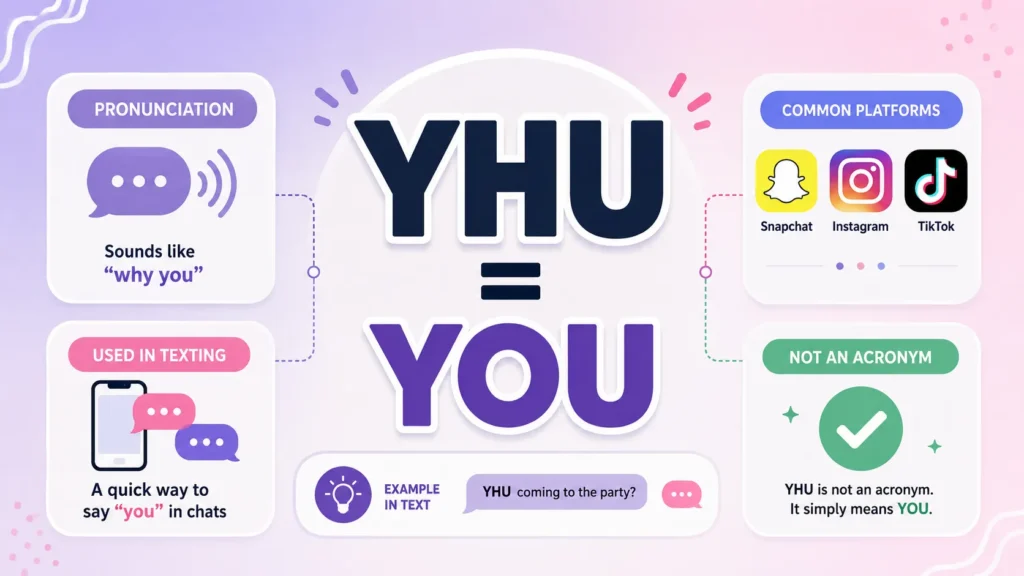
YHU sounds exactly like the word “you” (rhyming with “chew,” “few,” and “true”). Never pronounce it as separate letters: “Y-H-U.” The added H and U aren’t there to change the sound — they’re there to change the look of the word on screen. That’s the whole trick behind most stylized Gen Z spellings: same sound, different visual texture.
Origin and History: Where Does YHU Actually Come From?
Most competing articles either skip this entirely or vaguely say “it emerged from teen texting culture” without explaining how. Here’s the actual mechanism.
1. It’s a phonetic respelling, not a typo
Type “you” fast on a phone keyboard and your thumb naturally drifts toward the H key, which sits directly between G and J — close to the motion path between Y and O/U. Over time, casual texters and group chats began keeping that accidental-looking spelling on purpose because it looked more relaxed and less “correct.”
2. It follows a known pattern in African American Vernacular English (AAVE) digital speech
Linguists who study internet language have long documented that AAVE-influenced texting styles favor phonetic spelling over standard spelling — writing words the way they sound rather than the way they’re formally spelled (think “dis” for “this,” “wat” for “what,” “finna” for “going to”). YHU fits squarely into this tradition, and its early, heaviest usage on platforms like early Facebook and Myspace status updates reflects that.
3. Smartphone and Gen Z texting culture pushed it mainstream
As texting shifted from flip-phone T9 typing to full touchscreen keyboards in the 2010s, stylized spelling became a form of identity and personality — a way to make a text “sound” like a specific person’s voice rather than a formal sentence. YHU rode that wave alongside spellings like “u,” “yu,” and “ur.”
4. Snapchat and Instagram kept it alive
Because both platforms reward fast, casual, low-effort typing (streaks, captions, DM replies), YHU never fully died out the way some 2012-era slang did. It’s still common in 2026, especially among teens and younger Gen Z users.
Bottom line: YHU isn’t a typo, an acronym, or a mystery. It’s a deliberate stylistic choice with roots in phonetic and dialect-influenced texting, kept alive by mobile culture.
Is YHU an Acronym? (Clearing Up the Confusion)
No. This needs to be said clearly because a few sites currently ranking for this topic claim YHU stands for phrases like “You Have Unusual” or “You’re Hilariously Unique” — and then contradict themselves later in the same article by admitting it “doesn’t stand for anything.”
To be direct: YHU does not stand for anything. It is not built from initials of other words. If you see a claim online that it’s a secret acronym, that’s a backronym someone made up after the fact — not the real origin or meaning. When in doubt, context is your best guide: if “yhu” can be swapped for “you” and the sentence still makes perfect sense, that confirms it’s the stylized spelling, not an acronym.
How Is YHU Used? YHU Meaning From a Girl vs. From a Guy
Tone shifts slightly depending on who’s texting it and the relationship — though the core meaning (“you”) never changes.
| Sender | Common Tone | Typical Example |
| From a girl | Playful, affectionate, teasing | “yhu are so annoying omg 😂” |
| From a guy | Casual, joking, sometimes flirty | “yhu already know what it is” |
| From a friend | Neutral, low-effort casual texting | “yhu coming tonight?” |
| From a crush/partner | Soft, intimate, flirtatious | “miss yhu already 🫶” |
The word itself is gender-neutral — there’s no meaning difference based on who sends it. What actually shifts the tone is the relationship and the emojis attached, not the letters.
YHU Meaning on Social Media
YHU shows up slightly differently depending on where you see it. Here’s a breakdown that other guides only cover partially.
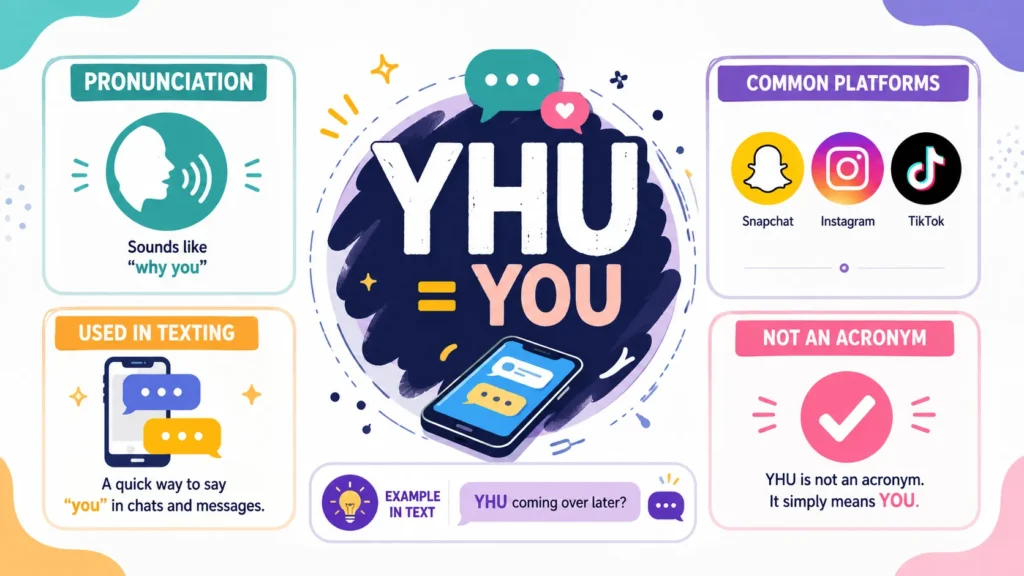
| Platform | How Common | Typical Use |
| Snapchat | Very common | Captions, streak chats, casual replies |
| Very common | Comments, DMs, compliment replies | |
| TikTok | Common | Comment sections, duets, stitches |
| Texting (SMS/iMessage) | Common | Casual one-on-one conversations |
| Discord | Moderate | Friend servers, casual chat channels |
| Less common | Mostly among younger, Gen Z-heavy chats | |
| X (Twitter) | Occasional | Replies and casual quote-posts |
| Rare | Mostly meme or slang-discussion threads, not organic chat | |
| Rare | Reads as outdated/very informal to older users | |
| Workplace apps (Slack, Teams) | Rare / avoid | Reads as unprofessional |
Example on Snapchat
“yhu snapped w that fit 🔥”
Example on Instagram
“omg yhu look amazing in this 😍”
Example on TikTok comments
“wait yhu are actually so funny”
When to Use YHU (and When to Avoid It)
| Context | Use It? | Why |
| Texting close friends | Yes | Fits the casual tone perfectly |
| Flirting or talking to a crush | Yes | Reads as soft and playful |
| Snapchat/TikTok/Instagram comments | Yes | Extremely normal on these platforms |
| Group chats with peers | Yes | Common and expected |
| Talking to older relatives | Careful | May be misread as a typo or confuse them |
| Professional emails or Slack/Teams | No | Looks careless and unprofessional |
| Customer service or formal messages | No | Undermines credibility |
| Academic writing | No | Not standard English |
Quick rule of thumb: if the conversation would also be fine with lowercase letters, no punctuation, and emojis, YHU fits right in. If the conversation requires formal grammar, skip it.
How to Reply to “YHU”
A gap every competing article misses entirely: people land on this search because they got a “yhu” text and don’t know how to respond. A few options depending on tone:
Casual/neutral: “haha stop 😂” or “yeah fr”
Mirroring the style: reply with your own stylized spelling (“ikr yhu too”)
Flirty context: a playful callback works well (“no yhu”)
If it’s from someone you don’t know well: standard spelling is totally fine — you don’t have to match their texting style
There’s no wrong way to respond grammatically — “yhu” doesn’t require a special reply format. It’s simply informal texting, so match the energy of the conversation.
Related Terms and Similar Meanings: YHU vs. Similar Stylized Spellings
YHU belongs to a much bigger family of phonetic, casual respellings. Seeing them side by side makes the pattern obvious — something no competing article maps out.
| Spelling | Standard Word | Vibe |
| yhu | you | Soft, expressive, slightly flirty |
| yu | you | Minimal, ultra-casual |
| yew | you | Cute, exaggerated, playful |
| u | you | Fastest, most neutral shorthand |
| dis | this | Phonetic, casual |
| wat | what | Phonetic, casual |
| tryna | trying to | Contraction-style casual speech |
| finna | going to | Contraction-style casual speech |
| ovr | over | Vowel-dropped shorthand |
YHU sits closer to “yew” on the affection scale and closer to “u” on the effort scale — it’s meant to feel a little warmer than a flat “u” without requiring extra typing effort.
Related Text Abbreviations Worth Knowing
Since YHU often shows up alongside other short texting slang, here’s quick context for terms people frequently confuse with it:
- YH — “yeah” or “yes” (a casual affirmative, unrelated to “you”)
- YU — a more minimal version of “you”
- U — the most basic shorthand for “you”
- FR — “for real,” used for emphasis
- NGL — “not gonna lie”
- ILY / ILU — “I love you”
If you see “YH” and assume it meant the same as “YHU,” it doesn’t — YH answers a yes/no question, while YHU replaces the pronoun “you.”
Common Misunderstandings About YHU
- “YHU is an acronym.” False — covered in detail above. It’s a spelling variant, not initials standing for anything.
- “YHU is rude or passive-aggressive.” False — tone comes from context and emojis, not the spelling itself.
- “Only teenage girls use YHU.” Not accurate — it’s used across genders and skews younger overall, but isn’t tied to one demographic.
- “YHU means something different on each app.” Not really — the meaning stays “you” everywhere; only frequency of use shifts by platform.
Examples of YHU in Real Sentences
Friends making plans:
A: yhu still coming later? B: yeahh omw
Flirty exchange:
A: yhu are so annoying 😭 (in a good way) B: no yhu
Instagram comment:
“yhu ate with this fit fr 🔥”
Compliment reply:
A: yhu did amazing today B: omg thank yhuuu 🥹
Mild teasing:
A: why yhu always late 😂 B: traffic i swear
People Also Ask
YHU Means “you.” It’s an informal, stylized spelling used to make texting feel more casual or expressive — it doesn’t stand for anything else.
No. Despite some claims online, YHU is not an acronym. It doesn’t stand for phrases like “You Have Unusual” — that’s inaccurate information circulating on a few slang sites. It’s purely a phonetic respelling of “you.”
It can be, depending on context and who’s sending it. On its own, YHU is neutral — the flirtatious tone comes from the relationship, emojis, and surrounding words, not the spelling itself.
No. It’s simply casual. Tone comes from context, not the word choice.
It’s most common among Gen Z and younger millennials, but there’s no strict age rule — anyone comfortable with casual texting culture uses it.
No. Avoid it in emails, workplace chat tools (Slack, Teams), or any formal communication — it reads as too casual
Conclusion
YHU means “you” — nothing more mysterious than that. It’s not an acronym, it’s not a secret code, and any article telling you otherwise is passing along a myth. What it is is a small but telling piece of how digital Communication Evolves: Phonetic, dialect-influenced spelling meeting mobile keyboard habits, kept alive by platforms like Snapchat and Instagram where casual, expressive texting is the norm. Now you know exactly where it came from, how it’s used across every major platform, how tone shifts by sender, and how to reply — the complete picture, not just half of it.