Best Guard Dogs for Families — Safe Protectors or Hidden Risk?
Best Guard Dogs for Families are loyal, protective, and safe when properly trained and matched to your home. Confused about which breed truly protects without risking your kids? This guide reveals the safest, most reliable choices, plus surprising picks most families overlook—helping you choose with confidence in 2026. The Best Guard Dogs for families are not the most intimidating, the loudest, or the most aggressive-looking breeds. The real winners are dogs that can do three things well at the same time: protect the home, stay composed around children, and respond reliably to your commands.
A lot of articles on this topic stop at a basic breed list. That is not enough. A family does not just need a “guard dog.” It needs the right dog for its daily routine, home environment, children’s ages, experience level, and climate.
Which Guard Dog Is Actually Safe for Kids?
Which guard dog is actually right for my family?
This guide answers that question in a practical, decision-focused way. Instead of just naming popular breeds, it gives you a framework to compare them, understand their strengths, and avoid expensive mistakes.
Family-Safe Traits + Top Picks Explained
Choose a dog using a simple family-fit scoring system
Compare the top guard dog breeds side by side
Identify the safest guard dogs for families with children
Find the best beginner guard dogs
Match breeds to apartments, suburban houses, and colder European climates
Understand the training and safety rules every parent should know
By the end, you will not only know which breeds are commonly recommended. You will understand which breed actually fits your family’s lifestyle.
What Makes the Best Guard Dogs for Families?
A true family protection dog is not a constant threat. It is not reactive to every sound, every stranger, or every sudden movement. A good family guard dog is alert, emotionally stable, obedient, and naturally protective without becoming dangerous or unpredictable.
In other words, the best guard dogs for families are usually:
Calm under pressure
Easy to train
Naturally loyal
Socialized early
Predictable around children
Confident without being reckless
The biggest mistake people make is confusing protective with aggressive. Those are not the same thing. A protective dog observes, assesses, and alerts. An aggressive dog may overreact, struggle with impulse control, or create safety problems at home.
For families, the goal is not to find a dog that “looks scary.” The goal is to find a dog that is dependable, responsive, and steady in real life.
A strong family guard dog should also fit the household’s practical needs. That includes:
Space available in the home
Daily activity level
Noise tolerance
Grooming capacity
Climate and weather
Children’s age and behavior
The owner’s training experience
A breed may be excellent in one home and a poor fit in another. That is why temperament and compatibility matter more than reputation.
4 Must-Have Traits in a Family Guard Dog
1. Controlled Protection Instinct
The dog should notice unusual activity, remain alert, and respond with judgment. It should not panic, snap, or escalate every small situation. Controlled protection means the dog can serve as a watchdog and deterrent without becoming a liability.
2. Kid-Friendly Behavior
If children live in the home, patience matters. A family guard dog should tolerate movement, noise, play, and unpredictable behavior without becoming stressed. That does not mean a child can behave carelessly around any dog. It means the breed should have a stable, forgiving nature.
3. High Trainability
Trainability is one of the most important features in a home protection dog. A dog that learns quickly and obeys consistently gives you better control, better communication, and far fewer risks. Trainability also helps with recall, leash manners, house rules, and social behavior.
4. Lifestyle Compatibility
The “best” guard dog is not the strongest dog. It is the dog that fits your daily life. A highly active breed in a low-energy household can become frustrated. A giant breed in a small apartment can become stressed. A cold-weather dog in a hot climate may struggle.
When the breed matches the home, the dog is easier to train, easier to manage, and safer around the family.
A Simple Family-Fit Scoring System
Instead of guessing, use a practical scoring model before choosing a breed. Rate each dog from 1 to 5 in every category.
| Factor | What to Look For | Why It Matters |
| Protection instinct | Alert, confident, attentive | Helps keep the home secure |
| Child compatibility | Calm, patient, tolerant | Reduces risk around kids |
| Trainability | Learns quickly, responds well | Gives the owner better control |
| Energy level match | Fits your routine | Prevents stress and frustration |
| Climate fit | Coat and body type suit your region | Supports comfort and health |
A breed that scores well in all five areas is usually a stronger family choice than one that only scores high in protection. That is the balance most people miss.
A dog with extreme guarding instincts but low child tolerance is not ideal for a family. A dog with high friendliness but no protective awareness also may not meet your security needs. You need the middle ground: dependable, stable, and manageable.
Best Guard Dogs for Families
1. German Shepherd — Best Overall Family Guard Dog
The German Shepherd remains the benchmark for family protection dogs because it combines intelligence, loyalty, discipline, and versatility. It is one of the most adaptable breeds for homes that want both companionship and serious guarding ability.
Why It Stands Out
German Shepherds are exceptionally smart and quick to learn. They usually pick up routines, commands, and boundaries faster than many other breeds. Their natural loyalty makes them strongly attached to their family, and their alert temperament helps them notice changes in the environment quickly.
They are also highly versatile. A well-trained German Shepherd can function as a watchdog, a family companion, a working dog, or a balanced household protector. That flexibility is one reason this breed appears so often in discussions about the best guard dogs for families.
Best For
Active families
Owners who like structure
Homes with enough indoor and outdoor space
People who want a highly trainable breed
Watch-Outs
This is not a low-maintenance dog. German Shepherds need physical exercise, mental stimulation, and consistent training. Without enough activity, they can become restless or develop problematic habits.
Family Verdict
If trained properly and raised with structure, the German Shepherd is one of the most balanced family guard dogs available. It offers protection without excessive unpredictability.
2. Boxer — Best Guard Dog for Kids
The Boxer is one of the best choices for families that want a dog that feels protective without being overly severe. Boxers are playful, affectionate, energetic, and naturally watchful. They are often described as a “family dog with a protective streak.”
Why Families Love Them
Boxers are known for their lively personality and strong bonds with people. They tend to be affectionate and fun, which makes them appealing to families with children. Their natural watchdog instincts also mean they pay attention when something seems off.
A Boxer can be a wonderful fit for families that want a breed with warmth, alertness, and a strong family-first attitude.
Best For
Families with older children
Active households
Owners who want a friendly protector
Homes where exercise is part of everyday life
Watch-Outs
Boxers can be very energetic, which may be too much for households with toddlers or very small children unless the adults are actively managing interactions. They also need regular exercise to stay balanced and calm.
Family Verdict
The Boxer is one of the safest guard dogs for families with children when socialized and trained correctly. It protects through awareness and confidence, not intimidation.
3. Rottweiler — Powerful Family Protector
The Rottweiler has a strong reputation as a serious guardian, and for good reason. It is powerful, confident, and deeply loyal to its family. In the right home, it can be calm, affectionate, and dependable.
Strengths
Rottweilers are naturally protective and can be highly devoted to their family. They often project a strong physical presence, which can act as a deterrent before any actual confrontation occurs. That presence alone is one reason they are often considered one of the best guard dogs for home security.
Best For
Experienced owners
Families who want a strong deterrent breed
Homes where training is already a priority
Watch-Outs
A Rottweiler should not be chosen casually. It needs solid socialization, early obedience training, and a confident owner. This breed can be wonderful at home, but only if the adults are consistent and responsible.
Family Verdict
A well-trained Rottweiler can be affectionate inside the home and formidable outside it. It is an excellent family guardian breed, but it is not the easiest choice for beginners.
4. Doberman Pinscher — Fast & Fearless Guardian
Dobermans are sleek, intelligent, and extremely alert. They are often admired for their speed, responsiveness, and sharp awareness. For families who want a highly trainable and elegant protection breed, the Doberman is a serious contender.
Why They’re Great
Dobermans are known for rapid learning, strong loyalty, and fast reactions. They are often very tuned in to their household, which makes them excellent watchdogs. They also tend to be highly responsive when trained correctly, which gives owners a strong sense of control.
Best For
Structured households
Urban families
Owners who enjoy consistent training
Homes where responsiveness matters
Watch-Outs
Dobermans are sensitive to cold weather and do best when their environment suits their coat and activity needs. They also thrive on routine, so inconsistent handling can create problems.
Family Verdict
If you want a modern, athletic, highly trainable guard dog, the Doberman is one of the strongest choices. It is especially appealing for families that value precision, alertness, and obedience.
5. Bullmastiff — Quiet Home Protector
The Bullmastiff is one of the most quietly effective guard dogs for families. It is not usually noisy, frantic, or highly excitable. Instead, it protects through presence, size, and calm vigilance.
Strengths
Bullmastiffs are often composed indoors and naturally imposing without needing to be aggressive. Their size alone can discourage intruders, while their steady nature makes them suitable for families that want calm protection rather than constant barking.
Best For
Families wanting low-key home protection
Homes with space
Owners who appreciate calm, stable breeds
Watch-Outs
Bullmastiffs are large and need early training. Because of their size and strength, owners should be prepared to manage them responsibly from puppyhood onward.
Family Verdict
The Bullmastiff is a strong choice for families that want a quiet, watchful protector. It is more about steady deterrence than energetic defense.
6. Great Pyrenees — Calm & Natural Guardian
The Great Pyrenees is a natural guardian with a calm and independent personality. It is often seen as a gentle giant that watches over its family with quiet confidence.
Why It Works
This breed is known for a protective instinct that does not usually feel frantic or chaotic. It is often gentle with family members while still remaining highly aware of its surroundings. That combination can be very appealing for calmer households.
Best For
Suburban or rural homes
Families in colder climates
People who prefer a calm guardian
Watch-Outs
The Great Pyrenees can be independent, which means training and recall require patience. It may also bark more than some families expect, especially if it senses things near the property.
Family Verdict
For families who want a gentle, watchful dog with natural guarding ability, the Great Pyrenees is a top-tier option.
7. Bernese Mountain Dog — Gentle Family Guardian
The Bernese Mountain Dog is one of the most family-friendly large breeds. It is known for its calm nature, affectionate behavior, and loving presence around children.
Strengths
Bernese Mountain Dogs are often gentle, stable, and loyal. They fit well into family life because they are typically less intense than some of the stronger working breeds. They are especially appealing for parents who want a soft protector with good manners and a patient temperament.
Best For
Families with children
Cold-weather homes
Owners who want a gentle giant
Watch-Outs
This breed needs grooming and regular health care attention. Families should be prepared for maintenance, both in coat care and overall wellness.
Family Verdict
If you want a dog that feels protective but remains soft, affectionate, and easy to live with, the Bernese Mountain Dog is a strong candidate.
8. Saint Bernard — Gentle Giant Protector
The Saint Bernard is famous for its enormous size, calm personality, and patient behavior. It is not a sharp, high-drive guard dog in the classic sense, but it can be a reassuring presence in a family home.
Why Families Choose It
Saint Bernards are usually affectionate, tolerant, and gentle with children. Their size can be impressive, and their temperament is often more soothing than intense. For some families, that makes them the ideal “guardian” breed.
Best For
Large homes
Families who want a calm giant
Cold climates
Watch-Outs
Saint Bernards can drool, shed heavily, and require a lot of space. Their sheer size also means owners must be ready for serious day-to-day management.
Family Verdict
The Saint Bernard is not for everyone, but in the right home, it can be a loving, steady, and surprisingly reassuring family companion
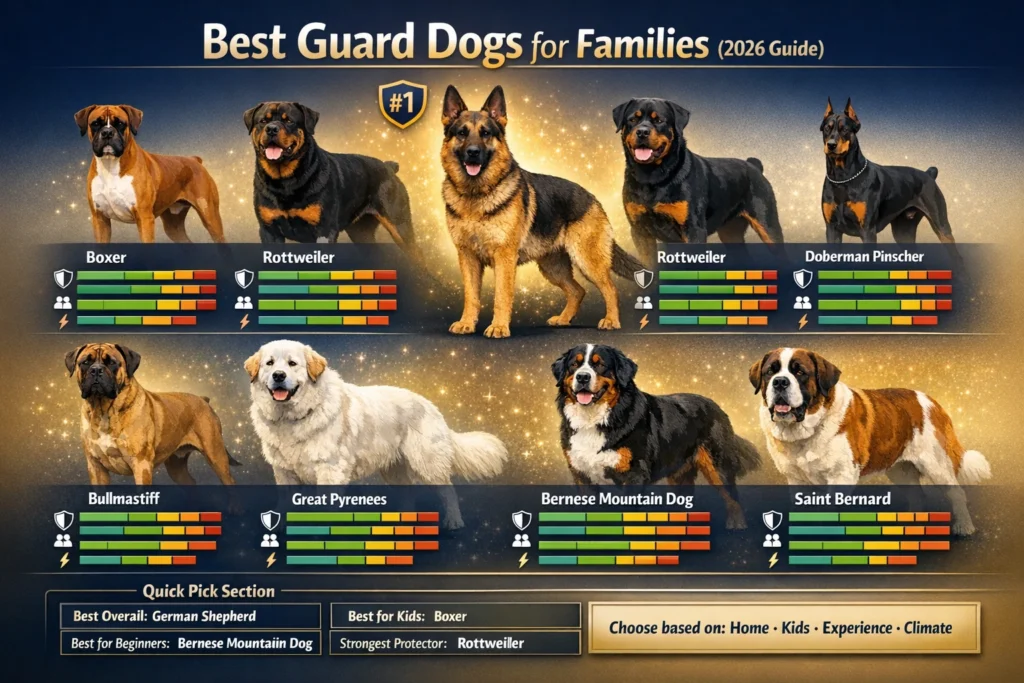
Comparison Table: Best Guard Dogs for Families
| Breed | Protection | Kid-Friendly | Trainability | Climate Fit | Best For |
| German Shepherd | Very High | Very High | Very High | Cold / Mixed | All-round family protection |
| Boxer | High | Very High | High | Indoor / Mild | Families with kids |
| Rottweiler | Very High | High | High | Mixed | Experienced owners |
| Doberman Pinscher | Very High | High | Very High | Mild | Active urban homes |
| Bullmastiff | High | Medium | Medium | Moderate | Quiet protection |
| Great Pyrenees | High | High | Medium | Cold | Calm homes |
| Bernese Mountain Dog | Medium | Very High | Medium | Cold | Gentle families |
| Saint Bernard | Medium | Very High | Medium | Cold | Giant dog lovers |
This table makes the decision easier. So, for your top priority is overall balance, the German Shepherd stands out. So your top priority is child friendliness; the Boxer and Bernese Mountain Dog deserve a closer look. If your top priority is serious deterrence, the Rottweiler and Doberman deserve consideration.
Safest Guard Dogs for Families with Children
The safest options are not necessarily the biggest or toughest. They are the breeds that combine protective awareness with patience and social stability.
The strongest family-friendly choices usually include:
German Shepherd
Boxer
Bernese Mountain Dog
Great Pyrenees
Saint Bernard
Why These Breeds Rank Safely
These breeds tend to offer a better mix of protection and tolerance. They can watch over a home while still being more manageable around children than extremely high-strung or overly dominant dogs.
That said, no breed is “automatic safety.” Dogs and children should always be supervised together. Even the friendliest family dog can become stressed, startled, or overwhelmed if boundaries are ignored.
Important Rule
Never leave young children alone with any dog, no matter how gentle the breed is known to be. Supervision is not optional. It is the foundation of safety.
Best Beginner Guard Dogs
If you are new to dog ownership, the best guard dogs for families are the ones that are easier to train, easier to manage, and less likely to overwhelm you.
Strong Beginner-Friendly Picks
German Shepherd
Boxer
Bernese Mountain Dog
Why These Work for Beginners
The German Shepherd offers high intelligence and trainability, which helps new owners establish routines. The Boxer is usually more playful and socially warm, which can make family life easier. The Bernese Mountain Dog is often calm and affectionate, making it appealing for owners who want a softer temperament.
Breeds to Approach Carefully
Rottweiler
Doberman Pinscher
Bullmastiff
These are not “bad” choices. They are simply more demanding in terms of structure, consistency, and handling skill. A beginner can succeed with them, but only if the training plan is serious and the household is disciplined.
Beginner Verdict
If this is your first serious family guard dog, start with a breed that is strong on temperament and trainability, not only on looks or reputation.
Which Guard Dog Fits Your Lifestyle?
Choosing the right dog is not just about breed traits. It is about the daily environment the dog will live in. A breed that thrives in one household may struggle in another.
Apartment Living
Best options:
Boxer
Doberman Pinscher
A well-trained German Shepherd
These breeds can adapt to apartment life if they get enough exercise, structure, and mental stimulation. The main challenge in apartments is energy management, not just size.
Suburban Homes
Best options:
German Shepherd
Rottweiler
Bullmastiff
Suburban homes often give dogs more room to move, patrol, and rest. This environment can suit medium-to-large guarding breeds very well.
Cold European Climate
Best options:
Great Pyrenees
Bernese Mountain Dog
Saint Bernard
These breeds are especially suited to colder conditions. Their coats, build, and temperament often make them better matched to chilly weather than short-coated breeds.
Urban Families
Urban homes usually need a breed that is manageable, trainable, and calm indoors. A beautiful guardian with no indoor discipline can be difficult in a city setting. In urban life, reliability matters more than raw size.
The best fit is not always the most famous breed. It is the breed that can live comfortably with your schedule, your space, and your household rhythm.
Training & Safety Essentials
Even the best guard dogs for families need structure. An untrained protective dog is not a security asset. It is a risk.
Basic Rules
Start training early
Socialize the puppy with people, sounds, and places
Reward calm behavior
Set boundaries from the beginning
Stay consistent with commands and rules
Key Commands to Teach
Sit
Stay
Come
Leave it
These commands are simple, but they are powerful. They help prevent accidents, reduce impulsive behavior, and give the owner control in stressful moments.
Why Training Matters So Much
A dog that knows how to respond will be easier to guide around guests, children, visitors, and unfamiliar situations. Training turns instinct into dependable behavior. That is especially important in a family home, where safety and predictability matter.
Socialization Is Not Optional
Socialization helps a dog understand the world without reacting fearfully. A dog that grows up around different people, environments, and everyday sounds is usually more stable than a dog that has had limited exposure.
Family Reminder
A guard dog should not be isolated from the family. It should be integrated into normal life in a controlled, structured, and respectful way.
Common Mistakes Families Make
1. Choosing Looks Over Behavior
This is one of the biggest errors. A breed may appear impressive, but that does not guarantee family suitability. A frightening appearance does not equal a stable temperament.
2. Skipping Socialization
Without early socialization, even a smart dog can become cautious, reactive, or difficult to manage. Socialization teaches the dog what is normal and what is not.
3. Ignoring Energy Needs
Every breed has a different exercise profile. A German Shepherd needs meaningful activity. A Boxer needs play and movement. A Bullmastiff may need less running, but still needs structure and proper handling.
4. Having No Training Plan
A family guard dog cannot be treated like a decorative pet. It needs rules, repetition, and guidance. Without that, behavior problems become more likely.
5. Underestimating Size and Strength
Large dogs are not only bigger physically; they are also stronger emotionally and mechanically in everyday life. Pulling, jumping, leaning, and excitement can all become serious issues if not addressed early.
6. Failing to Match the Dog to the Household
Some families need a calm guardian. Others need a highly energetic working dog. There is no one-size-fits-all answer. A thoughtful match is better than a trendy choice.
Pros and Cons of Family Guard Dogs
Pros
Home security
Strong family bonding
Intelligence and trainability
A reassuring presence
Companionship and loyalty
Cons
Requires time and effort
Needs training and Socialization
Larger breeds can be costly to feed and maintain
Not a “set and forget” pet
Can be challenging if matched poorly to the home
A family guard dog gives a lot, but it also asks a lot. That is why preparation matters.
Expert Tips to Choose the Right Guard Dog
Choose based on lifestyle, not fashion
Think long term, not just puppy stage
Meet the dog before making a final decision
Study temperament before size
Be honest about your own experience level
Consider your climate, home layout, and daily routine
The best dog is not the one that impresses other people. It is the one you can confidently live with, train, and care for every day for many years.
A responsible choice protects the whole family better than a rushed one.
How to Think About “Protection” the Right Way
Many people imagine a guard dog as something that will automatically defend the family in a dramatic moment. In real life, protection is usually quieter and smarter than that.
A good family guard dog:
Notices unusual behavior
Barks or alerts when appropriate
Stays close to the household
Learns who belongs and who does not
Responds to commands before situations escalate
That is the kind of protection that helps in daily life. It is not about creating fear. It is about creating confidence.
A family guard dog should make the home feel safer, not more chaotic.
Best Guard Dogs for Families in Europe
For families living in Europe, climate, housing style, and neighborhood density may affect the choice even more.
Good European-Fit Picks
German Shepherd
Boxer
Doberman Pinscher
Great Pyrenees
Bernese Mountain Dog
Saint Bernard
What European Families Should Consider
The cooler regions, thick-coated breeds often feel more comfortable. know cities, apartment adaptability matters more. In suburban and rural settings, larger guarding breeds may be easier to manage because they have more space.
Families should also think about travel, housing rules, and local expectations for breed behavior. A breed with strong guarding instincts can still be an excellent companion, but it must fit the legal and practical environment of the household.
Family Protection Dog Checklist
Before choosing a breed, ask these questions:
Can I provide daily exercise?
Can I commit to training?
Will this dog be around children regularly?
Do I have enough space for the breed?
Is my climate suitable?
Can I handle a large, strong dog?
Do I want calm protection or active protection?
Am I prepared for grooming and maintenance?
If the answer to most of these is yes, you are closer to finding the right match. If several answers are no, consider a breed with lower demands and higher manageability.
Frequently Asked Questions
Yes, Guard Dogs can be safe for Families when they are properly trained, socialized, supervised, and matched to the household correctly. Safety depends far more on ownership and training than on breed name alone.
The German Shepherd and Boxer are often considered top choices because they combine protectiveness with strong family compatibility. Bernese Mountain Dogs, Great Pyrenees, and Saint Bernards can also be excellent in the right home.
German Shepherds and Doberman Pinschers are among the easiest guard dogs to train because they are intelligent, attentive, and responsive to structure. That said, trainability still depends on consistency from the owner.
No. Proper guard dogs do not attack randomly. They are trained to observe, assess, and respond to commands. The best family guard dogs are controlled, not reckless.
Great Pyrenees, Bernese Mountain Dogs, and Saint Bernards are especially suited to cold climates. Their coats and body types help them handle lower temperatures more comfortably.
Yes, a Rottweiler can be very good for families, but it is best suited to experienced owners who can provide early training, structure, and consistent leadership.
Conclusion:
The best Guard Dogs for families are not the most dangerous-looking dogs. They are the most balanced, reliable, trainable, and family-compatible dogs.
So you want the strongest all-around choice, the German Shepherd is hard to beat. Family-Safe Traits + Top Picks Explained: Your priority is children; the Boxer deserves serious attention. If you are an experienced owner seeking stronger deterrence, the Rottweiler and Doberman are excellent options. If you want calm, steady, gentle protection, Great Pyrenees, Bernese Mountain Dogs, and Saint Bernards can be wonderful family guardians.
Top Picks Summary
Best Overall: German Shepherd
Best for Kids: Boxer
Best for Experienced Owners: Rottweiler and Doberman Pinscher
Best for Calm Homes: Great Pyrenees and Bernese Mountain Dog
Best Gentle Giant: Saint Bernard
Final Advice
Choose a dog that matches your:
Home size
Children’s ages
Experience level
Daily routine
Climate
Training commitment
A guard dog should do more than protect your home. It should fit into your family life with confidence, stability, and trust.