
Introduction
Mustard is one of those foods that seems harmless on a sandwich, a hot dog, or a picnic plate, but it is not a safe condiment for dogs. Veterinary and poison-control sources explain that Mustard contains mustard seeds, and those seeds can contain toxic compounds that may irritate the stomach and intestinal tract, leading to gastroenteritis. Other mustard products can also include ingredients that are not ideal for dogs.
That is why the right answer is not just “yes” or “no.” Dog owners need to know how much was eaten, what type of mustard it was, what symptoms to watch for, and when to call a vet immediately. In real life, the biggest risk is panic, guesswork, and delay. A clear action plan matters more than a vague warning. Poison-control and veterinary sources also stress that you should not induce vomiting at home without professional guidance, and that kitchen tricks like mustard do not actually work for making pets vomit.
This guide is built to help dog owners make a fast, responsible decision. It covers the risk level, symptoms, what to do next, the types of mustard to avoid, and how to stay calm if your dog sneaks a lick at home, in a café, or during a family cookout.
Can dogs eat mustard?
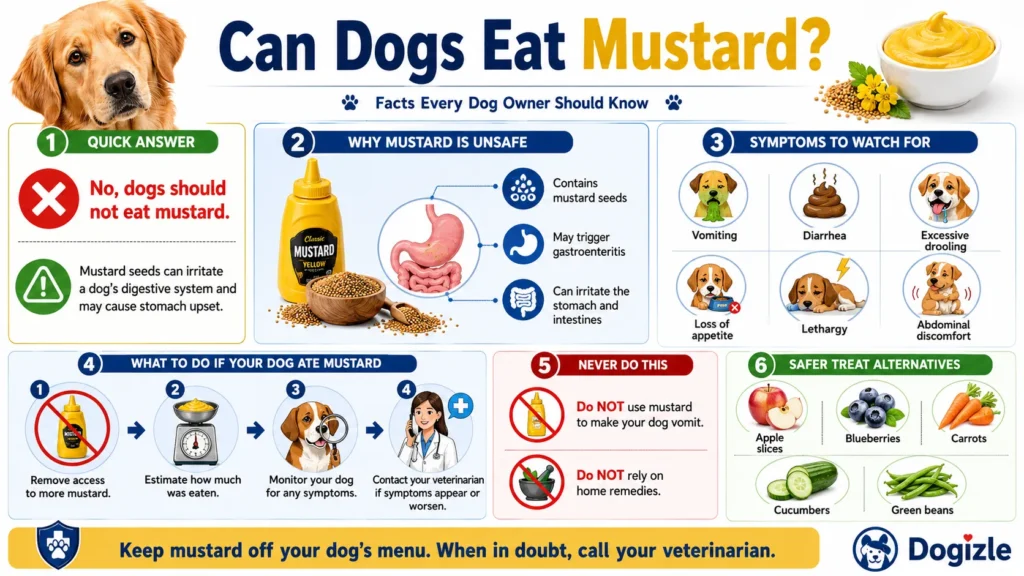
No, dogs should not eat mustard. The safest answer is to treat mustard as a condiment to avoid, not a treat to test. Purina’s veterinary-backed guidance says mustard is bad for dogs because it contains mustard seeds, and those seeds can lead to gastroenteritis. Mustard products may also contain other ingredients that could be harmful.
The practical rule is simple: there is no “dog-safe serving” of mustard. A tiny lick is less concerning than a large amount, but it is still not something to encourage. The real issue is not whether mustard tastes spicy or mild to us; it is whether it can irritate your dog’s digestive system and trigger vomiting, diarrhea, drooling, belly pain, or worse. Veterinary sources consistently place those symptoms in the warning-sign category for stomach inflammation and poisoning-style exposures.
Snippet-ready answer
Can dogs eat mustard? No. Mustard is not recommended for dogs because it can irritate the stomach and cause vomiting, diarrhea, drooling, and abdominal pain. If your dog ate mustard, monitor for symptoms and contact your vet if your dog seems unwell.
Why mustard is not safe for dogs
Mustard is risky for dogs for two main reasons. First, the mustard seed itself can contain compounds that irritate the digestive tract and trigger gastroenteritis. Second, many commercial mustard products contain additional ingredients, seasonings, or flavorings that can make the stomach upset worse.
Dogs are also not small humans. Their digestive systems are more sensitive to rich, spicy, salty, or highly seasoned foods. What looks like a harmless dab on a burger can turn into a very uncomfortable day for a dog, especially if the dog is small, sensitive, young, elderly, or already has a delicate stomach. In general veterinary guidance, vomiting and diarrhea are not always emergencies, but they do need close monitoring because repeated episodes can lead to dehydration.
What mustard can do in the body
When mustard irritates the stomach or intestines, the result may be:
- nausea
- vomiting
- diarrhea
- drooling
- loss of appetite
- painful abdomen
- Dehydration if symptoms continue
Which types of mustard should be avoided?
The safest rule is to avoid all mustard forms, including plain yellow mustard, Dijon mustard, spicy mustard, honey mustard, mustard sauce, mustard powder, and mustard seeds. If the label says mustard is part of the product, do not treat it as dog-safe. This broad avoidance approach is consistent with the fact that mustard seeds are the underlying concern, not just one brand or one flavor.
Mustard type comparison table
| Mustard type | Risk level for dogs | Why is it a problem | Best action |
| Yellow mustard | High | Can irritate the stomach and cause GI upset | Do not share |
| Dijon mustard | High | Same core mustard risk, often more seasoned | Do not share |
| Honey mustard | High | Mustard risk plus extra ingredients | Do not share |
| Spicy mustard | High | Mustard risk plus spicy ingredients | Do not share |
| Mustard powder | High | Concentrated mustard ingredient | Do not share |
| Mustard seeds | High | Seeds are the core concern in mustard toxicity-style guidance | Keep away |
| Mustard sauce/marinade | High | May contain mustard plus additional seasonings | Avoid entirely |
Source basis: Mustard is unsafe because mustard seeds contain toxic compounds that can cause gastroenteritis, and commercial mustard may include other risky ingredients.
Quick summary
If it is mustard, the answer is no. The specific flavor may change the taste, but it does not change the basic safety issue.
What symptoms can mustard cause in dogs?
The most common symptoms after a dog eats something that irritates the stomach are vomiting, diarrhea, loss of appetite, a painful belly, drooling, and lethargy. Veterinary sources also list dehydration, blood in vomit, and blood in stool as more serious warning signs that need prompt attention.
Symptom guide table
| Symptom | What it may mean | What to do |
| Mild drooling or lip licking | Early nausea or taste irritation | Watch closely |
| One episode of vomiting | Possible stomach upset | Monitor and rest |
| Repeated vomiting | More serious irritation or illness | Call your vet |
| Diarrhea | GI inflammation | Watch hydration; call if it continues |
| Painful tummy/stretching posture | Abdominal discomfort | Call your vet |
| Lethargy | The dog feels unwell or may be dehydrated | Contact your vet |
| Blood in vomit or stool | Urgent warning sign | Seek veterinary help promptly |
| Bloated abdomen with retching | Possible emergency unrelated to mustard | Treat as urgent |
Source basis: VCA, PDSA, and Blue Cross identify vomiting, diarrhea, pain, lethargy, dehydration, and blood as important warning signs; continuous retching and bloat can signal a life-threatening emergency.
When mustard becomes more concerning
A small taste is less likely to be serious than a large serving, but the dog’s size, age, stomach sensitivity, and what else was eaten matter. If the mustard was on a hot dog, sandwich, burger, or leftover food, the other ingredients may be a bigger issue than the mustard itself. That is why owners should always think beyond the condiment and check the full food item. This is especially important in multi-dog homes, picnic settings, and restaurant leftovers.
What to do if your dog ate mustard
This is the part most readers need fast. A calm, structured response is better than panic.
Step-by-step action plan
- Remove the food immediately. Stop any more licking or swallowing.
- Check what kind of mustard it was. Look at the label if possible.
- Estimate how much was eaten. A lick is different from a spoonful.
- Look for other ingredients. The food may contain onions, garlic, rich meats, or other additives.
- Watch for symptoms for the next several hours. Vomiting and diarrhea are the key early signs.
- Call your vet if symptoms start or if the amount is more than a tiny taste.
- Treat repeated vomiting, lethargy, abdominal pain, blood, or collapse as urgent.
What not to do
Do not assume mustard is a home remedy. Do not try to make your dog vomit with mustard or any kitchen ingredient. ASPCA states that mustard and similar kitchen items do not work to induce vomiting in pets. Pet Poison Helpline also warns not to induce vomiting without consulting a vet or poison-control professional.
When to call the vet
Contact your vet right away if:
- Your dog keeps vomiting
- Your dog has diarrhea that does not settle
- Your dog seems painful, weak, or unusually quiet
- There is blood in vomit or stool
- Your dog is a puppy, a senior, or medically fragile
- Your dog ate a large amount, or you are unsure what else was in the food
Emergency contacts
Cornell and poison-control resources recommend contacting your veterinarian or an emergency clinic immediately if your Dog has eaten something potentially harmful. If you are in the U.S. or Canada, Poison Control and ASPCA Poison Control are both established emergency resources. ASPCA lists its poison-control number as (888) 426-4435, and Pet Poison Helpline lists 855-764-7661.
Should you make your dog vomit?
No, not on your own. That is one of the most important safety points on this topic. Poison-control guidance says not to induce vomiting without veterinary advice, and ASPCA specifically notes that mustard is one of the kitchen items people wrongly believe can do the job. It does not work for that purpose.
The reason this matters is simple: vomiting is not always the right response for every exposure. In some cases, it may make things worse or delay real treatment. If your dog may have eaten something harmful, the safest move is to get professional guidance first. Cornell’s poison-first-aid guidance also stresses telling the vet the brand, ingredient list, amount eaten, time eaten, and your dog’s weight so they can judge the risk accurately.
Mini summary
Mustard is not a safe vomiting trick, and it is not a safe home remedy. Get veterinary advice instead.
Pros and cons of giving mustard to dogs
This section is blunt on purpose because dog owners searching this topic need the real answer.
Pros
There are no meaningful nutritional or health benefits that justify giving mustard to a dog. Mustard is not a dog treat, not a supplement, and not a recommended flavoring. The risk outweighs any perceived benefit.
Cons
- can irritate the stomach
- can trigger vomiting
- can cause diarrhea
- can lead to drooling and nausea
- may hide other risky ingredients
- may delay proper first aid if owners try kitchen fixes
Bottom line
There is no good reason to feed mustard to dogs. Avoid it completely.
Safe alternatives to share instead
If you want to give your dog something tasty, choose plain, dog-safe foods that are simple, fresh, and unseasoned. PDSA’s vomiting guidance also reminds owners that when the stomach is irritated, bland and easily digestible food is usually the gentlest approach.
Good options include:
- small pieces of plain apple
- banana slices
- cucumber
- carrot
- green beans
- blueberries
Keep portions small, and skip salt, sauces, butter, spices, and condiments. When a dog has an upset stomach, “plain” is better than “interesting.”
Helpful rule for owners
If a food needs mustard to be enjoyable for humans, it is usually not a dog treat.
Safety and health guidance for dog owners
Mustard-related stomach upset is often short-lived, but that does not mean it should be ignored. VCA notes that gastritis can involve sudden vomiting, dehydration, lethargy, abdominal pain, and blood in vomit or stool. Blue Cross also warns that vomiting and diarrhea can sometimes signal toxicity or a more serious health problem, especially in puppies or vulnerable dogs.
A practical at-home approach is:
- Keepwater available
- Avoid rich foods for the moment
- Monitor the dog’s energy and appetite
- Note how many times vomiting or diarrhea happens
- Contact your vet if the signs continue or worsen
Dangerous myths to avoid
- “A little mustard will settle the stomach.”
- “Mustard makes dogs vomit safely.”
- “If the dog is acting normal now, it cannot get worse.”
- “Honey mustard is gentler, so it is safe.”
Those ideas are not supported by veterinary poison-control guidance.
Common mistakes dog owners make
- Waiting too long. Repeated vomiting or diarrhea should not be brushed off.
- Forgetting the rest of the food. The sandwich, hot dog, or sauce may contain other issues.
- Using kitchen remedies. Mustard is not a legitimate vomiting trick.
- Treating small dogs like large dogs. Smaller dogs can be affected faster by the same amount of food.
- Ignoring subtle signs. Quiet behavior, drooling, and a painful belly matter.
Mini summary
The most common error is assuming the problem is “just a little condiment.” In real life, the safer response is to observe, check ingredients, and call a vet when symptoms appear.
Expert tips for real-world dog owners
- Keep picnic food and condiment bottles out of reach when eating outdoors.
- In apartment homes, do not leave trash bins open after meals.
- During travel, avoid giving dogs table scraps from unfamiliar foods.
- If multiple people feed the dog, make mustard a household “never.”
- Save your vet’s number and a poison-control number in your phone before you ever need them.
Why this matters in Europe and other urban markets
In cities, Dogs often get exposed to shared food at cafés, parks, holiday gatherings, and train travel. In these settings, the best prevention is simple control: no unattended plates, no open takeaway boxes, and no family guessing games over what the dog “probably ate.” That is especially useful for apartment owners and busy city households where food is close to the floor. This is an inference based on practical dog-ownership patterns, not a direct clinical claim.
Apartment living advice
Apartment dogs are more likely to encounter human food on low tables, counters, or floor-level picnics after delivery meals. Keep mustard packets, sauce cups, and leftovers fully closed and elevated. Use a sealed bin, and train a strong “leave it” cue so the dog does not practice scavenging.
For smaller homes, prevention matters even more because the dog is near kitchens, dining spaces, and packed routines. A single accidental lick is one thing; repeated access to condiment wrappers is where the real trouble starts. The same prevention logic is supported by poison-control advice to remove the pet from the exposure and act early.
Cold weather and seasonal considerations
Mustard exposures happen more often during cookouts, holiday meals, sports gatherings, and travel-friendly food sharing. In colder months, people also tend to eat richer comfort foods, which can mean more table scraps and heavier sauces around the home. Keep an eye on kitchen counters, low coffee tables, and guest bags during seasonal visits.
If your dog is already dealing with winter stomach sensitivity, do not “test” extra foods. When a dog is vomiting or has diarrhea, the body can lose fluids quickly, and dehydration is a real concern. Cornell specifically notes that vomiting combined with diarrhea increases dehydration risk.
What the top pages are weak at
The strongest existing pages usually do one of two things well: they give the direct answer fast, or they explain symptoms briefly. Their weaknesses are that they stay short, repeat themselves, and skip the real owner decision-making framework. Most do not build a full “what to do now” flow, a clear symptom ladder, or a practical emergency checklist. Some also place mustard inside broader cookout or toxic-food roundups, which dilutes the exact intent.
That creates a real opening for a pillar page that is:
- more structured
- more calming
- more action-oriented
- more useful after the click
- better at serving AI Overview and featured-snippet style answers
People Also Ask
A small lick is less likely to cause serious trouble than a larger amount, but mustard is still not safe to offer. Watch for vomiting, diarrhea, drooling, or abdominal discomfort, and call your vet if your dog seems unwell.
Mustard is treated as unsafe because mustard seeds contain toxic compounds that can cause gastroenteritis, and commercial products may include other ingredients that are not suitable for dogs.
Check the whole food, not just the mustard. The hot dog, bun, sauces, and toppings may contain other issues. Monitor closely and contact your vet if vomiting, diarrhea, lethargy, or pain appear.
No. Do not induce vomiting on your own. Poison-control guidance says not to use home antidotes or vomiting tricks without professional instruction, and mustard does not work as a safe vomiting aid.
Call if your dog keeps vomiting, has persistent diarrhea, shows belly pain, becomes lethargic, or has blood in vomit or stool. Puppies, seniors, and medically fragile dogs deserve quicker attention.
Remove the food, estimate the amount, check the ingredients, and monitor for symptoms. If your dog seems off at all, call your vet or a poison-control line right away.
No. Mustard seeds are the core concern behind mustard’s GI risk, so they should not be offered to dogs.
No. Honey mustard still contains mustard and may also include extra ingredients that can upset a dog’s stomach. It should still be avoided.
Conclusion
So, can dogs eat mustard? The safest answer is no. Mustard is not a dog treat, not a home remedy, and not something to “test in a tiny amount.” The main concern is stomach irritation that can lead to vomiting, diarrhea, drooling, pain, and dehydration. The smarter move is to keep mustard away, watch for symptoms if your dog got into it, and call your vet quickly if anything seems wrong.
For responsible dog ownership, the best habit is prevention: keep condiments out of reach, avoid sharing seasoned human food, and save poison-control numbers before an emergency happens. That simple routine helps protect dogs in homes, apartments, travel situations, cookouts, and family gatherings. If your dog ate Mustard and you are unsure what to do, act early and get professional guidance rather than guessing.