What Does “Watch Your Six” Mean? Origin, Uses & Examples
1. What Does “Watch Your Six” Mean?
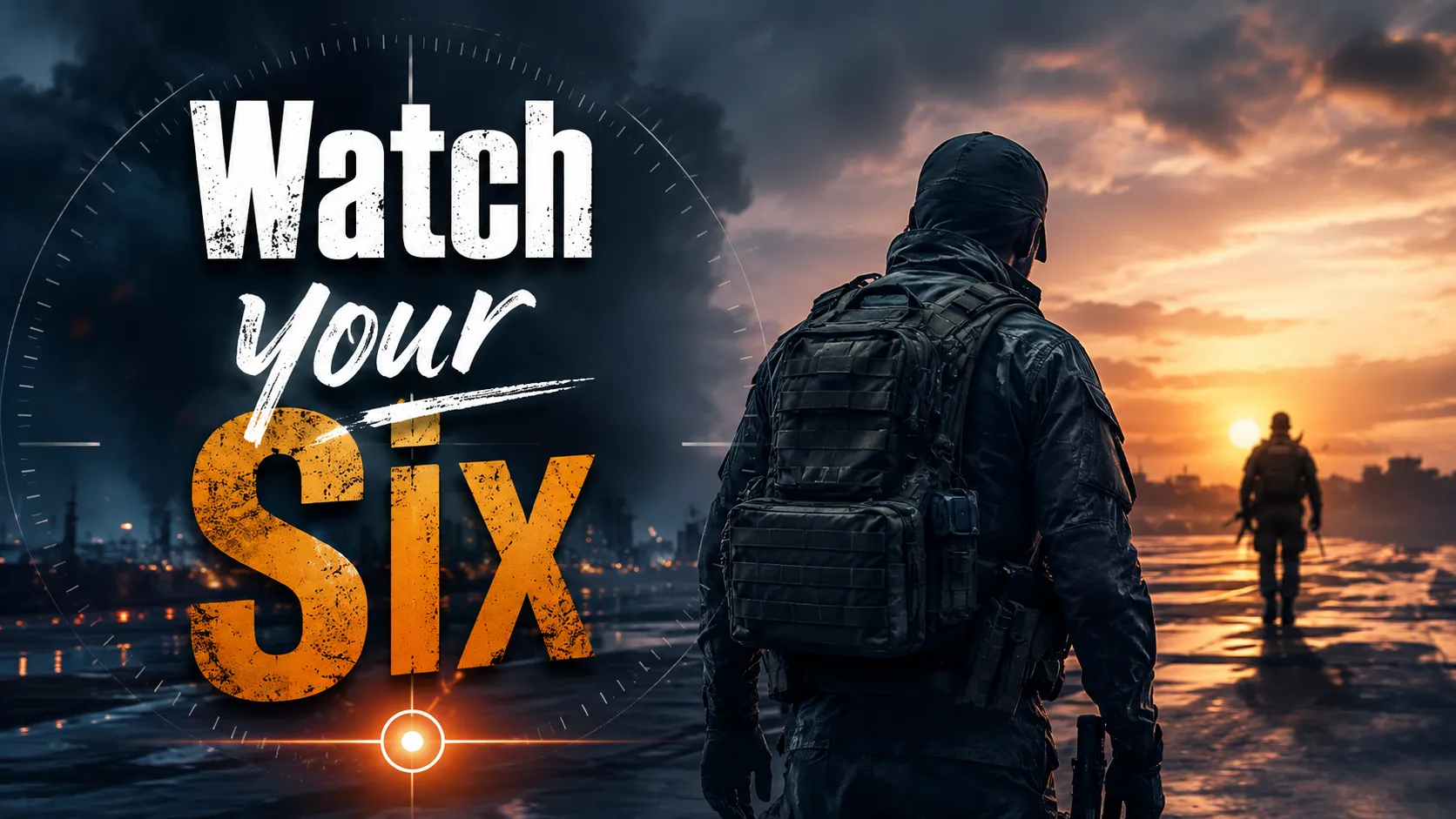
“Watch your six” means “watch your back” or “stay alert for danger you can’t see.” It comes from military clock-position code, where 12 o’clock is straight ahead and 6 o’clock is directly behind you — your blind spot. Say it to someone, and you’re telling them: something could approach from the one direction they’re not watching.
The phrase works both ways:
- Literally, in military, police, or security settings: physically check behind you.
- Figuratively, in everyday or professional speech: stay alert to risks, setbacks, or people working against you when you’re not looking.
Its natural counterpart is “I’ve got your six” — a pledge that someone else is covering that blind spot for you.
2. Quick Meaning Summary
| Element | Detail |
| Meaning | Watch your back / stay alert to danger behind you |
| Category | Military slang → general idiom |
| Origin period | Clock-code convention from WWI-era gunnery; spoken phrase verified in Korean War-era air combat |
| Literal use | Physically checking behind you |
| Figurative use | Staying alert to risks, setbacks, or people working against you |
| Common counterpart | “I’ve got your six” (a pledge to protect) |
| Modern usage | Military, police, gaming, office/workplace slang |
3. The Clock Code Explained
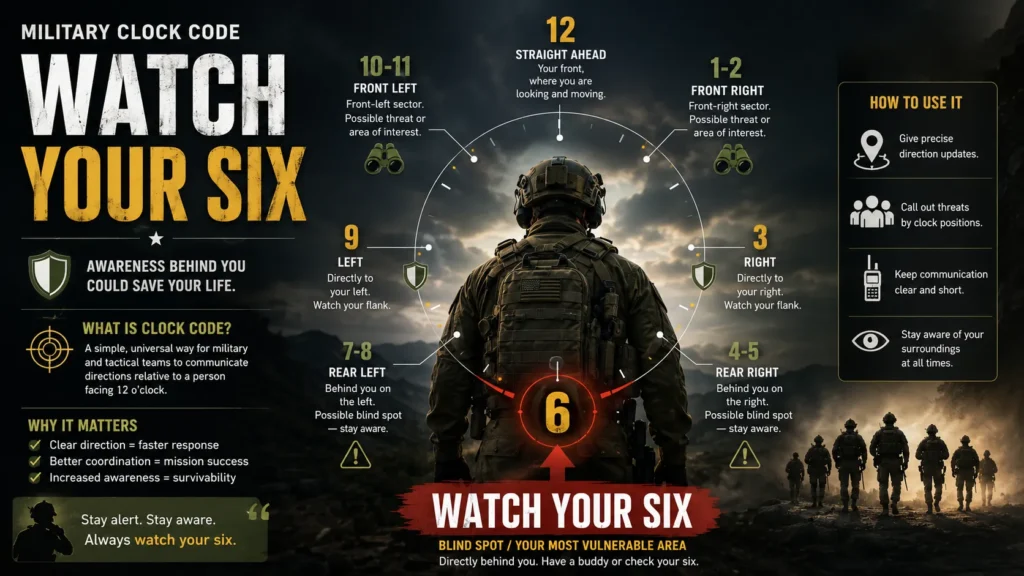
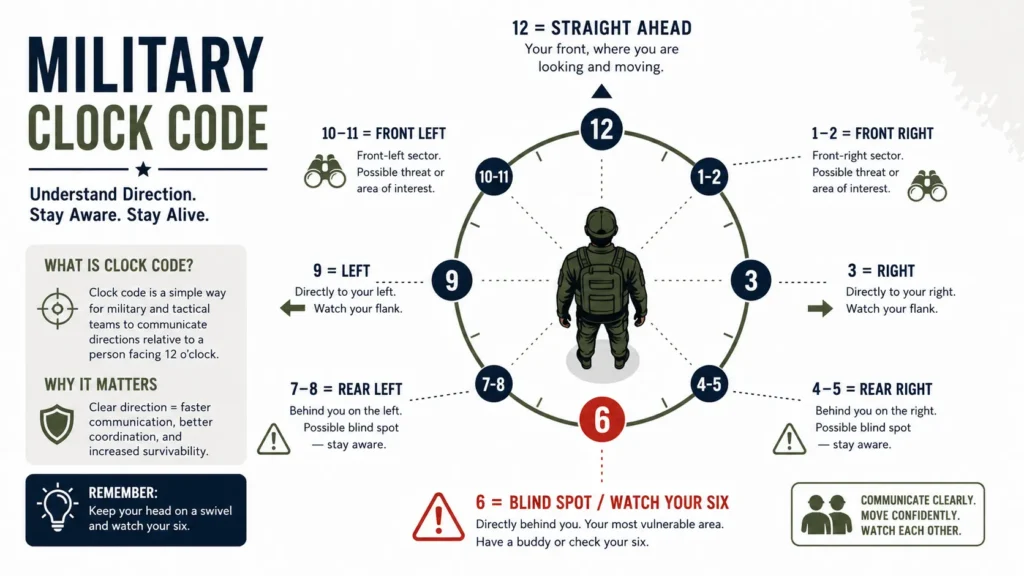
Military clock code is a full 360-degree reference system, not just a “6 means behind you” trick.
Picture yourself at the center of an analog clock, facing 12:
| Position | Direction | Meaning |
| 12 o’clock | Straight ahead | What you can see and react to directly |
| 1–2 o’clock | Forward-right | Approaching from your front-right |
| 3 o’clock | Directly right | Your right flank |
| 4–5 o’clock | Rear-right | Closing in from behind on your right |
| 6 o’clock | Directly behind | Your blind spot — most vulnerable position |
| 7–8 o’clock | Rear-left | Closing in from behind on your left |
| 9 o’clock | Directly left | Your left flank |
| 10–11 o’clock | Forward-left | Approaching from your front-left |
The system exists for speed. “Contact, your seven o’clock” says in three words what would otherwise take a full sentence — a real tactical shorthand, not a figure of speech. “Watch your six” is simply the single most-used position from that system, because the rear is the one direction people physically can’t monitor without turning around.
4. The Real Origin of “Watch Your Six”
Most articles repeat the same unsourced line: “it started with WWI pilots.” There’s a problem with that story — WWI-era aircraft rarely carried radios, so pilots in 1917–1918 communicated with hand signals and flares, not spoken clock positions. The clock-code idea has roots in early aerial gunnery training, but the spoken phrase doesn’t appear as a documented radio convention until air combat had reliable voice radios to say it over.
That points to a better-documented period: the Korean War (1950–1953), when U.S. fighter pilots flying jets like the F-80 Shooting Star had working air-to-air radios and used clock-position calls constantly. One F-80 pilot’s own after-action account from a June 1950 engagement near the Yalu River describes checking whether enemy MiGs were at his “six o’clock” mid-dogfight — a dated, first-person combat record of the exact phrase in operational use. Around the same period, USAF fighter tactics formally assigned each wingman in a four-aircraft flight the job of covering the leader’s six o’clock position — likely where “I’ve got your six” grew from as an actual tactical role.
The honest timeline:
- Clock-position referencing for aerial gunnery: WWI onward, as a training convention
- Spoken radio phrase “watch your six”: documented in Korean War-era air combat
- Formalized as wingman doctrine: through Vietnam and the Cold War
- Adopted by infantry, police, and SWAT: as tactical radio culture spread
- Went mainstream: through military films, gaming, and office slang
If a competing article can’t name a decade, a unit, or a source for its origin claim, treat it as folklore, not fact.
5. Why Is “Watch Your Six” Still Popular Today?
- It solves a real communication gap. “Behind you” is vague about direction and urgency; “watch your six” implies both in two words.
- It maps cleanly onto daily life. The rear blind spot maps naturally onto office politics, personal safety, and relationships — situations where the “threat” is a missed detail or a person acting in bad faith rather than a physical attacker.
- Pop culture keeps refreshing it. Every new military film, war-themed game, or veteran-run social account reintroduces the phrase to a new audience.
6. Got Your Six vs. Watch Your Six vs. Check Your Six
| Phrase | What It Does | Example |
| Watch your six | A warning — stay alert to your rear | “Watch your six, we don’t know where the second vehicle went.” |
| Check your six | A one-time action — look behind you now | “Check your six before you back the truck up.” |
| I’ve got your six | A pledge — someone else is covering your blind spot | “Go ahead and brief the client, I’ve got your six on the numbers.” |
| Watching 6 | A status update — actively on rear guard duty | “I’m watching 6 while you two clear the room.” |
Using the wrong one changes the meaning: “watch your six” puts the alertness burden on you; “I’ve got your six” removes it and places it on the speaker.
7. Watch Your 12, Watch Your 20, Watch My 9 Explained
- Watch your 12 — a warning about a threat directly in front of you, the opposite of six.
- Watch my 9 — asking someone to cover your direct left side, part of coordinated team movement.
- Watch your 20 — a genuine mix-up, but not for the reason usually given. “20” isn’t a mangled clock position — it comes from a different system entirely: CB radio and police 10-code, where “what’s your 20?” means “what’s your location?” People saying “watch your 20” are blending two separate slang systems, not misremembering a clock number.
8. From Cockpit to Culture: How the Phrase Went Mainstream
- Military aviation films of the 1980s–90s put clock-position radio chatter into mainstream dialogue for the first time.
- Police and SWAT adoption moved tactical radio habits from air combat to ground operations.
- Video games, especially military shooters, use “check six” and “watch your six” constantly in mission dialogue and multiplayer callouts.
- Office and startup culture uses “watch your six” and “got your six” loosely for covering a colleague or flagging a risk — the workplace equivalent of a wingman.
9. “Watch Your Six” on Social Media and Gaming
- TikTok / Instagram — used Jokingly, captioning near-misses or “protect your peace” style posts.
- Reddit (military, veteran, gaming subs) — used closer to its literal sense, often correcting misused military slang.
- Discord / gaming voice chat — used almost exactly like the original military callout, since squad shooters replicate real rear-guard communication.
- X / Twitter and Facebook — mostly figurative, detached from any literal direction.
10. How to Use “Watch Your Six” in Everyday Life
- “Watch your six — that parking lot’s had a few break-ins lately.”
- “Check your six before you change lanes.”
- “Contact, your six o’clock, two hundred meters.”
- “I’ve got your six, move up.”
11. How to Use “Watch Your Six” at Work Professionally
“Watch your six” can sound jarring dropped straight into a meeting. Softer, professional equivalents that carry the same warning include:
- “Heads up — let’s double-check the numbers before we present.”
- “Worth flagging: there’s a risk with the legal review timeline.”
- “I’ll keep an eye on that for you.” (the professional version of “got your six”)
- “You focus on the pitch, I’ve got your six on the follow-up questions.”
- “I’ll back you up in there.”
12. Grammar, Register and Common Mistakes
- Part of speech: functions as an imperative idiom — a command phrase, like “watch your step.”
- Possessive changes with subject: “watch your six” (warning someone else), “watch my six” / “I’ve got your six” (offering to cover someone), “watching his/her/their six” (third person).
- Capitalization: lowercase in normal sentences; capitalize only in titles or at a sentence start.
- Common mistake: treating “watch your 20” as a clock position — it isn’t.
- Register: casual to tactical. In formal writing, use a plain equivalent like “stay alert” unless the tactical tone is intentional.
13. Common Misunderstandings About “Watch Your Six”
- “It’s the same as ‘watch your back.'” — Close, but “watch your six” specifically implies a direction and a system; “watch your back” is more general.
- “Watch your 20 means watch behind you.” — It doesn’t; “20” is a location marker from 10-code.
- “It started with WWI pilots.” — Repeated everywhere, rarely sourced; the spoken phrase is verifiably Korean War-era and later.
- “It’s rude or aggressive to say at work.” — Context-dependent; casual among peers, abrupt in formal settings.
14. Related Terms and Similar Meanings
| Term | Relationship |
| Watch your back | Closest plain-English equivalent, no positional system implied |
| Blind spot | The concept “six o’clock” literally represents |
| Situational awareness | The broader skill the phrase is teaching |
| Wingman | The person traditionally responsible for covering someone’s six |
| Heads up | A general-purpose warning, less specific than “watch your six” |
| Cover me | A related tactical request, focused on active protection rather than alertness |
15. Quick Reference Chart
| Phrase | Meaning | Best Used For |
| Watch your six | Stay alert behind you | Warnings |
| Check your six | Look behind you now | One-time action |
| I’ve got your six | I’m covering your blind spot | Pledging support |
| Watching 6 | Actively on rear guard | Status update |
| Watch your 12 | Threat ahead | Frontal warnings |
| Watch my 9 | Cover my left side | Team coordination |
| Watch your 20 | Mix of location + direction slang | Rarely precise — avoid in formal use |
People Also Ask
Look behind you right now — a single, immediate action, compared to “watch your six,” which implies sustained alertness over time.
Someone is actively serving as rear lookout for a group, covering the blind spot so others can focus ahead.
A warning about a threat directly in front of you — the opposite direction from six.
A mix of two systems. “20” refers to location (from police/CB 10-code), not a clock direction, so “watch your 20” is a common but imprecise blend of two different slang systems.
A request for someone to cover your direct left side, part of coordinated team movement.
No. It started in military aviation but is now common in law enforcement, security, gaming, and everyday professional speech.
They mean the same thing. “Watch your six” is the more specific, tactical version, referencing an exact direction rather than a general area.
Conclusion
“Watch your six” means watch your back — but it Carries Real, documented military history behind it, not just internet folklore. Knowing the full clock system, the verified Korean War-era origin, and the precise differences between “watch,” “check,” and “got” your six is what separates actually knowing the phrase from just repeating it.