“Can I Get a Hoya?” — Meaning, Origin, and How to Actually Use It (2026 Guide)
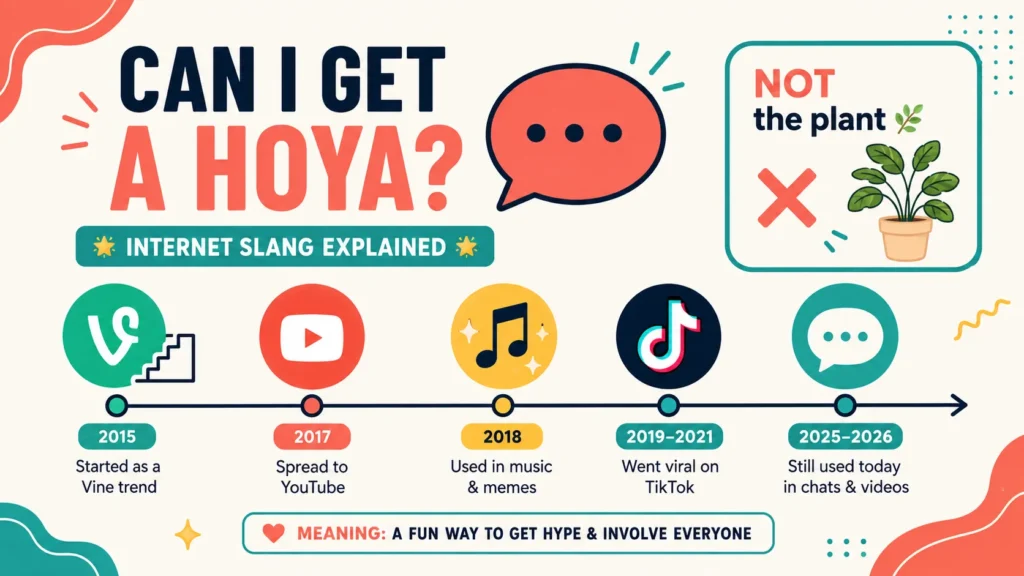
Quick answer: “Can I get a hoya?” is internet slang for “can I get a hype response?” — a call-and-response phrase where the speaker shouts the question and expects the crowd (or the comments) to yell back “HOYA!” It started as a 2015 Vine stunt where someone jumped down a flight of stairs on cue, and it’s had at least two major TikTok revivals since. It has nothing to do with the houseplant of the same name.
If you clicked on this because you heard it shouted at you in a Walmart, saw it in a TikTok caption, got sent a voice memo of someone screaming “HOYAAAA,” or just watched a group chat lose its mind over a single word and had no idea why — you’re in the right place. This guide covers the full history with dates, the mechanics of how and when to use it, the phrases it gets confused with, and the judgment calls people are actually searching for (is it weird, is it rude, is it the plant).
1: What “Can I Get a Hoya” Means
At its core, it’s a hype request. The speaker is asking a group — friends, an audience, strangers, the comments section — to give them a loud, enthusiastic, drawn-out shout in response. It functions the same way a hype-man call works at a concert or the way a coach might ask a locker room “can I get an amen?” except the reply isn’t a real word. It’s a made-up sound that only carries meaning because a group of people have implicitly agreed it does.
That’s actually the most important thing to understand about the phrase, and it’s the part most explainer content skips past: there is no dictionary definition of “hoya” outside of this specific ritual. . It’s closer to a crowd chant — a sound built for the exchange itself, not for carrying independent meaning.
What the phrase is not:
- Not an acronym
- Not a shortened word
- Not a repurposed dictionary word
- Not tied to any specific fandom, sport, or brand
What the phrase functions as:
- A call-and-response cue
- A social “temperature check” (will people respond?)
- A hype/energy marker in texting and captions
- A short-form video format on its own
Because the word itself is empty of independent meaning, its entire value comes from delivery and context — which is why the pronunciation and setting sections further down matter as much as the definition does.
2: Is This the Hoya Plant?
Before going further, it’s worth pulling out a chunk of traffic that lands on this exact search term for a completely different reason: Hoya is also the botanical name for a genus of vining, waxy-leafed houseplants, commonly sold under a handful of nicknames. Some plant sellers lean into the coincidence and use “can I get a hoya?” as a cheeky listing caption when selling cuttings, which occasionally sends slang-searchers straight into a plant marketplace and plant-searchers straight into this meme explainer. It’s a genuine, if minor, source of search confusion.
Common names for the plant genus:
- Hoya
- Wax plant
- Porcelain flower
- Honeyplant (occasionally used informally)
If a plant nursery, propagation guide, or houseplant-care page is what you actually came here for, that’s a different search — the rest of this article is entirely about the slang phrase and its internet history.
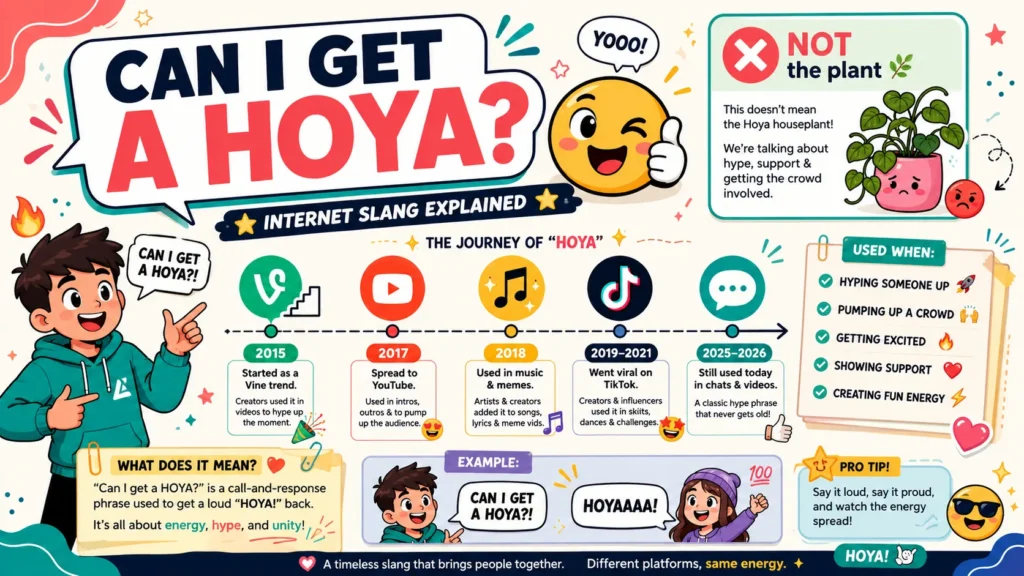
3: The Real Origin — A 2015 Stairwell Vine
Most existing explainers on this phrase shrug and describe the origin as “unclear,” or vaguely gesture at “influencer culture” without a date attached. That’s a weak answer, and it’s avoidable — the origin is documented well enough to state plainly.
The phrase traces back to a 2015 Vine video. In the six-second clip, someone standing at the bottom of a staircase yells “Can I get a hoya?” — and on cue, a second person at the top of the stairs jumps down, lands, and shouts “hoya!” back, usually followed by an exaggerated, drawn-out “yeaaah.” The entire joke lives in the delivery and the physical stunt: the jump functions as the “response,” and the phrase itself is just the setup line that triggers it.
Vine as a platform shut down in January 2017, but by that point the clip had already escaped the app. It was re-uploaded to YouTube on September 1, 2015, where it kept circulating for years after the original Vine ecosystem disappeared, eventually racking up well over a million views on that reupload alone.
Key origin facts:
- Original format: six-second Vine video
- Structure: verbal call (“can I get a hoya?”) + physical stunt response (stairwell jump)
- Reupload platform: YouTube
- Reupload date: September 1, 2015
- Vine platform shutdown: January 2017
A commonly repeated theory online tries to tie the phrase directly to military “Hooyah” call-and-response culture — the idea being that “hoya” is just a spelling drift of the military term. It’s a reasonable-sounding guess given how similar the two words sound out loud, but there’s no documented connection between the military term and the 2015 Vine stunt specifically. It’s speculation, not history, and the two phrases are covered separately later in this guide because conflating them is one of the most common misunderstandings around the trend.
4: Timeline of the Hoyeah Challenge
The trend hasn’t stayed static since 2015 — it’s resurfaced on a fairly predictable cycle, roughly every time a new short-form platform needs fresh, easily replicable content. Here’s the full sequence.
Years covered in this timeline:
- 2015
- 2017
- 2018
- 2019
- 2021
- 2025–2026
Pattern across all revivals:
- Gets rediscovered on a newer platform
- Spreads to an audience with zero knowledge of its original context
- Repeats
That cycle — Vine to YouTube to TikTok to texting — is the single most consistent thing about this trend’s fourteen-year run, and it’s the main reason the phrase keeps generating fresh “what does this mean” searches instead of fading out the way most one-off memes do.
H2 5: Key Names Behind the Trend
A handful of names show up repeatedly across every writeup of this meme’s history. Listing them out clearly (rather than burying them in narrative paragraphs) makes it easier to see who did what, and when.
- Soya — musician; released “Can I Get A? (Hoya)” in 2018, a separate work from the original meme
- stephpuppychan — YouTuber; took the challenge into public spaces starting in 2017
- Brendan Lebaron30 — TikTok creator; helped bring the challenge to TikTok starting in 2019
- Know Your Meme — the primary documentation source cataloguing the trend’s history and dates
None of these figures “invented” the phrase in the sense of being credited as the original 2015 Vine creator — that original video is generally treated as unattributed in most trend documentation. The names above are the people and entities responsible for the trend’s major revivals and cross-platform jumps, not its origin point.
6: Why the Phrase Keeps Coming Back
A meme surviving eleven years and multiple platform migrations is unusual. Most viral formats have a shelf life measured in weeks. A few structural reasons explain why this one keeps resurfacing instead of dying out after its first wave.
- It’s low-effort and high-payoff. There’s no props, no editing, no elaborate setup required — just a shout and a reaction, which is exactly the kind of format that short-form video platforms reward algorithmically. Anyone can attempt it with a phone and zero preparation.
- It’s a genuine, if small-stakes, social experiment. Half of the appeal — especially in the 2017 and 2021 waves — is watching whether real strangers actually respond on camera. That unpredictability gives even a low-effort video some genuine stakes, which is rarer than it sounds in short-form content.
- It’s self-explanatory on first viewing. Even someone encountering it for the very first time understands the entire “rule set” within a single video: someone asks, someone else yells back. That low barrier to understanding is what lets it re-spread so easily every time a platform shift introduces it to a fresh audience with no prior context.
- It has almost no production cost, which lowers the bar for participation. Trends that require editing skill, props, or choreography naturally shrink to a smaller pool of creators. This one doesn’t, so participation stays wide open across every revival.
Put together, those four traits are basically a checklist for what makes a phrase “revival-proof” rather than a one-cycle trend — and it’s why “can i get a hoya” is still generating fresh search volume in 2026 instead of being a dead reference from a shut-down app.
7: How to Pronounce “Hoya” Correctly
Delivery matters more than most people assume when they first read the phrase written out. Said flatly, it doesn’t land. Said with the right exaggeration, it works even on people who’ve never heard it before.
Say it like “oh-yeah” compressed down into a single syllable — closer to “HOY-ya” than to the standard pronunciation of the houseplant name (“HOY-uh”).
Pronunciation checklist:
- Drawn out, not clipped: “hoyaaaaa,” not a flat “hoya”
- Slightly nasal, exaggerated tone
- The call (“can I get a hoya?”) delivered with rising, hyped-up energy
- The response delivered as a loud, sustained shout back, not a quick word
Common pronunciation mistakes:
- Saying it flatly, like a normal word
- Over-enunciating each syllable clearly
- Matching it to the plant’s pronunciation instead of the meme’s
- Delivering it quietly or self-consciously, which undercuts the entire bit
The whole format depends on sounding a little unhinged. A technically “correct” but flat delivery is the fastest way to make the phrase confusing instead of funny to someone hearing it for the first time.
8: Platforms Where the Trend Has Lived
Tracking the phrase by platform (rather than by year) makes the migration pattern easier to see at a glance.
- Vine — 2015 origin; six-second stairwell-jump format
- YouTube — 2015 reupload that survived Vine’s shutdown; 2017 public-space challenge videos by creators like stephpuppychan
- TikTok — 2019 crossover; 2021 major resurgence with the #hoya hashtag passing 100M+ views
- Group chats / texting — 2025–2026 general-purpose use, detached from any specific video format
Each platform shift changed how the phrase gets used slightly. On Vine and early YouTube, it was tightly tied to the stairwell-jump stunt specifically. By the TikTok era, it had loosened into a broader “yell it at strangers/friends and film the reaction” format. By its 2025–2026 texting-era revival, it’s loosened further still into a general hype interjection that doesn’t require video at all — closer to how people use “let’s gooo” in a text thread than a specific meme reference.
H2 9: How People Use It Today
The phrase now shows up across several distinct contexts, each with a slightly different tone.
In a group setting (the original use case):
“We just hit 1,000 followers — can I get a hoya?!” → “HOYAAAA!”
This is the closest modern usage to the original 2015 concept: an announcement followed by a group shout as acknowledgment.
In texting or group chats:
“Finals are officially over 😭 can I get a hoya?”
Here it functions almost identically to typing “let’s gooo” or a string of fire emojis — a request for friends to match your energy in text form, no actual shouting involved.
On TikTok and Instagram:
Caption on a concert video: “Front row tonight. Can I get a hoya?”
Used as a caption, it signals excitement and doubles as a soft invitation for commenters to respond in the same energy.
As a joke or troll format: Sometimes it’s deployed specifically to fluster or embarrass someone — yelling it unprompted in a quiet public space and filming the reaction. This is the version most closely tied to the “is this rude” search intent, since it shifts the phrase from mutual hype to a one-sided prank.
Summary of current contexts:
- Group announcements
- Texting/group chats
- Social media captions
- Public prank/troll videos
H2 10: Hoya vs. Hooyah — Are They the Same Word?
No — related only by sound, not by origin, and this is one of the more common points of confusion the phrase generates.
- “Hooyah” is genuine U.S. military slang, used by the Navy, Marine Corps, and SEAL teams to acknowledge an order or express enthusiasm. It predates the internet phrase by decades and has a real, documented institutional history tied to military culture rather than internet culture.
- “Hoya” is the internet call-and-response phrase originating from the 2015 Vine stunt covered earlier in this guide.
People frequently search “can I get a hooyah” thinking it’s the same trend as the meme — which is a plausible mix-up given how close the two words sound when spoken aloud, but they come from completely different worlds with no documented crossover.
Quick distinction:
- Writing about the military context → “hooyah” is correct
- Referencing the TikTok/Vine meme → “hoya” is correct
11: Is “Can I Get a Hoya” Rude or Inappropriate?
The phrase itself carries no vulgar or hidden meaning — it’s a nonsense hype word, full stop. That said, “is this word offensive” and “is this okay to use” are two different questions, and the second one is really what most searchers mean when they type “is can i get a hoya inappropriate.”
- Fine to use: among friends, in group chats, on casual social posts, or in playful public moments where everyone involved is in on the joke
- Can land awkwardly: when shouted at strangers who clearly aren’t expecting it, especially in a quiet or serious setting — this can come across as disruptive, or like an attempt to embarrass someone specifically for content
So the honest answer is: not inherently offensive, but the delivery method — specifically, yelling it at unconsenting strangers purely for a reaction — is where the “is this rude” concern actually originates. The word isn’t the problem; the setup often is.
H2 12: When Not to Say It
Some contexts are a clean mismatch for the phrase regardless of how it’s delivered.
- Work emails or professional messages
- Job interviews or formal presentations
- School assignments or academic writing
- Any setting where the other person doesn’t share the reference
In each of these cases, the issue isn’t offense — it’s confusion. Without shared context, the phrase just reads as a nonsense sentence rather than a joke, which undercuts the entire point of using it.
13: Similar Hype Phrases, Compared
Placing “can i get a hoya” alongside comparable hype phrases makes its niche clearer — it’s part of a broader category of call-and-response language, not a one-off oddity.
| Phrase | Meaning | Origin | Best used for |
| Can I get a hoya? | Request for a loud hype response | 2015 Vine stunt | Group hype, TikTok bits |
| Hooyah | Enthusiastic acknowledgment | Military call-and-response | Military/formal enthusiasm |
| Can I get a witness? | Rhetorical request for agreement | Older colloquial/religious phrasing | Emphasizing a point |
| Let’s gooo | General excitement | Broad internet/gaming slang | Any hype moment |
| Make some noise | Request for crowd reaction | Live event/MC culture | In-person crowds |
Names of compared phrases:
- Can I get a hoya?
- Hooyah
- Can I get a witness?
- Let’s gooo
- Make some noise
What separates “can i get a hoya” from the others on this list is that it’s the only one built entirely around a nonsense word invented specifically for the ritual — every other phrase in the comparison uses real, pre-existing English vocabulary, even when used informally.
14: The Soya Song Connection
Part of why this phrase keeps generating mixed search results is musical, not just meme-related: in 2018, an artist credited as Soya released a track titled “Can I Get A? (Hoya).” It’s a separate piece of content from the original Vine stunt — a song riffing on the same viral phrase rather than a continuation of the meme itself — but it’s frequently what people find when they search the exact phrase on music streaming platforms.
Why this matters for searchers:
- The song and the meme share a name but not an origin
- Searching “can i get a hoya” on a music platform surfaces the Soya track, not the meme history
- This overlap is a genuine (if minor) source of the “what does this actually mean” confusion online
If you were specifically looking for the song rather than the meme’s meaning, that’s a different piece of content entirely — worth noting only so the two don’t get conflated the way “hoya” and “hooyah” sometimes do.
15: Common Misunderstandings
A short list of the recurring wrong assumptions people carry into this search.
- “It must mean something sexual.” It doesn’t. It’s a nonsense hype word with no hidden or vulgar meaning attached to it.
- “It’s the same as ‘hooyah.'” It isn’t — see the dedicated comparison section above; different origin, different world, similar sound only.
- “It’s brand new.” It’s not. It’s a decade-old trend currently on its third or fourth major wave of popularity.
- “It’s only a TikTok thing.” It started on Vine in 2015 and now shows up just as often in plain texting and group chats as it does in short-form vide
Explore More: https://dogizle.com/moment-vs-momment/
The essentials:
- Meaning: a request for a loud, hyped-up group shout in response
- Origin: 2015 Vine video, stairwell-jump stunt
- First documented reupload: YouTube, September 1, 2015
- Not related to: the military term “hooyah,” or the Hoya houseplant genus
- Not offensive on its own; can feel disruptive depending on delivery and audience
- Best used with: friends, group chats, casual social content
- Best avoided in: professional, academic, or formal settings
Names worth remembering if you’re tracing the trend further:
- Soya (musician behind the 2018 song)
- stephpuppychan (2017 public-space challenge videos)
- Brendan Lebaron30 (2019 TikTok crossover)
- Know Your Meme (primary documentation source)
That’s the full picture — origin, timeline, pronunciation, appropriate use, and the phrases it’s most often confused with. Whether you heard it shouted at you once and moved on, or you’re planning to use it yourself, the short version stays the same: it’s a nonsense hype word with a documented, decade-plus history, and its entire function is the shout-back, not the word itself.
People Also Ask
What does “can I get a hoya” mean on TikTok? It’s a hype Call-and-response: the poster asks for a “hoya” (a loud, excited shout) as a reaction, often filmed live to see if strangers or friends will respond.
A 2015 Vine video in which someone at the bottom of a staircase called out the phrase and another person jumped down the stairs shouting “hoya” in response. It was re-uploaded to YouTube on September 1, 2015, and spread from there.
No. “Hooyah” is military slang with its own long history; “hoya” is the unrelated internet phrase from the 2015 Vine trend. They just sound alike.
The phrase itself isn’t offensive. It can come across as disruptive or embarrassing if shouted at strangers who aren’t in on the joke, which is usually the actual concern behind this question.
Yes, separately — Hoya is a genus of houseplants known for waxy leaves, sometimes called wax plants or porcelain flowers. It has no connection to the slang phrase.
Shout “HOYA!” back — loud, drawn out, and a little over the top. That’s the entire mechanic of the exchange.
Conclusion
“Can I Get A Hoya?” is a decade-old internet call-and-response bit — born on Vine in 2015, kept alive through YouTube reuploads, and revived at least twice on TikTok — that means nothing more than “give me a hype shout back.” It’s harmless in the right setting, awkward in the wrong one, and completely unrelated to both military “hooyah” and the Hoya houseplant, despite sharing a name with both. The phrase’s staying power comes down to how little it asks of anyone using it: no props, no editing, no prior knowledge required beyond a single viewing — which is exactly why it keeps resurfacing, platform after platform, more than a decade after that first stairwell jump.