What Does ‘Tweaking’ Really Mean? A Slang Breakdown
If someone just texted you “You Tweaking” and you’re not sure whether to laugh, apologize, or worry — you’re in the right place. “Tweaking” is one of those slang words that means something completely different depending on who says it, where you see it, and what came right before it in the conversation.
This guide covers the full picture: where the word actually comes from, the four distinct meanings it carries today, how to tell them apart from context, whether it’s rude to say, and how to respond when it’s aimed at you.
What Does “Tweaking” Mean in Slang?
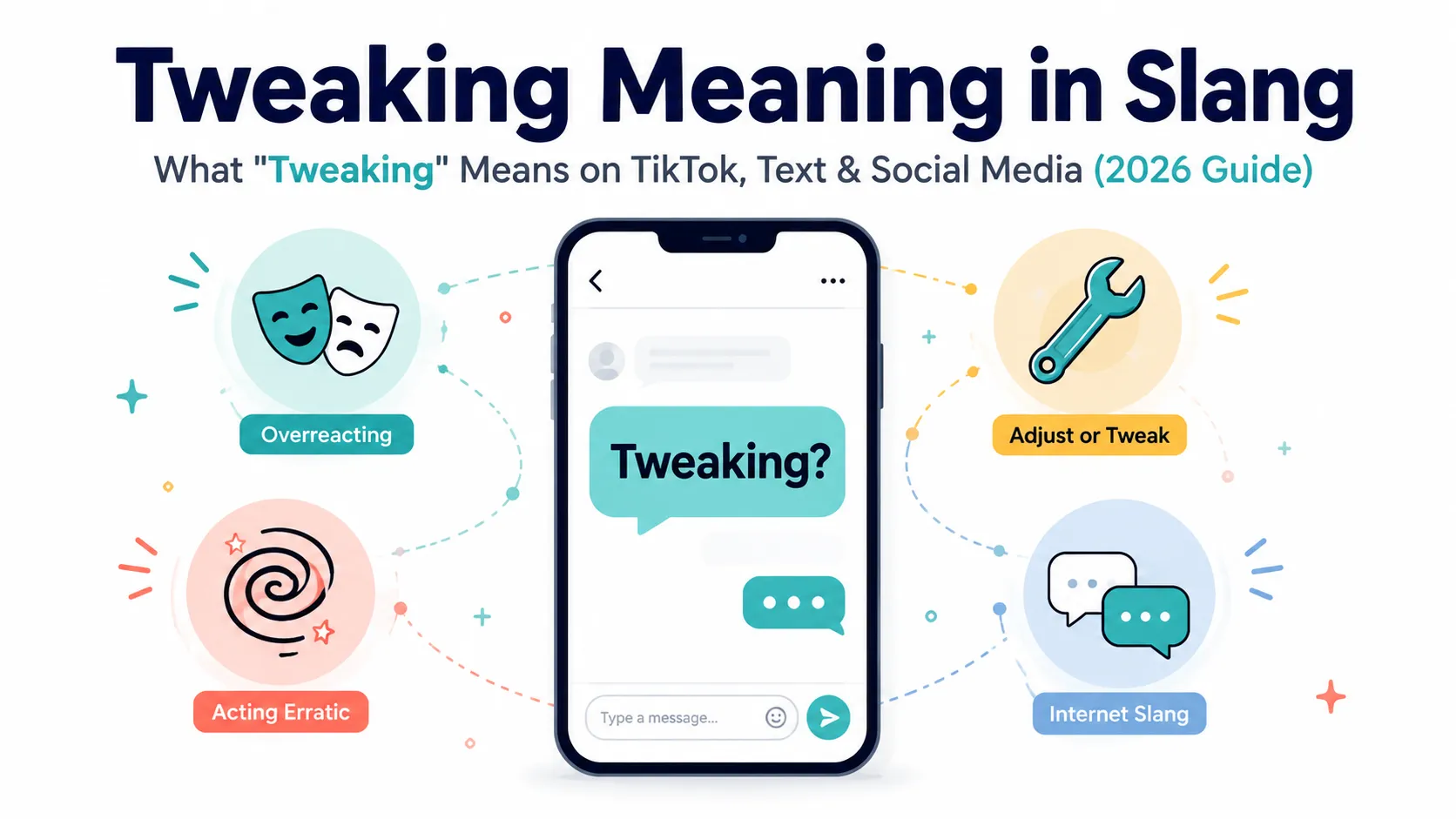
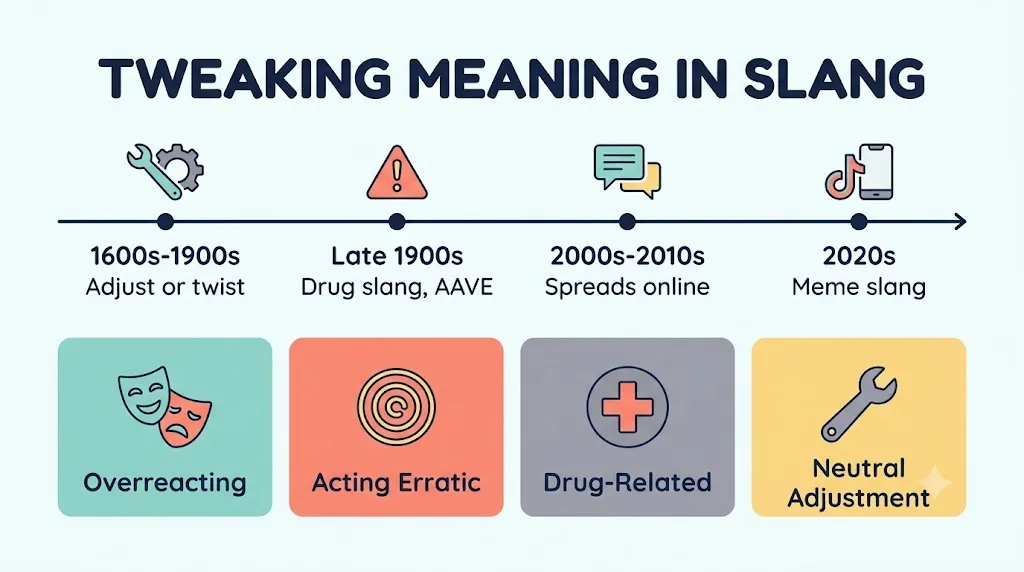
In modern slang, “tweaking” means acting irrational, overly dramatic, paranoid, or hyperactive — usually about something the speaker thinks doesn’t deserve that big a reaction. It ranges from playful (“you’re overreacting over a text message”) to serious (describing erratic behavior linked to stimulant drug use). The correct meaning almost always depends on tone and context, not the word alone.
Quick Meaning Summary
| Meaning | What it looks like | Typical context |
| Overreacting / dramatic | Calling out an exaggerated response to something minor | Texting, TikTok, casual conversation |
| Acting paranoid or erratic | Genuinely unusual, anxious behavior | Everyday conversation about someone’s mood |
| Drug-related agitation | Frantic, compulsive behavior tied to stimulant use | Health, recovery, clinical contexts |
| Making small adjustments (neutral) | Fine-tuning something | Work, writing, engineering, design |
A few practical notes:
Keep the alt text under ~125 characters if you want it to display fully in most screen readers and image search snippets — the one above is right at that range.
The caption works as an on-page caption and doubles as a strong social share/Pinterest description if you repurpose the infographic there.
If you generate this with an AI image tool, expect to regenerate 2-3 times to get text-free icon labels clean — infographic text inside AI-generated images is often garbled, so many teams generate the icons/layout via AI, then add the text labels afterward in Canva or Figma for crisp typography.
Origin and History
Most articles on this topic skip straight to “it means overreacting” without explaining how it got there. The path matters — it explains why the word carries four different meanings depending on who’s using it.
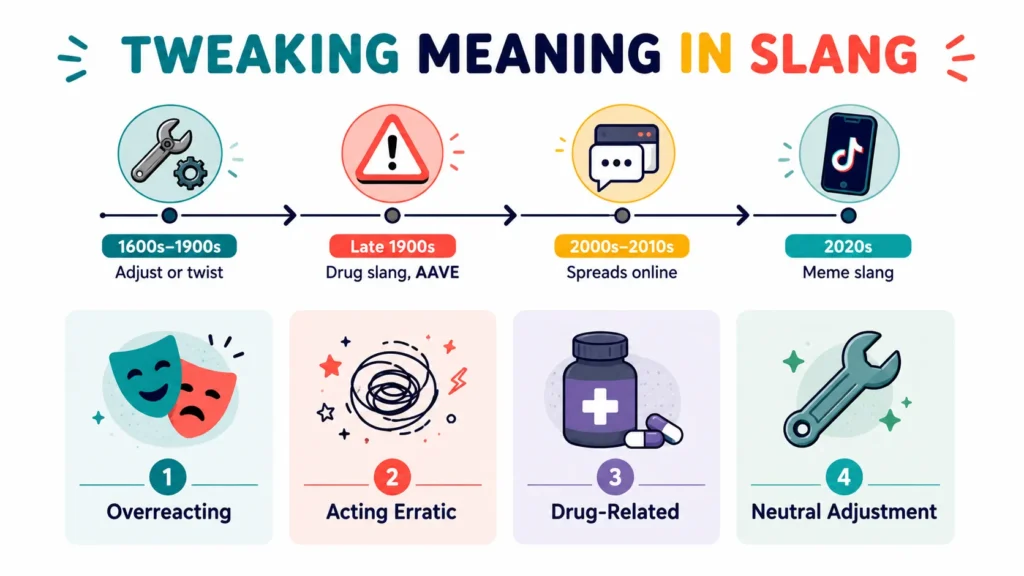
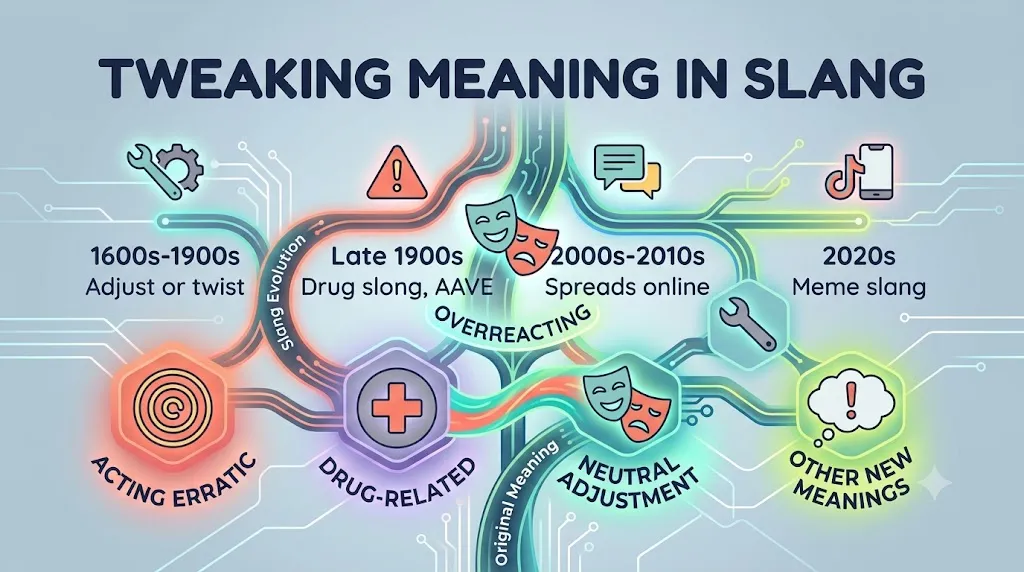
1600s–1900s — The Litera lMeaning. “Tweak” entered English meaning to pinch, twist, or give a sharp jerk. By the mid-1900s it had also picked up a neutral, technical sense: making small adjustments, as in tweaking an engine, a recipe, or a piece of writing. That meaning never went away — it’s still standard usage today, completely separate from the slang.
Late 20th century — Drug culture and AAVE. Around the same era, “tweaking” developed a second, much more specific meaning in African American Vernacular English and drug-culture slang: the frantic, paranoid, repetitive behavior associated with heavy methamphetamine use. “Tweaker” became — and still is — a derogatory term for a chronic meth user.
2000s–2010s — Spreads through hip-hop and online forums. As internet slang absorbed more AAVE-originated terms, “tweaking” moved from strictly drug-related contexts into looser use describing anyone acting erratically, whether or not drugs were involved.
2020s — TikTok mainstreams it into a general reaction word. By the 2020s, “tweaking” had shed most of its drug-specific meaning for a huge share of casual users, especially Gen Z. It became a catch-all reaction phrase for calling out any exaggerated response — the digital equivalent of “you’re being dramatic.” Meme formats like “Nah, he tweaking” and “I’m genuinely tweaking” cemented this shift.
That’s a genuinely interesting linguistic drift: literal → drug-specific → broad meme slang — in roughly 400 years.
Why Is “Tweaking” Popular Right Now?
It’s popular because it’s flexible and low-stakes: it lets people call out an overreaction without sounding harsh, it works as a caption on almost any reaction video, and it’s short enough to fit any meme format. That combination is exactly what keeps slang alive on fast-moving platforms like TikTok and X.
How Is “Tweaking” Used?
- Texting a friend: “You tweaking, it’s just a group project.”
- Calling out mood swings: “He’s been tweaking all week over that email.”
- Gaming: “He’s tweaking after that one loss; it’s just ranked.”
- Neutral/work use: “I’m just tweaking the slide deck before we present.”
- Health/clinical use: referenced in addiction-recovery resources to describe stimulant-related agitation — not typically used this way casually about a friend unless drug use is actually implied.
“You Tweaking” — What It Means When It’s Said to You
“You tweaking” (or “he tweaking,” “she’s tweaking,” “nah, they tweaking”) is almost always the overreacting/erratic meaning above: someone is telling you your reaction doesn’t match the situation. Tone decides everything:
- Friendly/joking (“lol you tweaking”) → they’re teasing you.
- Flat or repeated (“…you’re tweaking. for real.”) → they mean it.
- Concerned (“are you tweaking rn?”) → they may genuinely be checking on you.
A few practical notes:
Keep the alt text under ~125 characters if you want it to display fully in most screen readers and image search snippets — the one above is right at that range.
The caption works as an on-page caption and doubles as a strong social share/Pinterest description if you repurpose the infographic there.
If you generate this with an AI image tool, expect to regenerate 2-3 times to get text-free icon labels clean — infographic text inside AI-generated images is often garbled, so many teams generate the icons/layout via AI, then add the text labels afterward in Canva or Figma for crisp typography.
“Tweaking” on Social Media and by Platform
- TikTok / X (Twitter): Meme-driven — short clips of people, animals, or characters visibly overreacting, captioned “me genuinely tweaking” or “nah he tweaking.” Rarely meant literally.
- Texting/DMs: Usually playful, calling a friend dramatic over something small.
- Instagram/Snapchat: Same casual, teasing use as texting — often in comments or captions.
- Reddit/Discord: Frequently used in gaming or fandom contexts to mean someone is overthinking or overreacting to in-game events or discourse.
- Workplace/professional: Almost always the neutral, original meaning — “tweaking the budget,” “tweaking the copy.” Using the slang sense here risks sounding unprofessional or, worse, implying drug use.
Is “Tweaking” Offensive or Rude to Say?
It depends entirely on audience and setting:
- Among friends, casually: Generally fine — widely understood as a lighthearted callout.
- About a stranger or in a professional setting: Can land as dismissive, since it implies someone’s reaction is invalid.
- In reference to actual drug use or addiction: This is where caution matters most. Because the term’s roots are tied to methamphetamine use and carry real stigma for people affected by addiction, using it carelessly in that context can come across as mocking a serious health issue rather than joking around.
Common Misunderstandings
- “Tweaking always means drugs.” Not anymore for most casual, online use — though the drug-related meaning is still active in health and recovery contexts.
- “It’s always an insult.” Often it’s affectionate teasing between friends, not a genuine criticism.
- “It’s only Gen Z slang.” The neutral “making small adjustments” sense predates the slang by centuries and is still standard English.
A few practical notes:
Keep the alt text under ~125 characters if you want it to display fully in most screen readers and image search snippets — the one above is right at that range.
The caption works as an on-page caption and doubles as a strong social share/Pinterest description if you repurpose the infographic there.
If you generate this with an AI image tool, expect to regenerate 2-3 times to get text-free icon labels clean — infographic text inside AI-generated images is often garbled, so many teams generate the icons/layout via AI, then add the text labels afterward in Canva or Figma for crisp typography.
Related Terms and Similar Slang
| Term | Closest meaning | Key difference |
| Tweaking | Overreacting, acting erratically | Can also mean drug-related agitation or neutral adjustment |
| Trippin’ | Overreacting, unrealistic | Slightly older slang, less meme-driven |
| Freaking out | Panicking, overreacting | More universally understood, less Gen Z-coded |
| Glazing | Excessively praising someone | Different axis — about flattery, not panic |
| Capping | Lying or exaggerating claims | About honesty, not emotional state |
People Also Ask
It generally means acting irrational, overly dramatic, paranoid, or hyperactive about something — most often used to call out An Exaggerated Reaction.
No. While the term historically comes from describing stimulant-related agitation, most casual use today — especially online — has nothing to do with drugs.
It usually means they think you’re overreacting to something. Tone determines whether it’s a joke or a genuine callout.
It can be, depending on setting and relationship. Casual use among friends is generally harmless; using it about a stranger, in a professional setting, or about actual substance use requires more care.
Overreacting, tripping, freaking out, or panicking, depending on context.
It started as a literal word for twisting or making small adjustments, later took on a specific meaning tied to stimulant drug use (particularly in AAVE and drug-culture slang), and has since broadened into general internet slang for overreacting or acting erratically.
Yes — but only in its original, neutral sense (e.g., “tweaking a report”). The slang meaning doesn’t belong in professional communication.
Neither, technically — it’s a description of behavior. Whether it lands as playful or critical depends entirely on tone and relationship.
Conclusion
“Tweaking” is a word with real range — from a centuries-old, perfectly neutral term for small adjustments, to a serious drug-slang term, to today’s most common use: a playful or pointed way of calling out someone’s overreaction. Knowing which meaning applies comes down to two things: who’s saying it, and what tone they’re using. Keep this guidebook marked next time a new “tweaking” meme has you second-guessing what it actually means.