Introduction
IHY stands for “I Hate You” — the meaning behind nearly every casual use of this abbreviation. It’s rarely literal. People send IHY as a joke, a groan of mock jealousy, or exaggerated annoyance, not real dislike.
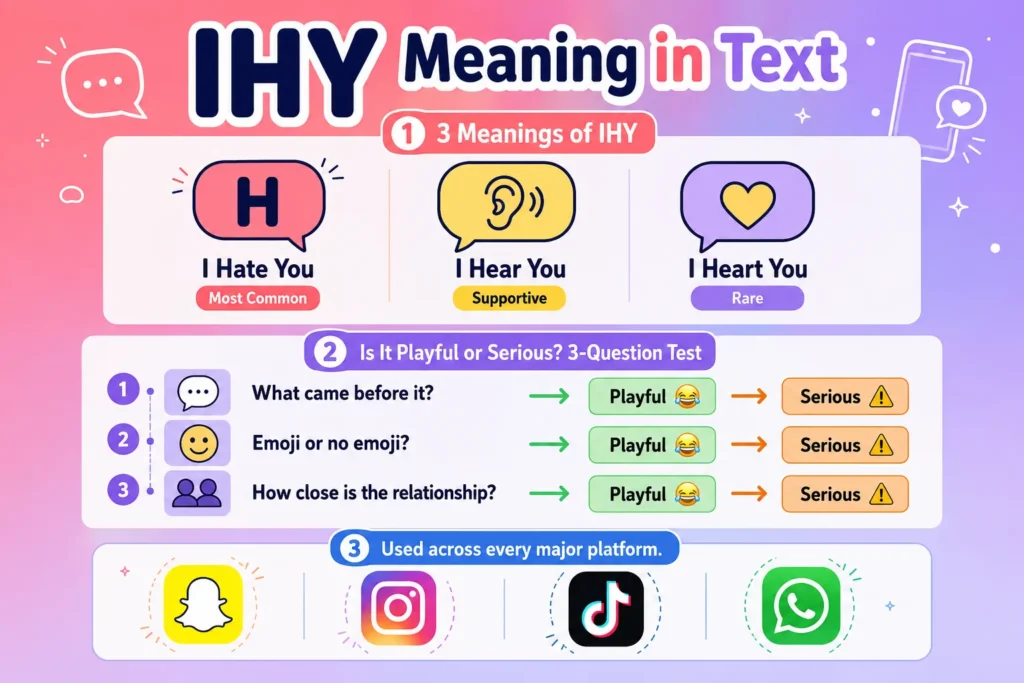
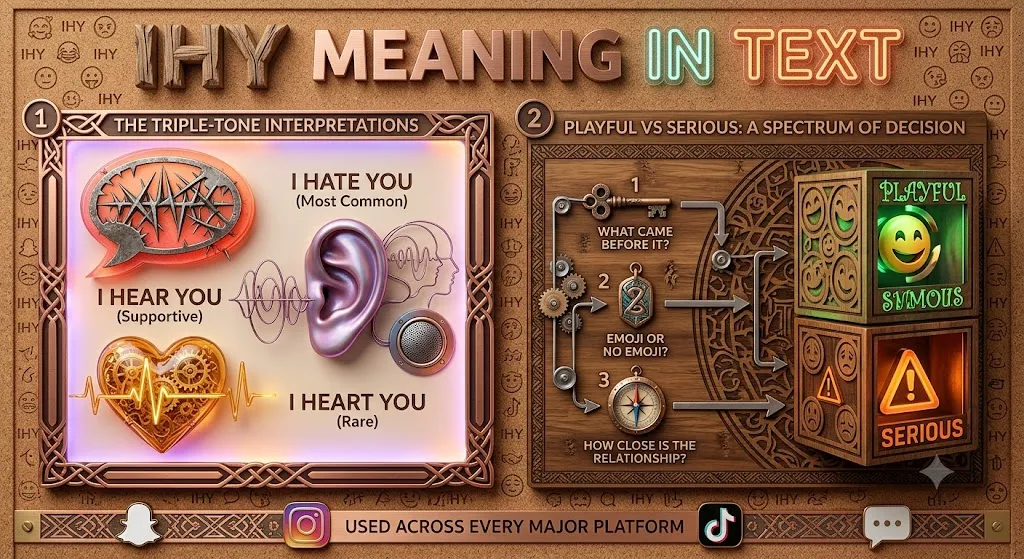
Less often, IHY can also mean “I Hear You” (acknowledging what someone said) or “I Heart You” (a soft, quiet form of affection). Which one applies comes down entirely to what was said right before it, and who sent it.
People search this term because the words look harsh on their own, but the actual feeling behind them is usually the opposite — and that gap is exactly what confuses the first time someone sees it.
Quick Meaning Summary
| Meaning | Frequency | Typical Tone |
| I Hate You | Most common (~90% of uses) | Playful, sarcastic, exaggerated |
| I Hear You | Occasional | Supportive, acknowledging |
| I Heart You | Rare | Affectionate, quiet |
Pronunciation: said letter by letter — “eye, aitch, why,” not as one word.
Origin and History
IHY comes from the same era as LOL, BRB, and IDK — abbreviations built for character-limited SMS texting in the early-to-mid 2000s, later carried into Twitter, Snapchat, and Instagram.
What sets IHY apart from its peers is the irony baked into it. “I hate you” is a strong phrase, so using it for something as small as losing a game or missing out on plans created a specific kind of dramatic-but-harmless humor. That contrast between the literal words and the much softer real meaning is exactly why the term stuck — and exactly why it still confuses people seeing it for the first time.
Related trivia: In ancient Egyptian mythology, Ihy was also the name of a god of music, son of Hathor and Horus. Unrelated to the slang term, but a fun overlap if it ever comes up.
Why Is IHY Still Popular?
IHY survives because it does something few other abbreviations do efficiently: it lets someone express strong emotion (jealousy, mock outrage, teasing) in three letters, with the irony doing the emotional work instead of a long explanation. As texting culture increasingly leans on short, expressive shorthand, terms like IHY that pack tone into brevity tend to stick around longer than purely literal abbreviations.
How Is IHY Used? (The 3-Question Tone Test)
Instead of guessing whether someone means it, run the message through three quick checks:
- What came right before it? Something funny, lucky, or enviable → playful. A real complaint or argument → possibly serious.
- Is there an emoji or exclamation point? IHY 😂 or ihy lol → joking. A flat IHY sent mid-conflict → treat as serious.
- What’s the relationship? Close friends, siblings, and partners use it constantly as banter. Coworkers or people you’ve just met are far less likely to be joking.
If two or more checks point to “serious,” a quick, low-key check-in beats assuming.
Examples of IHY in Use
Friends: “I get to work from home today.” → “IHY, some of us have commutes.”
Siblings: “Mom said I could have the car.” → “ihy, I asked first”
Romantic partners: “Everyone at the gym was staring at me today.” → “ihy but you’re mine 😏”
When it’s not a joke: “You didn’t tell me you were seeing him.” → “ihy” (no emoji, after real conflict — a moment to ask, not assume.)
IHY on Social Media
| Platform | Typical Use | Tone |
| Snapchat | Streak banter, reacting to a friend’s story | Almost always joking |
| Comments on vacation photos, achievements | Playful envy | |
| TikTok | Comment sections reacting to lucky/impressive content | Playful envy or admiration |
| X (Twitter) | Replies to good or bad news | Ranges from joking to genuinely annoyed |
| Between friends, siblings, partners | Depends on history — usually playful | |
| Discord | After losing a match | Competitive banter |
The closer the relationship, the safer IHY is as a joke. The newer the relationship, the more it needs an emoji attached to avoid being taken literally.
IHY Meaning From a Guy or From a Girl
IHY’s definition doesn’t change by gender — but the context it shows up in often does:
- In a romantic or flirty exchange: IHY often means “you’re too much” or “you’re distracting me,” without sounding overly sincere.
- From a partner: Usually pure banter, reacting to a tease or an inside joke.
- From a friend, regardless of gender: The classic playful-jealousy use.
Regardless of who sends it, the one moment to pay attention to is when IHY shows up without a joke, compliment, or emoji — especially after a disagreement.
Common Misunderstandings
“IHY always means literal hatred.” Rarely — context and relationship almost always soften it.
“Everyone online already knows what it means.” Not true. People newer to texting culture, older relatives, and non-native speakers often take it at face value, which is how a lot of “wait, are you mad at mIe?” moments start.
“It’s just the negative version of ILY.” Not quite — ILY is essentially always sincere. IHY carries built-in ambiguity ILY doesn’t have.
Related Terms and Similar Meanings
| Term | Meaning | Typical Tone |
| IHY | I Hate You / I Hear You / I Heart You | Usually playful; context-dependent |
| IH8U | I Hate You | Same use as IHY, more emphatic spelling |
| IHU | I Hate You | Nearly identical to IHY |
| IHYSM | I Hate You So Much | Intensified, still usually joking |
| ILY | I Love You | Sincere, positive |
| IDC | I Don’t Care | Neutral or dismissive |
| JK | Just Kidding | Explicitly clarifies a joke |
| SMH | Shaking My Head | Disapproval or disbelief |
People Also Ask
It can read that way out of context, but between people with an established playful relationship, it’s rarely taken as genuinely rude.
Not directly, but it can occasionally mean “I Heart You” — a quieter, less common cousin of ILY.
Usually playful jealousy or teasing reacting to someone’s story or streak, not literal dislike.
It’s popular with Gen Z but not exclusive to them — it’s been around since early SMS texting culture.
ILY (I Love You) is the closest direct opposite in tone and meaning.
Letter by letter: “eye, aitch, why.”
It’s safer with an emoji attached (IHY 😂) so the joking tone is unmistakable.
Same core meaning, applied to competitive banter — usually after losing a match to a friend.
Conclusion
IHY almost always means “I Hate You” — but rarely literally. It’s a piece of texting shorthand built on irony: strong words used for small, harmless moments of jealousy or teasing. The two things worth remembering are which of the three meanings fits the context, and whether the surrounding tone (emoji, relationship, what came before it) points to a joke or something real. Once you can read those signals, IHY stops being confusing and just becomes one more piece of everyday texting shorthand.