FEIN Meaning: What It Is, Why It Matters, and How to Get One
If you’ve spotted “FEIN” on a W-2, a loan application, or a business form and aren’t sure what it means, you’re not alone—many new business owners have encountered this common tax-related term.. FEIN Stands For Federal Employer Identification Number, a nine-digit ID the IRS assigns to a business, and it’s simpler than it sounds once you see it laid out clearly.
What Does FEIN Mean?
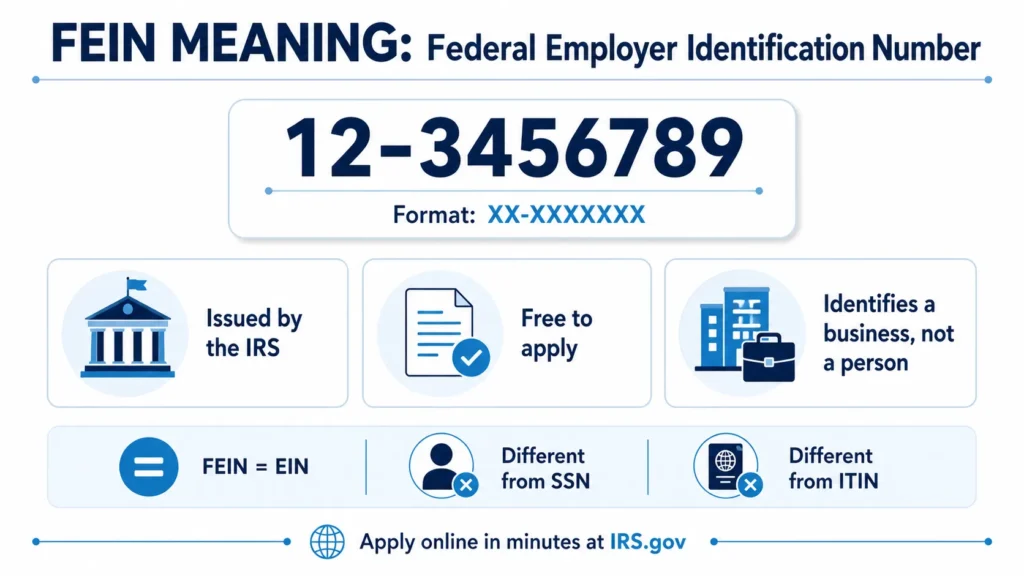
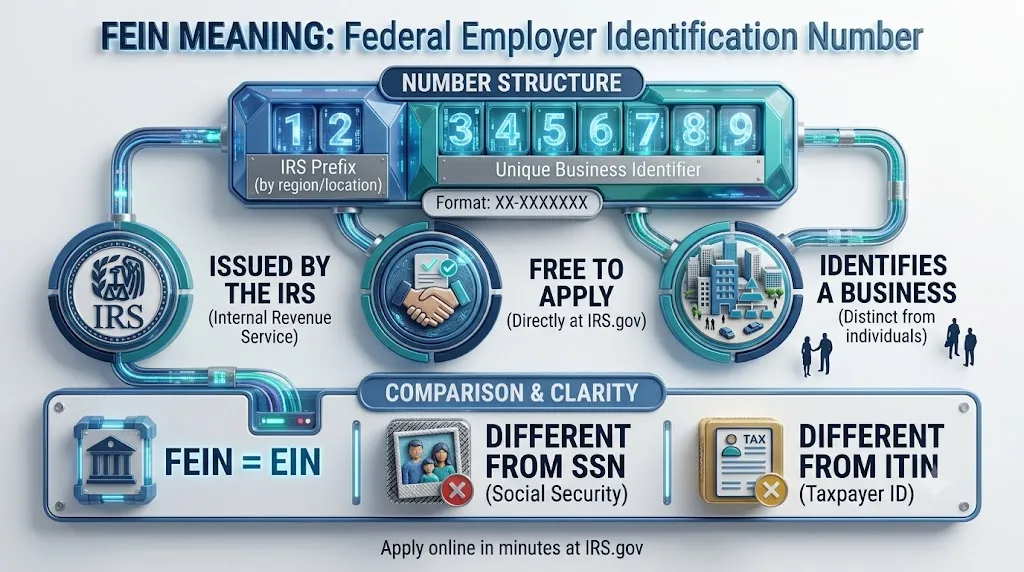
FEIN = Federal Employer Identification Number. It’s a unique nine-digit number, formatted XX-XXXXXXX, that the IRS issues to a business to identify it for federal tax purposes — the business equivalent of an individual’s Social Security number.
In everyday use, “FEIN” and “EIN” (Employer Identification Number) mean the same thing.
Quick Meaning Summary
| Full form | Federal Employer Identification Number |
| Also called | EIN, Federal Tax ID, FTIN, Business Tax ID |
| Issued by | Internal Revenue Service (IRS) |
| Format | XX-XXXXXXX (9 digits) |
| Who it identifies | A business, not a person |
| Cost to get one | Free |
| Example | 12-3456789 |
Origin and History
The Employer Identification Number system was created by the IRS to give businesses their own tax-tracking number, separate from the Social Security Numbers used for individuals
Why Do People Search “FEIN Meaning”?
Most people encounter this term for the first time in one of a few situations:
- They’re starting a business and a bank, state agency, or accountant asks for their FEIN.
- They’re hiring their first employee and need one to run payroll.
- They saw it on a W-2 or 1099 and didn’t recognize the abbreviation.
- They’re filling out a form (loan application, vendor form, license application) that asks for it.
How Is FEIN Used in Real Life?
A FEIN shows up anywhere the government or a financial institution needs to identify your business for tax purposes:
- Payroll and tax filing — required on Form W-2, Form 941, and business tax returns.
- Applying for business credit or loans — lenders use it to verify and track your business.
- Business licenses and vendor forms — often requested alongside your business name and address.
FEIN vs. EIN vs. TIN vs. SSN vs. ITIN
This is the part where most explanations get muddled. Here’s the clean breakdown:
| Term | Full Name | Identifies | Issued By | Format |
| TIN | Taxpayer Identification Number | Umbrella term for any tax ID | IRS / SSA | Varies |
| FEIN / EIN | (Federal) Employer Identification Number | Businesses | IRS | XX-XXXXXXX |
| SSN | Social Security Number | Individuals | Social Security Administration | XXX-XX-XXXX |
| ITIN | Individual Taxpayer Identification Number | Individuals ineligible for an SSN | IRS | 9XX-XX-XXXX |
| SEIN | State Employer Identification Number | Businesses, at the state level | State tax agency | Varies by state |
Takeaway: TIN is the category. FEIN/EIN, SSN, and ITIN are all specific types of TIN — a FEIN is simply the version assigned to a business.
Examples of FEIN in Use
- Example format: 12-3456789
- On a tax return: A business’s FEIN appears at the top of its federal tax filing.
- In a sentence
| Situation | FEIN Required? |
| You have employees | Yes |
| You operate as a corporation or partnership | Yes |
| Your LLC has two or more members | Yes |
| You file employment or excise tax returns | Yes |
| You have a Keogh plan or solo 401(k) | Yes |
| You’re a sole proprietor with no employees | No — SSN usually works |
How to Get a FEIN
Applying is free, directly through the IRS:
| Method | Who Can Use It | Turnaround |
| Online | U.S.-based businesses | Immediate |
| Fax (Form SS-4) | Any eligible applicant | ~4 business days |
| Mail (Form SS-4) | Any eligible applicant | Up to 4 weeks |
| Phone | International applicants only | Same call, if approved |
- Check your IRS confirmation letter (CP 575).
- Check the top of a past federal tax return.
- Check business bank account or loan paperwork.
- Check business licenses or payroll software records.
Common Misunderstandings
- “FEIN and EIN are different numbers.” They’re not — same number, same issuer, just different shorthand.
- “You have to pay to get one.” Applying directly through the IRS is always free; only third-party services charge a fee.
- “Changing your business name changes your FEIN.“ It doesn’t — only structural changes (like incorporating) typically require a new one.
- “A FEIN is as sensitive as an SSN
People Also Ask
Yes — in virtually every Practical Context, they refer to the identical nine-digit IRS-issued number.
Generally no. Sole proprietors without employees can usually use their SSN, though getting a FEIN is still common for privacy reasons.
Nothing, if you apply directly through the IRS. Third-party “EIN filing services” that charge a fee are optional, not required immediately, if you apply online (U.S. businesses only). Fax and mail applications take longer.
Immediately, if you apply online (U.S. businesses only). Fax and mail applications take longer.
Largely yes — it appears on SEC filings, nonprofit Form 990s, and business licenses, unlike a Social Security number.
For nonprofits and public companies, yes (via the IRS Tax Exempt Organization Search or SEC EDGAR). There’s no free public lookup for private for-profit companies.
Conclusion
FEIN simply means Federal Employer Identification Number — the IRS’s nine-digit tax ID for businesses, functionally the same thing as an EIN. Once you know that FEIN, EIN, and Federal Tax ID are all names for the same number, most of the confusion disappears.
Disclaimer: This article is for general informational purposes and isn’t tax or legal advice. Requirements can vary by business structure and state — consult a tax professional or the IRS directly for guidance specific to your situation.