ETC Meaning in Text: The Complete Guide to “Et Cetera” (Definition, Grammar & Examples)
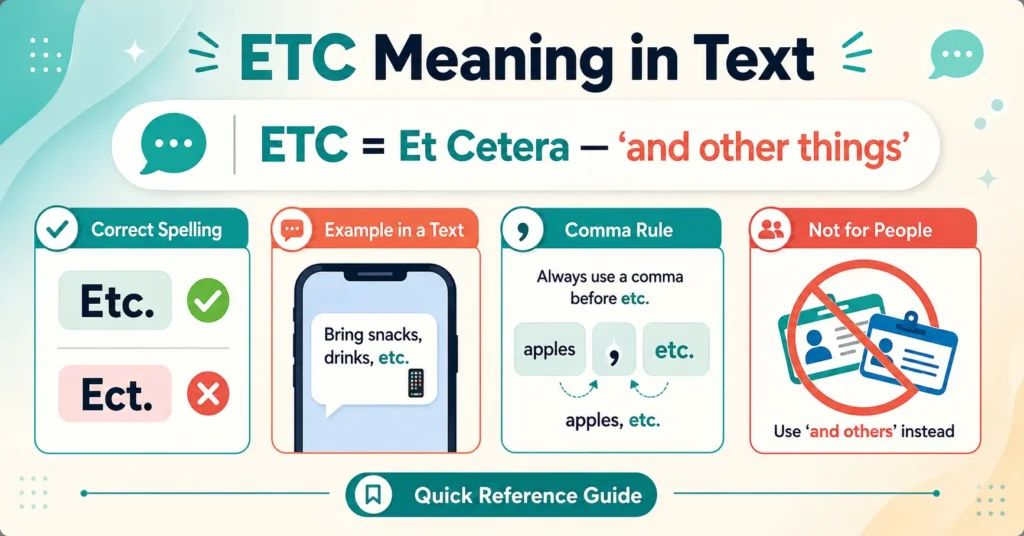
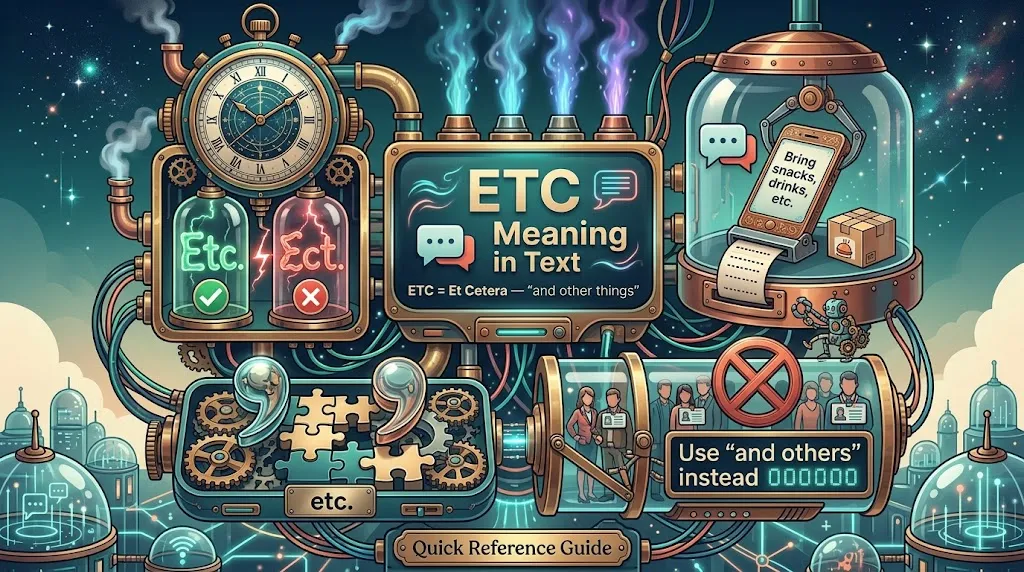
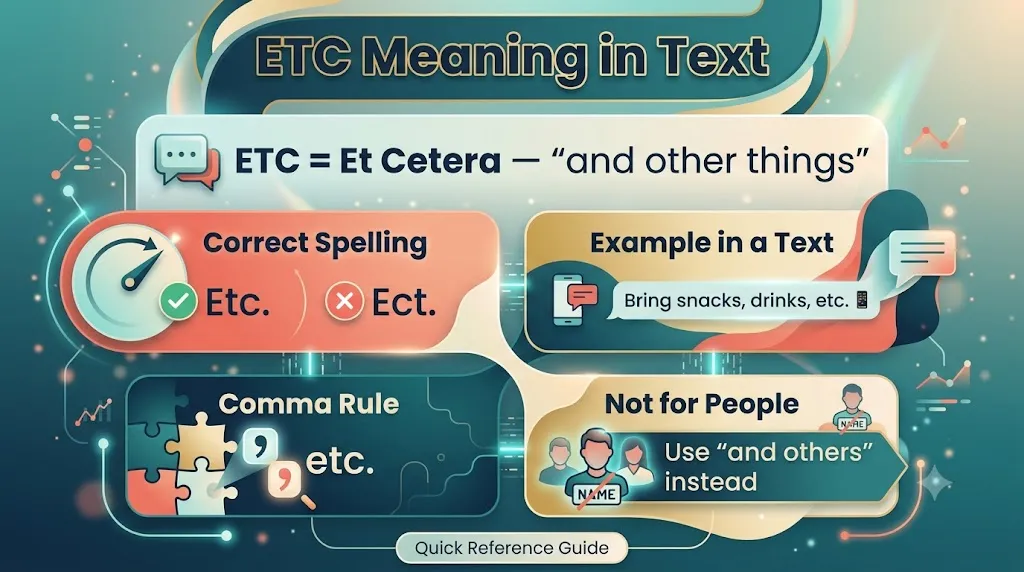
Quick answer: In a text, ETC means “et cetera,” a Latin phrase meaning “and other things” or “and so on.” It’s added to the end of a list to show more similar items exist without spelling them all out — e.g., “Bring snacks, Drinks, Napkins, Etc.” It isn’t slang; it’s a standard abbreviation used the same way in texts, emails, captions, and formal writing.
People usually search this after seeing “etc” in a casual text and second-guessing whether it means something else, whether it’s rude, or whether they’re using it correctly themselves. The short version above answers that. Everything below covers the details: spelling, grammar, texting examples, and the handful of unrelated things “ETC” stands for outside of messaging.
What Does ETC Mean in Text?
“Etc.” is short for the Latin phrase et cetera — literally “and the rest.” In texting, it closes a list to signal more similar items exist that the writer isn’t bothering to spell out.
Example: “We’re getting pizza, wings, soda, etc. for the party.”
Key facts:
- Not slang — it predates texting by roughly 2,000 years.
- Tone-neutral — it doesn’t sound rude or lazy on its own; tone comes from the rest of the message.
- For things, not people — “Sarah, Mike, etc.” is grammatically discouraged.
- Consistent across platforms — WhatsApp, Instagram, email, or a work report, it means the same thing every time.
Where “Etc.” Comes From
“Et cetera” splits into two Latin words: et (“and”) and cetera (“the rest”). It entered English through centuries of scholarly, legal, and religious writing, where Latin was the working language of educated Europe — placing it in the same family as “i.e.” (id est) and “e.g.” (exempli gratia), not a modern coinage.
This history explains a common mistake: because “et” already means “and,” writing “and etc.” is redundant — it literally reads “and and the rest.”
. How to Pronounce “Et Cetera”
Standard: et-SET-er-uh (/ɛtˈsɛtərə/).
A common variant swaps the first sound for a “k” (“ek-SET-er-uh”). Dictionaries generally label this widespread but nonstandard — common in speech, not the version taught as correct.
Etc. vs Ect. vs Etcetera: Which Is Right?
| Spelling | Correct? | Notes |
| Etc. | Correct | Standard abbreviation; keep the period in formal writing. |
| Etc (no period) | Informal | Fine in texting/casual chat. |
| Ect. | Incorrect | A letter-order typo; has no meaning. |
| Etcetera | Correct, formal | Full one-word spelling, rarely used outside literary writing. |
| Et cetera | Correct, most formal | Original two-word Latin phrasing. |
Memory trick: “Et Cetera” → E-T-C. Typing “ect” swaps the T and C.
Grammar Rules for “Etc.”
Rule 1 — Never write “and etc.” Redundant, since “et” = “and.” “Towels, sunscreen, and etc.” → “Towels, sunscreen, etc.”
Rule 5 — Never start a sentence with it. It’s a closer, not an opener.
Rule 6 — Use at least two items before it, so a pattern is actually established. “I like fruit, etc.” is weak; “apples, bananas, oranges, etc.” works.
ETC in Texting and Social Media
WhatsApp / iMessage: “Milk, bread, eggs, etc — you know the usual stuff “ — leans on shared context between two people.
Instagram / TikTok captions: “Weekend recap: brunch, beach, sunset, etc. “ — used stylistically to imply a full day without listing every detail.
Dating app bios: “Into hiking, cooking, live music, etc.” — signals more depth than fits the box, though a specific interest usually earns more replies than a vague “etc.”
Group chats: “Work, gym, laundry, my roommate’s drama, etc, etc, etc “ — repeated for comedic emphasis, understood as exaggeration, not a grammar rule.
Work Slack: “Agenda covers Q3 metrics, budget, hiring updates, etc. — will send the doc shortly.” — fine for quick updates, but swap for a full list in anything that becomes an official record.
Etc. vs E.g. vs I.e. vs Et al.
| Abbreviation | Latin origin | Meaning | Use case | Example |
| Etc. | et cetera | “and the rest” | Closes a list of similar things | “Pens, paper, folders, etc.” |
| E.g. | exempli gratia | “for example” | Introduces examples (non-exhaustive) | “Stationery, e.g., pens and folders.” |
| I.e. | id est | “that is” | Clarifies/restates | “Stationery, i.e., writing supplies.” |
| Et al. | et alii | “and others” | Lists additional people | “Smith et al. (2024)…” |
Fast rule: e.g. = examples of a category; i.e. = restates; et al. = people; etc. = things.
Common Mistakes
- Writing “and etc.” (redundant)
- Misspelling it “ect.”
- Using it after only one example
- Applying it to people instead of things
- Overusing it in formal writing (reads as vague/under-researched)
- Starting a sentence with it
- Assuming it inherently sounds casual — it’s neutral; context sets the tone
When NOT to Use “Etc.”
Avoid it in: Academic Papers (expects complete lists), legal/contract documents (ambiguity has consequences), resumes/cover letters (undersells specific skills), formal client/leadership reports (a complete list signals thoroughness).
| Instead of “etc.” | Best for |
| and so on | Conversational, spoken tone |
| and the like | Slightly formal written tone |
| among others | People or named items |
| and others | Neutral — people or things |
| and more | Marketing/casual copy |
Other Meanings of ETC
Beyond texting, ETC can also mean:
- Estimated Time of Completion/Arrival — logistics, project management, delivery apps
- Electronic Toll Collection — automated highway toll systems
- Electron Transport Chain — cell biology/biochemistry, core to cellular energy production
- Extended Thrust Control — used in some aviation/engineering contexts
- Ethereum Classic (ETC) — the ticker symbol for the cryptocurrency
- Company/product abbreviations — some brands use “ETC” as shorthand
If “ETC” appears in a technical or work message and “et cetera” doesn’t fit the sentence, one of these is likely the intended meaning.
How to Reply to “Etc.”
- Casual and clear: No reply needed — continue normally.
- Need the full list: Ask directly — “What else do you mean by etc.?”
- Playful/exaggerated (“etc, etc, etc”): Match the tone rather than taking it literally.
- Work context: If it stands in for something that matters, ask for specifics.
ETC Cheat Sheet
| Question | Answer |
| What does ETC mean? | “Et cetera” — and other things |
| Is it slang? | No — centuries-old standard abbreviation |
| Correct spelling? | Etc. |
| Common misspelling? | Ect. — incorrect |
| “And etc.” OK? | No — redundant |
| For people? | No — use “and others” |
| Comma before it? | Yes, after a list |
| OK in texting? | Always |
| OK in academic/legal writing? | Generally no |
| Pronunciation | et-SET-er-uh |
People Also Ask
It means “Et Cetera” — showing a list continues with similar, unlisted items, like “snacks, drinks, etc.”
No — it’s neutral on its own. It only feels dismissive if the rest of the message is dismissive.
“Etc.” closes a list, implying more unlisted items. “E.g.” opens a list, meaning “for example,” without implying completeness.
No — it’s a misspelling with no accepted meaning.
Generally no — spell out specific skills instead; “etc.” can read as vague.
Yes, in more formal spoken contexts; casually, most just say “etc.” or “and so on.”
No — it always closes a list, never opens a thought.
Many languages borrowed it directly from Latin, though some use their own native equivalent instead.
Conclusion:
At its core, “ETC” in text simply means “and other things” — the abbreviation for the Latin phrase et cetera, used to close a list without spelling out every item. It’s not slang, it’s not new, and it’s not rude on its own; it’s a 2,000-year-old piece of standard English doing a very modern job: keeping messages sho