TTS Meaning in Text: What It Really Stands For (2026)
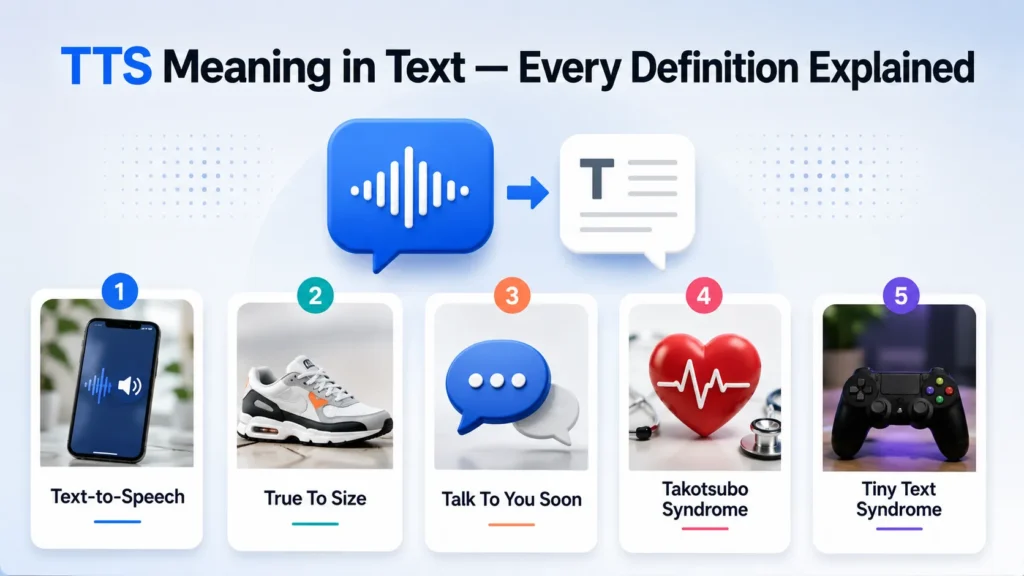
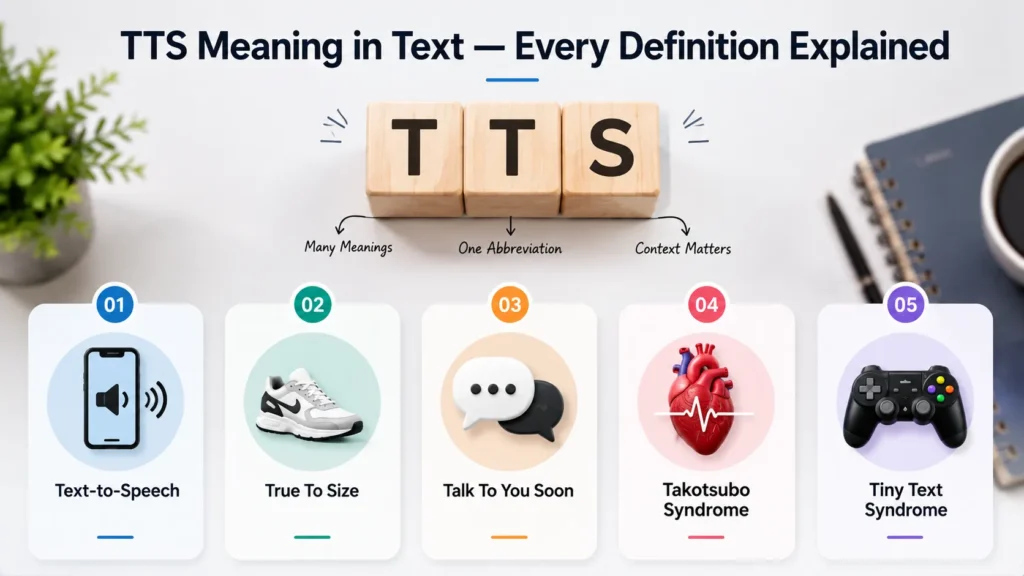
Quick answer: In texting and on social media, TTS Almost Always Means “Text-To-Speech” — the technology that turns written words into a spoken, computer-generated voice. That’s the meaning behind 90%+ of real-world usage on TikTok, Instagram, Snapchat, Discord, and WhatsApp. Outside of texting, TTS has a handful of completely different meanings: “True To Size” in clothing and shoe reviews, “Time-Temperature Superposition” in materials science, and Takotsubo Syndrome or Thrombosis with Thrombocytopenia Syndrome in medicine. Less commonly — and mostly as personal shorthand rather than standardized slang — some people stretch TTS into “Talk To Someone” or “Talk To You Soon.”
If you clicked because a friend, a caption, or a comment section left you stuck on three letters, this guide sorts out exactly which meaning applies, where it came from, and how to use or reply to it correctly.
TTS Meaning at a Glance
| Meaning | Where You’ll See It | How Common |
| Text-to-Speech | TikTok, Instagram Reels, Snapchat, Discord, WhatsApp, accessibility tools | Dominant meaning — most common by far |
| True To Size | Shoe and clothing reviews, Instagram shopping comments | Common, but only in fashion/shopping contexts |
| Talk To Someone / Talk To You Soon | Casual DMs, sign-offs | Occasional, informal, not standardized |
| Takotsubo Syndrome | Medical and cardiology contexts | Niche, professional use only |
| Thrombosis with Thrombocytopenia Syndrome | News coverage of vaccine side effects | Niche, appears mainly in health journalism |
| Tiny Text Syndrome | Gaming forums and reviews | Very niche, gaming-specific slang |
| Time-Temperature Superposition | Engineering and materials science | Technical/academic use only |
Notice something the other guides on this topic won’t tell you: there is no single universal “texting slang” alternate meaning for TTS. If you search around, you’ll find different sites confidently claiming the default slang meaning is “Time To Sleep,” others insisting it’s “Talk To Someone,” and others “Talk To You Soon.” None of them agree — because none of these are actually standardized. They’re occasional, personal shorthand that a small number of people use, not an established internet acronym like “brb” or “ttyl.” The one meaning that shows up consistently, across every platform and every real chat example, is Text-to-Speech. That’s the definition to default to unless the sentence around it clearly points somewhere else (like sizing or sign-offs).
What TTS Actually Stands For: Text-to-Speech
Text-to-Speech (TTS) is a form of assistive and generative technology that converts written text into audible, spoken words using a synthetic voice. Instead of a human recording audio, software analyzes the text and generates speech in real time.
You’ve almost certainly heard TTS without realizing it:
- The voice that narrates TikTok videos when a creator doesn’t want to talk on camera
- Siri, Google Assistant, or Alexa reading a message or notification aloud
- GPS apps announcing turn-by-turn directions
- Screen readers used by blind and visually impaired users to browse the web
- Audiobook apps that generate narration from ebook text
- Customer service phone lines that “speak” account information
How TTS Technology Actually Works
Most competing explanations stop at “it converts text to speech” and move on. Here’s what’s actually happening under the hood, in plain language:
- Text analysis (front-end processing): The system reads the raw text and normalizes it — expanding abbreviations, numbers, and symbols into words a voice can pronounce (“Dr.” becomes “Doctor,” “$5” becomes “five dollars”).
- Linguistic analysis: The software determines pronunciation using phonetic rules and dictionaries, and has to resolve ambiguous words — deciding, for example, whether “lead” should sound like the metal or the verb, based on surrounding context.
- Prosody generation: The system maps out rhythm, pitch, stress, and pauses so the speech doesn’t sound flat or robotic — this is the step that separates old-school “robot voices” from today’s natural-sounding AI narration.
- Waveform synthesis (the vocoder): Finally, a vocoder converts that linguistic and prosodic data into an actual audio waveform — the sound you hear.
Modern TTS systems (like the ones powering TikTok’s narrator voice or ChatGPT-style voice assistants) use neural networks trained on huge amounts of recorded human speech, which is why 2026-era TTS voices sound dramatically more natural than the flat, robotic TTS voices from the 2000s and 2010s.
A Brief History of TTS
Speech synthesis research dates back to the mid-20th century, with early electronic speech synthesizers built in research labs in the 1950s and 60s. TTS became mainstream through screen readers for visually impaired users in the 1980s and 90s, moved into GPS navigation and phone systems in the 2000s, and exploded into pop culture once TikTok added its built-in narrator voice feature around 2020 — which is the single biggest reason “TTS” became a term Gen Z and Gen Alpha type casually in everyday chats.
Why Is “TTS” So Popular Right Now?
Three things converged to make TTS a term people type casually instead of just a technical acronym: TikTok’s narrator voice became a recognizable meme sound around 2020–2021, AI voice generation got dramatically more natural starting around 2023–2024 (making TTS content worth sharing rather than skipping), and every major platform — TikTok, Snapchat, Discord, Instagram — has since built TTS directly into its native tools. When a feature moves from “something a few apps offer” to “something built into the app you already use every day,” the abbreviation for it inevitably becomes everyday shorthand too.
TTS Meaning by Platform (With Steps to Use It)
The exact flavor of “TTS” shifts slightly depending on where you see it. Here’s how it actually plays out platform by platform, plus how to turn the feature on yourself.
TTS on TikTok
This is where the term went viral. TikTok’s built-in Text-to-Speech feature reads on-screen captions aloud in one of several stock voices, letting creators narrate videos without recording their own voice.
How to use it: Add text to your video → tap the text box → select “Text-to-Speech” from the pop-up menu → choose a voice.
In comments, “TTS voice” or “that sounds so TTS” usually refers to the recognizable, slightly robotic default narrator — it’s become a meme in its own right, often used for comedic or dramatic timing.
TTS on Instagram
On Instagram, TTS shows up in two ways: as the app’s own auto-captioning/voiceover tools in Reels and Stories, and as a general reference to AI-generated narration in a post. In shopping-related comments and captions, though, TTS is more likely to mean True To Size (see below) — so context is essential here.
TTS on Snapchat
Snapchat’s voice filters and captioning features let creators convert typed text into a spoken voice within Snaps and Stories. When someone says “use TTS for your story,” they’re asking for the typed caption to be read aloud automatically.
TTS on Discord
In gaming and community Discord servers, TTS is a literal built-in setting: when enabled on a channel, any message sent gets read aloud to everyone in a voice channel. Streamers often use this so donation messages or chat comments get announced during a livestream.
How to use it: Server settings → enable Text-to-Speech for a channel → messages typed with /tts (or in TTS-enabled channels) are read aloud automatically.
TTS on WhatsApp
WhatsApp doesn’t have a dedicated TTS button, but Android and iOS accessibility settings can read incoming messages aloud, and some users use third-party TTS apps to listen to long messages hands-free while driving or multitasking. On WhatsApp specifically, TTS is almost always used literally and rarely as slang.
TTS on Reddit
On Reddit, “TTS” most often shows up in subreddits about AI voice tools, accessibility, or TikTok-style narrated video content (r/CapCut, r/TikTokHelp, and various AI-tool subreddits), where users compare TTS voice quality or ask which app was used to generate a specific narration.
TTS on X (Twitter)
On X, TTS is typically used the same way as on TikTok — referencing narrated video clips, AI voice tools, or accessibility-related screen-reading features shared in threads.
TTS on Facebook
On Facebook, TTS shows up mainly in accessibility settings (screen readers for the visually impaired) and in shared TikTok-style narrated video content re-posted from other platforms.
TTS as Casual Texting Shorthand
Outside of the technology itself, a smaller number of people use “TTS” as informal shorthand in a sentence, most commonly for:
- “Talk To Someone” — expressing a desire to chat: “I’m bored, TTS?”
- “Talk To You Soon” — a casual sign-off, similar to TTYL: “Heading to class, TTS!”
These usages exist, but they’re inconsistent and audience-dependent rather than a fixed, widely recognized acronym — treat them as possible, not default. If a message ends a conversation or reads like a goodbye, one of these could be the intended meaning; if it’s about a video, app, voice, or feature, it’s Text-to-Speech.
TTS in Non-Texting Contexts
TTS shows up well beyond chat apps. If you saw it somewhere that has nothing to do with texting, one of these is probably what’s meant:
TTS = True To Size (Clothing & Shoes)
In fashion and footwear reviews, TTS means “True To Size.” If a reviewer writes “these sneakers run TTS,” it means the item fits according to the standard size chart — order your normal size, no need to size up or down. This is one of the most common non-tech meanings and shows up constantly in Instagram shopping comments, sneaker forums, and product reviews.
TTS = Tiny Text Syndrome (Gaming)
In gaming communities, TTS is slang for “Tiny Text Syndrome” — a complaint about games where on-screen text is shrunk down for HD displays, making it hard to read on older or smaller, non-HD screens.
TTS = Takotsubo Syndrome (Medical)
In cardiology, TTS stands for Takotsubo Syndrome (also called “broken heart syndrome”), a temporary heart condition often triggered by extreme emotional or physical stress.
TTS = Thrombosis with Thrombocytopenia Syndrome (Medical/News)
This medical abbreviation appeared frequently in health news coverage referring to a rare blood-clotting condition linked to certain COVID-19 vaccines. If you encountered TTS in a news article about vaccines or blood clots, this is the meaning.
TTS = Time-Temperature Superposition (Engineering)
In materials science and engineering, TTS is a technical principle used to predict how a material’s mechanical properties change over time and temperature — a meaning you’ll only encounter in academic or technical writing.
How to Reply When Someone Sends “TTS”
Once you know the context, replying is easy:
- If it’s about a video, voice, or app feature: “Haha yes it’s TTS, I didn’t want to record my actual voice” or simply confirm what tool you used.
- If it’s a shopping/sizing question: “Yep, TTS — order your normal size.”
- If it looks like a sign-off: A simple “okay, talk soon!” works whether they meant “Talk To You Soon” literally or just used it as a casual goodbye.
- If you’re unsure: Just ask — “wait what do you mean by TTS?” is a completely normal, low-stakes question. Nobody will judge you for it.
Popular TTS Tools Worth Knowing
Since so much of today’s TTS usage comes from actual tools people use daily, here are the categories worth knowing:
- Built-in device tools: iOS “Speak Screen,” Android “Select to Speak,” and Windows Narrator — free, no download required.
- Platform-native tools: TikTok’s Text-to-Speech, Discord’s channel TTS, Snapchat’s voice filters.
- Dedicated TTS apps and AI voice generators: Standalone tools used for narration, audiobooks, and content creation, ranging from simple free readers to advanced neural voice generators used by professional creators and businesses.
People Also Ask
Almost always “Text-to-Speech” — a feature or technology that reads written words aloud in a computer-generated voice. Only in fashion or shopping contexts does it more commonly mean “True To Size.”
Text-to-Speech is a legitimate, decades-old technical term used across the tech, accessibility, and telecom industries — not slang. Its use as a casual texting sign-off (“Talk To You Soon”) is informal slang and far less standardized.
TikTok’s built-in Text-to-Speech feature that narrates on-screen captions in a synthetic voice — one of the most recognizable sounds on the app.
Usually Text-to-Speech, referring to voice filters or captions read aloud within Snaps and Stories.
Not as a standard meaning. Some individual users may use it that way, but it isn’t a widely recognized or consistent definition — you’ll get more reliable results reading TTS as Text-to-Speech unless the conversation is clearly about bedtime.
“True To Size” — the item fits according to the standard size chart, so you should order your usual size.
Conclusion
At the end of the day, TTS Meaning In Text almost always comes down to one thing: Text-to-Speech — the technology quietly powering the voices you hear on TikTok, in Siri’s replies, and inside every screen reader built for accessibility. But as this guide shows, three letters can carry real weight depending on where you spot them — from a sneaker review (“True To Size”) to a cardiology chart (“Takotsubo Syndrome”) to a casual sign-off between friends.