Someone texted you “yuh” and you’re not sure if that’s an enthusiastic yes, a bored yes, or something else entirely. Fair — it’s genuinely ambiguous if you don’t know the word. Below is everything you need: what it means, where it came from, how it’s used differently across TikTok, Snapchat, Discord, and Twitter/X, when it’s sarcastic, when it’s rude, and what to text back.
Quick Meaning Summary
| Meaning | “Yes” or “yeah” — casual agreement |
| Word type | Internet/texting slang, not standard dictionary English |
| Origin | African American Vernacular English (AAVE) → hip-hop ad-lib → mainstream texting slang |
| Pronunciation | Rhymes with “duh” — /yʌ/ |
| Where it’s used | TikTok, Instagram, Snapchat, Twitter/X, Discord, everyday texting |
| Tone range | Neutral agreement, hyped excitement, dismissive, or sarcastic — depends on context |
| Alternate meaning | “You” in Jamaican Patois (functions as a pronoun, not an answer) |
| Formality | Casual only — avoid in professional or formal writing |
| Is it rude? | No — completely harmless; safe for all ages |
What Does “Yuh” Mean?
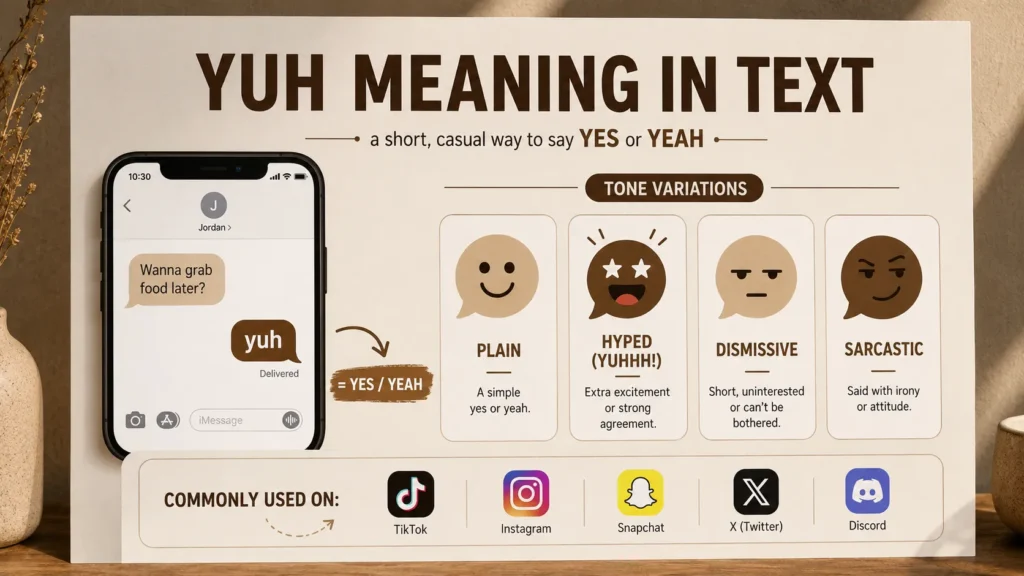
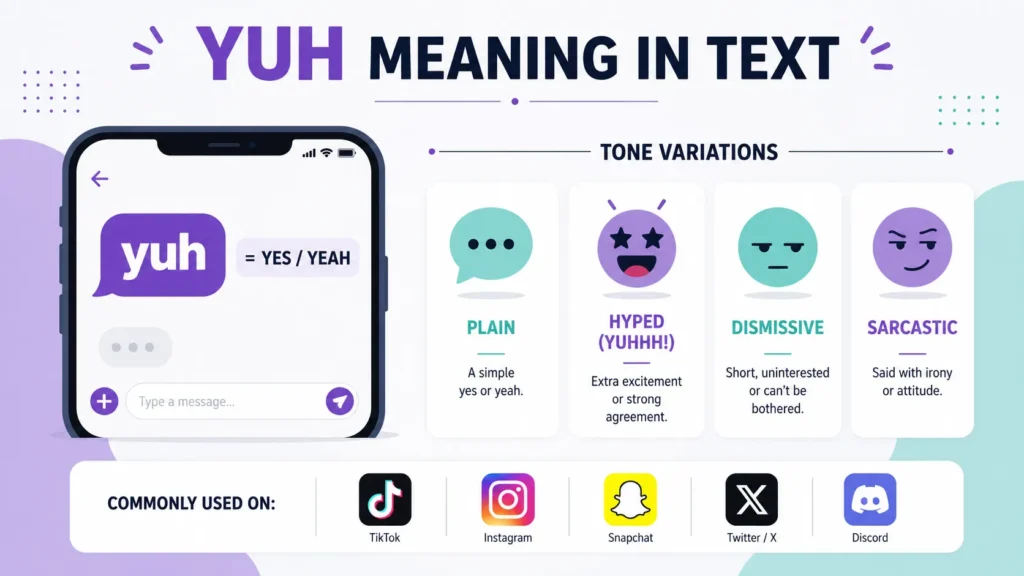
At its core, “yuh” means “yes” or “yeah.” It’s a stylized, phonetic spelling of how a lot of people actually say “yeah” out loud — shorter, flatter, and dragged slightly at the end. When it shows up in a text, a comment, or a caption, it’s almost always doing one of three jobs:
- Confirming something — “You still coming?” / “Yuh”
- Agreeing with a statement — “That was actually kind of funny” / “Yuh, ngl”
- Adding hype or energy — “NEW ALBUM DROPPED” / “YUHHH”
The word isn’t in Merriam-Webster or Dictionary.com as standard English — it’s slang, tracked and defined the way most internet slang is: through usage on Urban Dictionary and observed patterns on social platforms, not through formal dictionary editors. That doesn’t make it less “real” — it makes it the same category of word as “bet,” “fr,” or “lowkey”: informal, spoken-language-first, and understood almost entirely through context.
<a id=”pronunciation”></a>
How to Say “Yuh” (Pronunciation)
This trips people up more than you’d think, because the spelling looks unfamiliar. Say it like this:
- Rhymes with “duh” or “huh” — not with “you.”
- It’s one syllable: /yʌ/ (like the “u” in “cup”).
- In hype or excited use, people stretch it into “yuhhh” or “yuhhhh” — same sound, just held longer for emphasis, the texting equivalent of raising your voice.
If you’ve heard it in a song and wondered why it doesn’t sound like it’s spelled — that’s why. It’s meant to represent speech, not follow spelling rules.
Where Did “Yuh” Come From?
“Yuh” wasn’t invented online — it grew out of spoken language. Linguistically, it traces back to African American Vernacular English (AAVE), where casual pronunciations of “yes” and “yeah” have long included variants like “yeah,” “yea,” and “yuh.” This kind of vowel-shortening and dragging is a well-documented feature of AAVE phonology, not a random internet mutation.
It moved from speech into mainstream pop culture through hip-hop ad-libs. Rappers use short, punchy sounds — “yuh,” “skrrt,” “ayy” — to fill space in a beat and add energy without adding actual lyrics. You’ll hear it used this way by artists including Playboi Carti, Travis Scott, and XXXTentacion, among others; it’s a well-established ad-lib in trap and hip-hop production. It also got a mainstream pop boost when Ariana Grande used it as a repeated chant in “Thank U, Next” (2018), which pushed the word in front of an audience well beyond hip-hop fans.
From music, it jumped to comment sections and captions in the late 2010s, and TikTok’s rise after 2020 cemented it as a default way to type agreement or hype in a caption, comment, or duet.
Rough timeline: “Yeah” (informal English, long-standing) → “yuh” as a spoken AAVE variant → 2010s hip-hop ad-lib → 2018 pop mainstreaming via Ariana Grande → default TikTok/Gen Z
Yuh vs. Yeah vs. Yes vs. Yuhhh
They all mean “affirmative,” but they don’t all sound the same in someone’s head when they read them. Here’s how to think about the spectrum:
| Word | Formality | Feels like | Best used for |
| Yes | Formal | A clear, respectful confirmation | Email, work, interviews, official replies |
| Yeah | Neutral / casual | A normal, relaxed answer | Everyday texting, most conversations |
| Yuh | Very casual | Confident, low-effort, a little detached or hyped | Close friends, group chats, social captions/comments |
| Yuhhh | Very casual, amplified | Excitement, hype, agreement with energy | Reacting to something exciting, hyping a friend up |
| Yep / Mhm | Casual, soft | Light, quick, low-commitment | Quick acknowledgments, not big statements |
The simplest rule of thumb: if you’d say it to a teacher or boss, use “yes.” If you’d say it to a friend, “yeah” is safe anywhere. If you’d only say it in your group chat, that’s “yuh” territory.
How “Yuh” Is Used on Each Platform
The word doesn’t behave identically everywhere — the platform changes the job it’s doing.
TikTok: Mostly in comments and captions, reacting to something relatable, funny, or hype-worthy. Also shows up lip-synced/spoken in videos using trending audio that features the word as an ad-lib.
Instagram: Common under photos and Reels as a one-word compliment or co-sign — “yuh, this is fire” under a selfie or outfit post. Functions almost like a stamp of approval.
Snapchat: Because Snaps are fast, low-effort replies, “yuh” fits naturally as a quick response to a photo or video Snap — confirming, agreeing, or just acknowledging you saw it.
Twitter/X: Used to punctuate agreement with a take or a thread without writing a full reply — often paired with “fr,” “no cap,” or a retweet.
Discord / gaming chat: Functions as a fast in-game confirmation (“you got the flag?” / “yuh”) — same job as “yeah” or “yep,” just faster to type mid-match.
Texting (SMS/iMessage/WhatsApp): The most literal use case — a one-word answer to a yes/no question, or a way to co-sign what a friend just said.
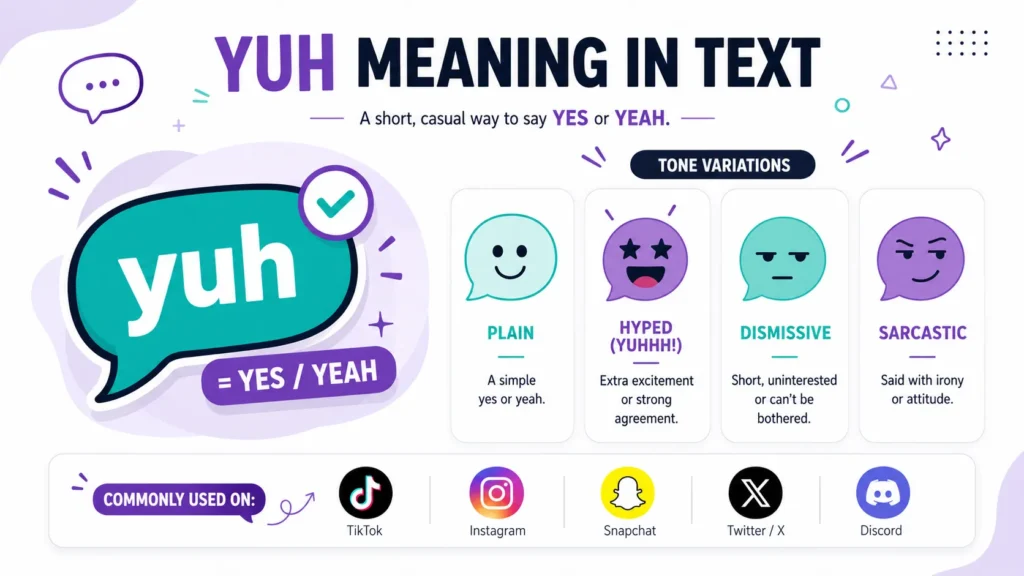
The 4 Tones of “Yuh” (and How to Tell Them Apart)
This is the part most guides skip, and it’s the part that actually matters if you’re trying to read a text correctly, not just define a word.
1. Plain agreement. No punctuation, no extra letters, sent alone. “You in?” / “Yuh.” Reads as a normal, neutral yes.
2. Hyped agreement. Extra letters, caps, or repetition — “YUHHH,” “yuh yuh yuh.” Reads as excitement or hype, often paired with something exciting just happened.
3. Dismissive or low-effort. Sent as a one-word reply to a longer message, especially with a delay. Can read as “I heard you, I’m not that invested right now.” This is the tone that causes the most misreads — someone asking a serious question and getting a flat “yuh” back can reasonably feel brushed off.
4. Sarcastic. Paired with an obviously exaggerated or ironic follow-up — “Yuh, sure, totally believe you” — flips the meaning entirely. In sarcasm, “yuh” doesn’t mean yes at all; it means the opposite, delivered dryly.
Since text has no tone of voice, the surrounding words, punctuation, and response time are doing all the work of telling you which of these four you’re getting.
<a id=”patois”></a>
Is “Yuh” the Same as “You” in Jamaican Patois?
No — and this is a genuinely useful distinction most guides gloss over. In Jamaican Patois, “yuh” is a standard, everyday word meaning “you.” It’s not slang there; it’s simply how the second-person pronoun is spelled and pronounced in Patois.
So a sentence like “Yuh ready?” means two completely different things depending on who’s texting you:
- In Gen Z internet slang: closer to “Yes, ready” (if used as a reply) or read as an agreement marker.
- In Jamaican Patois: it means “Are you ready?” — “yuh” is the subject of the sentence, not the answer.
If you’re texting with someone from the Caribbean or who speaks Patois, don’t assume “yuh” is always the “yes” version — check whether it’s functioning as a pronoun (“yuh ready?” = “are you ready?”) or as a standalone answer (“yuh” = “yes”).
<a id=”rude-or-not”></a>
Is “Yuh” Rude? Is It Okay for Kids to Use?
“Yuh” itself is not rude, offensive, or inappropriate. It’s simply an informal way of saying “yes.” There’s no hidden meaning, no acronym, and nothing NSFW buried in it — it’s safe for kids and teens to use, and it’s one of the more harmless pieces of texting slang out there.
Where it can land badly is tone, not the word itself:
- Replying “yuh” to a serious or emotional question can come across as dismissive, even if that’s not the intent.
- Using it in a professional email, a job interview follow-up, or with someone who doesn’t know internet slang will read as unprofessional or confusing.
- A flat, one-word “yuh” to a parent’s request (“clean your room”) can come across as mumbled and disinterested — that’s about delivery, not the word.
Bottom line: perfectly appropriate for casual texting and social media; skip it in formal or professional writing.
<a id=”real-word”></a>
Is “Yuh” a Real Word?
Not in the sense of appearing in a standard dictionary like Merriam-Webster — it’s classified as slang, the same category as “lol,” “bet,” or “lowkey.” It is documented on Urban Dictionary, which is the primary crowd-sourced reference for this kind of fast-moving internet and spoken slang, and its usage is consistent enough across TikTok, Twitter/X, and everyday texting that it functions as a stable, understood word within casual digital communication — even without an entry in a formal dictionary.
How to Reply to “Yuh”
If someone sends you a plain “yuh,” you don’t need to overthink it — treat it like a normal “yeah” and reply naturally:
- To confirm plans: “Bet, see you at 8” or “Cool, sounds good”
- To keep the conversation going: Ask a follow-up question instead of matching the low energy
- If it feels sarcastic: Call it out lightly — “wait are you being for real” — since sarcasm is easy to misread in text
- If it feels dismissive and you need a real answer: Just ask directly — “yuh as in yes, or yuh as in you’re not sure?”
There’s no rule that you have to match slang with slang. Replying with “yeah” or “okay” to someone’s “yuh” is completely normal and won’t read as cold.
Real Text Examples
Simple confirmation “Did you turn in the assignment?” — “Yuh, submitted this morning.”
Hyped Agreement “They just announced the tour dates” — “YUHHH finally, I’m getting tickets.”
Casual compliment (Instagram comment) “New profile pic 🔥” — “yuh you ate with this one”
Quick Snapchat reply to a food photo “yuh that looks so good”
Sarcastic use “I definitely wasn’t ignoring your texts” — “Yuh, sure, okay.”
Jamaican Patois use (pronoun, not agreement) “Yuh comin’ tonight?” = “Are you coming tonight?”
<a id=”acronyms”></a>
Other Meanings of YUH (Acronyms)
Written in capital letters, YUH occasionally shows up as shorthand or an abbreviation outside of slang contexts — these are far less common than the texting meaning, but worth knowing if you’ve seen it in a different setting:
- Yale University Hospital — occasionally abbreviated as YUH in internal medical or administrative contexts.
- Airport/location codes — some regional identifiers use YUH-style short codes, though this isn’t a standardized or widely recognized aviation code.
These are niche, industry-specific uses and almost never what someone means when they text you “yuh.
Common Misunderstandings
“It’s an acronym for something.” It isn’t. Despite occasional claims online, “yuh” is not shorthand for a phrase — it’s a phonetic spelling of a sound, the same way “lol” started as letters but “yuh” started as speech.
“It always means enthusiastic yes.” Not necessarily — a flat, undecorated “yuh” is often just neutral or even a little checked-out. Enthusiasm usually needs the extra letters (“yuhhh”) or exclamation marks to read clearly.
“It’s the same everywhere.” As covered above, Jamaican Patois speakers use “yuh” as the word “you,” not as agreement. Assuming one meaning across every conversation is the most common misread.
“Only teenagers use it.” It skews younger, but it’s common well into the 20s and 30s among people active on TikTok and Twitter/X — it’s more about internet fluency than strict age.
<a id=”related-slang”></a>
Related Slang Worth Knowing
“Yuh” rarely shows up alone — it’s often stacked with other short affirmations:
- No cap — not lying, for real
- Fr / fr fr — “for real,” used for emphasis
- Bet — okay, agreed, confirmed
- Say less — understood, no need to explain further
- Lowkey / highkey — somewhat / very (used to soften or emphasize a statement)
So a text like “yuh, no cap, bet” is essentially “Yes, I’m serious, and I’m on board” — three words doing the work of a full sentence.
People Also Ask
It means “yes” or “yeah” — a casual, informal way of confirming or agreeing with something.
The same as “yuh,” but with extra letters added to signal more energy, hype, or excitement — the texting equivalent of raising your voice.
Close, but not identical. Both mean yes, but “yuh” carries a more casual, sometimes more detached or confident tone and skews toward younger, internet-native usage. “Yeah” is understood more universally across age groups.
It developed from African American Vernacular English (AAVE) pronunciations of “yeah,” became a common hip-hop ad-lib in the 2010s, and went mainstream partly through Ariana Grande’s use of it in “Thank U, Next” before becoming standard TikTok and texting slang.
No. The word itself is neutral and harmless. It can read as dismissive if used as a flat, one-word reply to a serious question, but that’s about tone and context, not the word itself.
Yes. It’s simply a casual way of saying “yes” with no hidden or inappropriate meaning.
Conclusion
“Yuh” is a small word carrying more nuance than it first appears to. At its core it’s just “yes” — but which yes (hyped, neutral, dismissive, or sarcastic) depends entirely on the letters around it, the punctuation, and how fast the reply came back. Outside of texting, remember it has a completely separate life as the word “you” in Jamaican Patois. Once you can spot the difference, you’ll never misread a “yuh” text again — and you’ll know exactly how to text one back.