TSTS Meaning in Text: The Real Definition Explained
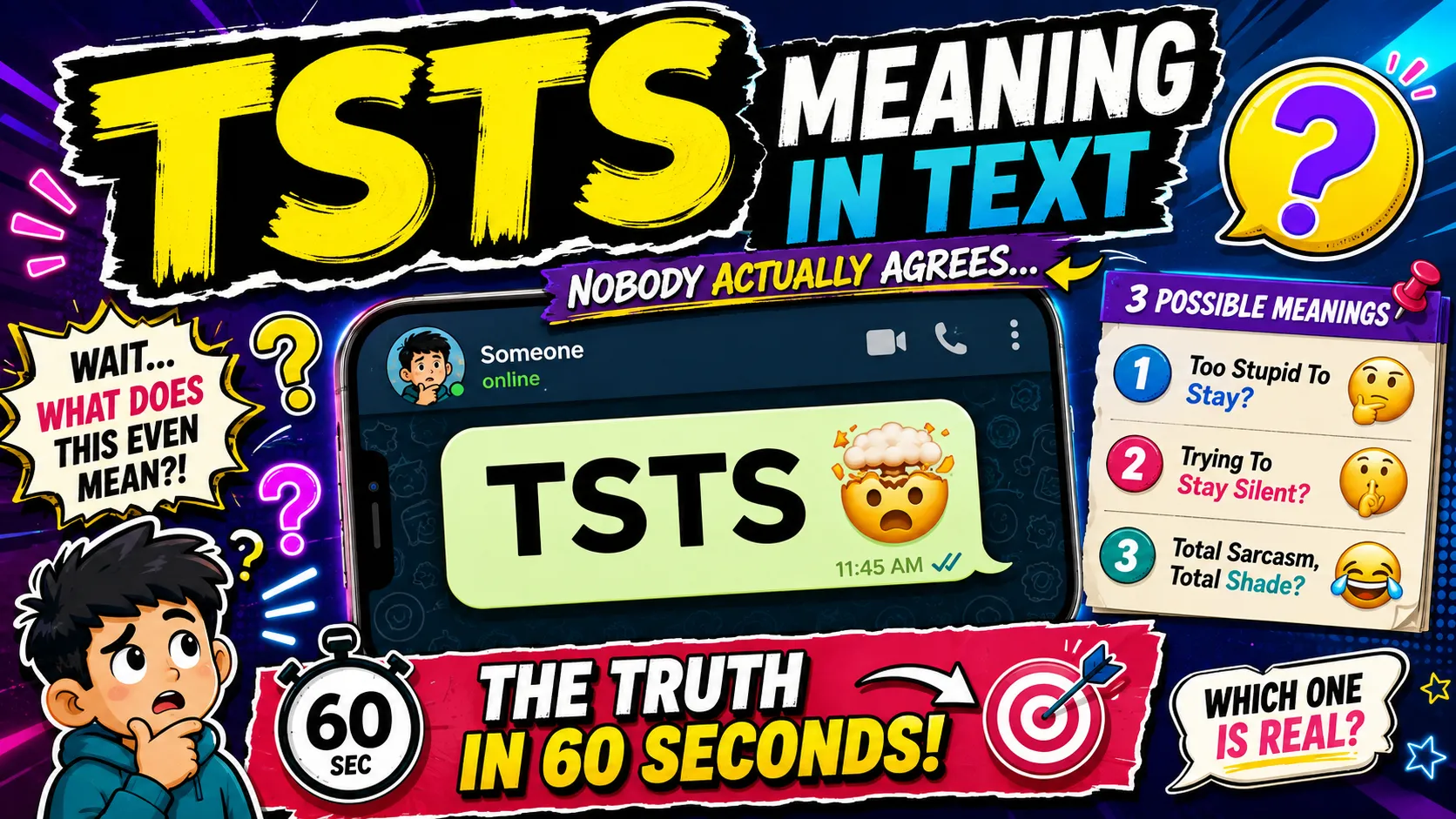
You got a text back that just says “TSTS.”\ No punctuation, no emoji, no follow-up. So you Google it — and now you’ve got a problem: the first three results tell you three different things.
One site swears it’s a written-out “tsk tsk” sound. Another insists it stands for “Too Smart To Say.” A third says it means “To Say The Same.” They can’t all be right, and none of them mention that the others exist.
Here’s the honest answer: TSTS doesn’t have one official meaning. It’s internet slang, not a dictionary word, and it’s currently used in a few genuinely different ways depending on who’s typing it. This guide breaks down every real interpretation, shows where each one actually comes from, and gives you a simple way to figure out which one applies to your conversation.
What Does TSTS Mean in Text?
In most casual texting and social media use, TSTS is shorthand for the “tsk-tsk” sound — the tongue-click people make to show mild disapproval, teasing judgment, or “I can’t believe you did that” energy. On Urban Dictionary and in some Gen Z chats, it’s also used to mean “too soon, too serious” or simply as a repeated, emphatic version of “ts” (“that shit”/”this shit”). A separate cluster of definition sites also claims it stands for phrases like “Too Smart To Say” or “Too Shy To Say,” though this usage is far less documented in real conversations. Context and tone are what actually decide the meaning.
Quick Meaning Summary
| Reading | What it signals | Where you’ll see it most |
| Tsk-tsk sound | Playful disapproval, mock judgment | Group chats, sibling/friend banter |
| Doubled “ts” | Emphasis, disbelief, attitude | WhatsApp/SMS, reacting to a claim |
| “Too soon, too serious” | Soft deflection | 1:1 DMs, after an awkward question |
| Backronym (“Too Smart/Shy/Stressed To Say”) | Playful or hesitant non-answer | Mostly seen on definition sites, less in real chats |
Why Does TSTS Have So Many Different Meanings?
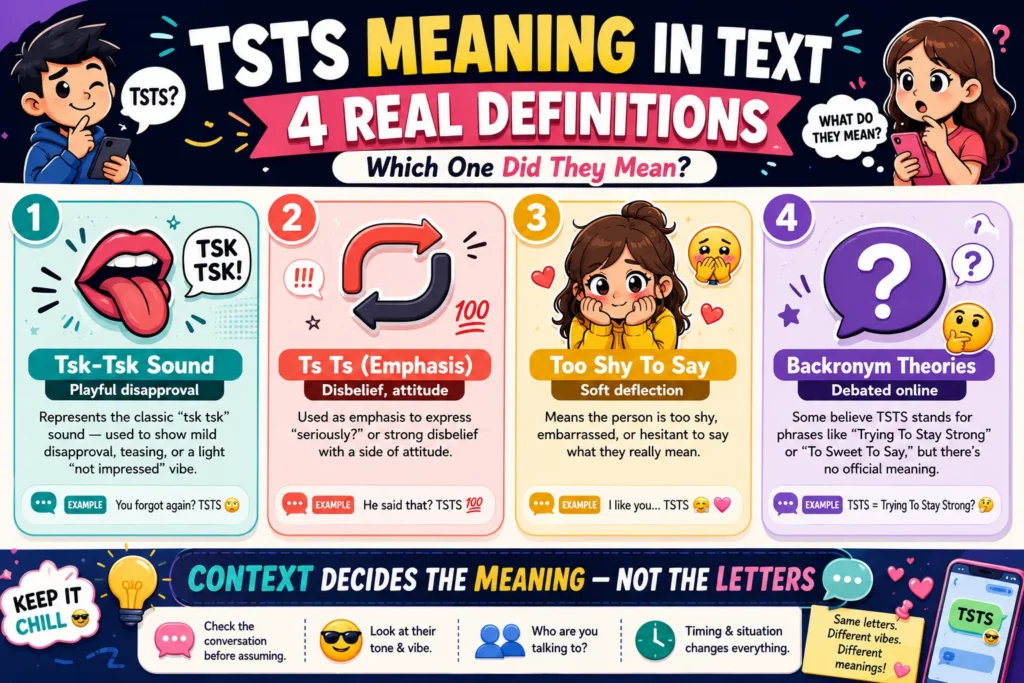
This is the part competing guides skip, and it’s the most useful thing to understand. TSTS isn’t an established acronym like LOL or BRB with one traceable origin — it’s a short, four-letter string that different communities have filled with different meanings independently:
- It looks like an onomatopoeia. “Tsk tsk” compressed and repeated naturally becomes “ts ts” or “tsts” when people type fast — similar to how “shh” or “psst” get typed as sound effects, not words.
- It looks like a backronym waiting to happen. Any short, pronounceable letter string invites people to invent a phrase that fits — the same way “GOAT” or “FOMO” spawned joke expansions before the “real” one stuck.
- It’s genuinely rare in real usage. Unlike “SMH” or “IDK,” which show up constantly across chat logs and social platforms, TSTS has relatively low real-world usage — which is exactly why it doesn’t have one settled, dictionary-style definition yet.
Origin and Background
“Tsk tsk” (also spelled “tisk tisk”) is a centuries-old written form of the tongue-click sound used across many cultures to express mild scolding or disappointment — long before texting existed. As typing compressed everything, that sound naturally got typed faster and looser: tsk tsk → tsks tsks → tsts.
Separately, “ts” became its own piece of Gen Z slang meaning “this/that shit,” used as a filler for attitude or emphasis (“ts is crazy”). Doubling it into “ts ts” follows the same pattern as other repeated slang (“no no no,” “bro bro”) — repetition for emphasis. Both trends converged on the same four letters, which is the real reason TSTS reads differently depending on who’s using it and why.
Theory 1: TSTS as the “Tsk-Tsk” Sound (Most Common Real-World Usage)
This is the interpretation with the strongest linguistic logic behind it. In this usage, TSTS carries a light, often affectionate tone — closer to teasing than actual anger.
Examples:
- “You forgot your umbrella again? TSTS.”
- “Ate the last slice and didn’t even ask. TSTS 😂”
- “Skipped the gym for the third time this week… TSTS.”
In every one of these, TSTS softens what would otherwise sound like a criticism. It says I noticed, and I’m judging you a little — but affectionately.
Theory 2: TSTS as “Ts Ts” — An Emphatic Double of “TS”
Doubling “ts” to “ts ts” or “tsts” exaggerates the emotion behind it — usually frustration, disbelief, or mock outrage. This version is grammatically closer to an interjection than an acronym, and it’s the meaning you’ll most often see explained by actual slang communities rather than SEO definition sites.
Example:
- “He said he’d text back in 5 minutes. That was 3 hours ago.”
- “ts ts is crazy behavior fr”
Theory 3: The Acronym Expansions (Backronyms)
A separate group of definition websites lists TSTS as standing for phrases such as these:
| Claimed expansion | Suggested context |
| Too Smart To Say | Playful, sarcastic non-answer |
| Too Stressed To Speak | Emotional overwhelm |
| Too Shy To Say | Romantic or hesitant admission |
| That’s So True, Seriously | Strong agreement |
Worth knowing: none of these expansions have verifiable, widespread real-conversation usage — they read like phrases invented specifically to explain an acronym after the fact, a common pattern on slang-definition content farms. That doesn’t mean nobody has ever used TSTS this way in a private chat; slang is invented constantly. But if you’re trying to figure out what a specific text meant, treat this table as a possible meaning, not the default one.
What Urban Dictionary Actually Says About TSTS
Since Urban Dictionary is the closest thing slang has to a crowdsourced record, it’s worth checking directly instead of taking another blog’s word for it. The real entries there define TSTS in two ways: as a stylized, emphatic repeat of “ts,” used the way someone might type it twice for effect in a fast, casual exchange; and as shorthand for “too soon, too serious,” typically used as a light deflection after an awkward or overly forward message.
Neither of these matches the “tsk-tsk” theory or the “Too Smart To Say” theory — which reinforces the core point of this guide: TSTS is not standardized slang yet. Anyone telling you there’s exactly one correct answer is oversimplifying.
TSTS vs. TS vs. TST vs. TBTS — Don’t Mix These Up
| Term | What it usually means | Tone |
| TS | “This shit” / “that shit” — a stand-alone filler/interjection | Emphatic, casual |
| TST | Varies by context (org names, niche communities); not standard texting slang on its own | Depends entirely on context |
| TSTS | “Tsk-tsk” sound, doubled “ts,” or (less commonly) an invented acronym | Teasing, judgmental, or deflecting |
| TBTS | “Throwback to something” — used to reference a past moment or inside joke | Nostalgic |
If a message is just “ts” by itself, it’s almost certainly the “this/that shit” filler, not a shortened TSTS. If it’s doubled to “ts ts” or “tsts,” context becomes far more important.
How Is TSTS Actually Used? (Context Clues That Decide the Meaning)
Since there’s no universal answer, use these four context clues to interpret a real message:
- What came right before it? TSTS responding to a mistake or confession almost always points to the tsk-tsk / disapproval reading. TSTS responding to a bold or unexpected statement often points to the “ts ts” emphasis reading.
- Check for emojis. A 😂 or 🙄 next to TSTS signals playful judgment. No emoji, sent after something personal or emotional, may fit the deflection reading.
- Consider the relationship. Close friends and siblings use it teasingly far more often than as a serious acronym. Romantic or flirty contexts are the one place the “Too Shy To Say” backronym shows up most.
- Look at the platform. TikTok and Instagram comment sections lean toward the sound-effect/judgment usage. DMs and 1:1 texts have more room for the deflection or emphasis readings.
When genuinely unsure, the safest move is just to ask — Nobody Will think it’s a strange question, since the term isn’t standardized to begin with.
TSTS Meaning in Text From a Guy vs. From a Girl
There’s no gender-specific “official” meaning, but real usage patterns skew by context, not gender:
- In banter/friend-group chats (any gender): almost always the tsk-tsk / teasing-disapproval reading.
- In flirty or early-dating texts: this is where the “too shy to say” reading is most plausible, usually after a direct question like “do you like me?”
- In reaction to a claim or flex: the emphatic “ts ts” reading.
Treat “from a guy” or “from a girl” searches as really asking “what’s the relationship context” — that matters far more than who sent it.
TSTS on Social Media
TikTok: usually a quick reaction to a bold, dramatic, or questionable clip — functions like a written eye-roll in the comment section.
Instagram: shows up in captions and comments similarly, often paired with a laughing or side-eye emoji.
Snapchat: tends to react to the content of a snap rather than a text message — playful skepticism about what’s shown.
WhatsApp / SMS: the most likely place to see the doubled “ts ts” emphasis version, since it mirrors how “ts” already gets used there as filler.
How to Respond to TSTS
- If it’s teasing: play along — “okay okay, I know, I know 😂”
- If it feels like deflection: give the person space rather than pushing.
- If you genuinely can’t read the tone: ask directly. It’s a low-stakes term; clarifying isn’t awkward.
When NOT to Use TSTS
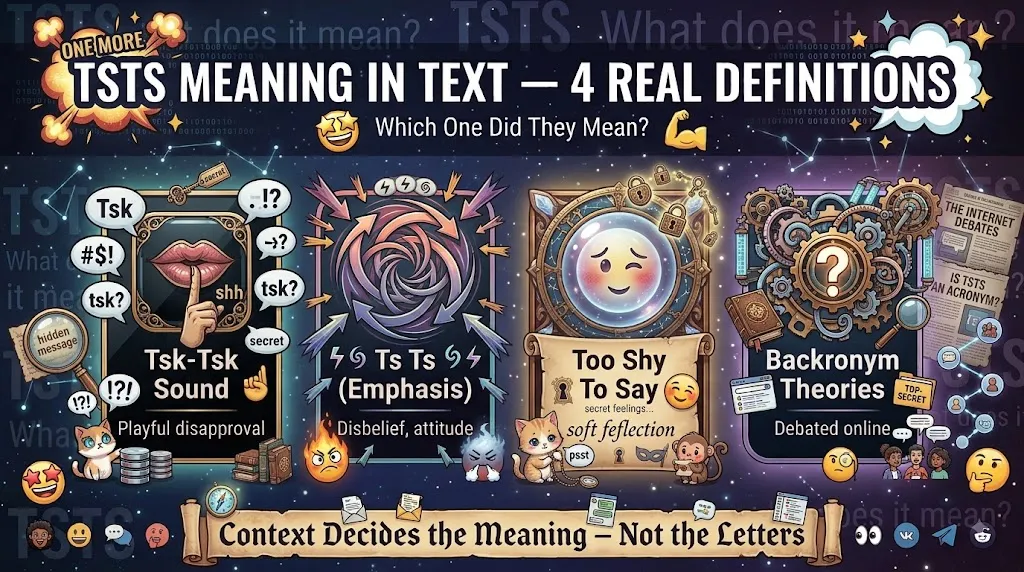
Because the meaning isn’t standardized, TSTS is a poor choice anywhere clarity matters: workplace chat or email, customer service conversations, messages to someone unfamiliar with texting slang, or any situation where your tone needs to be unmistakable.
Explore More: https://dogizle.com/smoke-show-meaning/
TSTS vs. Similar Slang Terms
| Term | Meaning | How it differs from TSTS |
| SMH (Shaking My Head) | Clear disappointment or disbelief | More direct and universally understood; TSTS is softer and more ambiguous |
| TBH (To Be Honest) | Signals an honest opinion is coming | Openly states something; TSTS often withholds or teases instead |
| IDK (I Don’t Know) | Genuine uncertainty | Straightforward; TSTS implies emotion or judgment, not just not-knowing |
| NVM (Never Mind) | Dropping the topic entirely | Ends a thought; TSTS usually reacts to one instead |
| LOL | Laughter | Purely amused; TSTS carries judgment, shyness, or emphasis instead |
Common Misunderstandings About TSTS
- “It always means the same thing.” It doesn’t — that’s the entire premise of this guide.
- “It’s always negative or rude.” In its most common usage, it’s actually playful and affectionate, not hostile.
- “There’s one official acronym expansion.” No single expansion is verifiably standard; treat any confident “TSTS officially means X” claim with some skepticism.
- “It’s fine to use professionally.” It isn’t — keep it in casual chats only.
People Also Ask
In flirty or early-dating contexts, it’s most often used as a soft deflection — implying hesitation to say something directly, close to “Too Shy To Say.” Tone and the question that preceded it matter more than the letters themselves.
Often, yes — TSTS is frequently just a fast-typed, doubled version of the “tsk tsk” disapproval sound. But it isn’t the only usage, so don’t assume this meaning without checking context.
“Ts ts” typically works as an emphatic double of “ts” (“this/that shit”), adding attitude or disbelief to a reaction — distinct from, though related to, TSTS.
Generally no. It can come across as dismissive or passive-aggressive in a sensitive conversation, but on its own it isn’t a slur or an inherently harmful term.
TBTS means “throwback to something” and references a past moment; TSTS is reaction-based and doesn’t reference the past at all
There’s no documented single origin. It most likely evolved from typed versions of the “tsk tsk” sound, alongside independent slang use of doubled “ts” for emphasis.
Conclusion
- TSTS has no single official meaning — it’s ambiguous, low-frequency slang, not an established acronym.
- The most common real-world usage is a stand-in for the “tsk-tsk” disapproval sound.
- A second real usage doubles “ts” (“this/that shit”) for emphasis.
- Backronym expansions like “Too Smart To Say” exist on definition sites but have little verified real-conversation usage.
- Context — what came before it, emojis, relationship, and platform — is the only reliable way to interpret it.
- Never use it in professional or formal communication.