KMS Meaning in Text: The Complete Guide
1: What Does KMS Mean?
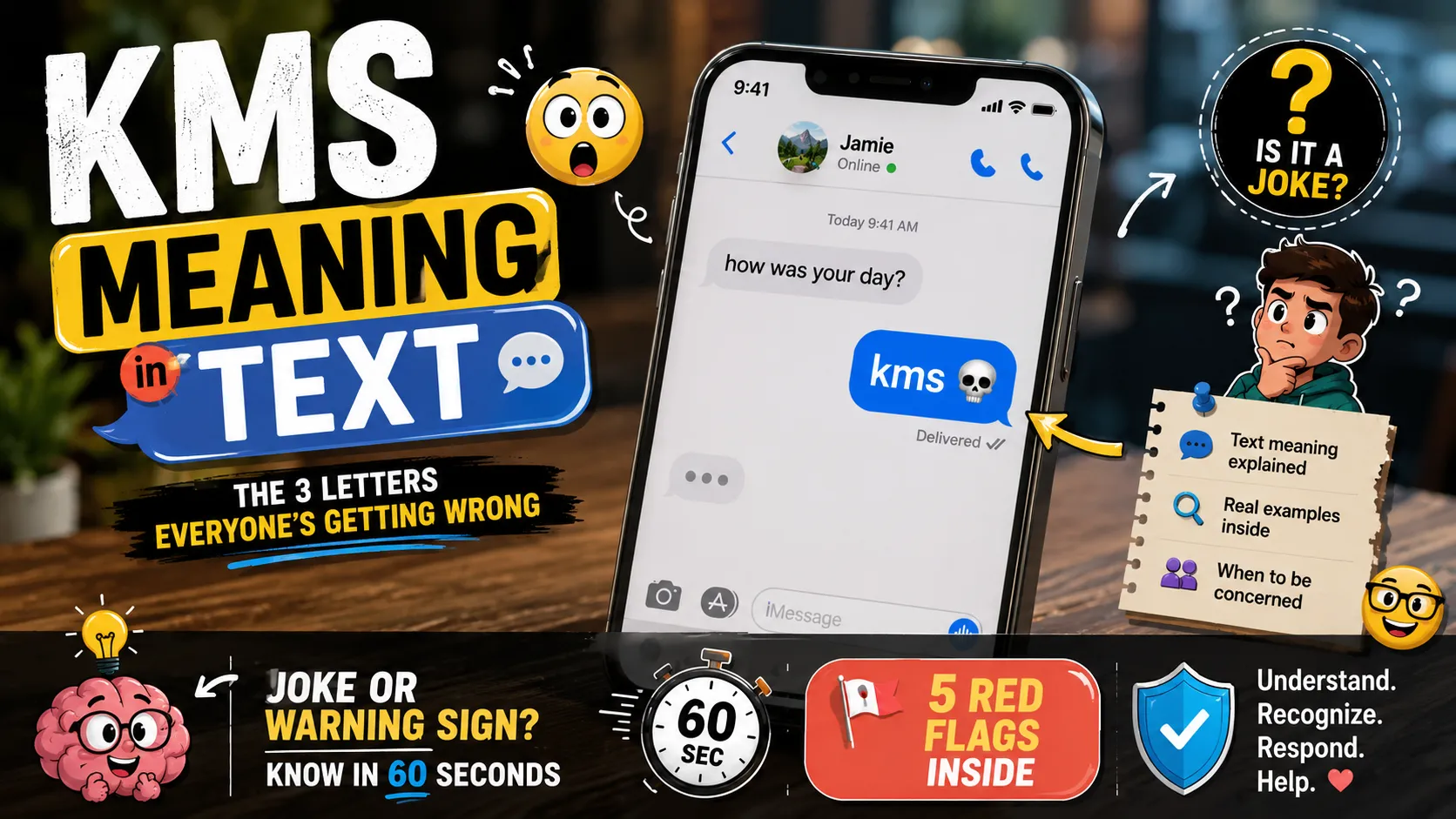
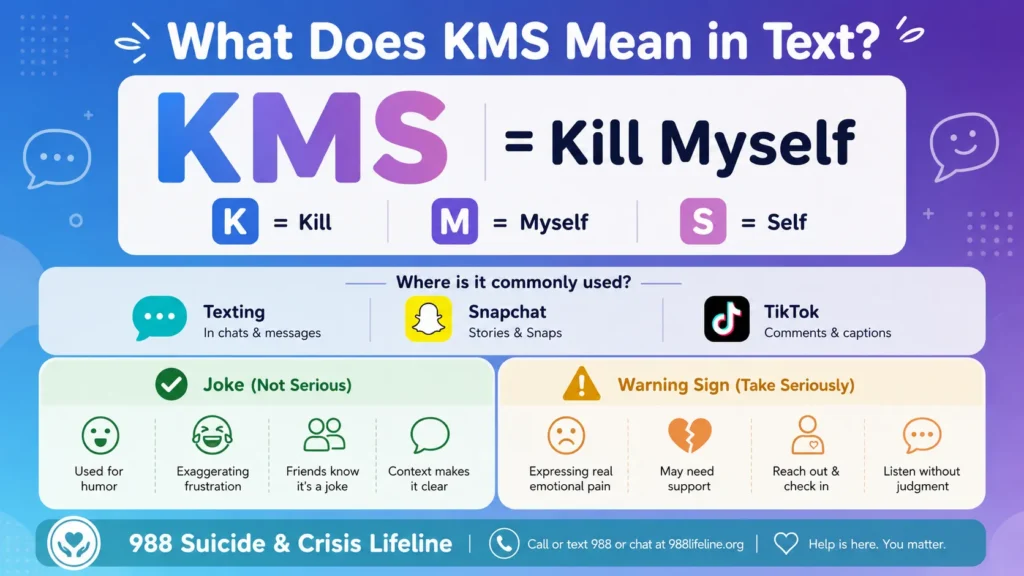
- Kill Myself — the primary and most common meaning; internet slang used to express embarrassment, stress, frustration, or overwhelm, almost always non-literally
- Key Management Service — a Microsoft IT/software licensing term used to activate products across a company network; unrelated to the slang usage
- Kilometers — informal shorthand occasionally used in some regions or in casual travel/fitness chat (e.g., “ran 5 KMS today”)
- Context is the deciding factor — a text thread, DM, or social caption almost always means “kill myself”; a spreadsheet, IT ticket, or road-trip chat almost always means something else
- Frequency of use — the “kill myself” meaning accounts for well over 95% of appearances in everyday texting and social platforms
- Why people search this term — most readers are trying to decode a message from a friend, partner, or child, and are looking for reassurance or a clear framework rather than a dictionary definition alone
- Quick gut-check before reacting — before assuming the worst or brushing it off entirely, look at what the message was attached to and how the sender normally talks online
H2 2: KMS Full Form
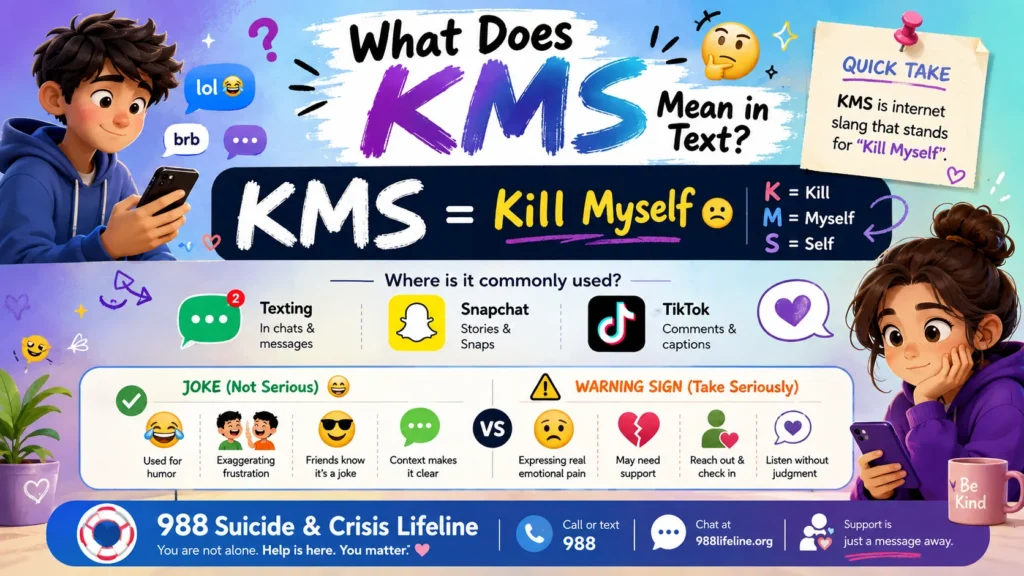
- K – Kill
- M – My
- S – Self
- Together – “Kill Myself,” typically delivered as an exaggerated reaction rather than a literal statement
- Comparable phrases – functions the same way as “I could just die,” “shoot me now,” or “I want to disappear,” all common hyperbole for embarrassment or stress
- Not a new phenomenon – the underlying habit of turning strong emotional language into shorthand predates KMS; it’s just the version that stuck for this particular expression
3: Origin and History of KMS
- Tumblr (early 2010s) — grew out of communities known for dark, self-deprecating humor used as a coping mechanism for stress and anxiety
- Twitter/X (spread phase) — helped push the term from niche blog culture into broader, mainstream internet slang
- Meme culture — folded into a wider trend of compressing big feelings into small, throwaway phrases (“I’m dead,” “I can’t even,” “kms”)
- Gaming chat — adopted early by online gaming communities as a reaction to bad plays, tough losses, or getting outplayed by teammates
- TikTok — cemented the term as a caption staple for embarrassing, relatable, or “why did I do that” clips
- Ongoing evolution — like most internet slang, KMS has drifted from a niche in-group phrase to something used casually across nearly every generation active online
- Why dark humor caught on this way:
- Fast typing environments favor short phrases over full sentences
- Self-deprecating humor is often used as a low-stakes way to acknowledge stress without dwelling on it
- Group chats and comment sections reward quick, relatable reactions over detailed explanations
- Cross-generational spread — what started in youth-dominated spaces has since been picked up by older users, workplace group chats, and even brand social media accounts leaning into “relatable” tone
4: Other Meanings of KMS Outside Texting
- Microsoft Key Management Service (enterprise IT)
- Used by IT administrators to activate Windows and Office products across an organization’s network
- Appears in technical documentation, licensing guides, and IT support tickets
- Has zero emotional connotation in this context
- Kilometers (casual/regional use)
- Occasionally shortened to “kms” in informal writing, especially in fitness tracking or travel logs
- Rare compared to the slang usage, but not unheard of
- Aviation/technical documentation codes
- Occasionally an internal abbreviation specific to a company, system, or manual
- Entirely dependent on the document or industry — not a standardized term outside that context
5: KMS Meaning on Snapchat
- Same “kill myself” slang meaning applies as elsewhere
- Usually paired with a photo or video reacting to something embarrassing, awkward, or mildly disastrous
- Common formats include:
- A blooper-style Snap with a caption like “kms 💀”
- A reaction Snap after an awkward interaction
- A quick vent after a bad day, often deleted from memory once the Snap disappears
- Snaps disappear quickly, which makes context harder to catch after the fact if someone else brings it up later
- Worth a direct, caring follow-up if a Snap paired “kms” with something that felt genuinely upsetting rather than funny
H2 6: KMS Meaning on TikTok
- Frequently used in captions for comedic self-deprecation
- Common on embarrassing clips, cringe compilations, or “this is so me” relatable content
- Often stacked with other slang for comedic Effect (e.g., “kms, I’m never leaving the house again 💀😭”)
- Almost always played for humor in this context — TikTok’s format leans heavily on exaggerated reactions as a genre of content
- Comment sections often use it the same way, reacting to someone else’s clip rather than describing their own feelings
H2 7: KMS Meaning on Instagram
- Used similarly to TikTok — mostly in captions, comments, or Stories replies
- Signals exaggerated embarrassment, secondhand embarrassment, or mock frustration
- Typically accompanied by:
- Laughing or skull emojis
- Self-deprecating hashtags or captions
- A specific photo or moment being referenced
- Less common in DMs unless reacting to something specific sent by a friend
- Tone tends to mirror the overall aesthetic of the post — playful captions rarely carry real distress
8: KMS Meaning on Discord and Gaming Chat
- Common after a bad play, a lost match, a missed shot, or getting clowned on by teammates
- Near-universally joking, tied tightly to the specific in-game moment
- Frequently used as a group bit — one player says it, others pile on with similar exaggerated reactions
- Rarely dwelled on; the conversation moves on quickly to the next round or topic
- Voice chat context (tone of voice, laughter) often makes intent even clearer than text alone
- Worth noting if it becomes a genuine pattern for one specific player outside of gaming losses — especially if paired with other signs of frustration in their life
9: KMS Meaning on Twitter/X
- Used as a punchline for everyday frustrations — traffic, exams, bad days, awkward encounters
- Also appears in a more emotionally raw way occasionally, especially in personal or vent-style threads
- The platform where tone is hardest to read out of context, because:
- Tweets are short and lack surrounding conversation
- Threads can mix humor and genuine venting in the same breath
- Strangers, not just friends, may see and respond to the post
- Because of this ambiguity, X/Twitter is one of the platforms where a direct check-in (even from someone who doesn’t know the person well) is reasonable if a post feels genuinely heavy
10: KMS vs. KYS
- KMS – self-directed, aimed at the speaker’s own feelings
- KYS – directed at someone else, telling another person to harm themselves
- KMS – usually joking, self-deprecating, or an Exaggerated Reaction to a personal moment
- KYS – usually considered aggressive, hostile, or a form of bullying, even when the sender claims it’s “just a joke”
- Why the distinction matters:
- KMS rarely targets or harms another person directly
- KYS is frequently reported as harassment on platforms and can carry real consequences for the sender
- Seeing KYS directed at someone (including yourself) warrants a more serious response than typical KMS use — including reporting it on the platform if it’s part of a bullying pattern
11: KMS vs. Other Related Slang
- KMSL – Kill Myself Laughing
- Purely comedic, no distress connotation
- Used interchangeably with “dying laughing” or “I’m crying 😭”
- FML – F*** My Life
- Expresses frustration, generally milder in tone than KMS
- Common for everyday annoyances (missed the bus, spilled coffee, forgot homework)
- I’m Dead / Deceased
- Figurative reaction to something extremely funny
- No self-harm language at all, despite the dramatic phrasing
- Menty B – Mental Breakdown (joking)
- Said to express overwhelm in a lighthearted, self-aware way
- Often used preemptively (“about to have a menty b over this deadline”)
- Shared pattern across all of these – internet slang consistently reaches for dramatic, oversized language to describe small, everyday stress; KMS is simply the version that borrows most directly from self-harm terminology, which is why it gets more scrutiny than the others
- Other related shorthand worth knowing:
- IDGAF – frustration or forced indifference, unrelated to self-harm language
- SMH – shaking my head, mild disapproval or disbelief
- NGL – not gonna lie, used to preface an honest or blunt statement
- Lowkey/highkey – used to soften or intensify a statement, often paired with slang like KMS for emphasis (“lowkey kms rn”)
12: Signs KMS Is Just a Joke
- Tied to a specific, minor incident (a typo, an awkward interaction, losing a game)
- Paired with laughing emojis, “lol,” “💀,” or similar tone markers
- Matches the person’s normal texting style and sense of humor
- Dropped without dwelling on it — the conversation moves on naturally afterward
- Consistent with how the person and their friend group generally talk online
- No accompanying signs of withdrawal, sadness, or a shift in behavior around the same time
H2 13: Signs KMS Might Be a Real Warning Sign
- New or increasing frequency — it wasn’t part of how this person talked before, or it’s showing up more and more often
- No specific trigger — the phrase feels untethered from any clear, identifiable event
- No humor or emoji attached — just the phrase, sitting there without a punchline
- Recent withdrawal or mood change — less social, more tired, disengaged from things they used to enjoy
- Unconvincing “I’m fine” when asked directly — a brush-off that doesn’t quite land
- Combination of factors matters more than any single one — no single sign is proof on its own, but several appearing together is worth taking seriously
14: How to Respond When Someone Texts KMS
- If it’s clearly a joke
- Respond naturally — you don’t need to turn every “kms” into an intervention
- Over-reacting to obvious hyperbole can make people less likely to be honest with you later
- If you’re unsure
- Ask directly and warmly: “Haha, I feel that, but for real — you doing okay today?”
- Keeps the door open without accusing them of being dramatic or dismissing a real feeling
- If it seems genuinely heavy
- Don’t try to “fix” it over text alone
- Stay present, ask how they’re really doing, and listen without judgment
- Encourage them to talk to someone — a parent, friend, school counselor, or crisis line
- If there’s immediate danger
- Treat it as an emergency
- Involve a trusted adult or contact emergency services right away
- Don’t leave the person alone if you can help it, and don’t wait to see if it passes on its own
15: Guidance for Parents and Educators
- Most teens use it exactly like “OMG” or “ugh” — digital shorthand, not a literal statement
- Reacting with panic to every instance can shut down communication and make kids less likely to share what they’re actually feeling
- Context is everything:
- A single KMS after a bad test grade, surrounded by jokes and emojis, is very different from repeated, unprompted, unexplained use
- Watch for a change in baseline, not just the word itself:
- Sleep changes
- Withdrawal from friends or activities
- Drop in grades
- A shift in how they talk about themselves generally
- Open a conversation, not an interrogation:
- “I saw you texted ‘kms’ — is everything okay?” tends to work far better than confiscating a phone or reacting with shock
- When in doubt, involve a professional:
- A school counselor, therapist, or pediatrician can help assess whether what you’re seeing is typical slang use or something that needs more support
- Professionals can also help you figure out how to keep the conversation open long-term, not just in a single check-in
- Building long-term openness rather than one-off reactions:
- Normalize talking about stress and emotions generally, not just after a concerning message
- Avoid punishing kids for being honest about hard feelings, even if the delivery (slang, dark humor) feels jarring
- Model healthy ways of expressing frustration in your own conversations
- Revisit the conversation over time rather than treating one talk as a permanent fix
People Also Ask
Not profanity in the traditional sense, but it references self-harm, which makes it inappropriate for formal, professional, or School settings even when meant as a joke. Many schools and workplaces treat it seriously regardless of intent.
The meaning doesn’t change based on gender — it’s the same slang for “kill myself,” almost always used hyperbolically to express embarrassment or frustration. Tone and context, not who’s sending it, determine whether it’s a joke or a concern.
Same answer — gender doesn’t change the meaning. What matters is the specific context, the relationship, and whether the tone feels joking or genuinely heavy, not the sender’s gender.
KMS is self-directed and almost always hyperbole. KYS is directed at someone else and is widely considered a form of harassment or cyberbullying, regardless of the sender’s claimed intent.
The same “kill myself” slang meaning applies, typically captioning an embarrassing photo or video. Because Snaps disappear, it’s worth paying attention to what the message was paired with if the tone ever felt off.
Usually no — most uses are joking and tied to something specific and minor. But a new pattern, lack of a clear trigger, or recent withdrawal is worth a genuine, non-judgmental check-in.
Among friends who clearly understand it as hyperbole, most people use it without issue. It’s best avoided in professional settings, with people you don’t know well, or around anyone you know is currently struggling, since tone doesn’t always translate over text.
Conclusion
- KMS most often means “kill myself,” used as hyperbole rather than literal intent, in the same spirit as phrases like “I could just die”
- Context, tone, frequency, and pattern matter far more than the presence of the word itself
- The vast majority of uses are tied to something specific, minor, and softened with humor or emoji
- Rare cases — untethered from a Trigger, repeated, flat in tone, paired with withdrawal — can signal genuine distress and deserve a direct, caring check-in
- KYS is a different and more serious case entirely, directed at others rather than the self, and warrants a firmer response
- Parents, educators, and friends alike are better served by staying calm, asking directly, and watching for real behavioral changes than by reacting to a single instance of slang
- When in doubt, ask directly, stay present, and involve a trusted adult or professional rather than guessing