IONK Meaning in Text: What It Really Stands For
If you’ve scrolled past “Ionk” in a text, a TikTok comment, or a Discord chat and had no idea what it meant, you’re not alone.
What Does IONK Mean?
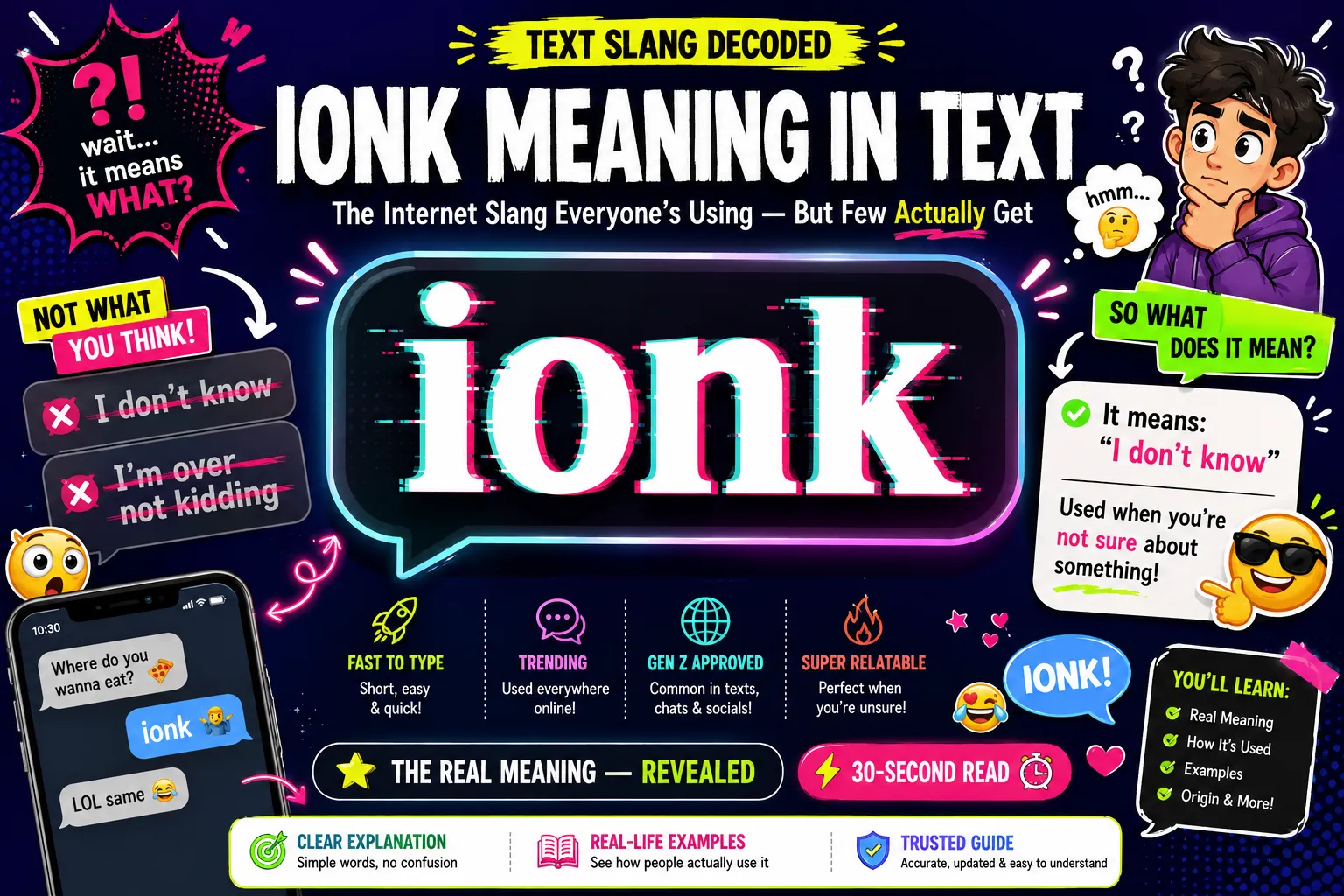
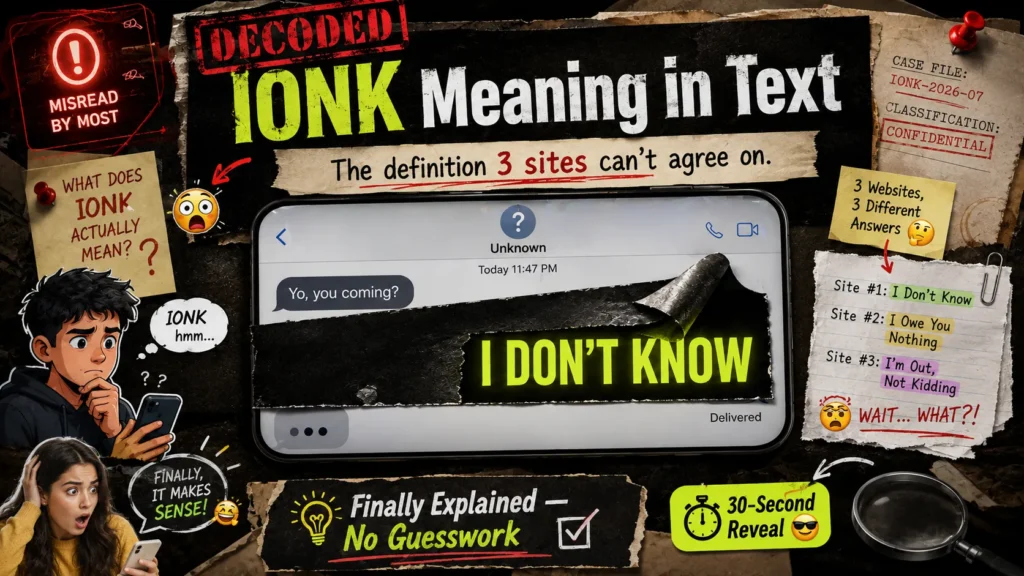
IONK is internet slang for “I don’t know.” It’s a phonetic, texting-style variation of IDK — spelled the way “I don’t know” sounds when said quickly and casually, almost like “ion-know” run together as one word. You’ll see it mostly on TikTok, Snapchat, and Instagram, usually typed in lowercase with no punctuation: “ionk lol.”
Unlike some slang terms that shift meaning depending on who’s using them, IONK is fairly consistent across platforms and age groups within its core Gen Z and younger-millennial user base. It doesn’t carry hidden layers or coded meaning the way some internet abbreviations do — it’s simply a faster way to type something people already say constantly in everyday speech. That simplicity is part of why it spread so quickly: there’s very little to learn or misinterpret once you know the basic definition, and it slots into almost any casual conversation without needing extra explanation.
IONK Meaning: Quick Definition
For anyone who just wants the fast version before diving into the details, here’s the breakdown at a glance:
- Full meaning: “I don’t know”
- Type: Phonetic texting abbreviation, similar in function to IDK
- Tone: Neutral and casual by default
- Common platforms: TikTok, Snapchat, Instagram, Discord
- Typical style: Lowercase, little to no punctuation
- Closest relative: IDK (same meaning, older and more universally recognized form)
- Formality level: Casual only — not suited for professional or academic writing
- Common variations: “ionkk,” “ionk lol,” “IONK” (capitalized for emphasis)
Why Do Some Sites Define IONK Differently?
If you’ve searched around, you’ve probably run into at least three competing definitions for IONK:
- “I don’t know” — the dominant, most widely used meaning by a wide margin
- “I Only Now Know” — occasionally used to express a sudden realization
- “I Only Know” — occasionally used to signal partial or incomplete knowledge
IONK is a textbook case of this. Because “I don’t know” doesn’t spell out I-O-N-K in a strict, letter-for-letter way (there’s no obvious “don’t” hiding inside the “on”), some writers have proposed alternate expansions that technically fit the letters more literally, even though that’s not how the term actually developed or spread.
In real-world usage — actual texts, comments, and Discord messages — “I don’t know” is overwhelmingly the meaning people intend and the meaning people understand the moment they read it. The “I Only Now Know” and “I Only Know” interpretations show up far less in genuine conversations and appear mostly in slang-dictionary-style articles rather than real chat screenshots.
Bottom line: default to “I don’t know” unless the surrounding sentence clearly doesn’t make sense with that reading.
Where Did IONK Come From? (Origin & History)
It’s part of the same abbreviation culture that produced IDK, BRB, and LOL: short forms built to save keystrokes and speed up typing on small screens, particularly during the early SMS and instant-messaging era when character limits and slow typing made shorthand genuinely useful.
What makes IONK different from many older abbreviations is that it’s phonetic rather than purely alphabetic. Instead of abbreviating each word individually the way “I-D-K” does, it mimics how “I don’t know” actually sounds when said quickly and casually in real speech — closer to “ion-know” than to three separate, clearly pronounced letters. This same phonetic pattern shows up in closely related slang like “ion” (a casual contraction of “I don’t”), which picked up speed on Vine and Twitter/X in the early-to-mid 2010s before both terms found a second wind on TikTok, Snapchat, and Instagram as short-form video and quick-reply culture took off in the years that followed.
This phonetic style of slang reflects a broader shift in how younger internet users communicate — favoring the sound of casual speech over the strict letter-by-letter logic of older acronyms.
How to Pronounce IONK
Said out loud, IONK is typically pronounced “Eye-onk” or as one blended, slurred syllable — mirroring the run-together way people naturally say “I don’t know” in fast, casual speech. It’s rarely spelled out letter by letter the way something like “BRB” or “OMG” often is.
If you say “I don’t know” quickly enough that it starts to blur together, you’re essentially already saying “ionk.”
IONK vs IDK vs ION vs IOK (Comparison)
| Term | Meaning | Typical Use |
| IONK | “I don’t know” | Casual chats, TikTok/Snapchat comments, a phonetic spin on IDK |
| IDK | “I don’t know” | The original, more widely recognized version; works in almost any casual context |
| ION | “I don’t” | Used before a verb, e.g. “ion think so,” “ion care” — not a complete standalone answer |
| IOK | “I’m okay” | Usually confirms wellbeing rather than expressing uncertainty |
The key distinction people miss most often: ION is not the same as IONK. ION modifies a verb (“ion think so” = “I don’t think so”), while IONK stands alone as a complete reply on its own (“ionk” = “I don’t know”). Mixing these up can genuinely change the meaning of a sentence, so it’s worth keeping straight — especially since a misread “ion” versus “ionk” can make a reply look like it’s missing a word or trailing off awkwardly.
How to Use IONK in a Sentence (Examples)
IONK usually works as either a standalone reply or the opening of a longer sentence, and it flexes easily depending on tone:
- Standalone reply: “What time does the movie start?” → “ionk, lemme check”
- Opening a sentence: “ionk why he’s acting weird today”
- With emphasis: “IONK 😭 someone tell me”
- In a caption: “me trying to figure out this new update… ionk 🤔 #confused”
- In a group chat: “Who’s driving Saturday?” → “ionk, ask Sam”
- Paired with another abbreviation: “ionk fr, ask someone else”
- As a reaction to a question with no easy answer: “why does my wifi keep dropping” → “ionk it’s been doing that all week”
It’s almost always lowercase and unpunctuated in casual use — capitalizing it (“IONK”) tends to add emphasis, frustration, or dramatic flair rather than change the underlying meaning. Adding extra letters, like “ionkkk,” is also common and generally signals stronger emotion or exasperation rather than a different definition.
IONK Meaning on TikTok
On TikTok, IONK shows up constantly in comment sections and captions, often on relatable or humorous posts where a creator or commenter admits they’re clueless about something happening in a video, trend, or ongoing joke. It fits naturally into the platform’s fast, reaction-driven comment culture, where short, low-effort replies get more engagement than fully typed-out sentences.
IONK Meaning on Snapchat
Snapchat’s fast-reply culture is practically built for a term like IONK. Because conversations on the platform tend to happen in quick bursts between snaps, users favor short, typo-tolerant slang that can be typed with minimal thought. IONK fits that mold perfectly, showing up often in chats and story replies where a full sentence would feel unnecessary or slow the conversation down.
IONK Meaning on Instagram
On Instagram, IONK is common in DMs and comment threads, especially among younger users who favor shorter slang over fully written-out sentences. It often appears in response to questions in comment sections, story replies, or group DM threads where a quick, casual answer is all that’s expected.
IONK Meaning on Discord
In Discord and other gaming chats, IONK is frequently used to admit uncertainty mid-conversation or mid-game without breaking the flow of what’s happening — for example, “how do you beat this boss?” → “ionk, I’m stuck too.” Because gaming chats often move quickly and players are multitasking between typing and playing, short phonetic slang like IONK is especially practical in that environment.
Across all of these platforms — TikTok, Snapchat, Instagram, and Discord — the core meaning stays consistent. Only the tone and pacing shift slightly depending on the platform’s overall conversational style.
Does IONK Mean Something Different by Tone?
IONK’s core meaning (“I don’t know”) doesn’t change based on who’s typing it or which platform it appears on. What does change is the tone surrounding it, and that comes entirely from context — not from the term itself:
- In a straightforward question, IONK is a genuine admission of not knowing something.
- In a flirty or evasive exchange, IONK can be used to dodge a direct answer without seeming outright dismissive.
- Paired with a laughing emoji or “lol,” it usually signals lighthearted, low-stakes uncertainty rather than anything serious.
- Sent bluntly with no punctuation in an otherwise serious conversation, it can come across as curt or disengaged, even if that wasn’t the intent.
Because text lacks tone of voice, facial expression, and pacing, a short reply like IONK can occasionally be misread — especially in emotionally charged conversations. If there’s any doubt about how it’s landing, reading the surrounding messages (and how quickly someone replies) usually gives a better sense of intent than the word alone.
Is IONK Rude or Appropriate for Formal Writing?
IONK is casual internet slang — it isn’t rude by default, but it’s also clearly not appropriate for certain contexts:
- Work emails or professional Slack and Teams messages
- School assignments, essays, or academic writing of any kind
- Messages to people you don’t know well, especially in a formal or first-impression context
It’s best kept to texting, DMs, and social platforms among friends or peers who already communicate casually. Using it in a professional context risks coming across as careless or overly informal, even if that’s not the intended tone. In formal writing or professional messaging, stick with “I’m not sure” or “I don’t know” instead — both convey the same meaning without the casual baggage.
How to Respond to IONK
If someone sends you “ionk,” a few natural replies work well depending on the tone of the conversation:
- Casual/no big deal: “no worries,” “same tbh,” “fair enough”
- Trying to move things along: “ok well can you find out?” / “lmk when you do”
- Matching the tone: “ionk either 😭”
- If it actually matters: “no worries — can you check and get back to me?”
- Lightly teasing: “how do you not know 💀”
- Ending the thread casually: “all good, we’ll figure it out”
There’s no need to overthink a reply — treat “ionk” the same way you’d respond to “idk.” It’s a low-stakes admission, not a conversational dead end, and most replies are meant to keep the exchange moving rather than dig for more information.
Common Mistakes People Make With IONK
Even once you know the basic definition, a few mix-ups come up often enough to be worth flagging:
- Confusing IONK with ION — ION means “I don’t” and needs a verb after it, while IONK stands alone as a complete phrase.
- Assuming it’s inherently rude — tone comes from context and surrounding punctuation, not from the word itself.
- Using it in formal settings — it doesn’t belong in emails, school assignments, or professional chats, even casually.
- Overanalyzing alternate meanings — “I Only Now Know” and “I Only Know” are real but rare interpretations; default to “I don’t know” unless context clearly suggests otherwise.
- Treating “lonk” as a separate term — it’s almost always just a fast-typing typo for “ionk,” not a distinct piece of slang with its own meaning.
- Reading capitalized “IONK” as angry — it’s more often emphasis or exasperation than genuine hostility.
Knowing these common pitfalls makes it much easier to both use IONK correctly and interpret it accurately when someone else sends it your way.
Why Slang Like IONK Keeps Evolving
Texting slang has always moved fast, but the pace has picked up noticeably over the last decade as short-form video platforms took over how younger users communicate. Where older abbreviations like “LOL” or “BRB” were built primarily to save keystrokes on flip phones and early smartphones, newer terms like IONK reflect a different pressure entirely: keeping up with comment sections and captions that move by the second.
This shift also explains why phonetic slang has become so dominant. Terms that mimic spoken sound — “ionk,” “ion,” “finna,” “tryna” — spread faster than strict letter-based acronyms because they’re easier to guess correctly the first time you see them, even without an explanation. A viewer scrolling past “ionk” in a comment can often intuit the meaning just by sounding it out, which isn’t always true of more traditional acronyms that require prior knowledge to decode.
Explore More:https://dogizle.com/uhm-meaning-in-text/
People Also Ask
IONK means “I don’t know.” It’s a casual, phonetic Abbreviation popular in texting and on social platforms like TikTok and Snapchat.
Functionally, yes — both mean “I don’t know.” IONK is simply a newer, more phonetic-sounding variation that’s popular with younger users online.
No. “Ion” means “I don’t” and is used before a verb (“ion think so”), while “ionk” stands alone to mean “I don’t know.”
Not inherently — it’s neutral, casual slang. It can come across as dismissive only if the tone or context around it suggests that.
Occasionally you’ll see claims that it means “I Only Now Know” or “I Only Know,” used to suggest sudden or partial understanding. These interpretations exist but are far less common than the standard “I don’t know” meaning — context will usually make it clear which one is meant.
It evolved gradually out of texting and social media slang culture, following the same phonetic-shorthand trend as terms like “ion.” There’s no single documented origin point or inventor.
Conclusion
IONK is a simple, casual piece of internet shorthand for “I Don’t Know” — nothing more complicated than a phonetic spin on the more familiar IDK. It’s neutral by default, spread widely across TikTok, Snapchat, Instagram, and Discord, and best kept out of formal writing like emails or schoolwork. While a few competing definitions exist online, they’re far less common in real conversations than the standard meaning. If you ever come across a sentence where “I don’t know” doesn’t quite fit, the surrounding context will almost always make the intended meaning clear — but in the vast majority of cases, “ionk” is exactly what it looks like: a fast, low-effort way to say you simply don’t have the answer.
At the end of the day, understanding a term like IONK isn’t really about memorizing a definition — it’s about recognizing the broader pattern behind it. Once you understand that it’s a phonetic shortcut for “I don’t know,” you’ll likely start noticing the same logic in other slang you come across, making future unfamiliar terms much easier to decode on your own.