UHM Meaning in Text: What It Really Means
You got a text back that just says “Uhm.“ No explanation, no emoji, just three letters sitting there while you reread your last message wondering what happened. Did you say something wrong? Are they annoyed? Thinking? Stalling?
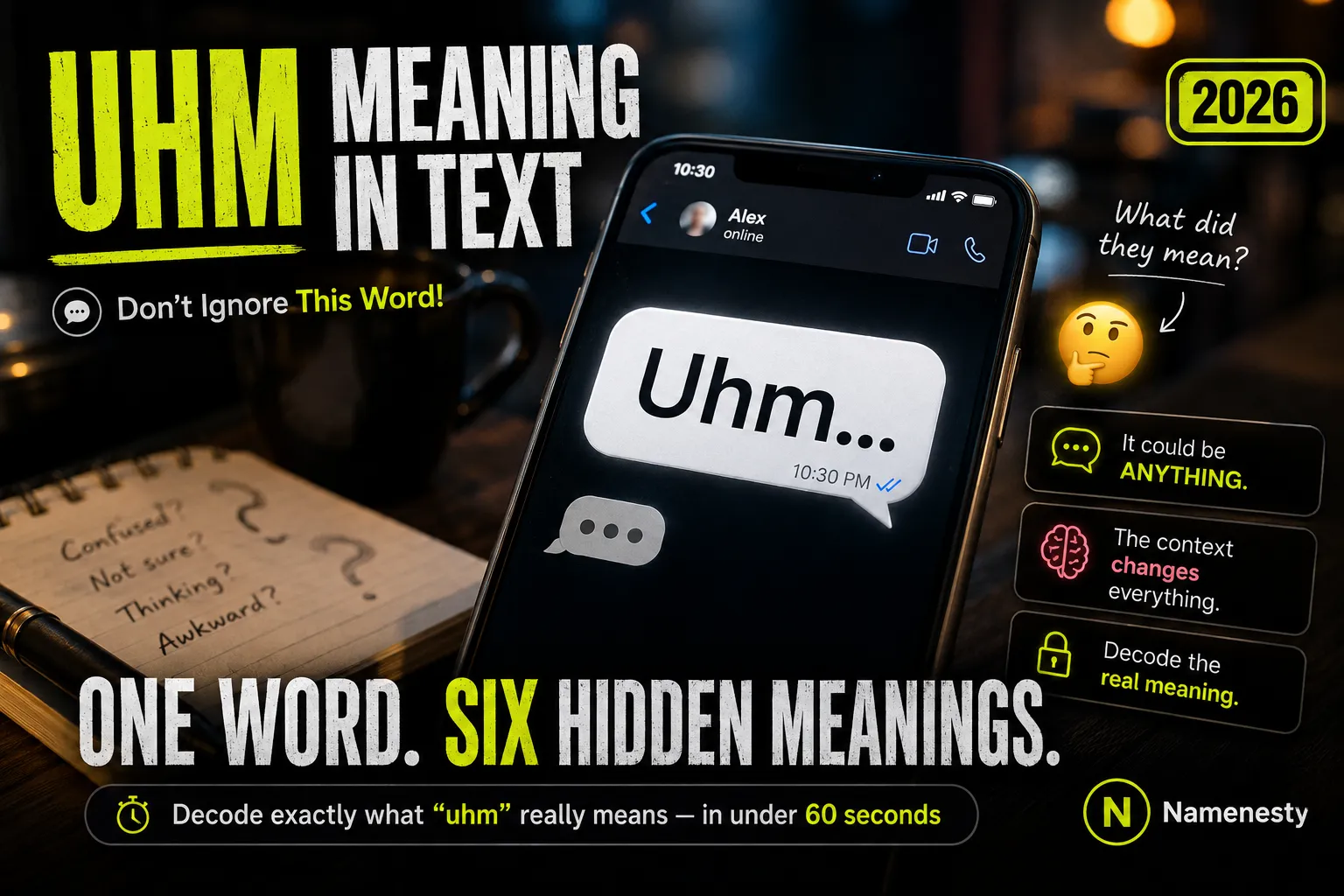
UHM meaning in text is the typed version of the spoken filler “um” — a hesitation sound used to signal thinking, discomfort, disbelief, or a pause before answering. It isn’t an acronym and doesn’t stand for anything on its own; it’s a written stand-in for a sound humans make constantly in real conversation, now carried over into digital messaging. Its exact meaning shifts depending on punctuation, platform, relationship context, and what comes right after it — which is exactly what this guide breaks down, piece by piece.
People search this phrase constantly because texting removes the one thing that would normally make “uhm” easy to interpret: your voice. In person, a pause tells you everything through tone, facial expression, and timing. In text, all of that gets compressed into three letters and whatever punctuation follows them. That’s the entire reason this small word causes so much overthinking — and why understanding it properly is genuinely useful, not just trivia.
1. What Does UHM Mean in Text?
UHM is a written filler word representing a vocal pause — the typed equivalent of “um.” It expresses hesitation, uncertainty, awkwardness, or a deliberate pause before a reaction. There’s no fixed dictionary definition beyond signaling a pause; the letters carry an emotion, not information.
Think of it as the text version of someone taking a breath before answering — sometimes because they’re genuinely thinking, and sometimes because what’s coming next needs a beat of buildup before it lands.
What makes UHM tricky to define in one sentence is that it doesn’t behave like a normal word. Normal words have fixed meanings you can look up. UHM behaves more as a tone of voice squeezed into text — which means the “definition” changes shape depending on who sent it, where they sent it, and what mood the rest of the conversation is in.
A few things UHM is not:
- It’s not an acronym or abbreviation standing for a phrase
- It’s not inherently negative or positive
- It’s not exclusive to any one age group, even though usage patterns differ generationally
- It’s not the same as leaving someone on read — UHM is an active response, just a hesitant one
Understanding UHM properly means treating it less like vocabulary and more like punctuation for emotion — a signal layered on top of whatever the rest of the message says.
2. Quick Meaning Summary
| Aspect | Detail |
| Full form | Not an acronym — a spelled-out vocal sound |
| Word type | Interjection/filler word |
| Core meaning | Hesitation, pause, or thinking |
| Common secondary meanings | Disbelief, awkwardness, soft rejection, nervous interest |
| Origin | Spoken English filler “um,” typed into internet chat in the late 1990s–2000s |
| Most common on | iMessage, Instagram, Snapchat, TikTok, Discord |
| Tone | Neutral by default — shaped entirely by punctuation and context |
| Formality | Casual; avoid in professional writing |
| Regional variants | “Erm” (British), “Ano” (Japanese), “Euh” (French) |
| Grammatical category | Interjection — doesn’t follow standard sentence structure rules |
This table alone answers most of what a quick reader needs, but the sections below unpack each row in far more detail, because the real value in understanding UHM comes from context, not a static definition.
3. Origin and History of UHM
“Um” and “uh” aren’t internet inventions — linguists call them filled pauses, and they’ve been part of documented spoken English since early psycholinguistic research in the mid-20th century. Long before anyone typed a text message, people said “uh,” “um,” and “erm” out loud constantly, almost without noticing they were doing it.
Early researchers assumed these sounds were essentially noise — an accidental byproduct of a speaker’s brain struggling to retrieve the next word mid-sentence. Under that view, filled pauses had no real meaning of their own; they were simply evidence that speech production had momentarily stalled.
That view has shifted substantially over the past two decades. A widely cited 2002 study by linguists Herbert Clark and Jean Fox Tree argued that “um” and “uh” behave enough like real words — with predictable timing patterns, structural placement, and interpretable meaning — that they function closer to interjections than to random noise. In other words, when someone says “um,” they’re not malfunctioning; they’re communicating something, even if that something
4. Why People Type “Uhm” Instead of “Um”
This is the part most explanations skip entirely, and it’s worth slowing down on, because it explains the whole appeal of the spelling choice.
- It slows the read down. Text has no tone of voice, so writers lean on spelling to do work a voice would normally handle. Adding a silent “h” stretches the word visually, the same way “sooo” reads slower than “so,” or “noooo” reads more dramatically than “no.” It’s a small typographic trick for pacing a message.
- It adds emotional weight. “Um” can look almost throwaway — a quick, automatic verbal tic barely worth noticing. “Uhm” looks considered. The extra letter suggests the person paused on purpose, rather than simply stumbling over their words.
- Autocorrect and muscle memory reinforce it. Once “uhm” became common enough across millions of messages, predictive keyboards started suggesting it after someone typed “uh,” which normalized the spelling further. It’s now common enough that most phone keyboards no longer flag it as a typo, which quietly cements it as an accepted written form.
- It reads as more expressive on screen. Early internet communities — chat rooms, forums, instant messengers — rewarded expressive spelling because that was the only stylistic tool available before emoji, GIFs, and voice notes existed. “Uhm” fit that pattern the same way “heyyy” or “lolll” did: stretching a word to carry more feeling than the base spelling could.
- It signals self-awareness. Somewhat counterintuitively, typing the longer “uhm” can actually make someone sound more composed, not less — as if they noticed their own hesitation and decided to represent it deliberately, rather than letting a stray “um” slip out unedited.
None of this makes “uhm” more “correct” than “um.” They’re functionally the same filler word at their core — the spelling choice is purely about how much emotional emphasis the sender wants to signal, and how much weight they want that pause to carry in the reader’s mind.
5. UHM vs UM vs UH vs ERM vs HMM
These fillers get lumped together constantly in casual conversation, but they don’t carry identical weight, and mixing them up changes how a message lands.
| Term | Typical Feel | Best Used For |
| Um | Light, quick, almost automatic | Casual thinking pause, low emotional weight |
| Uhm | Slower, heavier, more deliberate | Hesitation with a feeling attached — awkwardness, disbelief, held-back reaction |
| Uh | Sudden, blunt | Surprise, an abrupt pause, sometimes discomfort |
| Erm | Softer, more British in tone | Polite hesitation, gentle uncertainty |
| Hmm | Curious, contemplative | Genuine thinking, weighing an idea — rarely negative |
A useful way to remember the difference: Hmm sounds like a question mark. Uhm often sounds like a raised eyebrow. “Um” is closer to a shrug — quick, low-stakes, barely registered. “Uh” is closer to a flinch — sudden and reactive. Each one occupies a slightly different emotional lane, even though they all technically do the same basic job of filling a pause.
Regional and cultural variants exist too. British texters lean toward “erm” more often than “uhm.” Some online communities have even developed their own stylized versions — “uhmmm,” “uhhh,” or stretched variations — that intensify the base meaning further without changing what family of filler they belong to.
6. The 6 Real Meanings of UHM in Text
UHM stretches across more emotional registers than most people realize, and confusion usually comes from assuming it only ever means one of these.
- Genuine hesitation — The sender is honestly thinking or unsure what to say next. No hidden agenda, no subtext. This is the most common use in one-on-one, low-stakes conversations.
- Disbelief or shade — Sent deliberately and slowly to signal “I can’t believe you just said that” without spelling the reaction out directly. This version often appears alone, with no other words attached.
- Awkward discomfort — A social cushion for a moment that feels uncomfortable, embarrassing, or off. It softens the blow of acknowledging something slightly cringeworthy happened.
- Buying time — A placeholder sent before a fuller answer is ready, common in group chats, or when someone is mid-conversation elsewhere and needs a beat before responding properly.
- Soft disagreement or rejection — A gentler alternative to a flat “no,” used to push back on a request or suggestion without sounding confrontational.
- Nervous or flirty hesitation — Extremely common in dating conversations, where the pause signals interest mixed with uncertainty rather than a clean, confident answer.
Most confusion around UHM comes from readers defaulting to meaning #1 every time. In real usage, #2, #3, and #6 show up just as often — sometimes more, depending on who’s texting and what the relationship looks like. Learning to distinguish between these six requires looking past the word itself and paying attention to everything surrounding it.
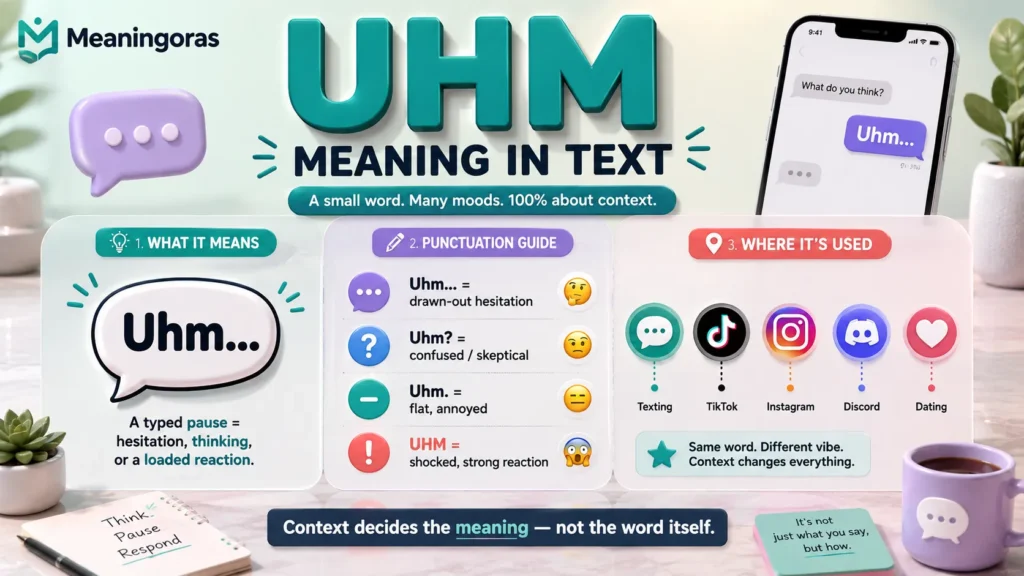
7. How Punctuation Changes What UHM Means
This is the single most overlooked layer of meaning in the entire topic, and it’s often more telling than the word itself.
| Format | Likely Meaning |
| Uhm (no punctuation) | Neutral pause, low intensity |
| Uhm… | Drawn-out hesitation, something more is coming |
| Uhm? | Confused or skeptical, mildly questioning what was said |
| Uhm. | Flat, closed-off, often a sign of irritation or disapproval |
| UHM (all caps) | High emotional charge — shock, disbelief, or strong reaction |
| Uhmm / Uhmmm | Exaggerated version, often used for comedic or dramatic effect |
A single “Uhm.” with a hard period can land far more coldly than “Uhm…” with a trailing ellipsis, even though the base word is completely identical in both cases. The punctuation — not the letters — is doing most of the emotional signaling here.
Capitalization matters just as much as punctuation marks. Lowercase “uhm” tends to feel casual and low-stakes. Fully capitalized “UHM” reads as shouted or emphasized, almost always signaling something closer to shock or pointed disbelief rather than gentle hesitation.
Combining these two layers gives an even clearer read. Learning to notice these combinations is the fastest way to stop misreading a text.
8. UHM Meaning in Text on Social Media
UHM doesn’t behave identically everywhere — context and audience shift the meaning platform by platform.
- TikTok — Mostly performative disbelief, written specifically for an audience reading the comment section, not just the original poster. Often exaggerated: “uhmmm sir.”
- Instagram — Common in DMs and comments to express irony or mild judgment, frequently paired with an emoji to soften or sharpen the tone further.
- Snapchat — Playful, nervous energy, often paired with filters or follow-up emojis in casual back-and-forth between friends or crushes.
- Facebook — Less common overall; when it does appear, it tends to read as a more literal, older-generation pause rather than a stylized reaction.
- Reddit — Frequently used as a skepticism signal in thread replies and debates, calling something into question without writing a full rebuttal.
- Discord — Common mid-game or mid-conversation as a genuine thinking or stalling marker, especially in fast-moving group chats.
- X (Twitter) — Used in replies and quote-posts as a clapback or disbelief marker, often standing entirely on its own for maximum effect.
The general pattern across all of these: the more public the platform, the more likely UHM is performance rather than genuine hesitation. A TikTok comment “uhm” is written to be seen by everyone reading the thread, not just the person being replied to — while an iMessage “uhm” between two people is far more likely to reflect an actual, private pause in thought.
9. What Does UHM Mean From a Guy or a Girl?
This is one of the most common reasons people search this exact phrase, and the honest answer is: UHM in a dating or flirting context rarely means a clean yes or no.
From a guy: Often signals he’s thinking through how to respond, especially to a direct or slightly loaded question. It can read as nervous interest — “Uhm, yeah I’d be down for that 😅” — or as gentle hesitation about committing to plans he isn’t fully sure about yet.
From a girl: Frequently used the same way — a soft pause before an honest answer, or a way to react to something surprising without fully committing to a tone right away. “Uhm, I don’t know…” usually reflects genuine uncertainty rather than rejection.
The reliable signal isn’t gender at all — it’s what follows the UHM. A warm, engaged reply after “uhm” usually means nervous interest rather than disinterest. A short, flat answer or an abrupt topic change usually means hesitation about the situation itself, not necessarily about the person asking. Don’t read the three letters in isolation; read the sentence that comes right after them, because that’s where the actual answer lives.
It’s also worth remembering that texting style is deeply individual. Some people say “uhm” constantly regardless of who they’re talking to — it’s simply part of how they type, not a special reaction reserved for someone they’re interested in. Context across the whole conversation, not a single message, gives the most reliable read.
10. Is UHM Rude, Flirty, or Just a Habit?
Neither by default. UHM functions like a blank canvas — the surrounding tone paints the actual picture.
- Friendly/habitual: Lowercase, no punctuation, sent in casual back-and-forth conversation. Usually just a texting tic with no deeper meaning attached.
- Flirty: Paired with emojis, sent in a dating or crush context, followed by a warm continuation rather than a cold stop.
- Rude/dismissive: Capitalized, ending in a period, sent as a standalone reply with no follow-up message afterward.
- Skeptical: Ends in a question mark, or is followed shortly after by a clarifying question about what was just said.
If you’re unsure which category a specific “uhm” falls into, check three things: capitalization, punctuation, and what came right before it in the conversation. Those three factors settle the tone far more reliably than the bare word itself ever could.
11. Real Conversation Examples Using UHM
1. Genuine thinking pause
A: “Pizza or sushi tonight?” B: “Uhm, honestly not sure yet.” A: “No rush, let me know in a bit.”
Reading: Sincere hesitation. Give them space instead of pushing for a fast answer.
2. Disbelief in a friend group chat
A: “He asked to split the bill after inviting me out.” B: “Uhm.” A: “Right?? I couldn’t even respond.”
Reading: One word doing the work of a full paragraph. Validate the reaction — that’s what B is fishing for.
3. Awkward family announcement
A: “I’m moving across the country next month.” B: “Uhm, okay… have you thought that through?” A: “Yeah, been planning it for a year.”
Reading: Concern, not confrontation. Explain calmly rather than getting defensive.
4. Nervous flirting
A: “Want to grab coffee sometime?” B: “Uhm, yeah! I’d like that 😅”
Reading: Nervous excitement, not hesitation about the person — the exclamation point and emoji do the reassuring.
5. Soft rejection
A: “Can you cover my shift Saturday?” B: “Uhm… I already have plans, sorry.”
Reading: A gentler no. The pause softens the refusal before it lands.
6. Workplace overstep
Manager: “Can you take on this extra project by Friday?” Employee: “Uhm, I’ll need to check my current workload first.”
Reading: A polite stall, buying time before committing — generally read as professional caution, not defiance.
12. Should You Use UHM at Work?
Sparingly, if at all. In professional messaging — email, Slack, work chats — “uhm” can read as unprepared or unsure of yourself, even when that’s not the intent behind it. Written communication doesn’t get the benefit of tone of voice, so a filler that sounds completely natural spoken out loud can look uncertain or unpolished on a screen.
Better alternatives for professional contexts:
- “Let me think that through and get back to you.”
- “I’d like to review this before confirming.”
- “Give me a moment to check on that.”
- “I want to make sure I answer that accurately — one sec.”
These phrases carry the same underlying function as “uhm” — buying time, signaling thoughtfulness before responding — without the casual undertone that can undercut professional credibility in writing.
Explore More: https://dogizle.com/igu-meaning-in-text/
13. Why Some Texters Use UHM More Than Others
Filler word usage isn’t random — it tracks with real patterns researchers have studied for years. Corpus research on American English speech has found filler word choice varies by age and gender, with “um” specifically trending upward among younger speakers and women relative to “uh.” That research was based on spoken conversation, but the same demographic lean shows up clearly in how people text today.
Beyond age and gender, individual habits matter too. People who text quickly and think while typing tend to lean on fillers like “uhm” more often — it’s a natural pause marker for a fast-moving thought process, similar to how the same pause shows up constantly in unscripted speech. It’s a normal communication pattern, not something that signals anything is wrong with how someone communicates.
Personality also plays a role. Some texters are naturally more expressive and lean into fillers, emojis, and stretched spellings as a default style. Others write tightly and rarely use fillers at all, regardless of how they actually feel in the moment. Neither approach is more honest than the other — they’re simply different texting personalities, and reading someone’s “uhm” usage against their general baseline style is often more accurate than reading it in isolation.
Relationship familiarity shifts frequency too. People tend to use more filler words, including “uhm,” with people they’re comfortable around, since there’s less pressure to sound polished. A curt, filler-free texting style with someone new can sometimes soften into a much more relaxed, “uhm”-heavy style once the relationship becomes more familiar.
14. How to Reply When Someone Says UHM
Match your response to the tone, not the bare word itself.
If it feels like genuine hesitation:
- “Take your time.”
- “No rush at all.”
- “What’s on your mind?”
“Okay, say what you’re thinking.”
Let it sit and see what they send next — sometimes the follow-up message explains everything on its own.
If it feels like soft rejection: Don’t push. Acknowledge it and move on: “All good, no worries.”
Lean into the warmth rather than overanalyzing it. A playful reply usually keeps the moment going better than a serious one would.
- A simple, low-pressure check-in works in almost every situation: “You good?” This gives the other person an easy opening to clarify without forcing them into an explanation they might not be ready to give yet.
15. Common Mistakes People Make With UHM
- Assuming it always means uncertainty. It’s just as often disbelief, discomfort, or a soft “no.”
- Using it in formal emails. It reads as unpolished in professional writing, even when the intent behind it is thoughtful.
- Overreacting to a single “uhm.” One instance is rarely a major signal — repeated hesitant “uhm” replies over time are far more telling than one isolated message.
- Ignoring punctuation. “Uhm.” and “Uhm…” are not the same message, even though they look nearly identical at a glance.
- Treating UHM as flirting when it’s context-neutral. Not every “uhm” in a conversation with someone you like is romantic — sometimes it’s simply how that person texts everyone.
- Forgetting to check the follow-up message. The word right after “uhm” almost always carries more useful information than the filler itself.
People Also Ask
It’s the typed version of the spoken filler “Um,” used to show hesitation, a pause in thought, disbelief, or mild discomfort depending on context.
Close, but not identical. “Um” reads lighter and quicker; “uhm” carries more emotional weight and reads as slower or more deliberate.
Not by default. It becomes rude-sounding mainly when it’s capitalized, ends in a period, and comes with no follow-up explanation.
Neither directly — it usually signals hesitation before an answer, not the answer itself. Check what comes after it.
The extra “h” visually slows the read and adds emotional emphasis, making the pause feel more deliberate than a plain “um.”
It’s better avoided in formal writing. Swap it for a phrase like “let me review that and get back to you.”
It’s more accurately a written filler word or interjection than slang — it doesn’t stand for anything and has no fixed dictionary definition beyond expressing a pause.
Conclusion
UHM isn’t a word with a single Definition — it’s a written stand-in for a very human sound, and its meaning shifts entirely based on tone, punctuation, platform, and what comes right after it. It can mean genuine thinking, quiet disbelief, an awkward cushion, a soft no, or nervous interest, and the only reliable way to tell those apart is by reading the whole message, not just the three letters on their own.
Read those signals together — capitalization, punctuation, platform, relationship, and the words that follow — and UHM stops being confusing and starts telling you exactly what the other person isn’t quite saying yet.