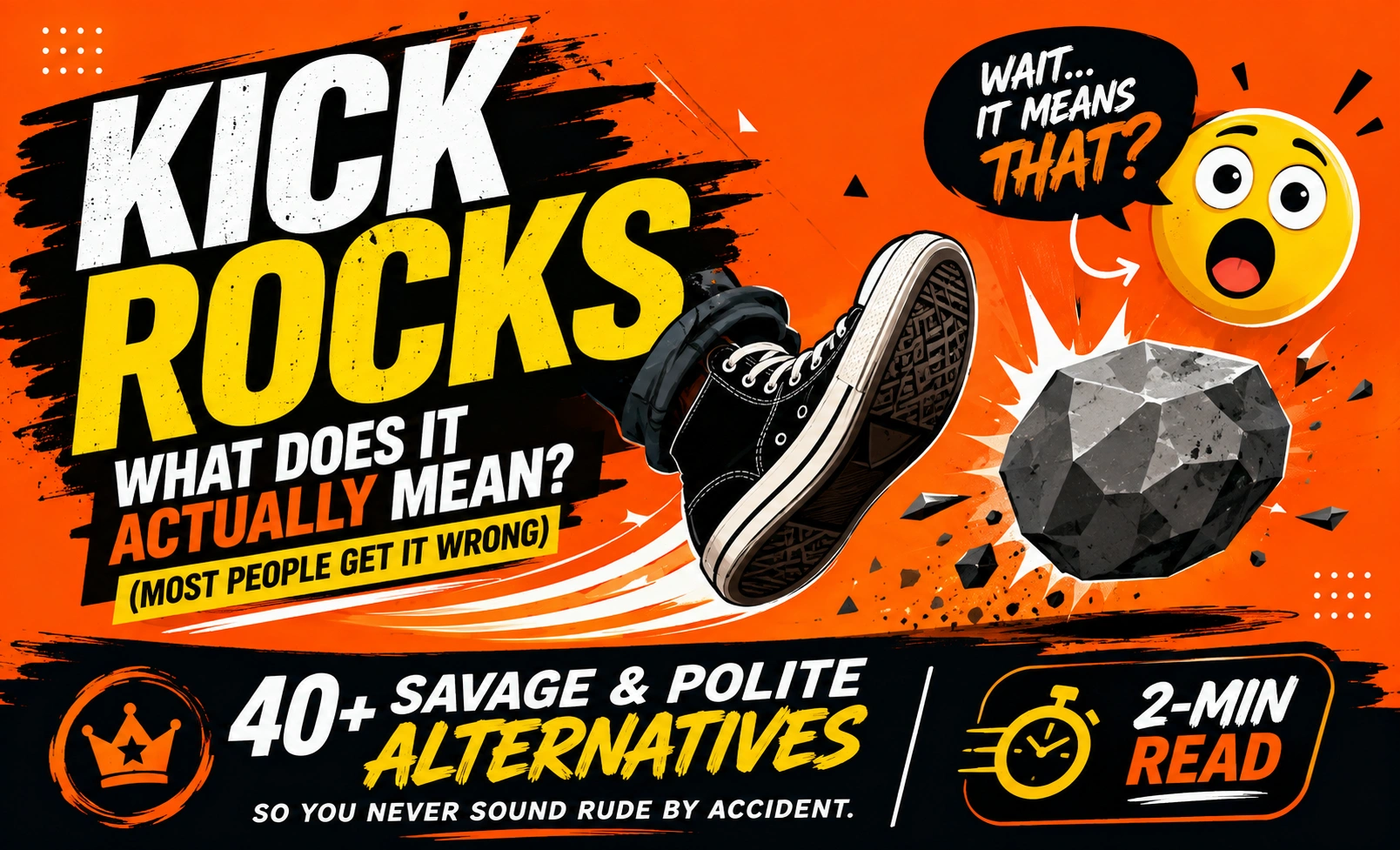
Kick Rocks Meaning: Origin, Usage, Tone & 40+ Alternatives
“Kick Rocks” Means “Go Away,” “get lost,” or “leave me alone.” It’s an informal, non-vulgar way to dismiss someone annoying, pushy, or overstaying their welcome. Whether it lands as a joke or an insult depends entirely on tone — and that’s exactly what this guide breaks down, section by section, along with 40+ alternatives you can use instead.
1. What Does “Kick Rocks” Mean?
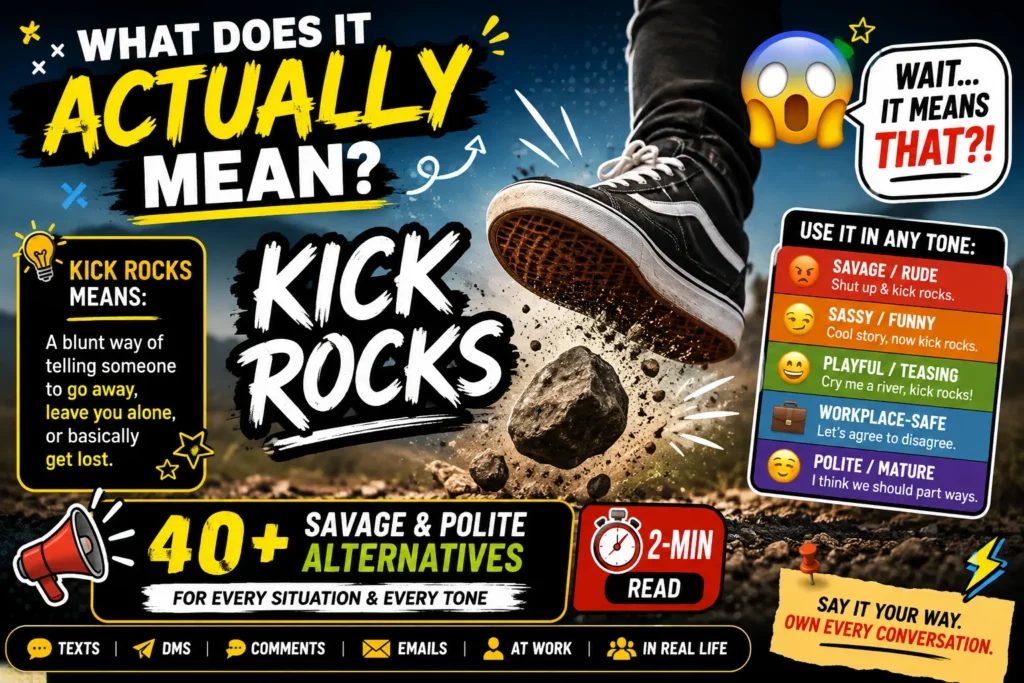
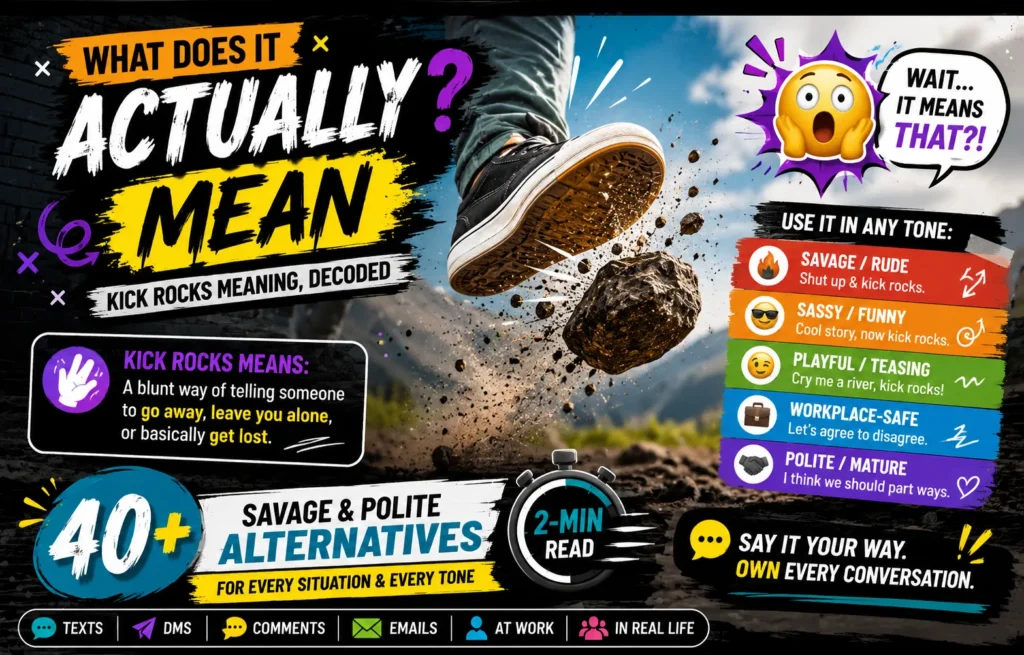
“Kick rocks” is an American English idiom used to dismiss someone — telling them to go away, stop talking, or leave you alone. It’s imperative in form (“go kick rocks!”) and almost always spoken in irritation, sarcasm, or firm boundary-setting.
The imagery does the heavy lifting: picture someone shuffling off alone, kicking loose gravel out of boredom or frustration. That’s the “activity” you’re sentencing the other person to — something pointless, solitary, and far away from you.
It’s grammatically flexible too — used as a direct command (“Kick rocks.”), a third-person dismissal (“He can kick rocks.”), or a reflexive statement (“I’m about to kick rocks” = “I’m leaving”).
2. Quick Meaning Summary
| Context | What it really means |
| Said to an annoying acquaintance | “Stop bothering me.” |
| Said to an ex | “We’re done. Don’t contact me.” |
| Said sarcastically to a friend | “You’re being ridiculous — I’m not engaging.” |
| Said in response to a request | “No, and don’t ask again.” |
| Said online/in gaming | “Get out of here / uninstall.” |
3. Where Did “Kick Rocks” Come From?
Most articles on this phrase confidently assign it a single origin — prison labor, military drills, quarry work, 1940s slang. The truth is more honest: there is no verified, documented first use of “kick rocks,” and no etymological dictionary has traced it to one clean source. Treat any article that states an exact decade or origin story as fact with skepticism.
What can be said with confidence:
- The image is the etymology. Kicking rocks as an idle, purposeless, mildly frustrated activity long predates the idiom — it’s a universal gesture of boredom or annoyance that almost anyone can picture instantly.
- It belongs to a documented family of American dismissal idioms — “pound sand,” “take a hike,” “hit the road,” “go fly a kite” — that all send someone off to do something trivial, physical, and solitary instead of engaging with them.
- Dictionary attestation is recent relative to spoken use. Slang dictionaries show clear, dated usage from the early 2000s onward, but that reflects when it was documented online, not when it was coined.
- It’s genre-agnostic. It shows up across military, prison, sports, and street contexts without a clear point of origin in any single one — suggesting parallel, independent coinage rather than one lineage that spread.
Bottom line: “kick rocks” is a 20th-century American dismissal idiom, popularized through spoken slang and cemented by 2000s–2010s internet culture, hip-hop lyrics, and meme circulation. Anyone claiming one precise origin story is speculating.
4. How Tone Changes the Meaning
Playful / teasing (friends, low stakes)
“You actually paid full price for that? Kick rocks.”
Firm but not hostile (setting a boundary)
“I can’t take on your project too. Kick rocks, respectfully.”
Cold/hostile (real anger)
“Don’t call me again. Kick rocks.”
Sarcastic dismissal (rejecting an idea, not a person)
“You want me to redo the whole report by 5 pm? Kick rocks.”
Text and DMs are risky — stripped of tone of voice, “kick rocks” can land far harsher (or softer) than intended. When in doubt, add a modifier (“lol kick rocks”) to signal intent.
5. Is “Kick Rocks” Rude or Playful?
It’s not profane, but it is dismissive by design — so “rude” depends entirely on relationship and setting. Between close friends,s it usually reads as banter. Toward a stranger, coworker, or in a serious conversation, the same words read as a real insult.
Rule of thumb: if you wouldn’t say “get lost” out loud in that setting, don’t say “kick rocks” either — it carries the same weight, just with better PR.
6. When to Use “Kick Rocks” (and When to Avoid It)
Generally fine:
- Between close friends as banter
- Responding to an obvious troll online
- Firmly declining an unwanted romantic advance
- Light sibling or roommate teasing
Risky or inappropriate:
- Workplace communication (Slack, email, meetings)
- With someone you don’t know well
- During a serious, emotionally charged conversation
- With older relatives or in formal/academic settings
7. “Kick Rocks” in a Sentence
- “If you don’t like the rules, you can kick rocks.”
- “She told her ex to kick rocks after he texted her at 2 a.mm.”
- “I already said no. Kick rocks.”
- “He lost the bet, so now he can kick rocks and stop complaining.”
- “Not interested — kick rocks, kindly.”
- “The coach told the heckler to kick rocks or leave the gym.”
- “You want a refund AND a free replacement? Kick rocks.”
- “I’m kicking rocks — see you guys later.” (self-referential: “I’m leaving”)
- “Tell your friend to kick rocks if he keeps borrowing money and not paying it back.”
- “Kick rocks, we’re done here.”
8. “Kick Rocks” in Music, TV, and Sports
- Hip-hop and R&B lyrics — circulated as a dismissive line in mainstream tracks since the 2000s, used to end a verse aimed at a rival or ex.
- Sports trash talk — a common line in pickup basketball and street football, shouted at someone loitering on the court or refusing to leave after losing.
- Reality TV and daytime talk — a recurring confrontation-segment line, valued because it’s dismissive without needing to be censored.
- Gaming and streaming chat — a common comment-section and voice-chat dismissal aimed at trolls or toxic teammates.
9. The “Kick Rocks” Meme
The phrase has picked up a visual life online — most notably as a cartoon showing a skeleton or stylized character mid-stride, literally kicking a rock, often paired with bold rainbow or neon lettering of the phrase. It circulates as a reaction image for dismissing bad takes or annoying comments in a way that’s funny rather than confrontational.
10. Regional and Generational Differences
- Younger speakers (Gen Z, younger Millennials) tend to use it lightly, closer to internet slang like “touch grass” than a real insult.
- Older speakers are more likely to read it as a genuine, disrespectful dismissal.
- In text/DM form, it reads harsher than spoken aloud, since tone markers are stripped away.
- Across US regions, it’s broadly understood coast to coast, though “pound sand” and “hit the bricks” are more common regional substitutes in some areas.
11. “Kick Rocks” on Social Media
- TikTok / Instagram Reels — used in captions and comment replies to shut down criticism or trolling, often paired with the skeleton meme graphic.
- X (Twitter) — a quick-fire reply to a bad take or unsolicited opinion, usually standalone with no further explanation.
- Reddit — appears in comment threads as a blunt dismissal of a weak argument, frequently upvoted for being short and final.
- Discord — common in gaming servers directed at rule-breakers, spammers, or toxic players before a mute or kick.
- Facebook — skews toward the older-user reading, more likely to be interpreted as genuinely rude than playful.
- Snapchat — used casually between friends, almost always in the playful register rather than the hostile one.
12. 40+ Alternatives to “Kick Rocks”
Playful, friend-to-friend: Take a hike, Go fly a kite, Bounce, Vamoose, Skedaddle,ddle Be, at i,t Shoo, Go touch grass
Cold / relationship-ending: Lose my number We’re done here Don’t contact me again I want nothing more to do with this
Sarcastic: Cry about it. Not my Problem. C. Cool story. Anyway…
Classic slang synonyms: Get lost, Scram ,Hit the road, Buzz off,f Pound sand, nd Take a walk, Walk,lk Move along, Get out of here, Out thereee,e Hit the bricks
Gen Z / internet-native: Touch grass Log off Ratio Be so fr and leave Girl, bye It’s giving “leave”
| Alternative | Tone | Safe for work? |
| Take a hike | Playful | No |
| Lose my number | Cold | No |
| Touch grass | Sarcastic/internet | No |
| Pound sand | Classic slang | No |
| Get lost | Direct | No |
| Beat it | Playful | No |
13. Polite Alternatives for Work and Formal Settings
I’m going to have to decline.ne That’s not something I can take on right now. Let’s revisit this another time. I need you to give me some space. Here, I’m not able to help with that right now. Let’s circle back later.I need to step away from this conversation.ersation That’s outside what I can take on today
14. How to Respond If Someone Tells You to Kick Rocks
- If it’s playful: laugh it off or fire back with your own dismissal — it’s banter, not a real fight.
- If it’s hostile: don’t escalate. A flat “okay” or simply disengaging removes the power of the insult.
- If it’s from someone you need an ongoing relationship with (coworker, family member): address the underlying issue calmly rather than reacting to the phrase itself.
15. Common Misunderstandings About “Kick Rocks”
- “It has one confirmed origin.” It doesn’t — no dictionary has traced a single, verified first use.
- “It’s always rude.” It isn’t — among friends it’s frequently a joke, not an insult.
- “It’s Gen Z slang.” It predates Gen Z by decades; younger speakers just kept it alive alongside newer terms.
- “It’s a curse word or profanity.” It’s not — that’s exactly why it’s used as a “safe” way to be blunt without swearing.
- “It only means anger.” It can just as easily signal sarcasm, teasing, or self-deprecating humor (“I’m out, kicking rocks”).
Peopalsos o ask
It means “go away,” “get lost,” or “Leave Me Aone.” It’s a dismissive but non-vulgar idiom.
It depends on tone and relationship. Among friends, it’s often playful; toward strangers, coworkers, or in serious conversations, it usually reads as disrespectful.
There’s no single, verified origin. It’s a 20th-century American slang idiom from the same family as “pound sand” and “take a hike.” Claims of one exact origin (prison, military, quarry work) are unproven theories, not documented fact.
It signals a firm, often final boundary — “I’m done with you, don’t contact me again.”
Q5 What’s a polite way to say “kick rocks”?
“I need some space right now,” “Let’s revisit this later,” or “I’m not able to help with that” all carry the same dismissive function without the edge.:
Q6 Is “kick rocks” the same as “pound sand”?
Nearly identical in meaning and register — both are non-vulgar dismissals from the same slang family. “Pound sand” skews slightly more old-fashioned.
Conclusion
“Kick Rocks” is a simple, non-vulgar way of saying go away — but its impact swings entirely on tone, setting, and relationship. There’s no single verified origin story despite what many articles claim, and it stretches from playful teasing to a hard, final boundary depending on how and where it’s said. Whether you’re using it, being told it, or just want to know what it means, the safest approach is matching the phrase — or one of the 40+ alternatives above — to the moment it deserves.