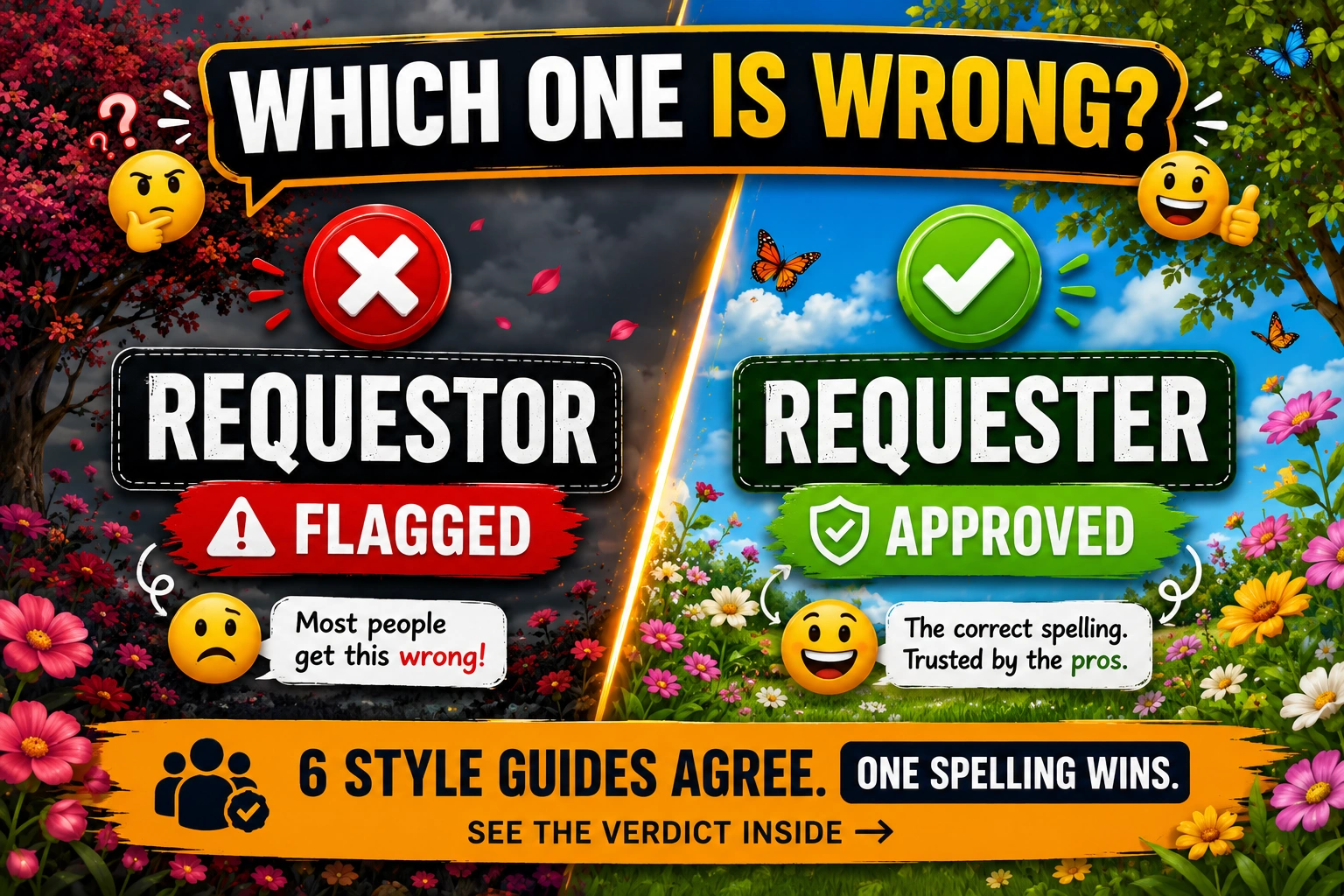
Requester vs. Requestor: Which One Is Actually Correct?
“Requester” and “requestor” look like a typo WaitingTo Happen — and most articles online just tell you “requester is more common” and stop there. That’s not enough if you need to defend your word choice in a contract, a style guide, or a code review.
Here’s the direct answer, backed by actual dictionaries, style guides, and real systems that use each spelling — not invented example sentences.
What Does “Requester vs. Requestor” Mean?
“Requester” and “requestor” are two accepted spellings of the same word — a person or system that makes a request. There is zero difference in definition. The only variable is which agent-noun suffix is attached to the verb “request”:
- Requester — uses “-er,” the native English suffix (as in teacher, builder).
- Requestor — uses “-or,” the Latin-derived suffix (as in editor, auditor, contractor).
Requester is the standard, dictionary-preferred spelling. Requestor is a legitimate but less common variant, typically found in legal, government, and technical/IT documentation.
Quick Meaning Summary
| Feature | Requester | Requestor |
| Meaning | Person/system that makes a request | Person/system that makes a request |
| Frequency | Far more common | Less common |
| Typical context | General writing, business, journalism, dictionaries | Legal contracts, some government forms, older IT/procurement systems |
| Dictionary status | Primary headword (Merriam-Webster, Oxford) | Recognized variant |
| Suffix origin | Germanic “-er” | Latin “-or” |
| Recommended default | ✅ Yes | Only when matching an existing document/system |
Origin and History of Requester and Requestor
“Request” entered English in the 14th century from Old French requeste, itself rooted in Latin requirere/requisitum — “to seek again” or “to ask for.” English then needed an agent noun for “the person who requests,” and it had two competing tools for the job: the native “-er” suffix and the borrowed Latin “-or” suffix. Both got applied to “request” independently over time — they aren’t from two different root words, despite what several competing articles claim by citing inconsistent Latin origins (you’ll see requaesita, requaerere, and requestus all offered as “the” source, usually with no citation).
Corpus tools like Google Ngram Viewer, which track word frequency across millions of published books, consistently show “requester” as the dominant spelling across the last century, with “requestor” rising alongside the growth of 20th-century legal and technical writing but never overtaking it. Treat any precise ratio you see quoted online (e.g., “10:1”) with caution — exact figures shift by corpus and methodology — but the direction of the trend is consistent everywhere it’s measured.

What the Dictionaries and Style Guides Say
| Source | Preferred Spelling | Notes |
| Merriam-Webster | Requester | Lists “requester” as the headword |
| Oxford English Dictionary | Requester | Recognizes both; “-er” is primary |
| Collins English Dictionary | Both listed | “Requestor” flagged as a specialized/legal variant |
| AP Stylebook | Requester | Follows standard dictionary spelling |
| Chicago Manual of Style | Requester | No listed exception for “requestor” |
| Microsoft Writing Style Guide | Requester | Used across Microsoft’s UX and developer documentation |
Takeaway: every major general-purpose authority defaults to “requester.” “Requestor” isn’t incorrect — it’s a recognized variant — but no major style guide recommends it as the first choice.
Requester vs. Requestor: Key Differences at a Glance
Strip away the dictionaries and corpora, and the practical differences come down to three things:
- Formality. “Requester” reads as everyday, general-purpose English. “Requestor” reads as formal, legal, or bureaucratic.
- Industry habit, not a grammar rule. Neither spelling is “more correct” grammatically — the split is about which fields adopted which suffix, not about which one follows the rules better.
- System lock-in. In software and legal templates, whichever spelling was chosen first tends to stay, since changing a field name, API parameter, or contract clause later creates inconsistency and rework.
In short: reach for “requester” by default, and only switch to “requestor” when you’re matching something that already exists.
How Is “Requester” vs. “Requestor” Actually Used?
Instead of made-up sentences, here’s how each spelling shows up in real, citable systems — this is the part most competing articles skip entirely.
Requester in Government and Legal Contexts (FOIA)
The Freedom of Information Act, the U.S. law governing public records requests, consistently uses “requester” as its formal term. Federal FOIA reference guides describe “FOIA requesters” appealing denials, and the FBI’s own FOIA program is literally named the “FOIA Requester Service Center.” When a term is this consistent across federal guidance, it’s a reliable default for legal, compliance, or government-facing writing.
Requester in Cloud and IT Systems (AWS “Requester Pays”)
Amazon Web Services uses “Requester” throughout its S3 documentation. The feature is literally named “Requester Pays” — a bucket setting where the person downloading data, not the bucket owner, covers the transfer cost, and it uses API/CLI parameters like x-amz-request-payer: requester. If you write developer docs or cloud cost-management content, this is the spelling your audience already expects.
Where “Requestor” Still Survives
“Requestor” survives in legal contracts and access-control clauses (alongside other Latin-suffix pairs like grantor/lessor), in some state or municipal public-records forms that don’t follow the federal FOIA convention, and in older IT service management or procurement systems where the field name was locked in years ago and changing it would break existing forms and integrations. This is an operational habit, not a grammar rule.
Examples of Requester vs. Requestor in Context
- Government/legal: “The requester submitted a formal FOIA request to the agency’s FOIA office.” (federal convention)
- Cloud/technical: “Enable Requester Pays so the requester, not the bucket owner, covers the download cost.” (AWS convention)
- Contract/legal drafting: “The requestor shall provide written authorization before access is granted.” (traditional legal drafting style)
- General business writing: “Each requester will receive a confirmation email once their ticket is submitted.” (everyday default)
Requester, Requestor, and Requestee: The Related Terms
If you work with formal or legal writing, you may also encounter a third related term:
- Requester / Requestor — the person making the request.
- Requestee — the person or system the request is directed at, following the same actor/recipient pattern as employer/employee, payer/payee, and mortgagor/mortgagee. It’s rare, but it shows up in access-control policies and legal drafting where both sides of a request need distinct labels.
Other Latin “-or” agent nouns that follow the same pattern as “requestor” include auditor, contractor, executor, and grantor — which is part of why “requestor” still feels natural in legal contexts even though “requester” wins in general usage.
Explore More:https://wordvice.ai/grammar/requester-vs-requestor
Common Misunderstandings About Requester and Requestor
- “They mean different things.” They don’t. The meaning is identical; only the spelling and typical context differ.
- “Requester is American English, requestor is British English.” Also false — both Merriam-Webster (US) and Oxford (UK) list “requester” as the primary spelling. The split is by formality and industry, not by country.
- “Requestor is always wrong.” It isn’t wrong — it’s just the less common, more specialized variant.
- “You can mix both spellings in one document.” Technically not “incorrect,” but it looks like an error to readers and should be avoided — pick one and stay consistent.

Which One Should You Use? Decision Guide
- Does an existing contract, style guide, or system already use one spelling? Match it.
- Writing general business, marketing, or journalistic content? Use requester.
- Drafting a legal document in a jurisdiction/firm that already uses “requestor”? Use requestor to match convention.
- Documenting a cloud/API product? Check the platform’s own docs first (e.g., AWS uses “requester”).
- Still unsure? Default to requester — it’s understood everywhere and never flagged as wrong.
People Also Ask
Yes. It’s a dictionary-recognized variant spelling of “Requester,” Not A Typo — just far less common.
Use “requester” unless your employer’s internal systems or house style guide specifically call for “requestor.”
AP Style follows standard dictionary spelling, which favors “requester.”
Legal drafting has a long tradition of Latin-derived “-or” agent nouns like grantor and lessor, and “requestor” fits that pattern. It’s a stylistic tradition, not a rule that “requestor” is more legally precise.:
No. Both Merriam-Webster and Oxford list “requester” as the primary spelling in their respective dialects. The difference is formality/industry, not region.:
The requester (or requestor) makes the request; the requestee is the person or system the request is directed at. “Requestee” is rare and appears mostly in legal and access-control writing.
Conclusion
“Requester” and “requestor” are the same word wearing two different suffixes — no difference in meaning, only a difference in formality and tradition. Every major dictionary and style guide (Merriam-Webster, Oxford, AP, Chicago, Microsoft) defaults to requester, and major real-world systems like AWS and the U.S. federal FOIA process use it too. Reach for Requestor only when you’re matching an existing legal, government, or system-specific convention. When in doubt, requester is always the safe choice — use it, stay consistent, and move on.
Usage conventions can vary by company style guide, legal jurisdiction, or specific software platform — when a governing document or system already uses one spelling, match it over any general recommendation here.