Impatient vs Inpatient: Meaning, Difference & Uses (2026)
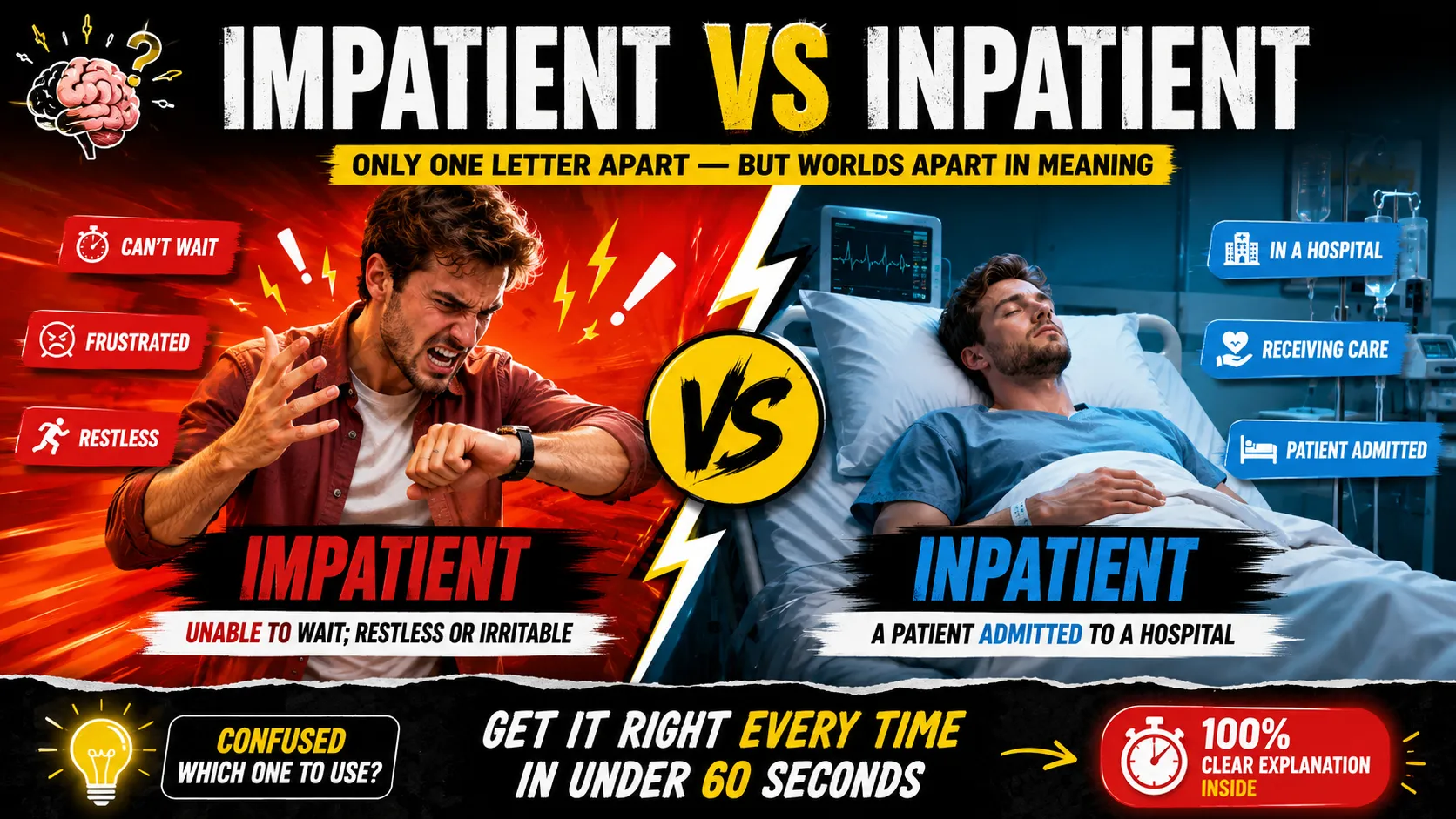
Quick answer: Impatient is an adjective meaning restless or unable to wait calmly. Inpatient is a noun/adjective referring to a patient admitted to a hospital overnight or longer. One is an emotion, the other is a medical status.
You’ve paused mid-sentence wondering which spelling you actually need — and you’re not alone. These two words are one letter apart, sound nearly identical, and both pass spellcheck. This guide settles it for good.
1. What Does “Impatient” Mean?
Impatient describes someone who cannot wait calmly, tolerates delay poorly, or becomes irritated when things move too slowly. It’s always an emotion or behavior — never a medical term.
- The customers grew impatient after waiting 40 minutes.
- He’s impatient with slow internet connections.
- The impatient driver kept honking at the car ahead.
2. What Does “Inpatient” Mean?
Inpatient refers to a patient formally admitted to a hospital who stays at least one night for treatment or observation. It also works as an adjective (“inpatient care,” “inpatient unit”).
- She was an inpatient at the medical center for four days after surgery.
- The hospital admitted 30 new inpatients this week.
- His plan covers inpatient care but requires pre-authorization.
3. Impatient vs Inpatient at a Glance (Comparison Table)
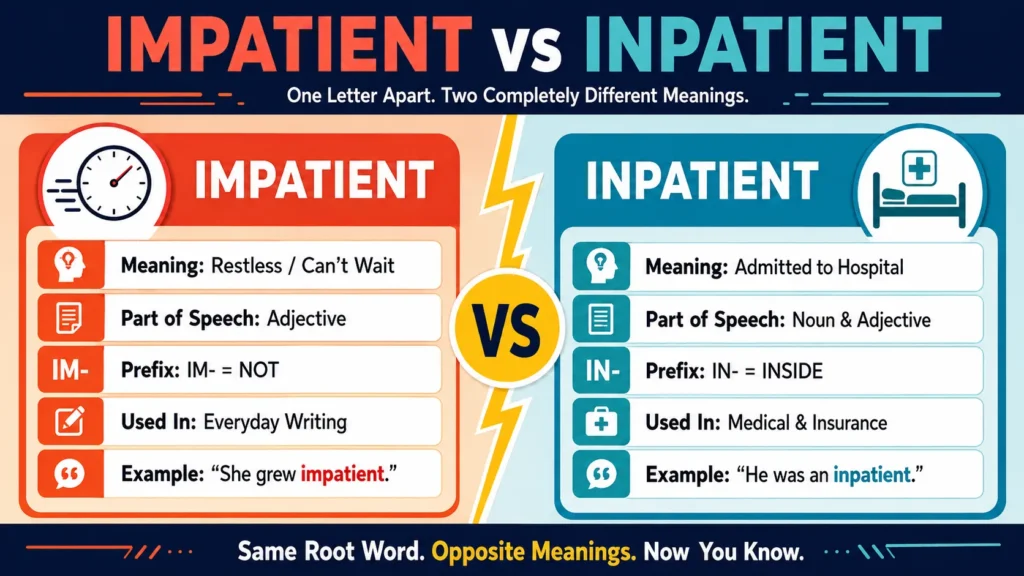
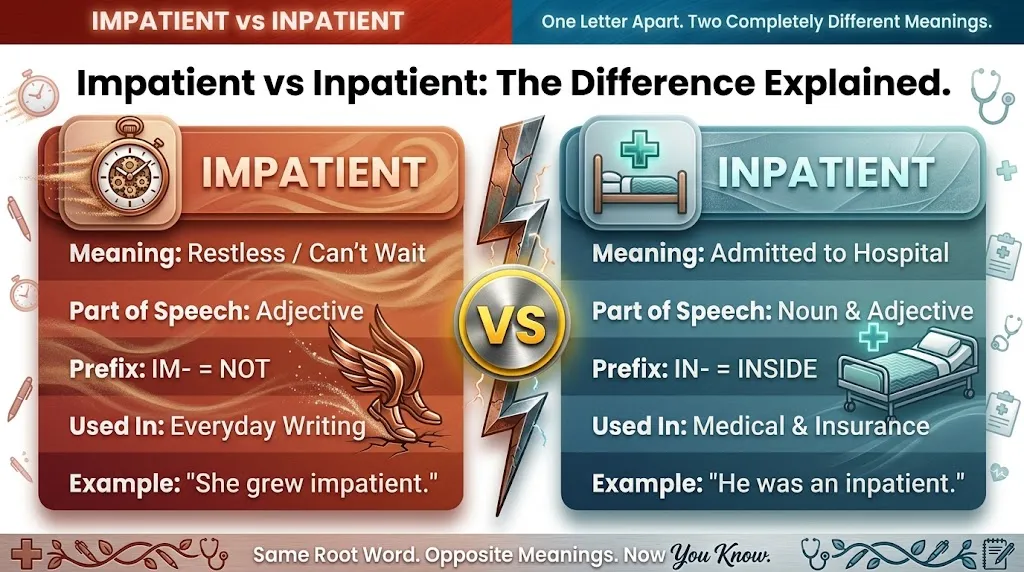
| Impatient | Inpatient | |
| Meaning | Restless, easily frustrated | Admitted to hospital overnight+ |
| Category | Emotion / behavior | Medical / healthcare status |
| Part of speech | Adjective only | Noun and adjective |
| Prefix | im- (“not”) | in- (“inside”) |
| Opposite | patient | outpatient |
| Example | “She grew impatient waiting.” | “He was admitted as an inpatient.” |
See the full breakdown below. 👇
4. Impatient vs Inpatient: Key Differences Explained
- Meaning: impatient = frustration; inpatient = hospitalization.
- Function: impatient only describes; inpatient can name a person (noun) or describe a service (adjective).
- Context: impatient belongs in everyday writing; inpatient belongs in healthcare, insurance, and medical records.
- Consequence of misuse: getting impatient/inpatient wrong in casual writing is a minor slip; getting it wrong in medical or insurance documents can cause real confusion over billing and coverage.
5. Why Do These Words Look So Alike? (The Real Etymology)
Both trace back to the Latin verb pati (“to suffer, to endure”), the root behind patient.
- Impatient = Latin negative prefix in- (“not”), which shifts to im- before p/b/m (as in impossible, immature). Literally: “not patient.”
- Inpatient = a different in-, meaning “inside” or “within” (as in indoor, inland). Literally: someone inside the hospital.
Same root, two unrelated prefixes — that coincidence is the entire source of the confusion.
6. Impatient vs Inpatient: Part of Speech Breakdown
- Impatient — adjective only. Never a noun. (“She is impatient,” not “she is an impatient.”)
- Inpatient — noun (“she is an inpatient”) and adjective (“inpatient treatment”).
- Impatience — noun form of impatient.
- Impatiently — adverb form of impatient.
7. How to Pronounce Impatient and Inpatient
- Impatient: im-PAY-shunt — /ɪmˈpeɪʃənt/ — stress on the second syllable.
- Inpatient: IN-pay-shunt — /ˈɪnˌpeɪʃənt/ — stress on the first syllable.
The stress shift is a useful spoken clue: impatient leans forward onto “PAY,” inpatient leans back onto “IN.”
8. How to Remember the Difference (Memory Tricks)
- IM = “I’m not able to wait.” Im- negates, like impossible.
- IN = “inside” the hospital. An inpatient is physically in the building.
- Swap test: If “restless” fits, use impatient. If “hospitalized” fits, use inpatient.
9. Inpatient vs Outpatient vs Impatient: The Three-Way Confusion
| Term | Meaning | Overnight stay? |
| Impatient | Restless, can’t wait | Not applicable |
| Inpatient | Admitted to hospital | Yes |
| Outpatient | Treated and goes home same day | No |
Example combining all three: “He came in as an outpatient for a scan, but was admitted as an inpatient after a concerning result — and by hour six of waiting, he was thoroughly impatient.”
10. Impatient vs Inpatient: Example Sentences
Impatient:
- Try not to sound impatient with new employees.
- She was impatient to hear the results, even though she wasn’t being tested.
Inpatient:
- The clinic doesn’t offer inpatient treatment, only same-day visits.
- Inpatient rehab gave him round-the-clock support.
11. Common Mistakes and How to Fix Them
- ❌ “The impatient ward was fully booked.” → ✅ “The inpatient ward was fully booked.”
- ❌ “She was inpatient waiting for her coffee.” → ✅ “She was impatient waiting for her coffee.”
- ❌ “He was admitted as an impatient.” → ✅ “He was admitted as an inpatient.”
- ❌ “I was an impatient at the clinic for three nights.” → ✅ “I was an inpatient at the clinic for three nights.”
12. Impatient vs Inpatient in Medical and Insurance Writing
- Medical records and insurance claims require the exact correct term — status affects billing and coverage.
- A doctor must formally order inpatient admission; time spent in a bed alone doesn’t automatically qualify (this affects Medicare and private insurance claims differently from “observation” status).
- Hospital websites typically separate “inpatient services” from “outpatient services” as distinct departments and billing codes.
13. Impatient vs Inpatient in Everyday and Professional Writing
- Emails, workplace Feedback, and casual writing almost always need impatient — you’re describing mood, not medical status.
- “The client seemed impatient on the call” — never “inpatient” here.
- If you’re not writing about a hospital, insurance claim, or medical chart, you almost certainly want impatient.
14. Related Words: Impatience, Impatiently, Inpatient Care
- Impatience (noun): “His impatience was obvious.”
- Impatiently (adverb): “She tapped her foot impatiently.”
- Inpatient care (noun phrase): treatment requiring an overnight hospital stay.
- Inpatient facility (noun phrase): a hospital or clinic equipped for admissions.
- Outpatient (related antonym of inpatient): treated without an overnight stay.
See the full breakdown below. 👇
15. Quick Quiz: Test Yourself
- The children became ______ waiting for the movie to start.
- She was admitted as an ______ after her surgery.
- His ______ tone made the meeting uncomfortable.
- The hospital’s ______ unit treats patients requiring long-term monitoring.
- My grandmother stayed as an ______ for a week following her fall.
- Don’t be ______ — the results will be ready soon.
Answers: 1. impatient — 2. inpatient — 3. impatient — 4. inpatient — 5. inpatient — 6. impatient
Explore More: https://dogizle.com/awl-meaning-in-text/
People Also Ask
One word, no hyphen — the same is true of impatient and outpatient.
Yes. They describe Different things entirely — someone hospitalized (inpatient) can also be frustrated about waiting (impatient).
Patient — calm, tolerant, able to wait without frustration.
Outpatient — treated without an overnight hospital stay.
Generally negative or critical, describing frustration or lack of composure, though it can read as neutral or even ambitious (“impatient for success”).
Almost always, but the exact clinical/billing definition varies by insurer — a doctor’s formal admission order, not just hours spent in a bed, usually determines status.
Conclusion
Impatient Describes an emotion — restlessness, frustration, an inability to wait calmly. Inpatient describes a medical status — a patient admitted to a hospital overnight or longer. They share a Latin root (patient, from pati, “to endure”) but split into two unrelated prefixes: im- meaning “not,” and in- meaning “inside.” Once that distinction clicks, the two words never get mixed up again — whether you’re writing a casual email or a medical record.