Gases or Gasses? The Correct Plural of Gas Explained
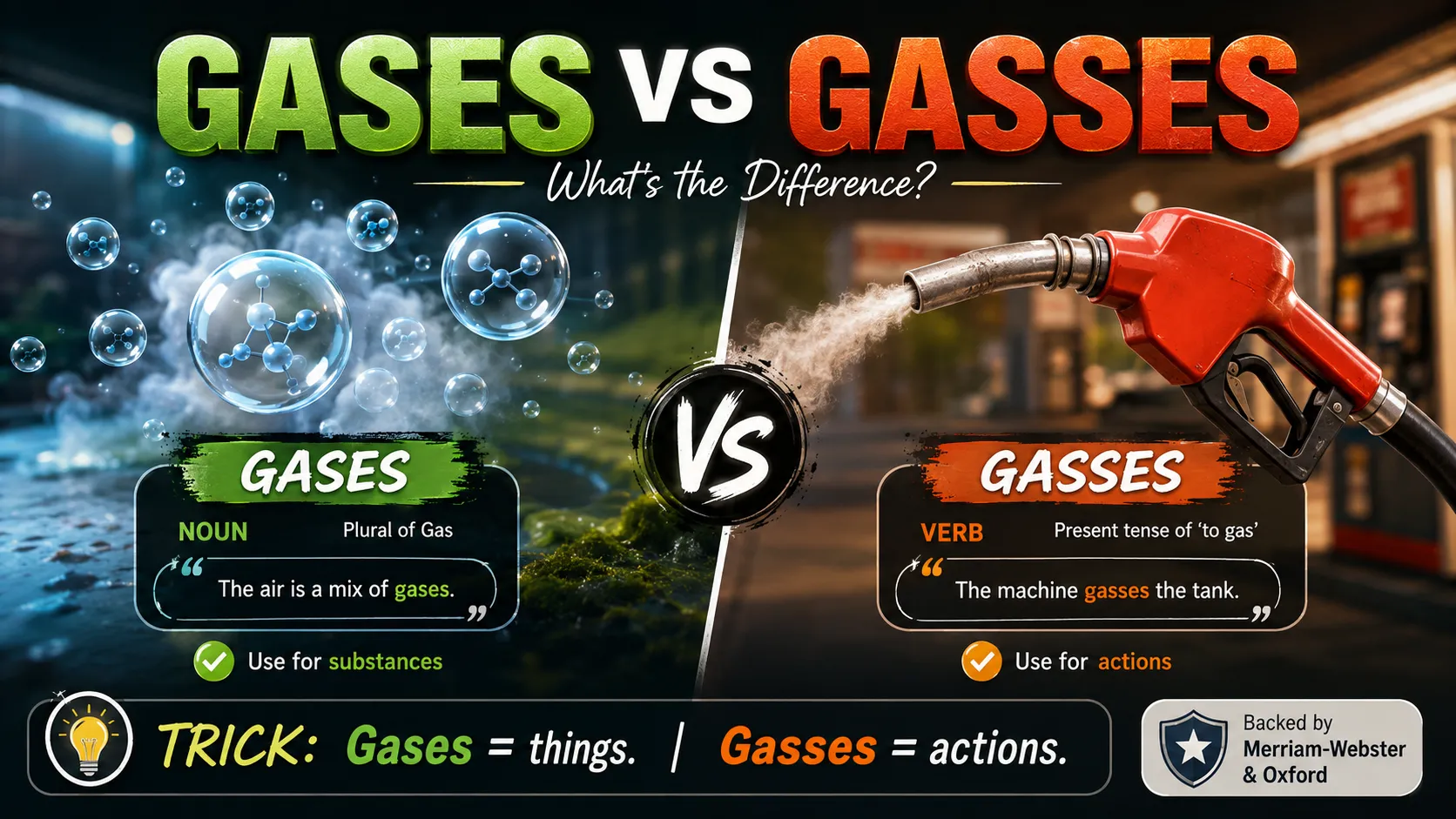
Quick answer: Use Gases when you mean more than one gas — it’s the correct plural noun. Use gasses only when you mean an action — it’s the present-tense verb form of “to gas” (as in the technician gasses the chamber). If you’re describing substances like oxygen, nitrogen, or carbon dioxide, always use gases.
1. What Does “Gases or Gasses” Mean?
“Gases or gasses” is a spelling question, not a meaning question — both words exist, but they do different grammatical jobs. Gases is the plural noun for more than one gas. Gasses is a verb describing the act of exposing something to gas. Mixing them up is one of the most common small errors in science and technical writing.
2. Quick Meaning Summary
| Gases | Gasses | |
| Part of speech | Plural noun | Verb (present tense) |
| Meaning | More than one gas (substance) | To expose to, treat with, or emit gas |
| Example | “The air is a mix of gases.” | “The machine gasses the container.” |
| Common in | Science, environment, everyday speech | Industrial, military, informal action contexts |
| Regional difference | None — same in US and UK | None — same in US and UK |
3. Gases: The Plural Noun
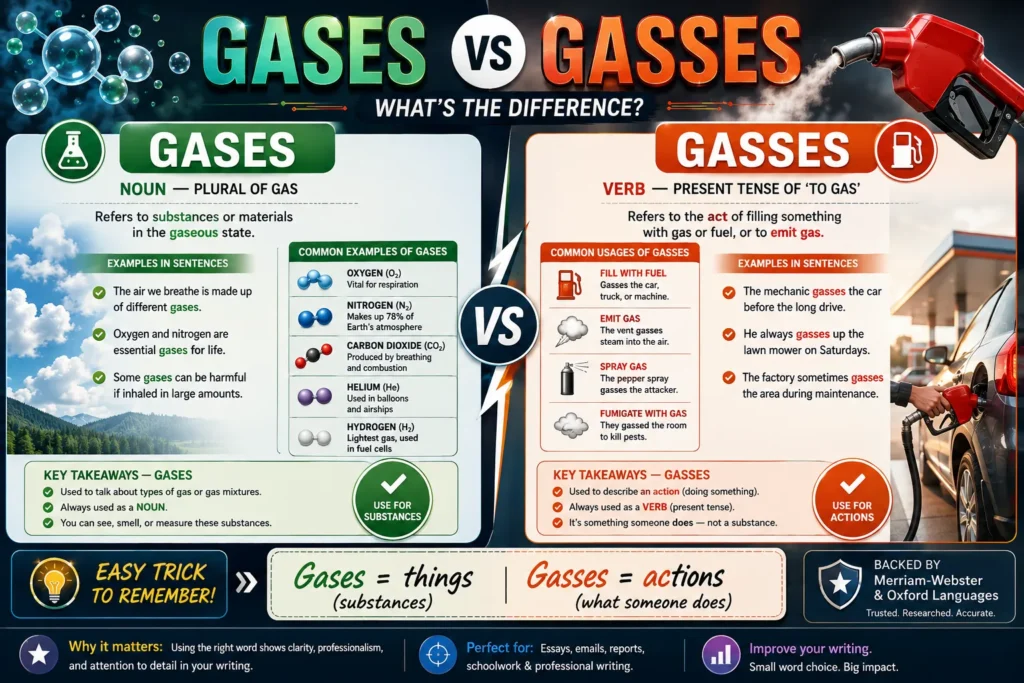
Gases is the standard plural of gas, one of the four fundamental states of matter alongside solid, liquid, and plasma. When referring to two or more gaseous substances — oxygen, nitrogen, helium, carbon dioxide — pluralize with “-es,” the same rule that turns “box” into “boxes.”
- The atmosphere is made up of several gases, mostly nitrogen and oxygen.
- Scientists study how gases behave under extreme pressure.
- Greenhouse gases trap heat in the atmosphere.
- Noble gases like argon and neon rarely react with other elements.
4. Gasses: The Verb Form
Gasses is the third-person singular present-tense form of to gas — meaning to supply, treat, or affect something with gas. It’s far less common than the noun and appears mostly in industrial, technical, or historical/military writing.
- The technician gasses the storage tank before sealing it.
- The factory gasses the chamber as part of the sterilization process.
- Chemical weapons historically gasses their targets — a grim but grammatically correct use.
5. Gases vs Gasses at a Glance (Comparison Table)
| Feature | Gases | Gasses |
| Type | Noun | Verb |
| Use for | Substances | Actions |
| Related forms | Gas (singular) | Gassed, gassing |
| Dictionary status | Standard plural | Standard verb form |
| Correct in science writing | Yes | Only for actions |
6. The Consonant-Doubling Rule Explained
English doubles a word’s final consonant before adding a suffix like -ed, -ing, or -es — but only for verb conjugations, not simple noun plurals.
- gas → gassed, gassing, gasses (verb forms — consonant doubles)
- gas → gases (noun plural — no doubling, just add “-es”)
Bus follows the same split: buses (plural noun) vs. bussed/bussing (verb).
7. Is Gases or Gasses a British vs American Difference?
No. Unlike colour/color, this is not a regional variant. Both American and British English use gases as the standard plural noun. Older British texts occasionally used “gasses” as a plural before spelling standardized, but that usage is now outdated in both dialects.
8. What Dictionaries Say About Gases and Gasses
Merriam-Webster lists gases as the standard plural of gas, and separately defines gas as a verb — the source of “gasses,” “gassed,” and “gassing.” The Oxford English Dictionary and Cambridge Dictionary follow the same split. Editors and grammar checkers rely on this same distinction.
9. Origin and History of the Word “Gas”
Gas was coined around 1630 by Flemish chemist Jan Baptist van Helmont, loosely based on the Greek word khaos (“chaos”), to describe the formless substance he’d identified (now known as carbon dioxide). By the 18th century, English settled on gases as the standard plural. The verb sense — “to gas” something — developed later, tied to industrial and military use in the 19th and 20th centuries.
10. How “Gases” Is Used in Real Sentences
- Medical oxygen is one of the most important gases in hospitals.
- Different gases behave differently under pressure and temperature changes.
- Car exhaust gases contribute to urban air pollution.
- Industrial plants must control the release of harmful gases.
11. How “Gasses” Is Used in Real Sentences
- The lab gasses the equipment to maintain sterility.
- The system gasses the chamber during the cleaning cycle.
- Workers carefully gasses the storage unit for preservation.
- The device gasses the material as part of the treatment process.
12. Gassed and Gassing: Related Verb Forms
- Gassed — past tense (“the room was gassed before inspection”)
- Gassing — present participle (“gassing the chamber took ten minutes”)
- Gasses — present tense, third-person singular (“he gasses the tank daily”)
All three double the final “s,” following the same consonant-doubling rule as “gasses.”
Explorre More: https://dogizle.com/igl-meaning-in-text/
13. Common Misunderstandings About Gases and Gasses
- “Gasses is just an old spelling of gases” — false; it’s a different part of speech, not an older variant.
- “Spellcheck accepts gasses, so it’s fine here” — spellcheckers approve correctly spelled words, not correct grammar for your sentence.
- “It’s a UK/US thing” — it isn’t; both dialects use gases for the noun.
- “Glasses and gasses follow the same pattern, so gasses must be right” — glass has no competing verb form; gas does, which is why the spellings split.
14. Related Terms and Similar Word Pairs
- Gas — singular noun or base verb
- Gaseous — adjective form
- Greenhouse gases — common real-world phrase
- Buses vs busses — same noun/verb spelling split
- Focused vs focussed — a related British/American doubling case
15. Tips to Never Confuse Gases and Gasses Again
- If you can swap in “types of gas” or “substances,” use gases.
- If you can swap in “exposes to gas” or “releases gas,” use gasses.
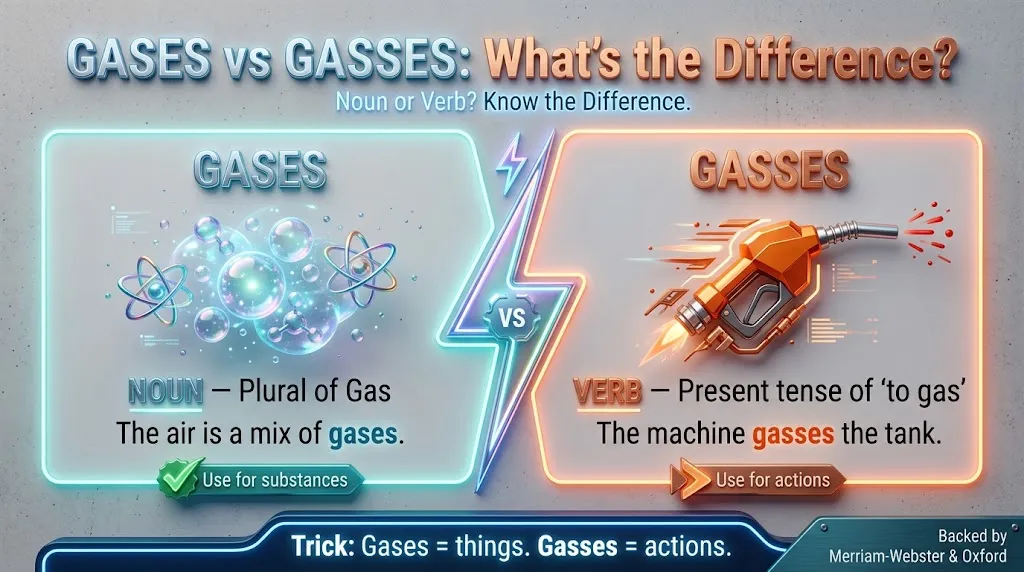
- Remember: gases names things, gasses describes actions.
- When in doubt in scientific or academic writing, gases is almost always correct.
People Also Ask
No. It only functions correctly as a verb, not as a group of Substances.
Gases — always use this for more than one gaseous substance.
No. Both use “gases” for the plural noun; this is a grammar distinction, not a regional one.
The doubling applies to verb forms (gassed, gassing, gasses), not the noun plural (gases).
Yes, as the present-tense verb form of “to gas.” It’s only wrong when used as a plural noun.
Gases = substances. Gasses = actions.
Conclusion
Gases and gasses aren’t interchangeable spellings — they’re different parts of speech. Gases names substances; gasses describes an action. Once you remember that split, along with the consonant-doubling logic behind it, you’ll never need to second-guess your spelling again. Explore our other commonly confused word guides to keep sharpening your writing.