Emasculate vs. Demasculate: Which Word Is Actually Real?
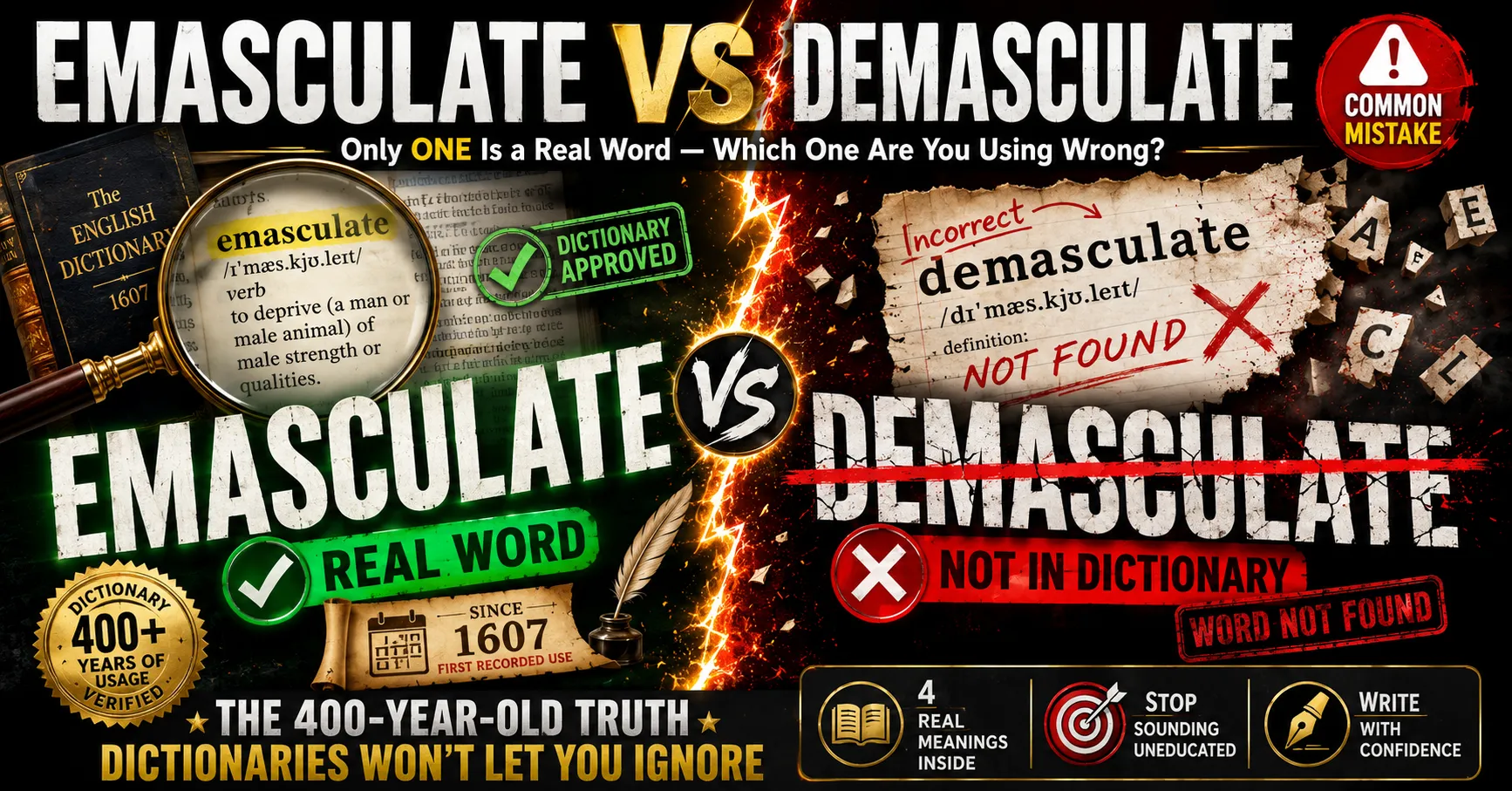
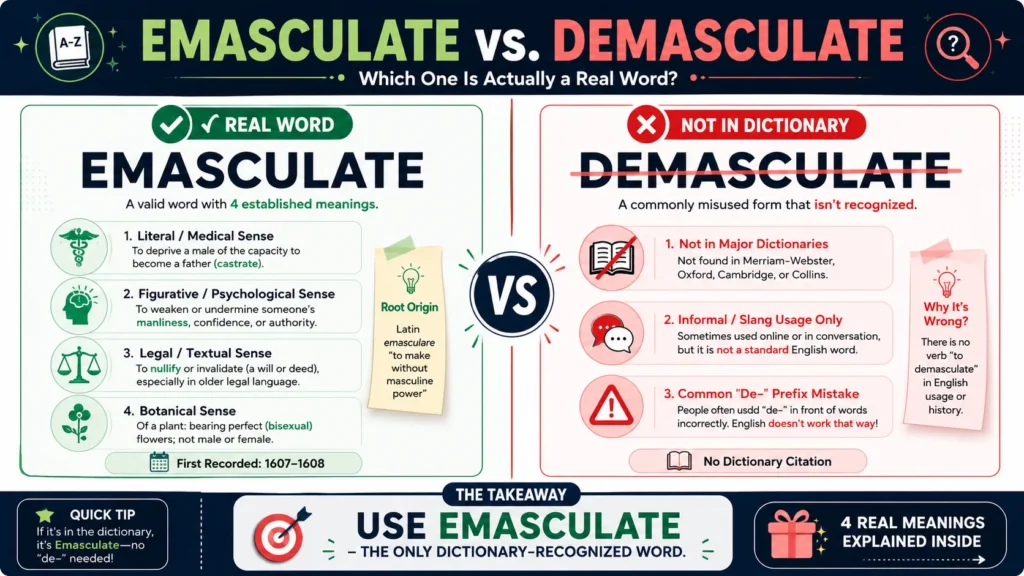
Quick answer: Emasculate is the correct, Dictionary-Recognized word. Demasculate isn’t listed in Merriam-Webster, Oxford, Cambridge, or Collins — it’s a nonstandard coinage that spreads because the “de-” prefix feels logical, even though it isn’t. Here’s the full picture, sourced from real dictionaries and etymology references.
1. What Does “Emasculate” Mean?
Emasculate /ɪˈmæskjəleɪt/ is a transitive verb meaning to deprive someone or something of strength, power, or vigor. It’s most often used figuratively — to describe stripping someone of authority, confidence, or influence — though it also has literal, legal, and botanical senses covered later in this guide.
Word forms: emasculate (base verb) → emasculated (past tense) → emasculating (present participle) → emasculation (noun).
2. Is “Demasculate” a Real Word?
No. Search Merriam-Webster, Oxford, Cambridge, or Collins for “demasculate” and you’ll find nothing. It appears informally on Wiktionary — defined loosely as “to remove the masculinity from (somebody)” — and on Urban Dictionary, a crowdsourced slang resource, not a lexicographic authority. It’s understandable, but it isn’t standard English.
3. Emasculate vs. Demasculate: Quick Comparison Table
| Emasculate | Demasculate | |
| In major dictionaries? | Yes — Merriam-Webster, Oxford, Collins, Cambridge, Dictionary.com | No |
| First recorded use | Verb: 1607–1608. Adjective: 1622 (OED) | No fixed date — informal, ongoing coinage |
| Part of speech | Verb (and archaic adjective) | Informal verb only |
| Standard in formal/academic writing | Yes | No |
| Where it’s found | Dictionaries, legal writing, botany, journalism, literature | Urban Dictionary, social media, forums |
| Number of dictionary senses | 4 distinct senses | 1 loose, informal sense |
4. Origin and History of “Emasculate”
Emasculate comes from the Latin ēmasculāre, “to castrate,” built from ex- (“out, away”) + masculus (“male, manly”). It entered English in the early 17th century. The Oxford English Dictionary records the earliest use of the verb in 1608, in the writing of clergyman Edward Topsell, with the adjective form first attested in 1622. Merriam-Webster dates the word to 1607.
5. Why Do People Say “Demasculate” Instead?
English has a large family of “de-” words meaning “reverse” or “remove”: deactivate, defrost, demote, dehumidify, deconstruct, detox. Because that pattern is so common, the brain naturally maps “remove masculinity” onto the same template and produces “de-masculate.”
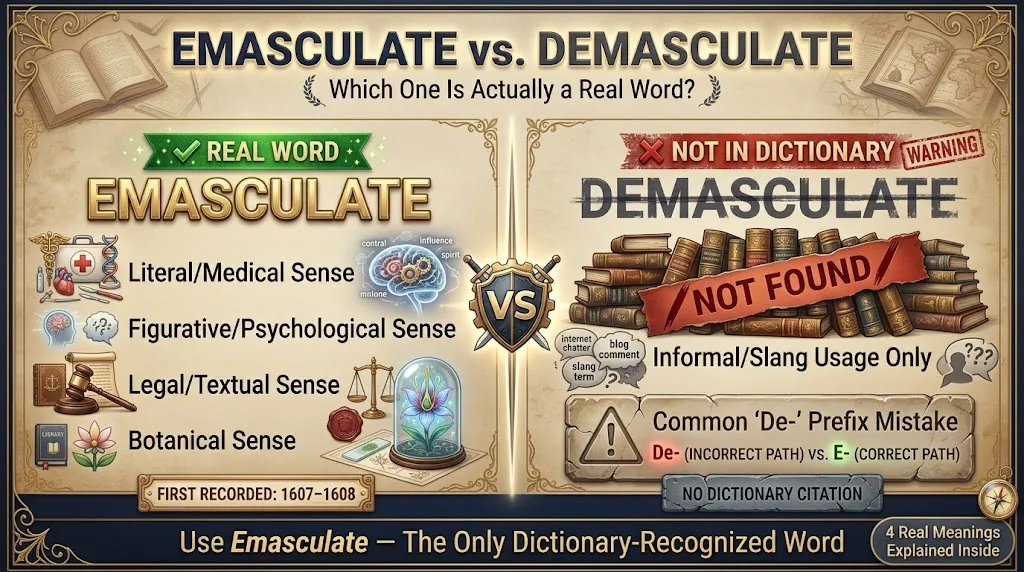
The catch: emasculate doesn’t use “de-” at all. It uses e-, a reduced form of the Latin ex-, meaning “out of” or “away from” — the same prefix in evade, emit, eject, exhale.
6. The 4 Dictionary Meanings of “Emasculate”
- Literal/medical — to castrate; to remove a male’s reproductive organs. Common in veterinary and historical medical writing.
- Figurative/psychological — to weaken power, authority, or confidence. The dominant modern usage.
- Legal/textual — to strip a law, ruling, or document of its force or effectiveness.
- Botanical — to remove the male part (stamens) of a flower during plant breeding.
7. Emasculate in Botany and Plant Breeding
In plant breeding, botanists emasculate a flower by removing its stamens (the androecium) before pollination, to prevent self-fertilization and control cross-breeding. This is a standard, everyday term in horticulture and agricultural science — a sense most articles on this topic skip entirely. Example: “Researchers emasculate the flowers by hand before cross-pollinating the two cultivars.”
8. Emasculate in Legal and Formal Writing
Merriam-Webster’s Dictionary of Law defines a legal sense of emasculate: to deprive a law, ruling, or document of its force. Example: “Critics argued the amendment would emasculate the agency’s enforcement power.” This usage has nothing to do with gender.
9. How to Use “Emasculate” in a Sentence
- Interpersonal: “The public correction from his manager emasculated him in front of the entire team.”
- Political/journalistic: “Critics argued the amendment would emasculate the agency’s enforcement power.”
- Cultural criticism: “The film has been criticized for how it emasculates its male lead for comic effect.”
- Botanical: “Researchers emasculate the flowers by hand before cross-pollinating the two cultivars.”
- Veterinary/agricultural: “Farmers emasculate young livestock to manage breeding and reduce aggression.”
Note: dictionaries confirm the figurative sense isn’t gender-locked — it describes stripping anyone’s or anything’s power, confidence, or effectiveness.
10. Emasculate in Pop Culture and Media
- Fight Club — Tyler Durden frames modern consumer culture as an emasculating force on men.
- The Simpsons — Homer is repeatedly placed in comically emasculating situations at work and at home.
Both are widely cited, real-world examples of how the word functions in cultural commentary.
11. Synonyms of “Emasculate”
Weaken, undermine, cripple, debilitate, enervate, devitalize, soften, hobble, sap, defang, castrate, geld, neuter, desex
12. Antonyms of “Emasculate”
Empower, strengthen, embolden, fortify, invigorate, energize
There’s no single standard one-word antonym the way empower pairs with disempower — writers typically reach for “empower” or “strengthen” in context.
13. Common Mistakes to Avoid
- Writing “demasculate” in formal or professional copy.
- Assuming emasculate only applies to men.
- Treating “emasculate” and “castrate” as fully interchangeable.
- Assuming the figurative meaning is a recent, “diluted” usage.
14. Related Terms and Similar Words
Unman, effeminize, neuter, desex, disempower, castrate
15. Emasculate vs. Demasculate: Which One Should You Use?
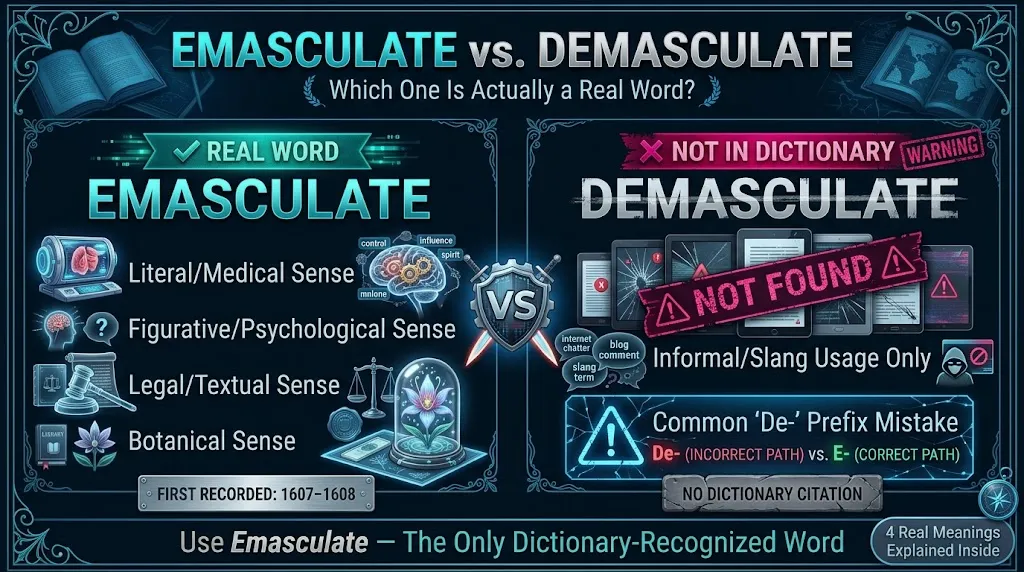
Use emasculate. It’s the only dictionary-recognized word, it carries four legitimate meanings across literal, figurative, legal, and botanical contexts, and it has a documented history back to the early 1600s. “Demasculate” is understandable in casual speech but reads as an error anywhere credibility matters — essays, professional writing, journalism, or published content.
Explore More: https://dogizle.com/rofl-meaning-in-text/
People Also Ask
No major dictionary — Merriam-Webster, Oxford, Cambridge, or Collins — lists it. It shows up informally on Wiktionary and slang sites, so treat it as nonstandard.
Emasculate is the correct, dictionary-recognized spelling and word.
Yes. The figurative and legal senses apply broadly to people of any gender, institutions, laws, and arguments.
From Latin ēmasculāre (“to castrate”), built from ex- (“out”) + masculus (“male”). It entered English in the early 1600s, first recorded around 1607–1608.
To remove the stamens (the male reproductive part) from a flower, typically to control pollination during plant breeding.
Close in meaning — unman means to deprive someone of manly qualities or courage — but it’s older, rarer, and far less common today than emasculate.
.
Conclusion
Emasculate is the only version of this word recognized by every major dictionary, with a documented history back to the early 1600s and four legitimate meanings: literal, figurative, legal, and botanical. Demasculate is a well-intentioned but nonstandard coinage, born from the natural instinct to apply English’s common “de-” prefix pattern to a word that already gets its meaning from a different Latin root. For any writing where credibility matters, the choice is simple: use emasculate.