Imbed vs. Embed: Which Spelling Is Correct?
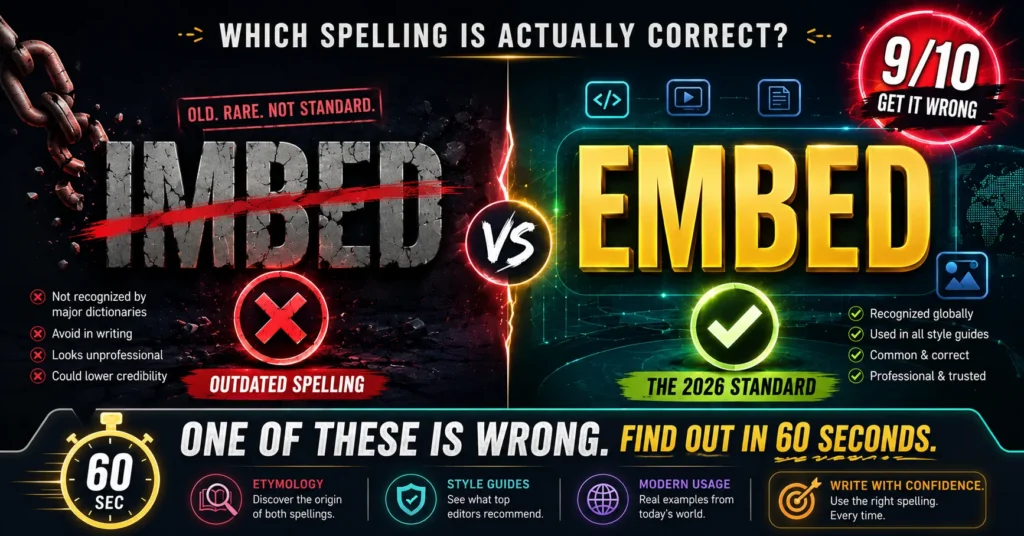
Quick answer: Embed is the Correct Spelling to use today. Imbed is a legitimate but archaic variant — it means exactly the same thing, but it’s fallen out of use so thoroughly that most style guides, dictionaries, and editors now treat it as outdated. Use embed, embedded, and embedding in virtually every writing context: academic, technical, journalistic, or casual.
That’s the one-line version. Here’s everything behind it — where these two spellings came from, why one won, and the specific situations (there are a few) where you’ll still legitimately encounter “imbed.”
What “Embed” and “Imbed” Actually Mean
Both words are verbs meaning to fix something firmly and securely within a surrounding mass, medium, or context. Neither spelling changes the meaning, pronunciation, or grammar — this isn’t a pair like affect/effect where mixing them up changes what you’re saying. It’s closer to gray/grey: a single word with two accepted spellings.
You’ll see the same core meaning stretch across several contexts:
- Physical: The construction crew embedded steel rods in the concrete foundation.
- Figurative: Her love of jazz was embedded in her from childhood.
- Journalistic: The network embedded a correspondent with the infantry unit.
- Digital: You can embed a YouTube video directly in your blog post.
Both embed and imbed work grammatically in every one of those sentences. Only one of them will read as correct to a modern audience.
Is “Imbed” a Real Word?
Yes. This is worth stating plainly because it’s one of the most common questions people search alongside this comparison. Imbed is not a typo, not slang, and not “incorrect” in the way a genuine misspelling would be. It appears in Merriam-Webster, the Oxford English Dictionary, and Dictionary.com as a valid variant spelling of embed. The OED even files them under a single combined entry: “embed | imbed, v.”
So if a spell-checker flags imbed, it’s not because the word doesn’t exist — it’s because your software has decided embed is the preferred form, which, as you’ll see below, is the correct call for almost all modern writing.
Embed vs. Imbed: Key Differences at a Glance
| Embed | Imbed | |
| Meaning | Identical | Identical |
| Pronunciation | /ɪmˈbɛd/ or /ɛmˈbɛd/ | /ɪmˈbɛd/ |
| Status today | Standard, preferred spelling | Archaic variant |
| Style guide support | AP, Chicago, MLA, and Merriam-Webster all default to this | Not recommended by any major modern style guide |
| Where it still appears | Everywhere — tech, journalism, science, everyday writing | Older texts, some geological/scientific literature, deliberate stylistic or historical flavor |
| Word forms | embed, embeds, embedded, embedding | imbed, imbeds, imbedded, imbedding |
| Safe for professional/academic writing? | Yes, always | Not recommended |
Where Did These Two Spellings Come From?
This is the part almost every competing article skips, and it’s the part that actually explains why embed won.
Both words trace back to the same root: Old English bedd (“bed, resting place”), from Proto-Germanic badja-. The prefix em-/im- comes from Latin in-, meaning “in” or “into.” So embed, at its etymological core, literally means “to put into a bed” — to lay something down and surround it, the way you’d tuck an object into soil, sediment, or fabric.
According to the Oxford English Dictionary, the earliest recorded use of the verb dates to 1778, appearing in the geological writing of John Whitehurst — describing fossils settling into rock strata. That’s the word’s original home: geology. The figurative sense (ideas, traits, or people being “embedded” in something non-physical) didn’t emerge until around 1835.
For most of the 19th and early 20th centuries, imbed and embed coexisted as roughly equal spelling choices — the prefix flip between im- and em- was common in English generally (compare impress/empress, though that pair diverged in meaning; a closer parallel is how in- prefixes shift to im- or em- before certain consonants, a pattern borrowed from Latin and Old French phonetic assimilation). Usage data (via Google’s Ngram Viewer, which tracks word frequency across millions of scanned books) shows the two spellings running roughly neck-and-neck until about 1960. From there, embed pulled steadily ahead, and the gap widened sharply through the personal-computing boom of the 1980s onward — almost certainly because embed became the term computing and web culture standardized on, and technology writing scaled far faster than any other genre.
Embedded vs. Imbedded (and the Other Word Forms)
The same rule applies across every conjugation — whichever spelling you pick, apply it consistently to the whole word family:
| Base form | Past tense / adjective | Present participle | Third person |
| embed | embedded | embedding | embeds |
| imbed | imbedded | imbedding | imbeds |
Don’t mix spellings within the same piece of writing. “She embeds photos in her posts, but yesterday she imbedded three videos” is inconsistent and will read as a typo, not a stylistic choice. Pick one — and per the guidance below, that should almost always be embed.
Which Should You Use? What the Style Guides Say
If you write professionally, this is the section that actually settles the question:
- Merriam-Webster lists embed as the main entry and imbed as a variant — meaning look-ups, spell-check, and dictionary-first tools default to embed.
- AP Style (used by most news organizations) uses embed, including in the now-common phrase “embedded journalist,” a term that became widespread during the 2003 Iraq War when reporters were formally attached to military units.
- Chicago Manual of Style and academic publishing generally follow the dominant modern spelling, i.e., embed.
- Web and tech style guides (Google’s developer documentation, MDN, most brand style guides) use embed exclusively — there is no “imbed” equivalent in programming or markup contexts.
Bottom line: unless you have a Specific Reason to reach for imbed (see below), default to embed in resumes, articles, code documentation, emails, and anything else meant for a modern reader.
When “Imbed” Still Makes Sense
Imbed isn’t extinct — it’s a legitimate stylistic choice in a few narrow situations:
- Quoting or referencing older texts. If you’re citing 19th-century geological literature or older scientific papers, imbed may appear in the original source, and preserving it in a direct quote is correct.
- Deliberate old-fashioned tone. Historical fiction, period pieces, or writing that’s intentionally evoking an older voice can use imbed for flavor — similar to choosing colour over color to signal British spelling conventions.
- Established niche usage. A small number of specialized scientific and geological contexts have retained imbed longer than general writing did, simply out of field-specific convention.
Outside of those cases, imbed will generally just read as an unusual — or incorrect-looking — choice to most readers.
Modern Uses of “Embed” in Technology
This is where the word has grown the most in the last two decades, and where most comparison articles stop short — “embed” now covers everything from markup code to artificial intelligence.
Everyday figurative use. Habits, beliefs, memories, or cultural values that are deeply ingrained: That superstition is embedded in local folklore.
Embed in HTML and Web Development
In web development, “embed” describes placing external content — a video, map, tweet, or PDF — directly into a page, often via an <embed> or <iframe> HTML element, or a platform-provided “embed code.” When a social platform gives you a snippet to “embed this post,” that’s this exact sense of the word, just automated.
Embedded Journalism: Meaning and Origin
Since the Iraq War era, “Embedded” has meant a reporter formally attached to and traveling with a military unit, with negotiated access in exchange for certain reporting restrictions — a meaning specific enough that it’s now essentially its own term of art in journalism.
Embedded Systems in Engineering
In computing, an “embedded system” is a small, dedicated computer built into a larger device — the chip running your microwave’s control panel, not a general-purpose computer. This sense has existed since the mid-20th century and predates the web-embedding usage above.
Vector Embeddings in AI and Machine Learning
In machine learning, an “embedding” is a numerical representation of data — words, images, sentences — mapped into a multi-dimensional vector space so that a computer can measure similarity between concepts mathematically. It’s the mechanism underneath search, recommendation systems, and much of how large language models understand meaning. Interestingly, this sense traces its metaphor straight back to the word’s 1778 geological origin: just as fossils are preserved within rock, data is preserved within a structured mathematical space. Same core idea, radically different medium.
Common Mistakes to Avoid
- Mixing spellings in one document. Pick embed (or, rarely, imbed) and stay consistent through every form of the word.
- Assuming “imbed” is a misspelling. It isn’t — it’s outdated, not incorrect. Don’t “correct” someone quoting historical text.
- Using “imbed” in technical or professional writing. No programming documentation, style guide, or modern publication uses it; it will read as an error to most readers even though it technically isn’t one.
- Confusing “embed” with unrelated look-alikes like imbue (to infuse with a quality) or embody (to represent an idea in physical form) — related in flavor, but not interchangeable.
A Simple Memory Trick to Remember the Difference
If you need a mnemonic: “Embed” starts like “enter” — both begin with en-/em- and both are about something going in. Since embed is also the modern, “entering” the current standard, the two ideas reinforce each other. If in doubt, default to the version starting with E — it’s right almost every time.
Related Terms and Similar Word Pairs
If you’re untangling embed vs. imbed, these commonly confused pairs tend to trip up the same audience:
Explore More: https://dogizle.com/gases-or-gasses/
- Imbue vs. embed — imbue means to infuse a quality or feeling throughout something (a mood, a value), while embed means to physically or structurally place one thing inside another.
- Embody vs. embed — embody means to represent an abstract idea in tangible form; embed means to insert and surround.
- Ingrain vs. embed — near-synonyms; ingrain leans toward habits and character traits, embed is more general-purpose.
- Insert vs. embed — insert is neutral and simple; embed implies the inserted item becomes surrounded and secured, not just placed.
People Also Ask
No. It’s a genuine,Dictionary-Recognized Alternate Spelling — just one that’s fallen out of common use. It won’t be flagged as an error by most dictionaries, though many spell-checkers will suggest “embed” instead since it’s the preferred modern form.
Both are technically correct, following the same rule as the base words. Embedded is standard in modern writing; imbedded is the older, now-uncommon variant.
No — unlike many US/UK spelling splits (color/colour, organize/organise), this isn’t a regional divide. Both American and British sources overwhelmingly favor embed.
Usage data shows the two spellings were roughly equally common until around 1960, after which embed pulled ahead — accelerating sharply with the rise of computing and the internet, where “embed” became the standardized term for placing digital content into web pages.
“Embed” is the general verb. An “embedded system” is a specific engineering term for a small, dedicated computer built into a larger device (like an appliance or a car’s control unit) — a specialized, noun-phrase usage of the same root idea.
Conclusion
Embed and imbed are the same word wearing two different spellings — one modern and universal, one historical and fading. For everyday writing, technical documentation, journalism, or anything meant for a 2026 reader, Embed is the safe, correct, and expected choice every time. Imbed isn’t wrong, but reach for it only when you’re quoting older text or deliberately reaching for an antique tone.
Bookmark this page as your reference the next time spell-check flags one of these — and if you’re curious how “embed” jumped from 18th-century geology to the engine behind modern AI search, that thread alone is worth following further.