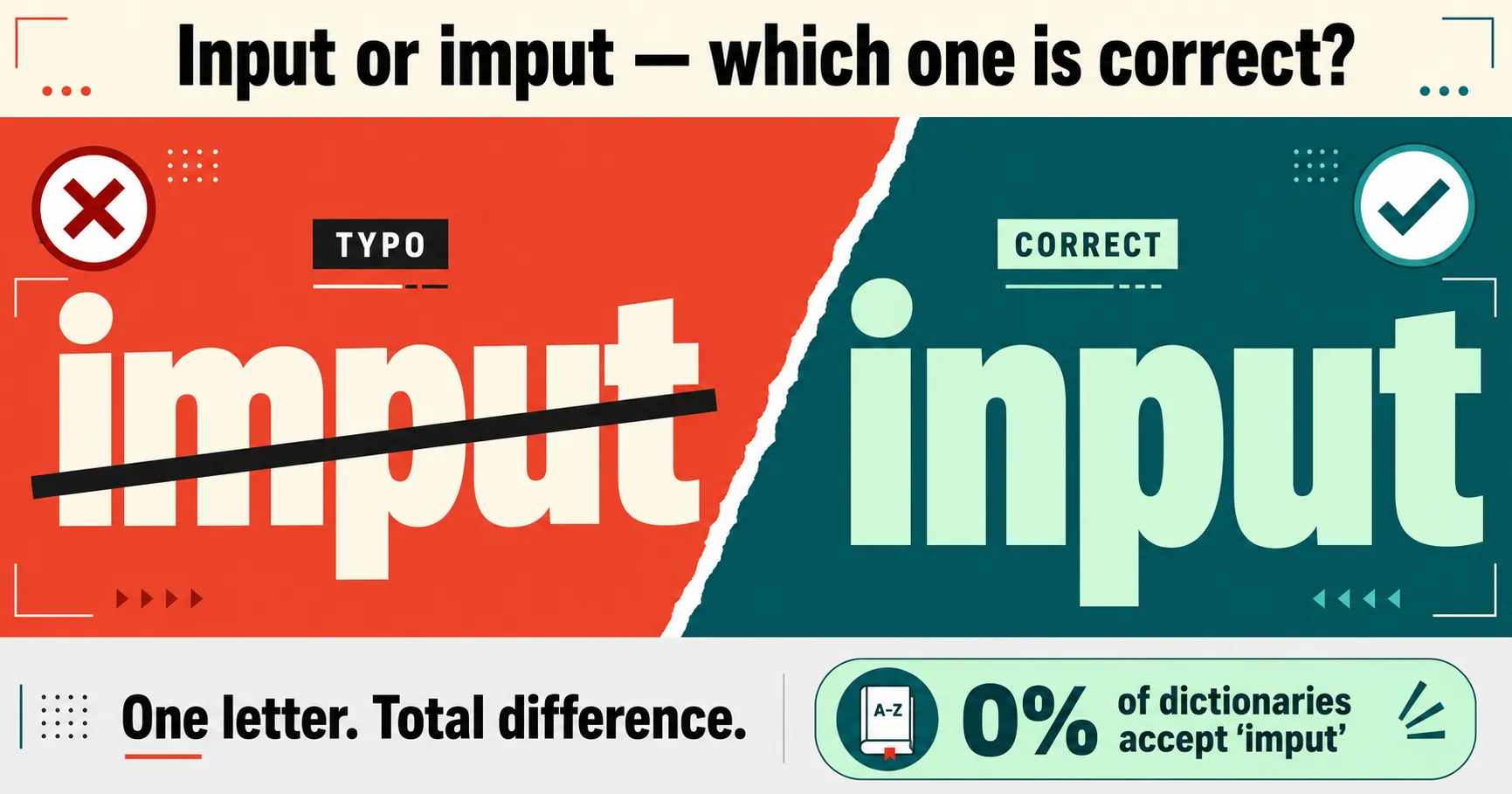
Input or Imput: Which Spelling Is Correct?
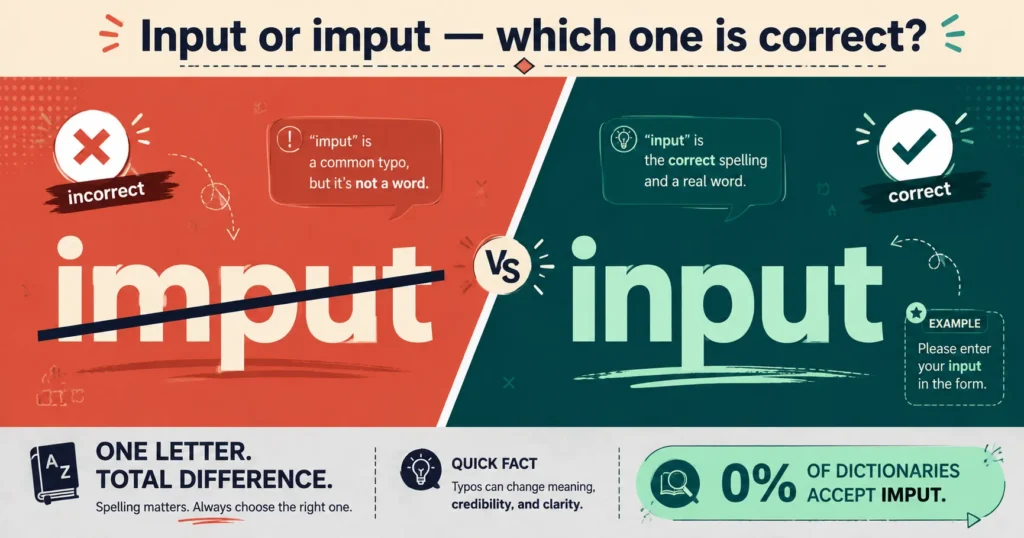
“Input” is the Correct Spelling. “Imput” is a common misspelling that doesn’t appear in Merriam-Webster, Oxford, Cambridge, or any dictionary of English. It shows up because of how the word sounds when spoken quickly — not because it’s an accepted variant.
There’s one wrinkle almost no other guide explains clearly: “impute” is a real English word, and it’s probably what some people are half-remembering when they type “imput.” It means something entirely different from “input” (full breakdown below).
1. What Does “Input” Mean?
Input refers to information, data, energy, or resources that go into a system, process, or conversation. As a noun, it’s what someone contributes — an opinion, a comment, or raw data fed into a computer. As a verb, it means to enter or feed information into something.
- “We need your input on this decision.”
- “Input the numbers into the spreadsheet.”
2. Input or Imput: Which Spelling Is Correct?
There’s no ambiguity here: input is correct in every context — casual writing, business communication, and technical documentation alike. Imput is never correct. It has no dictionary listing, no regional acceptance, and no historical usage as a legitimate word.
3. Quick Meaning Summary (Table)
| You typed | Correct word | Real word? | Meaning |
| imput | input | ✅ Yes | information or data entered into a system |
| imput | impute | ✅ Yes | to attribute or assign (blame, a value, a cause) |
| imput | — | ❌ No | not a word in any dictionary |
4. Why Is “Input” Correct?
“Input” is a compound word: in + put — literally, something “put in.” That’s the entire logic of the spelling. There’s no hidden rule, exception, or alternate form. “Imput” breaks that logic by inserting a letter that doesn’t belong to either half of the compound.
Compare it to real im- words, where “im-” functions as a prefix meaning “not” or “into”:
- impossible (not possible)
- impatient (not patient)
- imprint (press into)
“Input” doesn’t follow that pattern — it isn’t a prefixed word at all, just two words fused together.
5. Origin and Etymology of “Input”
According to the Online Etymology Dictionary, the noun input dates to 1753, originally meaning a sum of money put in, or a contribution or share. <cite index=”23-1″>The meaning shifted to “energy supplied to a device or machine” by 1902, later extending to electronic devices, and the now-familiar computing sense of “data fed into a machine” emerged around 1948.</cite>
<cite index=”23-1″>The verb form is even older, tracing back to the late 14th century with the meaning “put on, impose,” built from “in” plus “put.” The modern verb sense — “feed data into a machine” — appeared around 1946</cite>, arising alongside early computing.
So “input” isn’t a modern coinage invented for computers — it’s a centuries-old compound that computing simply adopted and popularized. “Imput” has no comparable history anywhere in that timeline; it never existed as a spelling.
6. Why Do People Misspell “Input” as “Imput”?
1. Nasal place assimilation. When you say “input” quickly, your mouth starts shaping the “p” sound before you finish the “n.” Because “m” is easier to produce right before “p” (both use the lips), the “n” sound shifts toward “m” in speech, even though the spelling doesn’t change. This is the same effect behind casual pronunciations like “hambag” for “handbag.”
2. Keyboard proximity. On a QWERTY keyboard, “m” sits right next to “n,” so fast typing occasionally produces the wrong letter — and because “imput” sounds plausible, the brain doesn’t always catch it.
3. Spell-check gaps. Some spell-checkers don’t flag “imput” because it resembles other real words like “import” or “impute.”
4. Confusion with the real word “impute.” This is the most overlooked cause — and worth its own section.
7. “Imput” vs. “Impute”: Don’t Confuse Them
Impute is a real, formal verb meaning to attribute, assign, or credit something — often blame, a cause, or a value — to a person or thing.
- “The report imputed the delay to poor planning.”
- In statistics, “imputation” means estimating missing data values.
- In tax and accounting, “imputed income” refers to a value assigned to a non-cash benefit.
“Imput” is not a shortened form of “impute” and not an alternate spelling of “input.” It’s simply the sound-based error that happens when “input” blurs in speech. If you meant “attribute” or “assign,” you wanted impute. If you meant “enter data” or “give feedback,” you wanted input. Neither is ever spelled “imput.”
8. “Input” as a Noun vs. a Verb
As a noun — information, data, or feedback provided to something:
- “Her input changed our entire strategy.”
- “The system accepts input from multiple sources.”
As a verb — to enter or feed information into a system:
- “Please input your password.”
- “She input the sales figures yesterday.”
9. Input vs. Inputted: Correct Past Tense
Both “input” and “inputted” are accepted past-tense forms:
- “Input” (unchanged) is more common in American technical and business writing: “I input the numbers yesterday.”
- “Inputted” is more common in British English and general writing: “She inputted her details into the form.”
Neither is wrong — pick based on audience and region.
10. Plural of “Input”
The plural is simply “inputs” — add an “s”:
- “We gathered inputs from five departments before deciding.”
- “The model takes multiple inputs and produces one output.”
11. “Input” in Technology and Computing
- <input> tag — the HTML element used to create form fields.
- Stdin (standard input) — the default stream a program reads from, typically the keyboard.
- Input validation — checking that entered data meets required rules before a system accepts it.
- Input device — hardware used to enter data (keyboard, mouse, scanner, microphone).
- Input field / input box — the UI element where users type information.
None of these are ever spelled “imput,” in code or in prose.
12. Input vs. Output: What’s the Difference?
- Input = what goes into a system (keystrokes, uploaded files, raw data).
- Output = what comes out of a system (results, printed pages, displayed answers).
They describe opposite directions of information flow.
13. Common Phrases and Collocations With “Input”
- user input — data or actions provided by a person using a system
- input data — raw information fed into a process
- provide/give input — to share feedback or opinions
- stakeholder input — feedback gathered from interested parties
- valuable input — feedback that meaningfully shapes an outcome
- input field/box — the space where users type data
- constant input — ongoing information or energy needed to keep something running
14. US vs. British English: Is There a Difference?
No. Both American and British English spell it identically: input. There’s no regional variant that permits “imput.” The only real difference between the dialects is the past-tense preference already covered in Section 9 — not the base spelling.
Explore Moore :https://dogizle.com/ctfu-meaning-in-text/
15. How to Remember the Correct Spelling (Memory Tricks)
- Break it apart: IN + PUT = INPUT.
- Compare it to “into.” You wouldn’t write “imto” — same logic protects “input.”
- Say it slowly once before typing it — this interrupts the nasal assimilation that causes the slip.
- Don’t rely on autocorrect alone — do a final read-through, since “imput” resembles other real words.
- If you meant “attribute” or “assign,” check whether you actually wanted “impute.”
People Also Ask
No. It has no dictionary entry and no regional acceptance. It’s always a misspelling — usually of “input,” occasionally a Mix-Up With “Impute.
“Imput” isn’t a word. “Impute” is a real, formal verb meaning to attribute or assign something, such as blame or a value, to a person or thing.
Both “input” and “inputted” are accepted. “Input” is more common in American and technical writing; “inputted” is more common in British usage.
“Inputs” — just add an “s.”
Input is what goes into a system; output is what comes out. They’re opposite directions of information flow.
Mainly nasal assimilation — the “n” sound shifts toward “m” before “p” when spoken quickly — plus keyboard proximity between “m” and “n,” incomplete spell-checking, and confusion with the real word “impute.”
Conclusion
Input is the only correct spelling — as a noun, a verb, or in any technical context, and it has been since long before computers existed. Imput is never correct; it’s a byproduct of how the word sounds in speech, not an accepted alternative. If you were actually reaching for a word about assigning blame or value to something, the word you wanted was impute, not “imput.” Keep that one distinction straight, and you’ll never second-guess this word again.