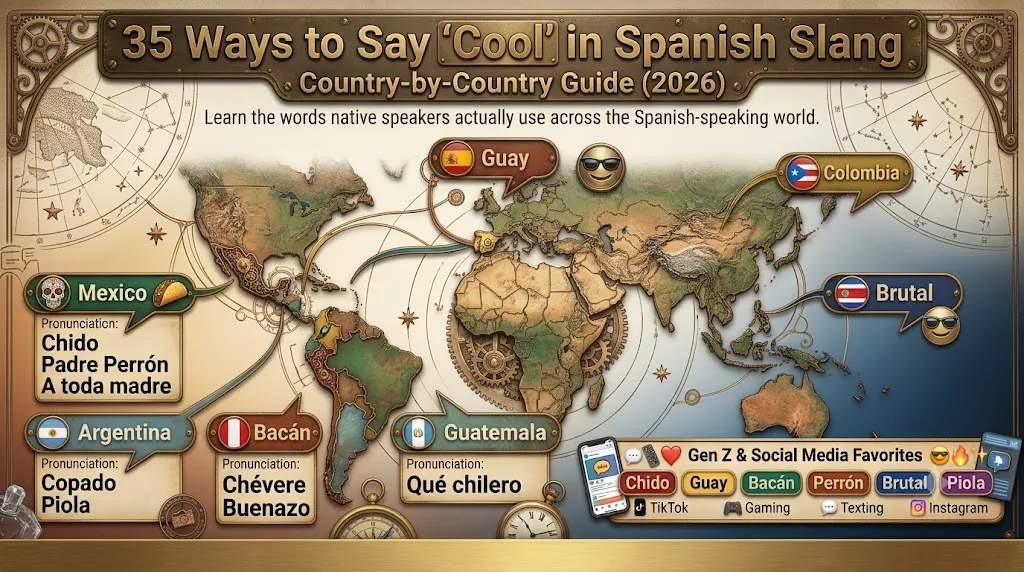
Stop Sounding Like a Tourist: Speak Like a Native Across the Spanish-Speaking World
If you’ve ever typed “cool” into a translator expecting one clean Spanish word, you’ve probably landed on genial — technically correct, but not what people actually say on the street in Mexico City, Madrid, or Buenos Aires.
Here’s the real answer: There Is no Single Spanish Word For “Cool.” Spanish is spoken natively in over 20 countries, and each region developed its own slang for expressing enthusiasm, approval, or admiration. A word that sounds perfectly natural in Mexico (chido) can sound completely foreign in Spain, where guay rules instead.
This guide breaks down the most authentic, currently-used slang words for “cool” country by country — with pronunciation, real example sentences, formality levels, and warnings about where each word does not work. By the end, you’ll know exactly which word to use, where, and with whom.
Is There One Spanish Word for “Cool”?
No. The right word depends on:
- Country — slang is highly regional
- Age — some words are older-generation, others are Gen Z-coded
- Context — texting a friend vs. talking to a teacher
- Formality — casual slang vs. neutral/formal vocabulary
If you only learn one universally safe word, learn genial. It’s understood everywhere and works in almost any casual-to-neutral situation. Everything below is what you graduate to once you want to sound like a local rather than a textbook.
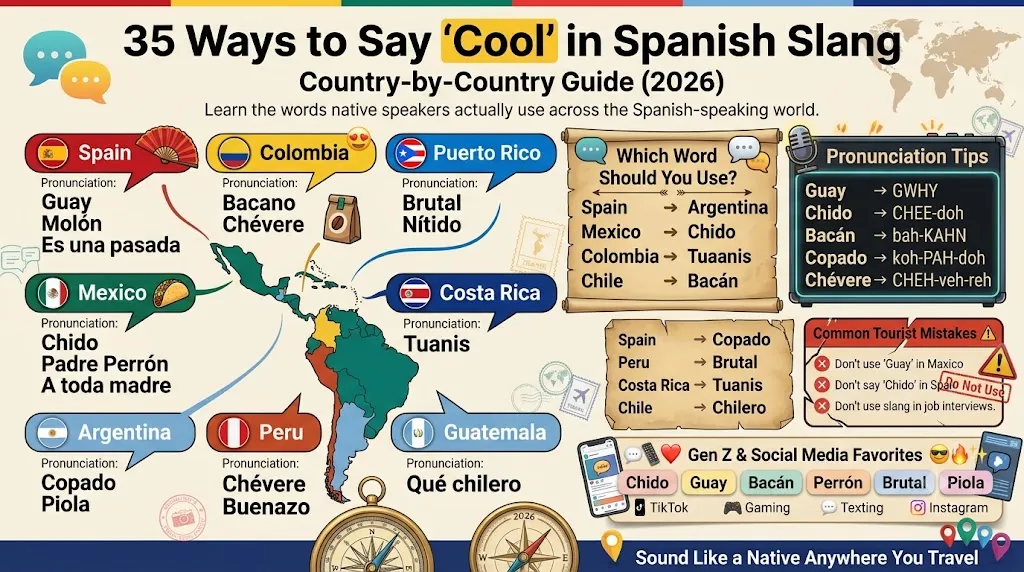
Quick Comparison Table: Most Common Word by Country
| Country | Most Common Slang Word |
| Spain | Guay |
| Mexico | Chido / Padre |
| Colombia | Bacano / Chévere |
| Argentina | Copado |
| Chile | Bacán |
| Peru | Chévere |
| Puerto Rico | Brutal |
| Venezuela | Chévere |
| Costa Rica | Tuanis |
| Guatemala | Chilero |
| Cuba | Asere qué bolá (phrase, not a direct word) |
| Uruguay | Copado / Genial |
25+ Cool Spanish Slang Words, Country by Country
Chido 🇲🇽
- Meaning: Cool, awesome, great
- Pronunciation: CHEE-doh
- Used in: Mexico
- Example: “Esa película está bien chida.” → “That movie is really cool.”
- Best with: Friends, family, casual settings
- Avoid in: Business meetings, formal writing
Padre 🇲🇽
- Meaning: Cool, great (literally “father”)
- Pronunciation: PAH-dreh
- Used in: Mexico
- Example: “¡Qué padre está tu carro!” → “Your car is so cool!”
- Best with: Casual conversation
- Note: Older term, but still widely used and understood by all ages
A toda madre 🇲🇽
- Meaning: Awesome, excellent
- Pronunciation: ah TOH-dah MAH-dreh
- Used in: Mexico
- Example: “El concierto estuvo a toda madre.” → “The concert was amazing.”
- Note: Very informal — avoid with strangers or in formal contexts
Guay 🇪🇸
- Meaning: Cool, nice
- Pronunciation: why (rhymes with “eye”)
- Used in: Spain
- Example: “¡Qué guay tu chaqueta!” → “Your jacket is so cool!”
- Avoid in: Latin America, where it’s rarely used and can sound out of place
Molar 🇪🇸
- Meaning: To be cool, to like something (used as a verb)
- Pronunciation: moh-LAR
- Used in: Spain
- Example: “Me mola mucho esta canción.” → “I really like/this song is cool.”
- Note: Common among younger Spaniards; not used as an adjective like “guay”
Molón / Molona 🇪🇸
- Meaning: Cool (adjective form of “molar”)
- Pronunciation: moh-LOHN
- Used in: Spain
- Example: “Es un tío muy molón.” → “He’s a really cool guy.”
Chévere 🇻🇪🇨🇴🇵🇪
- Meaning: Cool, great, nice
- Pronunciation: CHEH-veh-reh
- Used in: Venezuela, Colombia, Peru, and widely across the Caribbean
- Example: “Qué chévere que viniste.” → “It’s great that you came.”
- Note: One of the most widely recognized slang words across all of Latin America
Bacano / Bacana 🇨🇴
- Meaning: Cool, awesome
- Pronunciation: bah-KAH-noh
- Used in: Colombia
- Example: “Ese plan está bacano.” → “That plan sounds cool.”
Bacán 🇨🇱🇵🇪
- Meaning: Cool, great
- Pronunciation: bah-KAHN
- Used in: Chile, Peru
- Example: “Tu casa nueva está bacán.” → “Your new house is cool.”
Copado 🇦🇷🇺🇾
- Meaning: Cool, awesome
- Pronunciation: koh-PAH-doh
- Used in: Argentina, Uruguay
- Example: “Está copado el plan para el finde.” → “The weekend plan sounds cool.”
- Avoid in: Most of Latin America outside the Río de la Plata region — it won’t be understood the same way
Piola 🇦🇷
- Meaning: Cool, chill, low-key nice
- Pronunciation: pee-OH-lah
- Used in: Argentina
- Example: “Es un lugar piola para tomar algo.” → “It’s a chill place to grab a drink.”
Tuanis 🇨🇷
- Meaning: Cool, awesome
- Pronunciation: too-AH-nees
- Used in: Costa Rica
- Example: “¡Qué tuanis tu bici nueva!” → “Your new bike is so cool!”
Chilero / Chilera 🇬🇹
- Meaning: Cool, nice
- Pronunciation: chee-LEH-roh
- Used in: Guatemala
- Example: “Qué chilero el concierto.” → “The concert was cool.”
Brutal 🇵🇷
- Meaning: Awesome, incredible (not violent — a positive term here)
- Pronunciation: broo-TAHL
- Used in: Puerto Rico
- Example: “Esa fiesta estuvo brutal.” → “That party was amazing.”
Nítido 🇨🇴
- Meaning: Cool, sharp, on point
- Pronunciation: NEE-tee-doh
- Used in: Colombia
- Example: “Tu outfit está nítido.” → “Your outfit is on point.”
Buenazo / Buenaza 🇦🇷🇨🇱
- Meaning: Really good, cool
- Pronunciation: bweh-NAH-soh
- Used in: Argentina, Chile (informal)
- Example: “Ese asado estuvo buenazo.” → “That barbecue was awesome.”
Pulento 🇨🇱
- Meaning: Excellent, top-tier cool
- Pronunciation: poo-LEN-toh
- Used in: Chile (younger/informal slang)
- Example: “Ese gol fue pulento.” → “That goal was incredible.”
Calidá 🇨🇴 (shortened from “calidad”)
- Meaning: Cool, quality, solid
- Pronunciation: kah-lee-DAH
- Used in: Colombia (informal, coastal regions)
- Example: “Esa fiesta estuvo calidá.” → “That party was solid.”
Es una pasada 🇪🇸
- Meaning: It’s amazing / it’s over the top (in a good way)
- Pronunciation: ehs OO-nah pah-SAH-dah
- Used in: Spain
- Example: “Este restaurante es una pasada.” → “This restaurant is amazing.”
Perrón 🇲🇽 (regional, northern Mexico)
- Meaning: Awesome, badass-cool
- Pronunciation: peh-ROHN
- Used in: Northern Mexico
- Example: “Está perrón ese carro.” → “That car is awesome.”
- Note: More intense/informal than “chido” — use only casually
Qué show 🇨🇴🇻🇪
- Meaning: How cool / what a scene (something impressive happening)
- Pronunciation: keh SHOW
- Used in: Colombia, Venezuela
- Example: “¡Qué show ese concierto!” → “That concert was quite a show!”
Asere qué bolá 🇨🇺
- Meaning: Informal greeting implying “what’s cool/what’s up”
- Pronunciation: ah-SEH-reh keh boh-LAH
- Used in: Cuba
- Note: More of a greeting phrase than a direct “cool,” but essential Cuban street slang
Genial (neutral, works everywhere)
- Meaning: Great, wonderful
- Pronunciation: heh-nee-AHL
- Used in: All Spanish-speaking countries
- Example: “¡Qué genial noticia!” → “What great news!”
- Note: Not slang — the safest universal choice for learners
Increíble (neutral, works everywhere)
- Meaning: Incredible
- Pronunciation: een-kreh-EE-bleh
- Used in: All Spanish-speaking countries
- Example: “La vista es increíble.” → “The view is incredible.”
Which Word Should You Use in Each Country?
| Region | Use This | Skip This |
| Mexico | Chido, Padre | Guay, Copado |
| Spain | Guay, Molón | Chido, Bacano |
| Argentina/Uruguay | Copado, Piola | Chido, Chévere |
| Colombia | Bacano, Chévere, Nítido | Guay |
| Chile | Bacán, Pulento | Guay, Chido |
| Venezuela/Peru | Chévere | Copado |
| Puerto Rico | Brutal, Chévere | Guay |
| Costa Rica | Tuanis | Chido |
Words That Tourists Commonly Misuse
- Using “guay” in Mexico — Mexicans will understand you’re speaking Spanish, but it will sound noticeably foreign, like using British slang in Texas.
- Using “chido” in Spain — Spaniards recognize it from Mexican media but rarely use it themselves; it marks you as a learner who studied Latin American Spanish.
- Using “padre” in Argentina — Argentines associate “padre” with the literal word for “father,” not “cool,” which can cause real confusion.
- Using “copado” outside the Río de la Plata region — most Colombians, Mexicans, or Spaniards won’t recognize this as slang for “cool” at all.
The safest rule: match your slang to the country you’re actually speaking in, not to whatever you saw first online
Gen Z Spanish Slang for “Cool”
Slang evolves fast, and younger speakers often mix in English loanwords, memes, and shortened phrases that older generations don’t use. You’ll hear things like “está cool” (borrowed directly from English) or “es un crack” (used for someone impressively skilled or cool) among teens across several countries.
Because Gen Z slang shifts every year and varies heavily by neighborhood, platform, and even friend group, the best approach isn’t to memorize a fixed list — it’s to notice what real people around you or in the content you consume are actually saying, and mirror that, rather than assuming any single term is universal.
Cool Spanish Slang for Social Media
- Instagram/TikTok captions: “Qué chimba” (Colombia, very informal/vulgar in some contexts — use cautiously), “Está brutal,” “Qué crack”
- Gaming/Discord: “Está OP” (borrowed gaming slang), “Es un crack,” “Qué nivel”
- Texting shorthand: “q chido,” “xq esta bkn” (Chile), “tas copado” (Argentina)
Because some of these terms carry different levels of vulgarity or intensity depending on country, it’s worth double-checking a phrase’s connotation before using it publicly on social media in an unfamiliar region.
Pronunciation Guide (Quick Reference)
| Word | Pronunciation |
| Chido | CHEE-doh |
| Guay | why |
| Chévere | CHEH-veh-reh |
| Copado | koh-PAH-doh |
| Bacán | bah-KAHN |
| Bacano | bah-KAH-noh |
| Tuanis | too-AH-nees |
| Piola | pee-OH-lah |
| Brutal | broo-TAHL |
Formal Alternatives (When Slang Isn’t Appropriate)
If you’re in a job interview, speaking with elders, or writing formally, use:
- Genial — Great, wonderful
- Excelente — Excellent
- Fantástico — Fantastic
- Increíble — Incredible
- Maravilloso — Marvelous
- Perfecto — Perfect
These work in every Spanish-speaking country without risk of sounding too casual or region-specific.
Common Mistakes to Avoid
- Using regional slang in formal settings — save “chido” or “guay” for friends, not job interviews or teachers.
- Assuming one word works everywhere — Spanish slang is hyper-regional; what works in Mexico may confuse someone in Chile.
- Confusing “cool” (temperature) with “cool” (awesome) — “hace fresco” means the weather is cool/cold, not that something is impressive.
- Overusing slang as a beginner — native speakers often appreciate correct grammar with simple vocabulary more than forced slang.
Mini Conversations
Travel:
“¡Este lugar está increíble!” — “This place is incredible!”
School:
“Ese profesor es bien chido.” — “That teacher is really cool.” (Mexico, informal)
Restaurant:
“La comida aquí está brutal.” — “The food here is amazing.” (Puerto Rico)
Dating:
“Me pareces muy piola.” — “I think you’re really chill/cool.” (Argentina)
Gaming:
“Ese jugador es un crack.” — “That player is amazing/skilled.”
People Also Ask
There’s no single word, but Genial Is Understood Everywhere as a safe, neutral option. For regional slang, chévere has the widest reach across Latin America.
Yes, essentially. It’s rarely used in Latin America, where it can sound noticeably foreign.
No, it’s a completely normal, friendly slang word in Mexico with no negative connotation.
It means “cool” or “great,” and it’s widely recognized across Venezuela, Colombia, Peru, and much of the Caribbean.
They’re regional variants of the same idea — “bacán” is used in Chile and Peru, while “bacano” is more common in Colombia.
Yes. It’s the most universally understood and safest word if you’re unsure which regional slang applies.
Start with genial or chévere, since both are widely understood, then pick up more specific regional words as you spend time with speakers from a particular country.
Conclusion
There’s no single Spanish translation for “cool” — the right word depends entirely on where you are and who you’re talking to. Mexicans Say Chido, Spaniards Say Guay, Argentines say copado, and much of Latin America leans on chévere. If you’re just starting out, genial will get you through almost any situation safely. As you grow more confident, start adopting the regional slang of the specific country or community you’re actually speaking with — that’s what will make you sound like a local instead of a phrasebook.