
Can Dogs Eat Peaches? — Sweet Treat or Hidden Danger?
Yes, Dogs can Eat Peaches in moderation. The safe part is the fresh peach flesh only, served in small pieces. The peach pit, stem, and leaves are dangerous because they can create choking, obstruction, and cyanide-related toxicity risks.
Can Dogs Eat Peaches Safely or Not?
If you are enjoying a ripe peach on a warm day. And your dog is staring at you with intense interest. The question comes up fast. Can dogs eat peaches safely, or is this one of those fruits that should stay off the menu? The answer is reassuring, but only when the fruit is prepared correctly. Fresh peaches can be an occasional treat for many dogs. Yet the safety depends on removing the pit and offering only a small amount of flesh.
Peaches are not a “free-for-all” snack. They contain natural sugars, so they should be treated as an occasional reward rather than a daily food. The biggest hazard is the stone, or pit. Because it can cause choking or gastrointestinal blockage. The stem, leaves, and pit are linked with cyanide-related toxicity concerns in stone fruits.
That means the real question is not simply “can dogs eat peaches. But “how do you serve peaches safely?. Once you understand what to remove, how much to offer. And when to avoid them, peaches can fit into a balanced treat routine for many dogs.
Are Peaches Safe for Dogs?
Yes, peaches can be safe for dogs when they are fresh, plain, and offered in moderation. Veterinary and canine nutrition sources agree that small amounts of cut-up fresh peach can be a healthy snack, especially when the pit is fully removed.
The safest part of the fruit is the soft flesh. The risky parts are the pit, stem, and leaves. Those parts should never be offered as a treat, even if your dog seems interested or even if the fruit looks clean and ripe. The danger is not only from toxicity; the hard pit itself is also a swallowing hazard and can damage the digestive tract if it gets lodged inside.
In practical terms, peaches are safe in the same way many dog-friendly fruits are safe: they are fine as a small addition, not a major dietary component. That is why moderation matters so much. A small serving of peach flesh can be refreshing, but too much fruit can upset a dog’s stomach because fruit naturally contains sugar and fiber.
What Makes Peaches a Potentially Good Treat for Dogs?
Peaches offer water, fiber, and nutrients that can make them a reasonable occasional snack. Pet nutrition resources note that peaches contain fiber and antioxidants, and AKC highlights vitamin A as one of the useful nutrients found in small amounts of fresh or frozen peach pieces. These qualities make peaches a lighter alternative to many processed treats.
The high water content is especially appealing in hot weather. Many dog owners like to offer fruit as a hydrating snack during summer, and peach flesh can contribute to that refreshing feeling when it is served plain and chilled. That said, hydration support from fruit is only a bonus; it does not replace access to clean drinking water.
Peaches can also be useful as a training reward when cut into tiny pieces. Because they are naturally sweet, many dogs find them motivating, which makes them easy to use in very small amounts during positive reinforcement sessions. Even then, the total treat load for the day still needs to stay limited.
Nutritional Benefits of Peaches for Dogs
Peaches are often described as a fruit with a decent nutritional profile for dogs when they are used correctly. They contain fiber, antioxidants, and vitamins that may modestly support overall wellness. AKC and PetMD both identify peaches as a fruit that can provide nutritional value as long as the serving size remains small.
Fiber can help support digestive regularity when used in appropriate amounts, although too much fiber can also cause loose stool or extra gas. Antioxidants are another appealing feature because they help explain why peaches are seen as more than just a sugary treat. Still, the practical value of these nutrients remains limited if the serving is tiny, which is exactly how peaches should be fed to dogs.
Vitamin A is another commonly mentioned benefit. In small treat portions, the nutrient contribution is modest but still helpful. The important point is that peaches should be viewed as a bonus snack, not a substitute for a complete and balanced dog food formula.
Peach Pit Toxicity in Dogs
This is the most important safety issue. Peach pits are dangerous because they can cause choking, intestinal blockage, and cyanide-related poisoning concerns. ASPCA lists peach stems, leaves, and seeds as toxic, and AKC notes that the pit contains cyanide-related compounds. VCA also warns that peach pits can cause obstruction and that cyanide toxicity is an emergency.
The pit is hard enough to break teeth or get stuck in the throat. If swallowed whole, it can travel into the stomach or intestines and create an obstruction. That risk is especially serious in smaller dogs, but large dogs are not immune. Any dog that swallows a pit should be monitored closely and evaluated by a veterinarian, especially if the pit was chewed or partially cracked.
The cyanide concern comes from compounds in the seed and related parts of the fruit. The danger rises if the pit is chewed, split, or crushed, because the inner material is then more accessible. ASPCA specifically lists cyanogenic glycosides among the toxic principles and notes the risk from stems, leaves, and seeds, especially when plant material wilts.
The safest approach is simple: never offer the pit, never let a dog chew on the pit, and throw the pit away in a secure trash bin your dog cannot access. Even if the chance of toxicity is relatively low compared with the obstruction risk, the possible outcome is serious enough that there is no good reason to take the gamble.
Can Dogs Eat Peach Skin?
Dogs can usually eat the skin of a fresh peach if the fruit has been washed well and the skin is not covered in pesticides or residues, but the skin is not the main issue. The real danger is still the pit, stem, and leaves. That said, because fruit should be washed thoroughly before feeding, many owners prefer to remove anything extra that might be harder to digest or less appealing for a sensitive stomach.
For most dogs, a small amount of washed peach skin is not the problem that the pit is. Still, if your dog has a sensitive digestive system, a history of loose stool, or you are introducing peaches, plain flesh is the cleaner option. The more uncomplicated the serving, the easier it is to avoid unnecessary stomach upset.
Can Dogs Eat Canned Peaches?
Canned peaches are a poor choice for dogs, especially when they are packed in heavy syrup. PetMD states that canned peaches in heavy syrup are not a great idea because they contain lots of added sugar, and PetMD’s broader fruit guidance says canned fruit in syrup should never be given due to the high sugar content.
That sugar load is the issue. It turns a light fruit snack into a much sweeter, less suitable treat. Excess sugar is not ideal for dogs because it adds unnecessary calories and can contribute to stomach upset or weight gain over time. The simplest rule is this: fresh peaches are acceptable in moderation; syrupy canned peaches are not the same thing at all.
Can Dogs Eat Dried Peaches?
Dried peaches are not the best choice either. When fruit is dried, the water is removed, and the sugar becomes more concentrated, which makes it easier to overfeed and harder to keep portions small. This is why fresh fruit is usually preferred over dried fruit when dogs are involved. General fruit-feeding guidance from PetMD emphasizes fresh fruit and warns against syrup-packed or overly processed forms.
If a dried peach product contains added sugar, preservatives, or other flavorings, the treat becomes even less appealing from a Dog-safety standpoint. A small amount may not cause a disaster, but there is no nutritional advantage that outweighs the higher sugar density and the temptation to overdo it.
Can Puppies Eat Peaches?
Yes, puppies can eat peaches in very small amounts, but caution matters even more because puppies have smaller throats, more sensitive digestion, and a higher risk of choking on poorly prepared food. PetMD notes that peaches can be a safe snack for both puppies and adult dogs when served appropriately and in moderation.
For puppies, the portions should be tiny, the peach must be plain and pit-free, and the fruit should be introduced slowly so you can see how the puppy’s stomach reacts. A puppy that has never eaten fruit before may show loose stool or mild digestive upset if too much is offered too quickly. That is not unique to peaches; it is a common issue with any new food.
Because puppies are still growing, their core diet should remain focused on complete puppy food. Fruit should stay in the category of small extras, not meal replacements. That keeps their nutrition predictable and avoids crowding out the balanced food they need for growth and development.
How Much Peach Can Dogs Eat?
A good rule is that treats should make up no more than 10% of a dog’s daily calories, and peaches need to fit inside that total. PetMD gives this same general treat guidance for peaches, which is why moderation is central to safe feeding.
In everyday terms, that means a few small pieces are enough for most dogs. Small dogs need only a tiny amount, medium dogs can have a little more, and larger dogs can tolerate slightly larger portions, but none of them should be given a big bowl of fruit. The exact amount should always be adjusted to the dog’s size, diet, activity level, and tolerance.
It also helps to think in frequency, not just volume. Peaches should be occasional, not daily. A fruit snack once or twice a week is far more reasonable than making peaches a routine part of every meal or every treat session.
Fresh vs. Canned vs. Dried Peaches
Fresh peaches are the best option because they are the least processed and easiest to portion in a safe way. PetMD and AKC both support fresh peach flesh as an acceptable dog treat when the pit is removed, and the fruit is offered in moderation.
Canned peaches are less suitable because of the syrup and added sugar. Dried peaches are also less ideal because the sugar becomes concentrated, and the serving size is easy to overestimate. In both cases, the fruit form becomes less dog-friendly even though the peach itself started out as a fruit that many dogs can eat safely in its natural state.
Benefits of Peaches vs. the Risks
Peaches can provide hydration, fiber, antioxidants, and a pleasant low-fat treat experience when served correctly. That is why they are often included on lists of safe fruits for dogs.
The risks are more serious than the benefits are powerful. The pit can choke a dog or block the intestines, and the stems, leaves, and seeds contain toxic compounds. Too much fruit also means too much sugar for a treat that is supposed to be small and occasional. In other words, peaches can be useful, but only in the right form and the right quantity.
What If My Dog Ate a Peach Pit?
Treat this as a serious situation. If your dog ate a peach pit, the first concern is whether the pit was swallowed whole or chewed open. A swallowed pit can cause obstruction, while a chewed or cracked pit raises the concern for cyanide exposure. VCA and ASPCA both emphasize that this can require urgent veterinary attention.
Watch for symptoms such as vomiting, drooling, difficulty breathing, weakness, abdominal discomfort, or a sudden refusal to eat. ASPCA lists clinical signs that can include breathing difficulty, dilated pupils, and shock in cyanide-type poisoning scenarios, while VCA notes salivation, breathing trouble, and convulsions as emergency signs.
Even if no symptoms appear immediately, a blockage can still develop later. That is why it is not wise to “wait and see” for long. If a dog is small, if more than one pit may have been eaten, or if the pit was chewed, veterinary guidance should be obtained right away.
Common Mistakes Dog Owners Make
One of the most common mistakes is assuming that the fruit is safe just because the flesh tastes harmless. The pit is the real danger, and it is easy to overlook when fruit is served quickly or shared during a snack time.
Another mistake is giving processed peach products, such as canned fruit in syrup. PetMD specifically warns against syrup-packed canned fruit because of the added sugar, and that warning applies well beyond peaches. Dogs do not need sugary peach dessert-style foods when plain fruit is already available.
A third error is overfeeding. Because peaches are sweet and dogs often love them, owners may accidentally treat them like free snacks. But fruit should still stay within the 10% treat guideline so the dog’s main diet remains nutritionally complete.
Finally, some owners do not wash fruit or do not discard the pit safely. VCA recommends washing fruits and vegetables before feeding them and removing stems, seeds, pits, and cores to reduce choking and gastrointestinal blockage risks. That simple preparation step prevents a lot of avoidable problems.
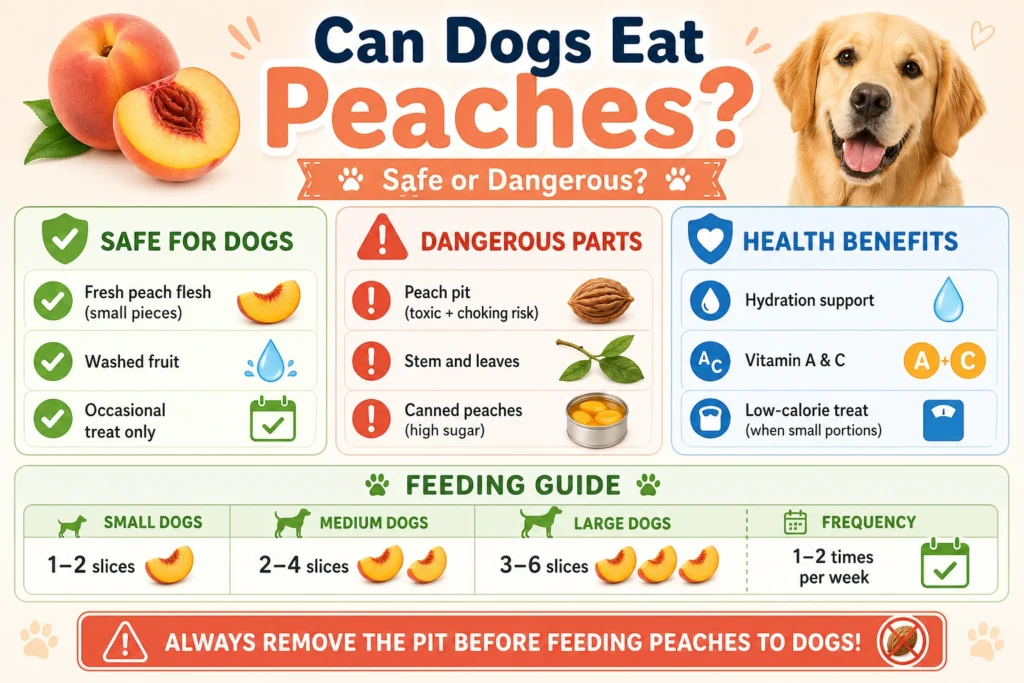
Yes—but only in moderation! Learn which parts are safe, what makes peach pits dangerous, and the exact feeding guide every dog owner should know in 2026.
Expert Veterinary Tips for Feeding Peaches Safely
Use only fresh, ripe peaches and wash them thoroughly before serving. Remove the pit completely, cut the flesh into tiny pieces, and discard the pit where your dog cannot reach it. VCA and AKC both emphasize careful preparation and safe disposal.
Introduce peaches slowly the first time. A small amount lets you see whether your dog handles the fruit well or develops stomach upset. Since fruit is higher in sugar than many other treats, it makes sense to keep the serving small, even when your dog seems enthusiastic.
Use peaches as an occasional seasonal reward, not a routine meal add-on. If you want a simple rule to remember, it is this: a few fresh peach pieces are fine, but the fruit should never become a mainstay of the diet.
Can Dogs Eat Peaches Every Day?
No. Peaches should not be a daily food for dogs. Even when a fruit is safe in small amounts, daily use can push sugar intake too high and turn a special treat into an ordinary habit. PetMD and VCA both support moderation, and AKC describes peaches as a reward rather than a staple.
Daily fruit treats also make it easier to lose track of calories. That matters because treats should remain a small portion of overall intake. Keeping peaches occasionally preserves their value as a fun snack without crowding out better nutritional choices.
Can Dogs Eat Frozen Peaches?
Yes, frozen peach pieces can be a refreshing option as long as they are plain, pit-free, and cut into dog-appropriate sizes. AKC specifically notes that cut-up fresh or frozen peaches can be a great treat when the pit is removed.
Frozen fruit can be especially useful in warm weather because it is cooling and fun to chew. The same basic safety rules still apply: no pit, no added sugar, no syrup, and no oversized chunks that could create a choking risk.
Can Dogs Eat Peach Yogurt or Desserts?
No, peach yogurt, peach cobbler, peach pies, peach-flavored desserts, and similar sweet foods are not good choices for dogs. Even when the word “Peach” appears on the label, the product may contain added sugar, dairy, artificial flavors, or other ingredients that are not appropriate for dogs. Pet nutrition sources consistently stress plain fruit over processed fruit products.
The safest rule is to separate the fruit from the dessert. A plain piece of peach flesh is one thing; a human dessert with peach flavor is something else entirely. Dogs do not need the extra sugar or extra ingredients that come with processed sweets.
Are Peaches Better Than Apples for Dogs?
Both peaches and apples can be dog-friendly when prepared correctly, but apples are often considered simpler because they do not come with the same pit risk that peaches have. AKC notes that fruit safety depends heavily on preparation, and peaches carry the special concern of stone-fruit pits.
That does not mean apples are always perfect or that peaches are always bad. It means apples are easier to handle safely because the risky part is more obvious to remove. Peaches remain acceptable as long as the pit is removed and the treat stays small.
Can Dogs Eat Peaches if They Have a Sensitive Stomach?
Dogs with sensitive stomachs need extra caution with any new food, including fruit. Even safe fruits can cause loose stool, gas, or mild digestive upset if too much is offered too quickly. PetMD notes that peaches can cause stomach upset in some dogs, which is why moderation and slow introduction are important.
For sensitive dogs, the best approach is to start with a tiny portion and observe how they respond over the next several hours. If there is any sign of digestive distress, skip peaches in the future and speak with a veterinarian about safer treat options.
Breed-Specific Considerations
Small breeds need the smallest portions because even a little extra fruit can be a bigger percentage of their daily intake, and the choking risk from large pieces is more serious. Large breeds may tolerate slightly more volume, but they still face the same pit and obstruction hazards. The size of the dog changes the quantity, not the basic safety rules.
Dogs with delicate digestion can be more reactive to fruit sugar and fiber. That is why the preparation process matters for every breed: wash the fruit, remove the pit, cut it into bite-sized pieces, and keep the serving controlled. Safety is a matter of method, not breed label alone.
Summer Treat Strategy: Why Peach Safety Matters
Peaches are often shared in summer because they feel cooling, light, and seasonal. AKC and VCA both frame peaches as a warm-weather snack, but they also remind owners that pit safety is non-negotiable. A summer treat should be refreshing, not risky.
That is why dog-safe fruit prep should become a habit. The best routine is simple: wash, pit, cut, and serve only a little. Done that way, peaches can be a pleasant part of summer enrichment without becoming a hazard.
FAQs
No. Peaches should be occasional treats only, not a daily food. Treats should stay within a small portion of the dog’s overall calories, and peaches are best kept as a sometimes snack.
Peaches contain sugar, so dogs with diabetes or other medical conditions need veterinary approval before eating them. Because fruit is naturally sweeter than many other treats, caution is the safer choice.
Yes, as long as the peach is fresh, pit-free, plain, and cut into appropriate pieces. AKC specifically includes fresh or frozen peaches among the small fruit options that can work well as treats.
Peach juice is not a good choice because it removes the fiber advantage of whole fruit and can deliver sugar in a more concentrated way. Whole, plain fruit is the safer, more useful option.
A peach pit can cause choking, intestinal blockage, or cyanide-related toxicity concerns if it is chewed or broken. This should be treated as a veterinary issue, especially if the dog shows symptoms.
Not usually. Apples are often easier to manage because they do not have a stone pit, while peaches require more careful preparation.
Yes, puppies can eat tiny amounts of peach flesh if it is prepared safely and introduced slowly. Puppies are more vulnerable to choking and digestive upset, so the portion should be very small.
Organic peaches may reduce exposure to pesticide residues, but they still must be properly washed, pitted, and cut. Organic does not eliminate the main hazard, which is the pit.
Conclusion
So, can Dogs Eat Peaches? Yes, many dogs can enjoy peaches safely when the fruit is fresh, plain, and served in moderation. The peach flesh can be a pleasant seasonal treat, but the pit, stem, and leaves are the danger zones and should never be fed.
The safest rule is easy to remember: fresh peach flesh is acceptable in small amounts, but the pit is not. If you keep the serving size small, remove the hard parts, and avoid processed peach products, you can share the fruit without turning a snack into a risk.