WTV Meaning in Text: What It Really Means (and When It’s Rude)
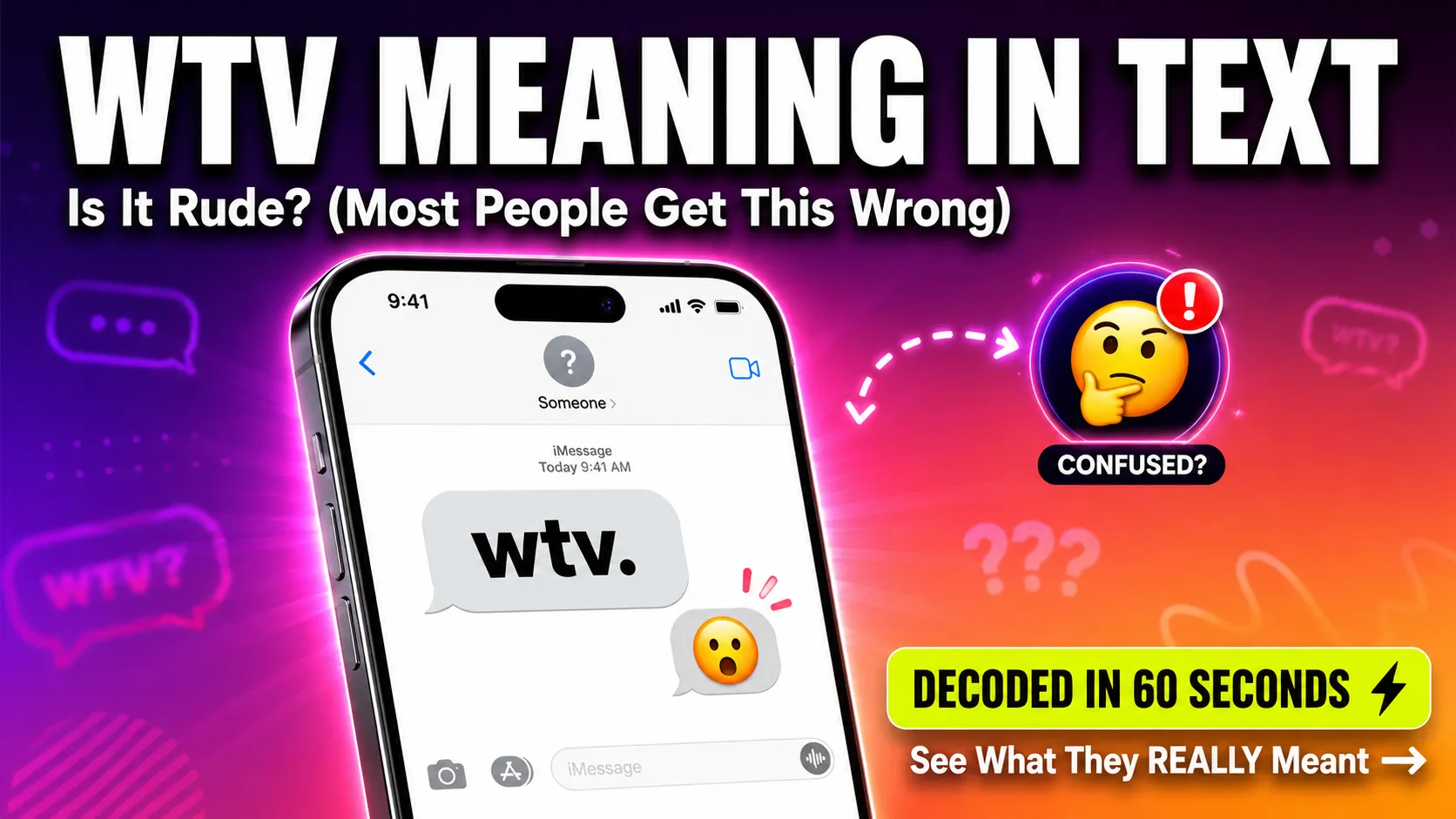
You’re mid-conversation, everything’s flowing, and then someone replies with just: “wtv.”
No punctuation. No explanation. Just three letters sitting there, and suddenly you’re re-reading the last ten messages trying to figure out what you did wrong. Did they lose interest? Are they annoyed? Or did they just not feel like typing four extra letters?
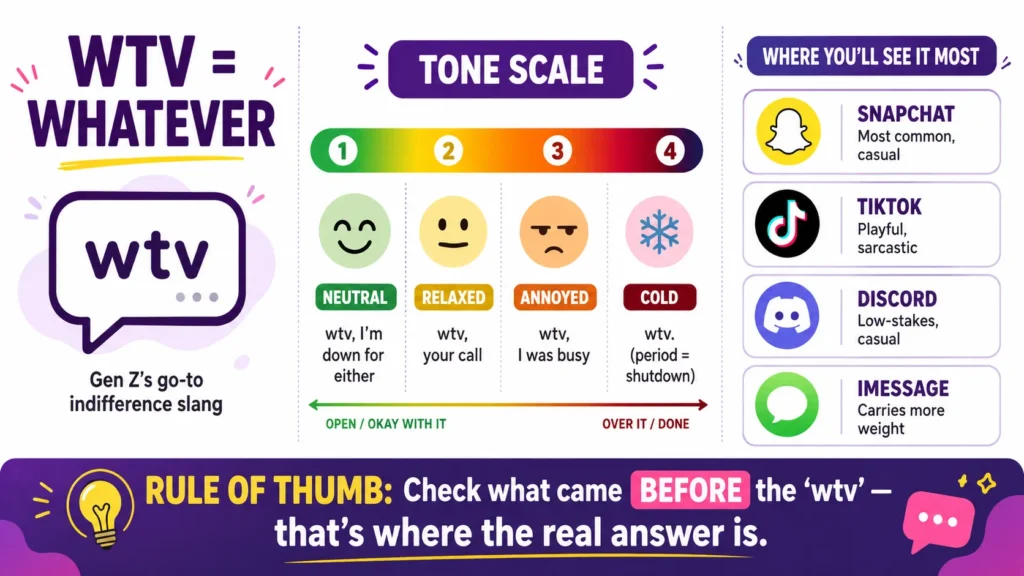
Here’s the immediate answer: WTV Means “Whatever.” It’s texting shorthand used across iMessage, Snapchat, TikTok, Discord, and Instagram to signal indifference, low-key agreement, or — depending entirely on context — mild irritation. People search for the wtv meaning in text specifically because that one-line definition doesn’t tell you which of those it is in your situation.
WTV doesn’t carry one fixed emotion. It borrows its tone entirely from what surrounds it — the message before it, the punctuation, and who’s sending it. This guide breaks down every version of that tone, answers directly whether WTV is rude, walks through how it shows up differently depending on who’s texting you, and gives you real ways to respond — which is where most guides on this topic stop short.
What Does WTV Mean?
WTV is a shortened form of “whatever,” used in texting and online chat to express indifference, casual agreement, or a dismissive attitude. It’s most common among Gen Z and younger millennials, and shows up heaviest on fast, casual platforms like Snapchat and TikTok comments. Unlike a word like “okay,” which is fairly neutral no matter how it’s used, WTV inherits a specific cultural baggage from “whatever” — a word that has carried a slightly confrontational edge in English since long before texting existed.
Quick Meaning Summary
| Full form | Whatever |
| Core meaning | Indifference, low-effort agreement, or dismissal |
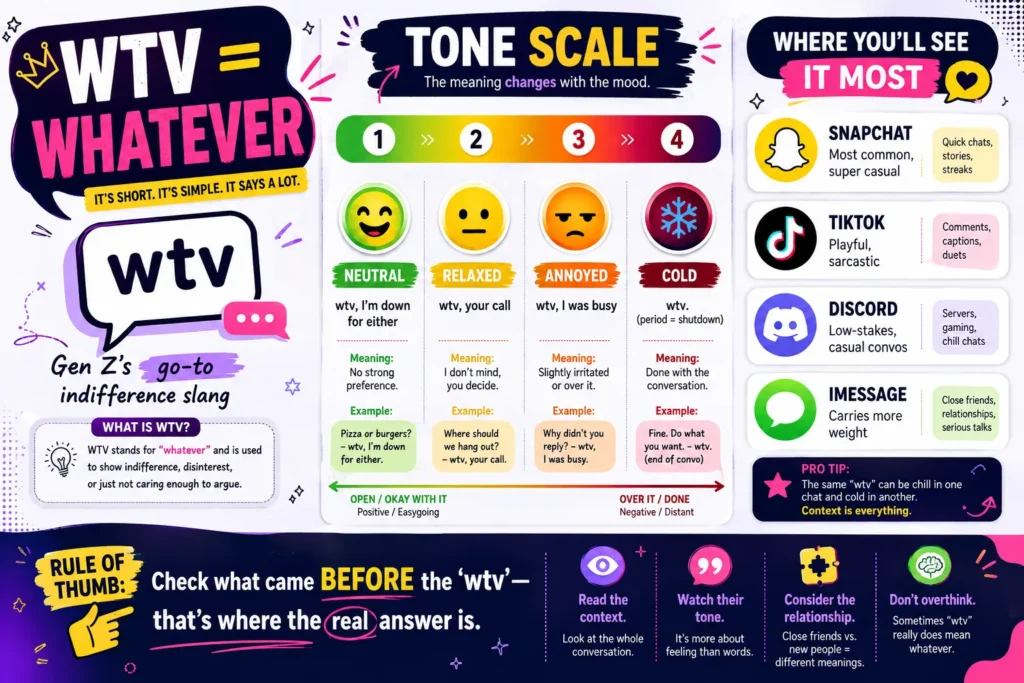
| Tone range | Neutral → Relaxed → Annoyed → Cold |
| Most common on | Snapchat, iMessage, Discord, TikTok comments |
| Who uses it most | Gen Z, younger millennials |
| Formal-context safe? | No — avoid in work or professional messages |
Origin and History
Most competing guides stop at “it emerged with SMS texting in the early 2000s.” The fuller picture has more nuance, and it actually starts before texting existed at all.
“Whatever” as a dismissive, tone-loaded word has roots in 1990s American teen culture, where it functioned almost as a signature phrase — carrying an implied eye-roll long before texting existed. Pop culture from that decade helped cement it as shorthand for “I’m checked out of this conversation,” often delivered with a specific vocal inflection that turned a neutral word into a mic-drop.
When SMS messaging took off in the early-to-mid 2000s, character limits and per-message costs pushed people toward compressing everything they typed. “Whatever” — already an emotionally loaded word — was a natural candidate for abbreviation, alongside similar compressions like “brb,” “lol,” and “idk.” At this stage, WTV was functional shorthand more than a cultural statement; people were just trying to save keystrokes on physical number-pad Keyboards.
WTV’s real growth into a distinct piece of internet culture came later, once smartphone messaging apps made rapid, low-effort texting the default way people communicated. Snapchat’s speed-and-disappearing-message format, followed by TikTok’s comment culture, accelerated its use further, since both platforms reward short, punchy replies over full sentences. By the 2020s, WTV had shed most of its “just saving time” function and picked up the emotional complexity it has today — where the same three letters can mean radically different things depending on where they land in a conversation.
Why Is WTV So Popular?
WTV fits how modern texting actually works: fast, low-friction, and emotionally efficient. It lets someone respond instantly without committing to a full sentence, which matters on platforms built around speed and volume. A typical Gen Z user might send and receive hundreds of messages a day across multiple apps — full sentences for every low-stakes decision simply aren’t realistic.
It also carries built-in ambiguity, which some users actually prefer. Typing “whatever” out in full can feel unnecessarily blunt or intense. WTV softens that same sentiment just by being shorter and more casual-looking, even though the underlying meaning hasn’t changed. There’s also a social-fluency element: using slang like WTV signals that you’re texting the way your peer group texts, which matters more in casual relationships than it might seem.
Is WTV Rude? The Direct Answer
This is the question underneath almost every search for this term, and most competing guides dodge it. Here’s the actual breakdown:
WTV is not inherently rude. On its own, it’s neutral. Whether it lands as rude depends on three things:
- What came before it — replying “wtv” to “want pizza or tacos?” is casual. Replying “wtv” to “I’m sorry, can we talk about this?” is cold.
- Punctuation and capitalization — “wtv” is casual-neutral. “WTV.” with a period and caps often signals irritation or a desire to end the conversation.
- Relationship context — between close friends, WTV is often just efficient shorthand. In a new relationship, an argument, or a professional setting, it reads as dismissive almost every time.
Rule of thumb: if the message before WTV asked for a decision or opinion, it’s usually harmless. If it required emotional engagement — an apology, a concern, a question about feelings — WTV usually reads as a shutdown.
It’s also worth noting what WTV is not. It’s rarely used as an insult on its own, and it’s almost never meant to be cruel — even in its coldest form, it’s more of a withdrawal than an attack. That distinction matters, because a lot of the anxiety around receiving a “wtv” comes from assuming the worst, when the sender is often just disengaging from a specific topic rather than the relationship as a whole.
How WTV Is Used in Real Conversations
Neutral / Easygoing
A: “Netflix or a movie tonight?” B: “wtv, I’m down for either 😊”
Mildly Dismissive
A: “You never texted me back yesterday.” B: “wtv, I was busy.”
Cold / Ending the Conversation
A: “Can we talk about what happened?” B: “wtv.”
Playful / Teasing
A: “You’re so extra lol” B: “wtv you love it”
Passive-Aggressive
A: “I already told you I can’t make it.” B: “wtv, it’s fine 👍” (Here, “it’s fine” paired with wtv often signals it is not fine — a classic passive-aggressive combo worth watching for.)
Genuine Flexibility
A: “Where do you want to eat?” B: “wtv works, I’m not picky tonight” (Adding context after “wtv” almost always neutralizes any coldness — it shows genuine flexibility rather than disengagement.)
WTV in Different Types of Relationships
Context isn’t just about the message before it — it’s also about who’s sending it. The same three letters mean different things depending on the relationship.
Between close friends: WTV is usually pure efficiency. Long-term friend groups often develop a shared shorthand where tone is assumed rather than spelled out, and “wtv” rarely raises alarm bells here.
In a new relationship or while dating: This is where WTV causes the most anxiety, and for good reason — you don’t yet have the shared context to know if it’s casual or cold. A “wtv” from someone you’ve been talking to for two weeks carries far more weight than the same word from a five-year friendship.
In an argument or conflict: WTV almost always functions as a way to exit the conversation without fully committing to ending it. It’s rarely a resolution — more often it’s a pause, sometimes a sulk, and occasionally a genuine signal that the person needs space.
With family members: Usage tends to skew more neutral here, largely because family texting patterns are often less charged than romantic or newly-formed friendships, and family members are more likely to just be describing genuine indifference (“wtv you’re cooking is fine”).
In group chats: WTV in a group setting is almost always low-stakes — it’s harder for a single word to carry emotional weight when it’s not clearly directed at one person, so group-chat “wtv” is usually just genuine flexibility.
WTV on Social Media
| Platform | How it’s typically used |
| Snapchat | Extremely common due to fast, disappearing chats; usually casual/neutral |
| TikTok | Heavy use in comments and captions; often playful or sarcastic |
| Discord | Common in gaming/group chats; usually low-stakes and casual |
| iMessage/SMS | More likely to carry emotional weight since messages persist and are searchable |
| Instagram DMs | Similar to Snapchat — casual, but tone depends on relationship |
Beyond the table, a few platform-specific nuances are worth calling out. On Snapchat, the disappearing nature of messages actually lowers the emotional stakes of WTV — since the message vanishes, users tend to type it more freely without worrying it will be reread and overanalyzed later. On iMessage, the opposite is true: messages persist, are easy to scroll back through, and often get shown to friends for a “was this rude?” second opinion — which is part of why iMessage WTVs tend to generate more anxiety than Snapchat ones.
On TikTok, WTV frequently shows up detached from any one-on-one conversation at all — used in captions or comment replies as a broader, almost performative expression of not caring what people think, closer to a personality trait than a direct response to someone. Discord, given its roots in gaming communities, tends to use WTV in a near-purely functional way — often just meaning “any option is fine” during quick in-game decision-making, with very little emotional subtext attached.
WTV vs. Similar Slang — Don’t Mix These Up
None of the currently ranking guides clearly separate WTV from the terms people most often confuse it with:
| Term | Meaning | Tone |
| WTV | Whatever | Neutral to dismissive |
| IDC | I don’t care | Usually more blunt/final than WTV |
| WBU | What about you | Neutral, engaged — opposite intent of WTV |
| NVM | Never mind | Withdrawal, similar cold tone to negative WTV |
| K | Okay (curt) | Often paired with WTV for maximum coldness |
The key distinction most people miss: WTV expresses indifference to an outcome, while IDC often expresses indifference to the topic itself — which is why IDC tends to feel more final. NVM, by contrast, usually signals that the sender is retracting something they were about to say or ask, which is a fundamentally different move than simply not caring how something turns out.
How to Reply to “WTV” (Without Overthinking It)
- If it seemed neutral: Just continue the conversation normally. Don’t read into it.
- If it felt cold or dismissive: Ask directly — “Everything okay?” works better than mirroring the coldness back.
- If you’re unsure: Give it space. Reply with something low-pressure like “no worries, let me know” instead of pushing for clarification immediately.
- If it’s happening repeatedly: A pattern of “wtv” replies to real questions usually signals the other person wants to disengage from the topic — worth addressing directly rather than over text.
- If it followed an apology you gave: Give it a little time before following up. A cold “wtv” right after an apology often means the person isn’t ready to fully move past it yet, not that the apology failed.
- Avoid matching energy immediately. Replying to a cold “wtv” with an equally curt one-word response tends to escalate rather than resolve the underlying issue.
If You’re the One Who Sent “WTV” and Regret It
This happens more than people admit — typing “wtv” in a moment of frustration and immediately wishing you’d said something else. If that’s the situation you’re in, a quick follow-up almost always fixes it: something as simple as “sorry, that came out colder than I meant” resets the tone instantly. Most people reading a random “wtv” assume the worst-case interpretation by default, so a small clarifying message goes a long way toward correcting that assumption.
Explore More: https://dogizle.com/emasculate-vs-demasculate/
When Not to Use WTV
- In professional emails or work chats — use “either option works for me” or “I don’t have a preference” instead.
- With someone you don’t know well — it can come across as low-effort or uninterested.
- Right after asking someone a serious or emotional question — it will almost always read as dismissive.
- In a first few conversations with someone new — without established rapport, WTV has nothing to soften it, so it tends to land more coldly than intended.
Common Misunderstandings
- “WTV always means someone is mad.” False — most uses are completely neutral.
- “WTV is the same as IDC.” Close, but IDC usually reads more final and blunt.
- “Only teenagers use WTV.” It’s most common among Gen Z, but plenty of millennials use it casually too.
- “A one-word ‘wtv’ means the relationship is over.” Almost never true — it’s far more often a temporary withdrawal from one specific topic than a signal about the whole relationship.
- “Adding a period always means anger.” Not always — some people simply text with consistent punctuation regardless of mood, so punctuation should be read alongside the message before it, not in isolation.
Related Terms and Similar Meanings
- IDC (I Don’t Care)
- NVM (Never Mind)
- WBU (What About You)
- IDK (I Don’t Know)
- K (Curt “Okay”)
People Also Ask
WTV is short for “whatever,” used to express indifference, Casual agreement, or mild dismissal depending on context.
Not inherently. It’s neutral by default and only reads as rude when it follows an emotional question or comes with cold punctuation like a period or all caps.
The same as everywhere else — “whatever” — but Snapchat’s fast, disappearing-message format makes it appear more often as a quick, low-stakes reply.
No. Both express low interest, but IDC (“I don’t care”) tends to sound more blunt and final, while WTV can range from relaxed to mildly annoyed.
No — it’s informal slang. Use phrases like “either option works for me” or “I’m flexible” in professional or formal contexts.
Look at what you said right before it. If you asked a real question or apologized, a one-word “wtv” response usually signals irritation or a desire to drop the topic.
Conclusion
WTV is one of the simplest-looking slang terms in modern texting and one of the easiest to misread. On its own, those three letters carry no fixed emotion — they take their tone entirely from what surrounds them. Once you know what to look for — the message before it, the punctuation, the relationship, and even the platform it was sent on — you’ll never have to guess what someone actually meant by “wtv” again.