Connector or Connecter: Which Spelling Is Actually Correct?
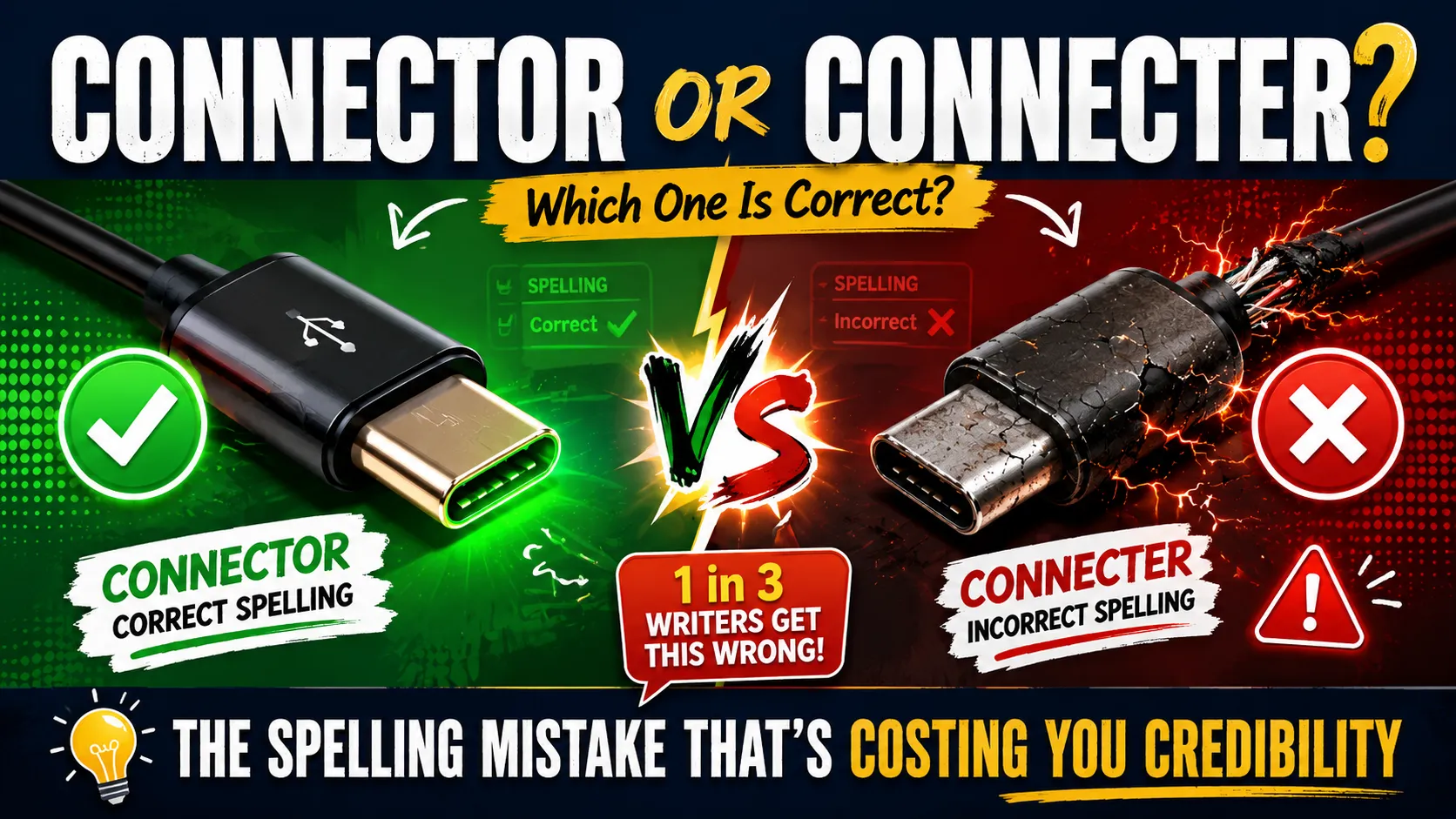
1. Quick Answer: Connector or Connecter?
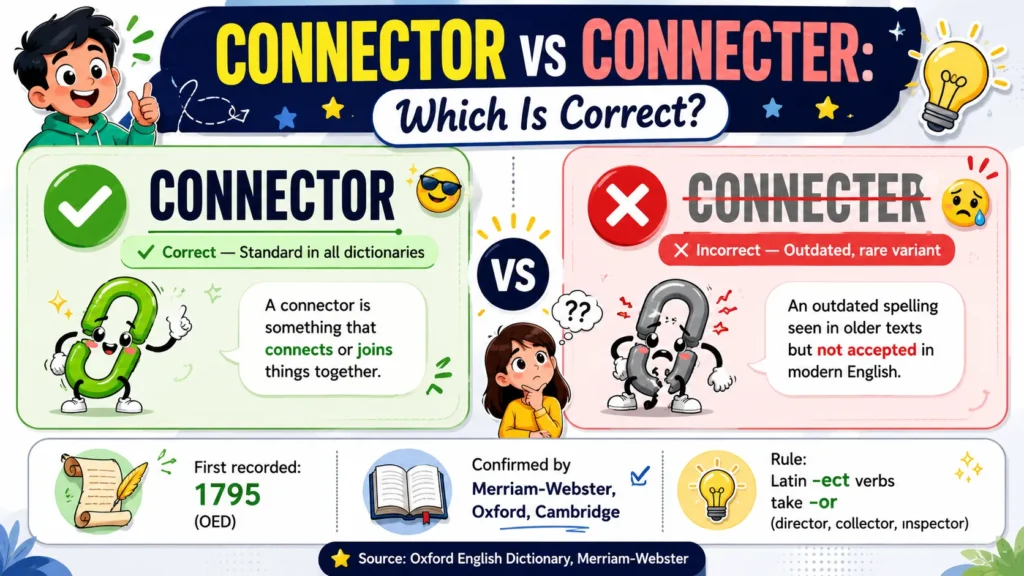
“Connector” is the correct spelling. “Connecter” is a rare, outdated variant that dictionaries and style guides treat as nonstandard in modern English. Whatever you’re writing — a product spec, an email, a school paper, an app description — use connector.
2. What Does “Connector” Mean?
A connector is something that joins or links two or more things together, either physically or in a more abstract sense. It can refer to a hardware part (a USB connector), a software component (an API connector), a person who links others socially, or a word that links ideas in a sentence (a sentence connector).
3. Connector vs Connecter: Side-by-Side Comparison
| Connector | Connecter | |
| Standard spelling? | Yes | No |
| Found in Merriam-Webster, Oxford, Cambridge, Collins | Yes, as the headword | No, or listed only as a rare variant |
| Used in tech, engineering, aviation, grammar | Yes | Essentially never |
| US vs UK difference? | No — identical in both | No — identical in both |
| Safe to use in professional writing | Yes | No |
4. Etymology and Origin of “Connector”
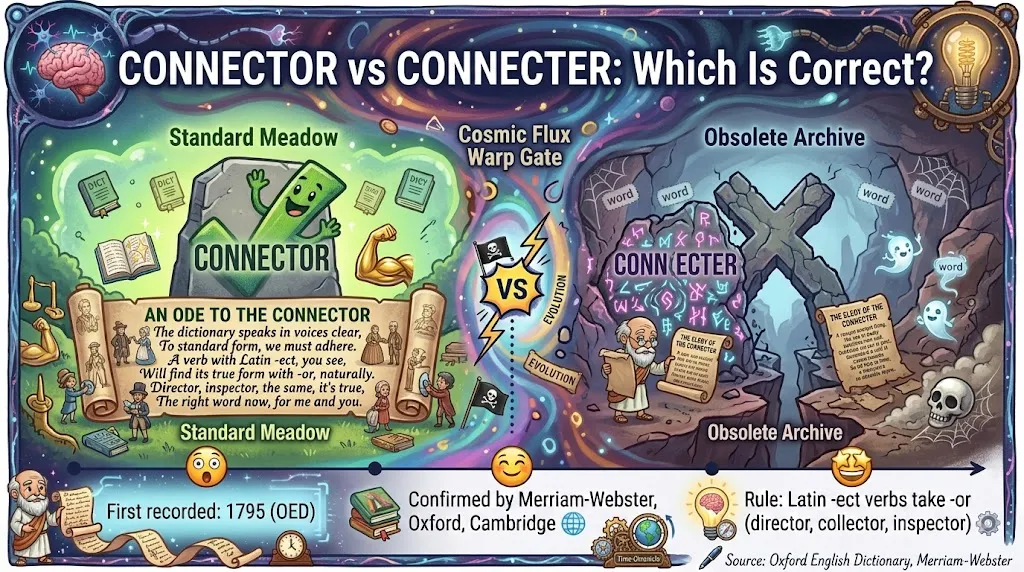
The verb “connect” comes from the Latin conectere — com- (“together”) plus nectere (“to bind”). The Oxford English Dictionary’s earliest recorded use of “connector” as a noun dates to 1795, in the writing of Wells. Because the word entered English through Latin, it followed the Latin-derived pattern for forming agent nouns, landing on the -or ending rather than -er.
5. Why “Connector” Follows the -or Spelling Rule
English forms agent nouns two main ways:
- -or, typically on verbs with Latin roots: act → actor, direct → director, select → selector, inspect → inspector
- -er, typically on verbs with native Germanic roots: teach → teacher, play → player, work → worker
“Connect” belongs to the same Latin -ct verb family as collect, direct, inspect, and select — all of which take -or in their noun form. “Connector” simply follows that same family pattern.
6. What Dictionaries Say About Connector and Connecter
- Merriam-Webster lists “connector” as the standard headword.
- Oxford English Dictionary lists “connector” as standard, with first use dated to 1795.
- Cambridge Dictionary and Dictionary.com list only “connector.”
- Collins Dictionary notes “connecter” as a variant spelling but marks “connector” as dominant.
- AP Stylebook and Chicago Manual of Style both default to “connector” in reference use.
7. Is Connecter a Real Word?
It appears in a small number of dictionaries as a rare, outdated variant, but it isn’t considered standard. It shouldn’t be used in professional, academic, or technical writing.
8. Is This a US vs UK Spelling Difference?
No. Unlike pairs such as “color/colour” or “realize/realise,” this isn’t a regional split. Both American and British English use “connector.” “Connecter” surfaces occasionally in older texts on either side of the Atlantic, but it isn’t a recognized British variant — it’s simply outdated or mistaken wherever it appears.
9. Why People Mistakenly Write “Connecter”
- Sound-alike suffixes: -or and -er are pronounced almost identically in most accents, so spelling by ear produces errors.
- Analogy with -er words: “teacher,” “worker,” and “player” are far more common in everyday vocabulary than -or agent nouns, so -er feels more natural by default.
- Non-native writing and fast typing: “connecter” is a common phonetic guess.
- False pattern matching: it looks plausible next to “collecter” or “directer” — except neither of those is standard either.
10. How to Remember the Correct Spelling
Think of the word family it belongs to: connector, director, selector, collector, inspector. If the base verb ends in -ect, the noun almost always ends in -or.
11. Connector in Electronics and Hardware
A connector is the physical component joining two parts of a circuit or device — a USB connector, an HDMI connector, an Ethernet connector, a battery connector.
“Make sure the connector is fully seated before powering on the device.”
12. Connector in Software, Networking, and APIs
In software and data engineering, a connector is a component that lets one application or system communicate with another — a database connector, an API connector, a Zapier connector.
“We built a custom connector to sync data between the CRM and the billing platform.”
13. Connector in Aviation and Travel
A connector, or “connecting flight,” links two other flights through a layover airport. “Connector” is also used for roads that link two highways.
“There’s a two-hour connector flight through Dallas before the final leg.”
Explore M,ore: https://dogizle.com/moment-vs-momment/
14. Connector in Grammar and Linguistics
A connector (also called a connective or linking word) joins clauses or ideas — words like “however,” “therefore,” and “in addition.”
“Use a connector like ‘however’ to signal contrast between two sentences.”
15. Related Words and Similar Spelling Confusions
- Director, not “directer”
- Collector, not “collecter”
- Inspector, not “inspecter”
- Selector, not “selecter”
- Advisor / adviser — a genuinely accepted dual spelling, unlike connector/connecter
- Connective, connection — related words, not subject to this confusion
People Also Ask
It’s listed in a few dictionaries as a rare, Outdated variant, but it’s not standard in modern English.
Not in current English. It may appear in older or historical texts, but no modern style guide recommends it.
Q3 What is the plural of connector?
Connectors.
No — both American and British English use “connector.”
Because it derives from the Latin verb conectere, and Latin-derived verbs typically form agent nouns with -or, as in director, collector, and inspector.
Both, depending on the writer — a phonetic slip for some, a genuine misspelling based on the more familiar -er pattern for others.
A noun — the noun form of “connect.”
Conclusion
Connector is the only spelling recognized by major dictionaries and used consistently across electronics, software, aviation, and grammar. It follows a clear linguistic rule — Latinate -ect verbs take -or — the same rule behind director, Collector, and inspector. “Connecter” survives only as an occasional, outdated variant, not a valid alternative for modern writing. When in doubt, default to connector.